Thanks for your patience during our recent outage at scalar.usc.edu. While Scalar content is loading normally now, saving is still slow, and Scalar's 'additional metadata' features have been disabled, which may interfere with features like timelines and maps that depend on metadata. This also means that saving a page or media item will remove its additional metadata. If this occurs, you can use the 'All versions' link at the bottom of the page to restore the earlier version. We are continuing to troubleshoot, and will provide further updates as needed. Note that this only affects Scalar projects at scalar.usc.edu, and not those hosted elsewhere.
Performing ArchiveMain MenuVisualizing the “Vanishing Race”: the photogravures of Edward S. CurtisFront Page for Visualizing the "Vanishing Race" pathCurtis' Image and Life: The Network of The North American Indian, Inc.An experiment with data visualization approach to understand and contextualize Curtis' images and his lifeMedia, Technology and MediationsCurtis's Technology, Relationships to Media and StyleContextualizing Curtis, The North American Indian, and Racethe collection of essays from the contributorsConsulting with Tribes as Part of Archive DevelopmentIntroduction to Consulting with Tribes by Ulia GosartContributing ArchivesInformation on how to participate in Performing ArchiveBrowsing the MediaA path of paths that allow users to cut through the collection in a variety of ways.Acknowledgements and Project InformationProject NetworkJacqueline Wernimontbce78f60db1628727fc0b905ad2512506798cac8David J. Kim18723eee6e5a79c8d8823c02b7b02cb2319ee0f1Stephan Schonberg23744229577bdc62e9a8c09d3492541be754e1efAmy Borsukc533a79d33d48cbf428e1160c2edc0b38c50db19Beatrice Schustera02047525b31e94c1336b01e99d7f4f758870500Heather Blackmored0a2bf9f2053b3c0505d20108092251fc75010bfUlia Gosart (Popova)67c984897e6357dbeeac6a13141c0defe5ef3403
12018-03-16T21:13:00-07:00Erik Loyerf862727c4b34febd6a0341bffd27f168a35aa637Tribe PathsErik Loyer1Explore the Media by Tribestructured_gallery2018-03-16T21:13:00-07:00Erik Loyerf862727c4b34febd6a0341bffd27f168a35aa637
Contents of this path:
12018-03-16T21:11:16-07:00Erik Loyerf862727c4b34febd6a0341bffd27f168a35aa637Vanishing race - Navaho1The thought which this picture is meant to convey is that the Indians as a race, already shorn in their tribal strength and stripped of their primitive dress, are passing into the darkness of an unknown future. Feeling that the picture expresses so much of the thought that inspired the entire work, the author has chosen it as the first of the series.plain2018-03-16T21:11:16-07:00Erik Loyerf862727c4b34febd6a0341bffd27f168a35aa637
12018-03-16T21:11:17-07:00Erik Loyerf862727c4b34febd6a0341bffd27f168a35aa637Chief of the desert - Navaho1Picturing not only the individual but a characteristic member of the tribe - disdainful, energetic, self-reliant.plain2018-03-16T21:11:17-07:00Erik Loyerf862727c4b34febd6a0341bffd27f168a35aa637
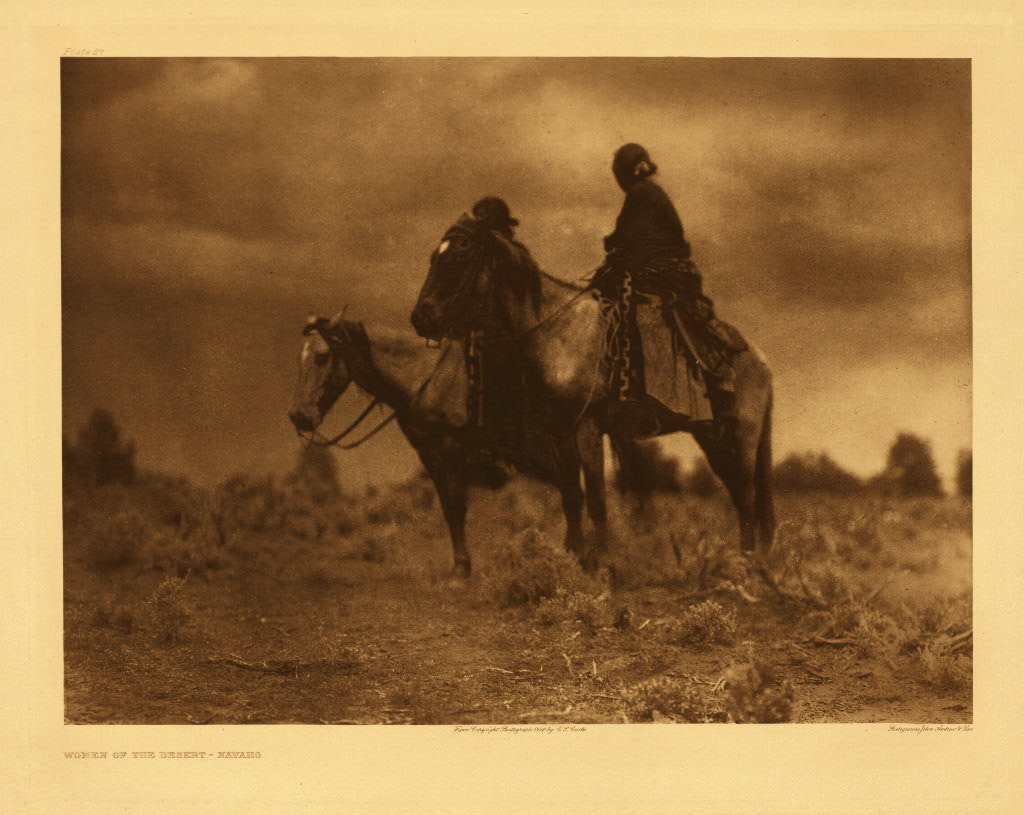
12018-03-16T21:11:17-07:00Erik Loyerf862727c4b34febd6a0341bffd27f168a35aa637Women of the desert - Navaho1The Navaho women are, for the greater part, the owners of the flocks and invariably, with the children, the herders. They are so thoroughly at home on their scrubby ponies that they seem a part of them and probably excel all other Indians as horsewomen.plain2018-03-16T21:11:17-07:00Erik Loyerf862727c4b34febd6a0341bffd27f168a35aa637
12018-03-16T21:11:04-07:00Erik Loyerf862727c4b34febd6a0341bffd27f168a35aa637Cañon de Chelly - Navaho1A wonderfully scenic spot is this in northeastern Arizona, in the heart of the Navaho country - one of their strongholds, in fact. Cañon de Chelly exhibits evidences of having been occupied by a considerable number of people in former times, as in every niche at every side are seen the cliff-perched ruins of former villages.plain2018-03-16T21:11:04-07:00Erik Loyerf862727c4b34febd6a0341bffd27f168a35aa637
12018-03-16T21:11:18-07:00Erik Loyerf862727c4b34febd6a0341bffd27f168a35aa637Cañon del Muerto - Navaho1New Southwest.plain2018-03-16T21:11:18-07:00Erik Loyerf862727c4b34febd6a0341bffd27f168a35aa637
12018-03-16T21:11:18-07:00Erik Loyerf862727c4b34febd6a0341bffd27f168a35aa637At the shrine - Navaho1Scattered about the Navaho reservation are many cairn shrines. The Navaho, when alone or in parties, on approaching one of these gathers a few twigs of piñon or cedar, places them on the shrine, scatters a pinch of sacred meal upon it, and makes supplication for that which he may habitually need or which the moment demands.plain2018-03-16T21:11:18-07:00Erik Loyerf862727c4b34febd6a0341bffd27f168a35aa637
12018-03-16T21:11:05-07:00Erik Loyerf862727c4b34febd6a0341bffd27f168a35aa637Nesjaja Hatali - Navaho1A well-known Navaho medicine-man. While in the Cañon de Chelly the writer witnessed a very interesting four days' ceremony given by the Wind Doctor. Nesjaja Hatali was also assistant medicine-man in two nine days' ceremonies studied - one in Cañon del Muerto and the other in this portfolio (No. 39) is reproduced from one made and used by this priest-doctor in the Mountain Chant.plain2018-03-16T21:11:05-07:00Erik Loyerf862727c4b34febd6a0341bffd27f168a35aa637
12018-03-16T21:11:18-07:00Erik Loyerf862727c4b34febd6a0341bffd27f168a35aa637Son of the desert - Navaho1In the early morning this boy, as if springing from the earth itself, came to the author's desert camp. Indeed, he seemed a part of the very desert. His eyes bespeak all of the curiosity, all of the wonder of his primitive mind striving to grasp the meaning of the strange things about him.plain2018-03-16T21:11:18-07:00Erik Loyerf862727c4b34febd6a0341bffd27f168a35aa637
12018-03-16T21:11:18-07:00Erik Loyerf862727c4b34febd6a0341bffd27f168a35aa637Navaho flocks1The Navaho might as well be called the "Keepers of Flocks". Their sheep are of the greatest importance to their existence, and in the care and management of their flocks they exhibit a thrift not to be found in the average tribe.plain2018-03-16T21:11:18-07:00Erik Loyerf862727c4b34febd6a0341bffd27f168a35aa637
12018-03-16T21:11:18-07:00Erik Loyerf862727c4b34febd6a0341bffd27f168a35aa637Blanket weaver - Navaho1The Navaho-land blanket looms are in evidence everywhere. In the winter months they are set up in the hogans, but during the summer they are erected outdoors under an improvised shelter, or, as in this case, beneath a tree. The simplicity of the loom and its product are here clearly shown, pictured in the early morning light under a large cottonwood.plain2018-03-16T21:11:18-07:00Erik Loyerf862727c4b34febd6a0341bffd27f168a35aa637
12018-03-16T21:11:19-07:00Erik Loyerf862727c4b34febd6a0341bffd27f168a35aa637Point of interest - Navaho1plain2018-03-16T21:11:19-07:00Erik Loyerf862727c4b34febd6a0341bffd27f168a35aa637
12018-03-16T21:11:19-07:00Erik Loyerf862727c4b34febd6a0341bffd27f168a35aa637Out of the darkness - Navaho1In Tesakod cañon, a small branch of Cañon de Chelly. At the point where this picture was made the gorge is very narrow.plain2018-03-16T21:11:19-07:00Erik Loyerf862727c4b34febd6a0341bffd27f168a35aa637
12018-03-16T21:11:19-07:00Erik Loyerf862727c4b34febd6a0341bffd27f168a35aa637Sunset in Navaho-land1plain2018-03-16T21:11:19-07:00Erik Loyerf862727c4b34febd6a0341bffd27f168a35aa637
12018-03-16T21:11:05-07:00Erik Loyerf862727c4b34febd6a0341bffd27f168a35aa637Alhkidokihi - Navaho1One of the four elaborate dry-paintings or sand altars employed in the rites of the Mountain Chant, a Navaho medicine ceremony of nine days' duration.plain2018-03-16T21:11:05-07:00Erik Loyerf862727c4b34febd6a0341bffd27f168a35aa637
12018-03-16T21:07:01-07:00Erik Loyerf862727c4b34febd6a0341bffd27f168a35aa637Assiniboin boy - Atsina1The head-band, so commonly used by many tribes of the Southwest, notably the Apache and Navaho, is often worn in the Northwest. A biographical sketch of Assiniboin Boy appears in Volume V, page 180.plain2018-03-16T21:07:01-07:00Erik Loyerf862727c4b34febd6a0341bffd27f168a35aa637
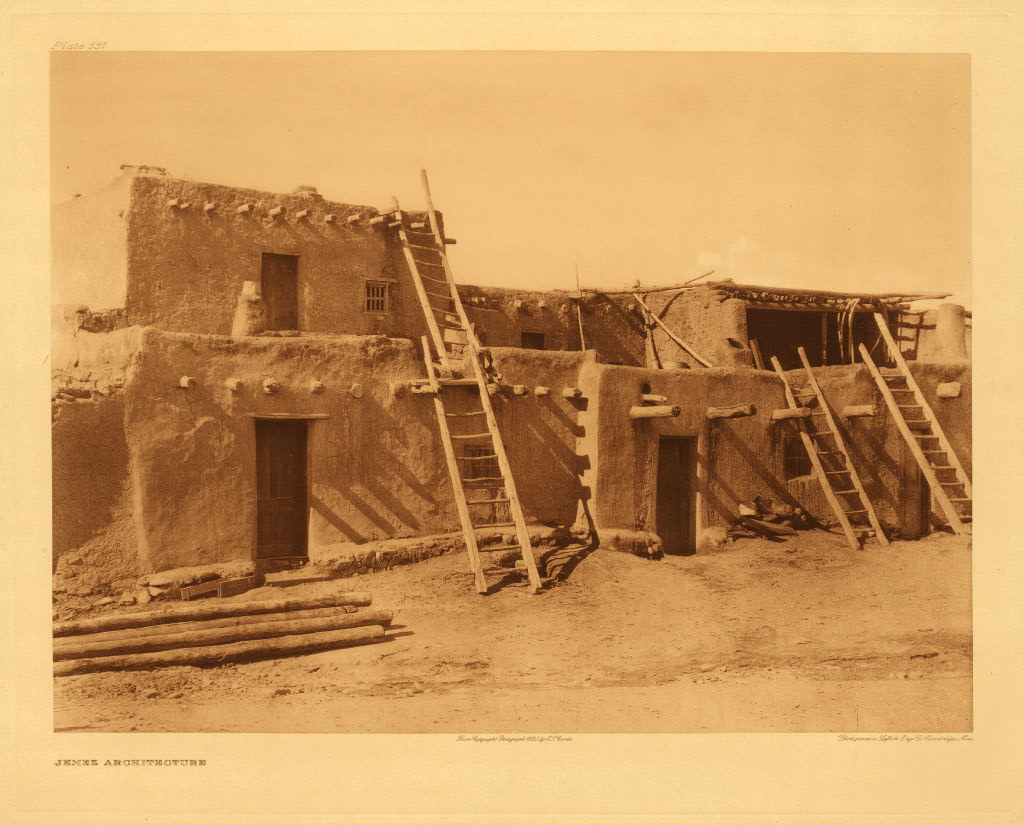
12018-03-16T21:12:30-07:00Erik Loyerf862727c4b34febd6a0341bffd27f168a35aa637Jemez architecture1On account of the comparative inaccessibility of its site on Rio Jemez, a westerly affluent of the Rio Grande, Jemez is annoyed by fewer white visitors than almost any other pueblo. The reticence and the mental sluggishness of its inhabitants do not encourage the ethnologist. The Jemez played a leading part in the rebellion of 1680 and were so severely punished by Vargas that their preference for isolation is comprehensible. They have long been intimate with the Navaho and considerable racial mixture has resulted.plain2018-03-16T21:12:30-07:00Erik Loyerf862727c4b34febd6a0341bffd27f168a35aa637
12018-03-16T21:12:31-07:00Erik Loyerf862727c4b34febd6a0341bffd27f168a35aa637Paguate1Paguate is the oldest and largest of ten villages subsidiary to Laguna, the patent pueblo of this group. It appears to have been founded about the middle of the eighteenth century. Laguna itself dates from 1699. The two-story structure at the right, one of the two oldest buildings at Paguate, was a watchtower erected for the defense of the farming population from the roving Navaho, who disputed possession of this locality.plain2018-03-16T21:12:31-07:00Erik Loyerf862727c4b34febd6a0341bffd27f168a35aa637
12018-03-16T21:07:01-07:00Erik Loyerf862727c4b34febd6a0341bffd27f168a35aa637Laguna watchtower1The Navaho caused the people of Laguna considerable trouble up to the middle of the nineteenth century. The latter probably gave a good account of themselves, for they were sufficiently warlike to furnish a band of volunteer scouts in the campaign against the Apache band under Geronimo, for which service they or their surviving relatives were voted substantial pensions by Congress in 1924.plain2018-03-16T21:07:01-07:00Erik Loyerf862727c4b34febd6a0341bffd27f168a35aa637
12018-03-16T21:07:33-07:00Erik Loyerf862727c4b34febd6a0341bffd27f168a35aa637A drink in the desert - Navaho1plain2018-03-16T21:07:33-07:00Erik Loyerf862727c4b34febd6a0341bffd27f168a35aa637
12018-03-16T21:07:33-07:00Erik Loyerf862727c4b34febd6a0341bffd27f168a35aa637Under the cottonwoods - Navaho1plain2018-03-16T21:07:33-07:00Erik Loyerf862727c4b34febd6a0341bffd27f168a35aa637
12018-03-16T21:07:34-07:00Erik Loyerf862727c4b34febd6a0341bffd27f168a35aa637Cornfields in Ca~non del Muerto - Navaho1plain2018-03-16T21:07:34-07:00Erik Loyerf862727c4b34febd6a0341bffd27f168a35aa637
12018-03-16T21:07:35-07:00Erik Loyerf862727c4b34febd6a0341bffd27f168a35aa637Navaho still life1plain2018-03-16T21:07:36-07:00Erik Loyerf862727c4b34febd6a0341bffd27f168a35aa637
12018-03-16T21:07:36-07:00Erik Loyerf862727c4b34febd6a0341bffd27f168a35aa637Through the ca~non - Navaho1plain2018-03-16T21:07:36-07:00Erik Loyerf862727c4b34febd6a0341bffd27f168a35aa637
12018-03-16T21:07:36-07:00Erik Loyerf862727c4b34febd6a0341bffd27f168a35aa637Evening in the desert - Navaho1plain2018-03-16T21:07:36-07:00Erik Loyerf862727c4b34febd6a0341bffd27f168a35aa637
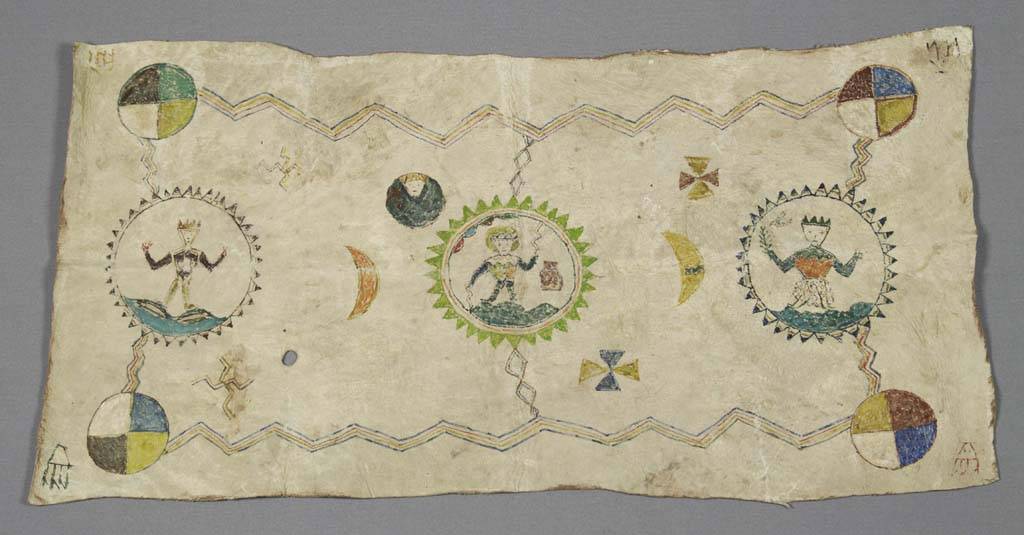
12018-03-16T21:06:46-07:00Erik Loyerf862727c4b34febd6a0341bffd27f168a35aa637Painting on Deerskin1Painting on brain tanned deerskin. The skin is an off white/grayish color. The paintings on the skin are yellow, brown, white, blue, green, black, orange and red. Various figures are painted on the skin which include, moons, equal sided crosses or "x", 3 anthropomorphic figures, one human head, a bird, and circles. There is a zig zag design the goes around the perimeter of the skin. There is a 1 cm wide hole in the skin in the lower left quadrant. The edges of the skin are fairly straight and smooth, indicating it was cut/trimmed to a roughly rectangular shape. The hide painting appears to be the same one illustrated in "Sacred buckskin - Apache", plate facing page 31, in The North American Indian (1907-1930) v.01, The Apache. The Jicarillas. The Navaho ([Seattle] : E.S. Curtis ; [Cambridge, Mass. : The University Press], 1907. See pp. 29-35 for explanatory text, where it is identified as a medicine skin formerly owned by Navajo medicine man Hashke Nilnte, and acquired by Curtis from Hashke Nilnte's wife. The symbolism is then outlined in detail in the publication.View this plate online here: http://curtis.library.northwestern.edu/curtis/viewPage.cgi?showp=1&size=2&id=nai.01.book.00000074.p&volume=1#nav .plain2018-03-16T21:06:46-07:00Erik Loyerf862727c4b34febd6a0341bffd27f168a35aa637
12018-03-16T21:06:46-07:00Erik Loyerf862727c4b34febd6a0341bffd27f168a35aa637Painting on Deerskin1Painting on brain tanned deerskin. The skin is an off white/grayish color. The paintings on the skin are yellow, brown, white, blue, green, black, orange and red. Various figures are painted on the skin which include, moons, equal sided crosses or "x", 3 anthropomorphic figures, one human head, a bird, and circles. There is a zig zag design the goes around the perimeter of the skin. There is a 1 cm wide hole in the skin in the lower left quadrant. The edges of the skin are fairly straight and smooth, indicating it was cut/trimmed to a roughly rectangular shape. The hide painting appears to be the same one illustrated in "Sacred buckskin - Apache", plate facing page 31, in The North American Indian (1907-1930) v.01, The Apache. The Jicarillas. The Navaho ([Seattle] : E.S. Curtis ; [Cambridge, Mass. : The University Press], 1907. See pp. 29-35 for explanatory text, where it is identified as a medicine skin formerly owned by Navajo medicine man Hashke Nilnte, and acquired by Curtis from Hashke Nilnte's wife. The symbolism is then outlined in detail in the publication.
View this plate online here: http://curtis.library.northwestern.edu/curtis/viewPage.cgi?showp=1&size=2&id=nai.01.book.00000074.p&volume=1#nav .plain2018-03-16T21:06:46-07:00Erik Loyerf862727c4b34febd6a0341bffd27f168a35aa637
12018-03-16T21:06:46-07:00Erik Loyerf862727c4b34febd6a0341bffd27f168a35aa637Painting on Deerskin1Painting on brain tanned deerskin. The skin is an off white/grayish color. The paintings on the skin are yellow, brown, white, blue, green, black, orange and red. Various figures are painted on the skin which include, moons, equal sided crosses or "x", 3 anthropomorphic figures, one human head, a bird, and circles. There is a zig zag design the goes around the perimeter of the skin. There is a 1 cm wide hole in the skin in the lower left quadrant. The edges of the skin are fairly straight and smooth, indicating it was cut/trimmed to a roughly rectangular shape. The hide painting appears to be the same one illustrated in "Sacred buckskin - Apache", plate facing page 31, in The North American Indian (1907-1930) v.01, The Apache. The Jicarillas. The Navaho ([Seattle] : E.S. Curtis ; [Cambridge, Mass. : The University Press], 1907. See pp. 29-35 for explanatory text, where it is identified as a medicine skin formerly owned by Navajo medicine man Hashke Nilnte, and acquired by Curtis from Hashke Nilnte's wife. The symbolism is then outlined in detail in the publication.
View this plate online here: http://curtis.library.northwestern.edu/curtis/viewPage.cgi?showp=1&size=2&id=nai.01.book.00000074.p&volume=1#nav .plain2018-03-16T21:06:46-07:00Erik Loyerf862727c4b34febd6a0341bffd27f168a35aa637
12018-03-16T21:06:46-07:00Erik Loyerf862727c4b34febd6a0341bffd27f168a35aa637Cap1Cap. Seamed buckskin cap; is a light tan color. There is a chin strap attached to the bottom of the cap that is made of a single strip of skin. One side of the cap has a carved piece of abalone in the shape of a cross or an "x". The abalone is attached with a piece of thin skin wrapped in sinew. There is also a white, circular shell on top of the abalone. On the opposite of the cap, there is the same type of white shell in a rectangular shape attached to the cap with a thin piece of skin wrapped in sinew. At the end of this thread, the remains of a feather are present. The keratin center of the feather is all that remains. The painting on the cap, on the side with the abalone shell, depicts a human figure in a geometric/triangular design in brown and yellow. Underneath the figure, on the bottom of the cap, a repeating triangular design in yellow and brown is present. Above the figure on the top of the cap, a blue, flowing design is present, perhaps representing water (?). On the opposite side of the cap, with the rectangular white shell and feather, the same human figure is present, this time, painted in blue and brown. Underneath the figure is the same triangular design in brown and yellow, as well as a boat shaped figure in blue and brown. Above the figure is a zig zag design, starting from the top of the hat, coming down to the figure, possibly representing lightning (?). The top of the cap is painted with brown and yellow stripes. The cap appears to be the same one illustrated, along with bag and figure # E432868, in "Medicine cap and fetich - Apache", plate facing page 40, in The North American Indian (1907-1930) v.01, The Apache. The Jicarillas. The Navaho ([Seattle] : E.S. Curtis ; [Cambridge, Mass. : The University Press], 1907. See pp. 40-41 for explanatory text.
View this plate online here: http://curtis.library.northwestern.edu/curtis/viewPage.cgi?showp=1&size=2&id=nai.01.book.00000089.p&volume=1#nav .plain2018-03-16T21:06:46-07:00Erik Loyerf862727c4b34febd6a0341bffd27f168a35aa637
12018-03-16T21:06:47-07:00Erik Loyerf862727c4b34febd6a0341bffd27f168a35aa637Cap1Cap. Seamed buckskin cap. Light tan color with a yellow stripe that is painted or dyed down the center seam. There are eight sinew wrapped feathers on the top of the cap. The barbs of the feathers are missing, leaving the hard keratin center. Glass beads line the bottom in a diagonal, repeating black, white, black, white pattern. In the center of the cap, a cross or x on top of crescent moon (?) is depicted. There is chin strap connected to the cap made of two thin strips of skin twisted together. There is a tag attached to the object that reads "Apache See Vol 1 NAS page 42. 194, 10" . This possibly refers to p. 42 inThe North American Indian (1907-1930) v.01, The Apache. The Jicarillas. The Navaho ([Seattle] : E.S. Curtis ; [Cambridge, Mass. : The University Press], 1907? The second paragraph on p. 42 discusses the crescent and cross motif that is on this hat, with origin discussion continuing in text to p. 44.plain2018-03-16T21:06:47-07:00Erik Loyerf862727c4b34febd6a0341bffd27f168a35aa637
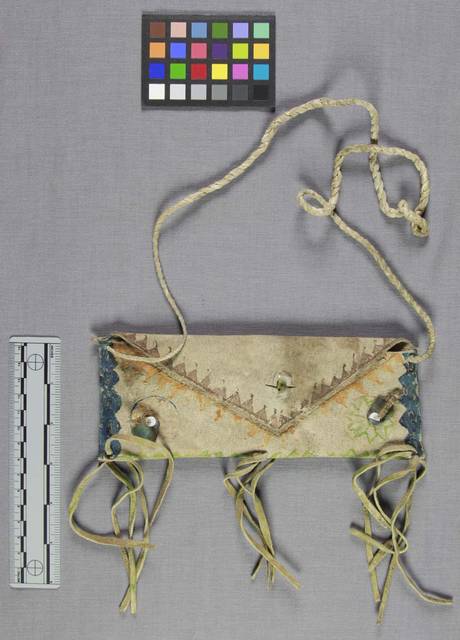
12018-03-16T21:06:47-07:00Erik Loyerf862727c4b34febd6a0341bffd27f168a35aa637Pouch And Wooden Figure1Pouch. The buckskin pouch is rectangular shaped with a long strap on the top, three bundles of fringe on the bottom, and a triangular flap to close the pouch. The purse fastens with a carved button made out of a white, shiny shell. There are two pieces of abalone and white, circular shells, each attached to lower right and left corners of the pouch with skin wrapped in sinew. The strap of the pouch is two strips of thin skin, twisted. A triangular design, painted in brown, lines the bottom of the flap that closes the pouch. Beneath that, an orange triangular design is painted. On the sides, a dark blue design is painted. On the bottom of the pouch, a green, triangular design is painted. Around the abalone on the left, a blue and orange triangular design is painted. Around the abalone on the right, a green and orange design is painted. The fringe on the bottom of the pouch is painted green, but some of the pigment has come off. On the opposite side of the pouch, there are no designs painted. The construction of the pouch is one, longer piece of skin, folded, and then sewn with strips of skin on the sides.
Amulet. The front side of the figure has smaller pieces of abalone for the eyes, nose and mouth. The abalone for the right eye is missing. The figure seems to be a human shape, with four triangles (two painted brown, and two painted green) on the top of the head, maybe a crown (?). The figure has cross figures in green and brown on it's face. The figure is painted with other various geometric designs in green, brown, orange, and blue. The back of the figure is also painted in blue brown, orange and green designs. Tag found in pouch says "Apache See NAS V 1 p 40, 193, 50" . The bag and figure appear to be the same ones illustrated, along with cap # E432866, in "Medicine cap and fetich - Apache", plate facing page 40, in The North American Indian (1907-1930) v.01, The Apache. The Jicarillas. The Navaho ([Seattle] : E.S. Curtis ; [Cambridge, Mass. : The University Press], 1907. See pp. 40-41 for explanatory text.
View this plate online here: http://curtis.library.northwestern.edu/curtis/viewPage.cgi?showp=1&size=2&id=nai.01.book.00000089.p&volume=1#nav .plain2018-03-16T21:06:47-07:00Erik Loyerf862727c4b34febd6a0341bffd27f168a35aa637