Thanks for your patience during our recent outage at scalar.usc.edu. While Scalar content is loading normally now, saving is still slow, and Scalar's 'additional metadata' features have been disabled, which may interfere with features like timelines and maps that depend on metadata. This also means that saving a page or media item will remove its additional metadata. If this occurs, you can use the 'All versions' link at the bottom of the page to restore the earlier version. We are continuing to troubleshoot, and will provide further updates as needed. Note that this only affects Scalar projects at scalar.usc.edu, and not those hosted elsewhere.
Performing ArchiveMain MenuVisualizing the “Vanishing Race”: the photogravures of Edward S. CurtisFront Page for Visualizing the "Vanishing Race" pathCurtis' Image and Life: The Network of The North American Indian, Inc.An experiment with data visualization approach to understand and contextualize Curtis' images and his lifeMedia, Technology and MediationsCurtis's Technology, Relationships to Media and StyleContextualizing Curtis, The North American Indian, and Racethe collection of essays from the contributorsConsulting with Tribes as Part of Archive DevelopmentIntroduction to Consulting with Tribes by Ulia GosartContributing ArchivesInformation on how to participate in Performing ArchiveBrowsing the MediaA path of paths that allow users to cut through the collection in a variety of ways.Acknowledgements and Project InformationProject NetworkJacqueline Wernimontbce78f60db1628727fc0b905ad2512506798cac8David J. Kim18723eee6e5a79c8d8823c02b7b02cb2319ee0f1Stephan Schonberg23744229577bdc62e9a8c09d3492541be754e1efAmy Borsukc533a79d33d48cbf428e1160c2edc0b38c50db19Beatrice Schustera02047525b31e94c1336b01e99d7f4f758870500Heather Blackmored0a2bf9f2053b3c0505d20108092251fc75010bfUlia Gosart (Popova)67c984897e6357dbeeac6a13141c0defe5ef3403
12018-03-16T21:13:00-07:00Erik Loyerf862727c4b34febd6a0341bffd27f168a35aa637Tribe PathsErik Loyer1Explore the Media by Tribestructured_gallery2018-03-16T21:13:00-07:00Erik Loyerf862727c4b34febd6a0341bffd27f168a35aa637
Contents of this path:
12018-03-16T21:11:34-07:00Erik Loyerf862727c4b34febd6a0341bffd27f168a35aa637In Black Cañon - Apsaroke1The Apsaroke, although not exclusively mountain dwellers, were ever fond of the hills, preferring the forest shade and the clear mountain streams to the hot ill-watered, monotonous prairies. The picture illustrates the Apsaroke custom of wearing at the back of the head a band from which fall numerous strands of false hair ornamented at regular intervals with pellets of bright-colored gum. Black Cañon is in the northern portion of the Bighorn mountains, Montana.plain2018-03-16T21:11:34-07:00Erik Loyerf862727c4b34febd6a0341bffd27f168a35aa637
12018-03-16T21:11:58-07:00Erik Loyerf862727c4b34febd6a0341bffd27f168a35aa637Evening on Puget Sound1The photograph was made near the city of Seattle.plain2018-03-16T21:11:58-07:00Erik Loyerf862727c4b34febd6a0341bffd27f168a35aa637
12018-03-16T21:12:13-07:00Erik Loyerf862727c4b34febd6a0341bffd27f168a35aa637Honovi - Walpi snake priest, with Totokya Day painting1This plate depicts the accoutrement of a Snake dancer on the day of the Antelope dance (see Volume XII, pages 146-149). The right hand grasps a pair of eagle-feathers - the "snake whip" - and the left a bag of ceremonial meal. Honovi was one of the author's principal informants.plain2018-03-16T21:12:13-07:00Erik Loyerf862727c4b34febd6a0341bffd27f168a35aa637
12018-03-16T21:11:06-07:00Erik Loyerf862727c4b34febd6a0341bffd27f168a35aa637Flute dancers at Tureva Spring1The Flute dance is a religious ceremony concerned with bringing rain. It represents the legendary arrival of the Flute people in the Hopi country, their friendly encounter with the clans already there, and the rain-making rites subsequently performed by them for the common good. The episode here represented was photographed at Middle mesa. The individual seated near the right end is an albino, not a white man.plain2018-03-16T21:11:06-07:00Erik Loyerf862727c4b34febd6a0341bffd27f168a35aa637
12018-03-16T21:12:28-07:00Erik Loyerf862727c4b34febd6a0341bffd27f168a35aa637Datsolali, Washo basket-maker1The coiled baskets produced by this woman have not been equalled by any Indian now living. Compare her work, shown in Plate 541, with the baskets of another woman as illustrated in Plate 542. The latter, seen alone, would be very excellent examples of Indian basketry, but their comparative coarseness is easily seen even in photographic reproduction. About ninety years old, Datsolali appears to be in the early sixties. She has the pride of a master in his craft, and a goodly endowment of artistic temperament. Persuading her to sit for a portrait is a task not to be lightly undertaken. Tatsolali (said to mean "big hips") is a nickname. Her proper name is Tabuta.plain2018-03-16T21:12:28-07:00Erik Loyerf862727c4b34febd6a0341bffd27f168a35aa637
12018-03-16T21:11:15-07:00Erik Loyerf862727c4b34febd6a0341bffd27f168a35aa637Ti'mu - Cochiti1This Cochiti girl married a Sia man, and the photograph was made at her adopted home.plain2018-03-16T21:11:15-07:00Erik Loyerf862727c4b34febd6a0341bffd27f168a35aa637
12018-03-16T21:12:30-07:00Erik Loyerf862727c4b34febd6a0341bffd27f168a35aa637Lucero - Santo Domingo1Photographing a native of Santo Domingo is comparable to hunting big game with a camera. This pueblo measures its contentment inversely to the extent of unavoidable contact with the hated white race. A guard is detailed to watch the Catholic priest when he visits the village, and the Government has pursued the wise policy of detailing Indian teachers to the local school. The Santo Domingans long resisted the gratuitous digging of wells to be equipped with windmills, continue to deny their sick children the services of the Government physician, and resist the activities of census enumerators. There is no doubt that the death sentence would be past on any individual found guilty of revealing native practices, and if the priestly authorities learned that Lucero sold his likeness to a white man he doubtless had an unpleasant half hour.plain2018-03-16T21:12:30-07:00Erik Loyerf862727c4b34febd6a0341bffd27f168a35aa637
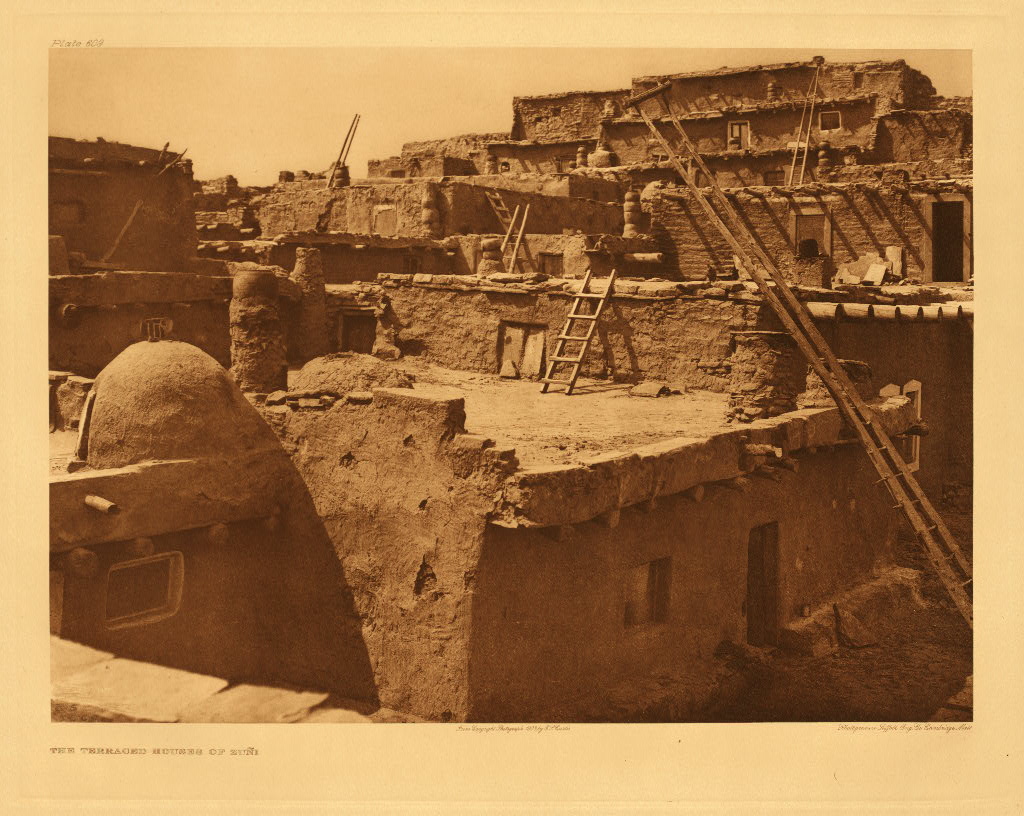
12018-03-16T21:12:36-07:00Erik Loyerf862727c4b34febd6a0341bffd27f168a35aa637Terraced houses of Zuni1In the early eighties one of the house-groups of Zuni rose to a height of six well-defined stories. In 1903, when the photograph here reproduced was made, there were five stories. In 1910 a single apartment was four stories from the ground, but in 1919 this room was demolished. Note the bottomless pots forming chimneys, the wooden drain piercing the coping, the hemispherical oven of Spanish provenience on a roof.plain2018-03-16T21:12:36-07:00Erik Loyerf862727c4b34febd6a0341bffd27f168a35aa637
12018-03-16T21:12:37-07:00Erik Loyerf862727c4b34febd6a0341bffd27f168a35aa637Titishu-kghitluhl ("Deer Running") - Sarsi1The Sarsi are an Athapascan tribe which prior to the nineteenth century came out of the far north, crossed the Saskatchewan, and becoming affiliated with the Algonquian confederacy of the Bloods, Blackfeet, and Piegan, became typical plainsmen, following the buffalo, engaging in horse-stealing raids, and in general adopting the religious practices of their allies. Old Sarsi, as the subject of this plate is colloquially known, was ninety-eight years of age when the photograph was made in 1925. In spite of his years, he was still agile and keen.plain2018-03-16T21:12:37-07:00Erik Loyerf862727c4b34febd6a0341bffd27f168a35aa637
12018-03-16T21:12:38-07:00Erik Loyerf862727c4b34febd6a0341bffd27f168a35aa637A Sarsi camp1The scene is a riverside grove near Okotoks, Alberta, where a band of Sarsi were awaiting clement weather to begin the prosaic labor of shocking wheat for one of their Caucasian neighbors.plain2018-03-16T21:12:38-07:00Erik Loyerf862727c4b34febd6a0341bffd27f168a35aa637
12018-03-16T21:12:43-07:00Erik Loyerf862727c4b34febd6a0341bffd27f168a35aa637Standing Two - Oto1The Oto belong to the great Siouan linguistic family and originally formed, with other tribes, a part of the Winnebago. The typical ceremonial head-dress of the Oto of the present time is shown here and in the nest three plates.plain2018-03-16T21:12:43-07:00Erik Loyerf862727c4b34febd6a0341bffd27f168a35aa637
12018-03-16T21:11:15-07:00Erik Loyerf862727c4b34febd6a0341bffd27f168a35aa637Old Eagle - Oto1The head-dress of this Oto is characteristic of the older style, like that worn also by the related Osage in plate 680 and the adopted head-dress of the Comanche in plate 683. The medal worn by Old Eagle, in this case bearing the portrait of Lincoln, is like other medals given by the Government to noted chiefs from Washington's time.plain2018-03-16T21:11:15-07:00Erik Loyerf862727c4b34febd6a0341bffd27f168a35aa637
12018-03-16T21:09:18-07:00Erik Loyerf862727c4b34febd6a0341bffd27f168a35aa637Seeing High - Oto1plain2018-03-16T21:09:18-07:00Erik Loyerf862727c4b34febd6a0341bffd27f168a35aa637
12018-03-16T21:09:19-07:00Erik Loyerf862727c4b34febd6a0341bffd27f168a35aa637Standing On The Earth - Oto1plain2018-03-16T21:09:19-07:00Erik Loyerf862727c4b34febd6a0341bffd27f168a35aa637
12018-03-16T21:09:19-07:00Erik Loyerf862727c4b34febd6a0341bffd27f168a35aa637A little Oto1plain2018-03-16T21:09:19-07:00Erik Loyerf862727c4b34febd6a0341bffd27f168a35aa637