This site requires Javascript to be turned on. Please enable Javascript and reload the page.
Thanks for your patience during our recent outage at scalar.usc.edu. While Scalar content is loading normally now, saving is still slow, and Scalar's 'additional metadata' features have been disabled, which may interfere with features like timelines and maps that depend on metadata. This also means that saving a page or media item will remove its additional metadata. If this occurs, you can use the 'All versions' link at the bottom of the page to restore the earlier version. We are continuing to troubleshoot, and will provide further updates as needed. Note that this only affects Scalar projects at scalar.usc.edu, and not those hosted elsewhere.
Performing Archive
Main Menu
Visualizing the “Vanishing Race”: the photogravures of Edward S. Curtis
Front Page for Visualizing the "Vanishing Race" path
Curtis' Image and Life: The Network of The North American Indian, Inc.
An experiment with data visualization approach to understand and contextualize Curtis' images and his life
Media, Technology and Mediations
Curtis's Technology, Relationships to Media and Style
Contextualizing Curtis, The North American Indian, and Race
the collection of essays from the contributors
Consulting with Tribes as Part of Archive Development
Introduction to Consulting with Tribes by Ulia Gosart
Contributing Archives
Information on how to participate in Performing Archive
Browsing the Media
A path of paths that allow users to cut through the collection in a variety of ways.
Acknowledgements and Project Information
Project Network
Jacqueline Wernimont
bce78f60db1628727fc0b905ad2512506798cac8
David J. Kim
18723eee6e5a79c8d8823c02b7b02cb2319ee0f1
Stephan Schonberg
23744229577bdc62e9a8c09d3492541be754e1ef
Amy Borsuk
c533a79d33d48cbf428e1160c2edc0b38c50db19
Beatrice Schuster
a02047525b31e94c1336b01e99d7f4f758870500
Heather Blackmore
d0a2bf9f2053b3c0505d20108092251fc75010bf
Ulia Gosart (Popova)
67c984897e6357dbeeac6a13141c0defe5ef3403
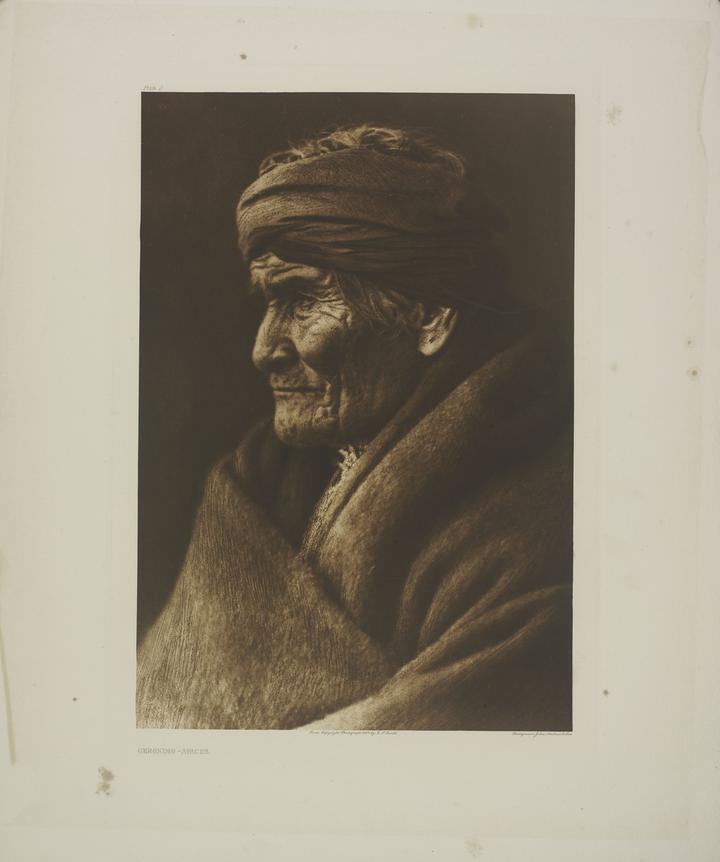
Geronimo
1
2018-03-16T21:12:53-07:00
Erik Loyer
f862727c4b34febd6a0341bffd27f168a35aa637
29482
1
part of Visualizing the "Vanishing Race"
plain
2018-03-16T21:12:53-07:00
Erik Loyer
f862727c4b34febd6a0341bffd27f168a35aa637
Ken Gonzales-Day, Scripps College
‘Wrapped in his blanket, a bronze enigma – a silent but irreconcilable criticism of our civilization! …They muffle themselves in their blankets and disappear over the edge of the hill into the dark valley. To throw the light of knowledge into that dark valley is the purpose of Mr. Curtis’ work.” Gustave Kobbe, The San Francisco Call, 1911. Perhaps no figure better exemplified the image of “the vanishing race” to Curtis in these early years than the image of Geronimo. As in a great many of his Native American portraits, Curtis once again employed the use of a blanket, both as a compositional device to direct the eye, and perhaps to cover any signs of contemporary life that may have been suggested by modern clothing. This image was taken in March 1905 and in his description, Curtis suggests that Geronimo was in a “retrospective mood” as he gazed off --constructed as an aging relic of a people in decline. In the text, Curtis explains that Geronimo was seventy-six years of age when the picture was taken in Carlisle, Pennsylvania, on the day before the inauguration of President Roosevelt. Geronimo had been invited to march in the inaugural parade. It should be remembered that the first image in the first portfolio of large prints was “the Vanishing Race” and that the second image was Geronimo, who appeared frail and immobile. A monument of Native American history rendered immobile by a blanket which both frames and literally confined his motion. With the support of President Roosevelt Curtis is given the absolute freedom to enter any reservation he wanted to, with or without invitation. Francis E. Leupp, director of the Bureau of Indian Affairs, is quoted as saying Mr. Curtis’ “...careful methods have been such that he is the one historical prospector to whom I have felt justified in giving absolute freedom to move about in the Indian country, wherever he would.” This freedom also reminds us that the reservation was not autonomous state but is more akin to series of colonies managed by the United States government, and as is suggested by the quote, Curtis was given unlimited access “prospect” for human treasures in Native American lands – and to transform their images into both a record, as well as marketable goods.
This page has paths:
1
2018-03-16T21:12:55-07:00
Erik Loyer
f862727c4b34febd6a0341bffd27f168a35aa637
Visualizing the “Vanishing Race”: the photogravures of Edward S. Curtis
Erik Loyer
1
Front Page for Visualizing the "Vanishing Race" path
splash
2018-03-16T21:12:55-07:00
Erik Loyer
f862727c4b34febd6a0341bffd27f168a35aa637
Contents of this path:
1
2018-03-16T21:11:59-07:00
Princess Angeline
1
Page 1 of Visualizing the "Vanishing Race" path
plain
2018-03-16T21:11:59-07:00
1
2018-03-16T21:11:11-07:00
Chief Josef –Nez Perce
1
Page 2 of Visualizing the "Vanishing Race"
plain
2018-03-16T21:11:11-07:00
1
2018-03-16T21:11:03-07:00
Vanishing Race and Cañon de Chelly
1
Page 3 of Visualizing the "Vanishing Race"
plain
2018-03-16T21:11:03-07:00
1
2018-03-16T21:11:23-07:00
Mosa –Mohave
1
part of Visualizing the "Vanishing Race"
plain
2018-03-16T21:11:23-07:00
1
2018-03-16T21:12:53-07:00
Geronimo
1
part of Visualizing the "Vanishing Race"
plain
2018-03-16T21:12:53-07:00
1
2018-03-16T21:12:51-07:00
Upshaw – Apsaroke
1
part of Visualizing the "Vanishing Race"
plain
2018-03-16T21:12:51-07:00
1
2018-03-16T21:06:48-07:00
At the Old Well and A Zuni Woman
1
part of Visualizing the "Vanishing Race"
plain
2018-03-16T21:06:48-07:00
1
2018-03-16T21:12:51-07:00
The Hopi Maiden and Watching the Dancers
1
part of Visualizing the "Vanishing Race"
plain
2018-03-16T21:12:51-07:00
1
2018-03-16T21:07:26-07:00
Warm tones and Wigs
1
part of Visualizing the "Vanishing Race"
plain
2018-03-16T21:07:26-07:00
1
2018-03-16T21:12:55-07:00
In a Piegan Lodge
1
part of Visualizing the "Vanishing Race"
plain
2018-03-16T21:12:55-07:00
1
2018-03-16T21:12:57-07:00
Kotsuis and Hohhug
1
part of Visualizing the "Vanishing Race"
plain
2018-03-16T21:12:57-07:00
1
2018-03-16T21:06:59-07:00
Bear Bull
1
part of Visualizing the "Vanishing Race"
plain
2018-03-16T21:06:59-07:00
1
2018-03-16T21:12:56-07:00
Jackson and Curtis at the end
1
part of Visualizing the "Vanishing Race"
plain
2018-03-16T21:12:56-07:00
1
2018-03-16T21:12:57-07:00
Erik Loyer
f862727c4b34febd6a0341bffd27f168a35aa637
"Portrait"
Erik Loyer
1
plain
2018-03-16T21:12:57-07:00
Erik Loyer
f862727c4b34febd6a0341bffd27f168a35aa637
Contents of this path:
1
2018-03-16T21:06:59-07:00
Geronimo - Apache
1
This portrait of the historical old Apache was made in March, 1905. According to Geronimo's calculation he was at the time seventy-six years of age, thus making the year of his birth 1829. The picture was taken at Carlisle, Pennsylvania, the day before the inauguration of President Roosevelt, Geronimo being one of the warriors who took part in the inaugural parade at Washington. He appreciated the honor of being one of those chosen for this occasion, and the catching of his features while the old warrior was in a retrospective mood was most fortunate.
plain
2018-03-16T21:06:59-07:00
1
2018-03-16T21:06:59-07:00
Alchise - Apache
1
Chief of the White Mountain Apache. A well-known character, having been a scout with General Crook. Colonel Cooley, who was chief of scouts under Crook, says a braver man than Alchise never lived. He was about twenty-two when Fort Apache, then Camp Ord, was established in 1870, making the year of his birth about 1848. This portrait was made at Alchise's camp on White river in the spring of 1903.
plain
2018-03-16T21:06:59-07:00
1
2018-03-16T21:11:20-07:00
Kaviu - Pima
1
The Pima are bright, active, progressive Indians, as the portrait of the typical man of the tribe attests.
plain
2018-03-16T21:11:20-07:00
1
2018-03-16T21:11:24-07:00
Captain Charley - Maricopa
1
This portrait shows clearly the strongly Yuman cast of features retained by this branch of the stock.
plain
2018-03-16T21:11:24-07:00
1
2018-03-16T21:11:25-07:00
Tonovige - Havasupai
1
This portrait was made in winter while a party of Havasupai were encamped in the high country above their cañon home. As a snowstorm was raging at the time, the woman's hair became dotted with flakes, as the picture reveals.
plain
2018-03-16T21:11:25-07:00
1
2018-03-16T21:11:26-07:00
Jack Red Cloud
1
The subject of this portrait is the son of the Ogalala chief Red Cloud. (See No. 103.)
plain
2018-03-16T21:11:26-07:00
1
2018-03-16T21:11:01-07:00
Little Hawk
1
This portrait exhibits the typical Brule physiognomy.
plain
2018-03-16T21:11:02-07:00
1
2018-03-16T21:11:38-07:00
Yellow Kidney - Piegan
1
The portrait shows Apuyotoksi ("light-colored kidney") wearing a wolf-skin war-bonnet.
plain
2018-03-16T21:11:38-07:00
1
2018-03-16T21:11:07-07:00
Cheyenne type
1
The original of this portrait is Wako'yami ("his horse bobtailed") of the Northern Cheyenne.
plain
2018-03-16T21:11:07-07:00
1
2018-03-16T21:11:44-07:00
Flathead type
1
Probably the Indian does not live in whose veins does not flow the blood of more than one tribe. The Flatheads are unusually composite, and the original of the portrait here presented, while as good a type as can be found, no doubt is of a very different mould from that of a Flathead of three or four generations ago.
plain
2018-03-16T21:11:44-07:00
1
2018-03-16T21:11:50-07:00
Luqaiot - Kittitas
1
The original of this portrait is a son Owhi (Ohai), who as chief of the Salishan band inhabiting Kittitas valley, Washington, at first appeared to favor the Stevens treaty of 1855, but a few months later was drawn into the Indian uprising by the act of another son, Qahlchun, in killing some prospectors. At the termination of hostilities Luqaiot made his permanent home among the Spokan, taking for his wife the daughter of a Spokan chief and widow of his executed brother Qahlchun. Luqaiot's recollections of the events of these times will be found scattered through the account of the Yakima war in Volume VII.
plain
2018-03-16T21:11:50-07:00
1
2018-03-16T21:11:51-07:00
Typical Nez Perce
1
This portrait presents a splendid type of the Nez Perce man.
plain
2018-03-16T21:11:51-07:00
1
2018-03-16T21:11:52-07:00
Lawyer - Nez Perce
1
The original of this portrait is a member of the family of that Lawyer who played a prominent part in the Nez Perce affairs in the years following the treaty of 1855.
plain
2018-03-16T21:11:52-07:00
1
2018-03-16T21:12:21-07:00
Old "Ukiah" - Pomo
1
The Pomo formerly occupied about half the area of Mendocino, Sonoma, and Lake counties, besides a small isolated territory in Glenn and Colusa. The survivors are found in greatest number in the vicinity of the town of Ukiah. This name, though it is applied to the original portrait as a nickname, is a word of Pomo origin, from yo, south, and kaia, valley.
plain
2018-03-16T21:12:21-07:00
1
2018-03-16T21:12:28-07:00
Datsolali, Washo basket-maker
1
The coiled baskets produced by this woman have not been equalled by any Indian now living. Compare her work, shown in Plate 541, with the baskets of another woman as illustrated in Plate 542. The latter, seen alone, would be very excellent examples of Indian basketry, but their comparative coarseness is easily seen even in photographic reproduction. About ninety years old, Datsolali appears to be in the early sixties. She has the pride of a master in his craft, and a goodly endowment of artistic temperament. Persuading her to sit for a portrait is a task not to be lightly undertaken. Tatsolali (said to mean "big hips") is a nickname. Her proper name is Tabuta.
plain
2018-03-16T21:12:28-07:00
1
2018-03-16T21:12:34-07:00
Ambrosio Martinez - San Juan
1
The original of this portrait could readily pass for an Indian of the southern plains. The influence of Plains blood is noticeable at all Tewa pueblos, and especially at San Juan, the most northerly of them. The typical Pueblo man is small-featured and of short to medium stature.
plain
2018-03-16T21:12:34-07:00
1
2018-03-16T21:12:35-07:00
Zuni governor
1
This portrait may well be taken as representative of the typical Pueblo physiognomy.
plain
2018-03-16T21:12:36-07:00
1
2018-03-16T21:11:15-07:00
Old Eagle - Oto
1
The head-dress of this Oto is characteristic of the older style, like that worn also by the related Osage in plate 680 and the adopted head-dress of the Comanche in plate 683. The medal worn by Old Eagle, in this case bearing the portrait of Lincoln, is like other medals given by the Government to noted chiefs from Washington's time.
plain
2018-03-16T21:11:15-07:00
1
2018-03-16T21:11:15-07:00
Esipermi - Comanche
1
There were no more vigorous people among the Indians of the Plains than the Comanche, a Shoshonean tribe, related to the Shoshone and Bannock of Idaho, from which region they entered the northern plains and drifted ever southward, following the bison in their wanderings. They were noted warriors and raiders, being the enemies of many tribes and extending their depredations far into Mexico. One need look no farther than the accompanying portraits to discern the warrior character of those old braves.
plain
2018-03-16T21:11:15-07:00
1
2018-03-16T21:12:44-07:00
Uyowutcha - Nunivak
1
The effect of trade is shown in this and in other portraits by the buttons with which this child's cap is ornamented; otherwise the costume is quite aboriginal.
plain
2018-03-16T21:12:44-07:00
1
2018-03-16T21:12:45-07:00
Ugiyaku - Nunivak
1
A portrait of the subject shown also in Plate 693, with a different and modified costume.
plain
2018-03-16T21:12:45-07:00
1
2018-03-16T21:11:16-07:00
Curtis and His Collaborators
1
part of Contextualizing Curtis
plain
2018-03-16T21:11:16-07:00
1
2018-03-16T21:12:53-07:00
Focus on the Portraits: Video Essay
1
Video Essay by Heather Blackmore
plain
2018-03-16T21:12:53-07:00
1
2018-03-16T21:06:54-07:00
AfterImages
1
Considering the Curtis Portraits
plain
2018-03-16T21:06:54-07:00
1
2018-03-16T21:12:53-07:00
Geronimo
1
part of Visualizing the "Vanishing Race"
plain
2018-03-16T21:12:53-07:00
1
2018-03-16T21:13:04-07:00
The Literariness of the Curtis Photographs
1
plain
2018-03-16T21:13:04-07:00
1
2018-03-16T21:13:04-07:00
The Literariness of the Curtis Photographs: Bibliography
1
plain
2018-03-16T21:13:04-07:00
1
2018-03-16T21:13:04-07:00
The Literariness of the Curtis Photographs
1
plain
2018-03-16T21:13:04-07:00
1
2018-03-16T21:13:04-07:00
The Literariness of the Curtis Photographs: Endnotes
1
plain
2018-03-16T21:13:04-07:00
1
2018-03-16T21:07:26-07:00
Warm tones and Wigs
1
part of Visualizing the "Vanishing Race"
plain
2018-03-16T21:07:26-07:00
1
2018-03-16T21:11:11-07:00
Chief Josef –Nez Perce
1
Page 2 of Visualizing the "Vanishing Race"
plain
2018-03-16T21:11:11-07:00
1
2018-03-16T21:12:56-07:00
Jackson and Curtis at the end
1
part of Visualizing the "Vanishing Race"
plain
2018-03-16T21:12:56-07:00
1
2018-03-16T21:12:51-07:00
Upshaw – Apsaroke
1
part of Visualizing the "Vanishing Race"
plain
2018-03-16T21:12:51-07:00
1
2018-03-16T21:11:59-07:00
Princess Angeline
1
Page 1 of Visualizing the "Vanishing Race" path
plain
2018-03-16T21:11:59-07:00
1
2018-03-16T21:13:04-07:00
Visualizing the "Vanishing Race": the photogravures of Edward S. Curtis Bibliography
1
plain
2018-03-16T21:13:04-07:00
1
2018-03-16T21:06:54-07:00
Oldest man of Nootka
1
This individual is the most primitive relic in the modernized village of Nootka. Stark naked, he may be seen hobbling about the beach or squatting in the sun, living in thought in the golden age when the social and ceremonial customs of his people were what they had always been.
plain
2018-03-16T21:06:54-07:00
1
2018-03-16T21:12:09-07:00
Hesquiat woman
1
plain
2018-03-16T21:12:09-07:00
1
2018-03-16T21:07:54-07:00
A woman of Hesquiat
1
plain
2018-03-16T21:07:54-07:00
1
2018-03-16T21:06:48-07:00
A Zuni Woman
1
“A Zuni Woman”, volume 17, portfolio plate 614, photogravure, 46 x 31 cm., Special Collection, Honnold Library, Claremont.
plain
2018-03-16T21:06:48-07:00
1
2018-03-16T21:11:20-07:00
Pima matron
1
A representative Pima woman of middle age.
plain
2018-03-16T21:11:20-07:00
1
2018-03-16T21:11:23-07:00
Judith - Mohave
1
A young Mohave woman about eighteen years of age.
plain
2018-03-16T21:11:23-07:00
1
2018-03-16T21:11:25-07:00
Tonovige - Havasupai
1
This portrait was made in winter while a party of Havasupai were encamped in the high country above their cañon home. As a snowstorm was raging at the time, the woman's hair became dotted with flakes, as the picture reveals.
plain
2018-03-16T21:11:25-07:00
1
2018-03-16T21:11:27-07:00
Ogalala woman
1
A face so strong that it is almost masculine, showing strikingly how slight may be the difference between the male and female physiognomy in some primitive people.
plain
2018-03-16T21:11:27-07:00
1
2018-03-16T21:11:27-07:00
Sioux girl
1
A young Sioux woman in a dress made entirely of deerskin, embroidered with beads and porcupine-quills.
plain
2018-03-16T21:11:27-07:00
1
2018-03-16T21:11:37-07:00
Two Bear Woman - Piegan
1
plain
2018-03-16T21:11:37-07:00
1
2018-03-16T21:11:47-07:00
Dusty dress - Kalispel
1
The Kalispel young woman, Skohlpba, is garbed in a dress ornamented with shells that imitate elk-tusks. The braids of hair are wound with strips of otter fur, and a weasel-skin dangles from each. The bands of white on the hair are effected with white clay.
plain
2018-03-16T21:11:47-07:00
1
2018-03-16T21:11:50-07:00
Nespilim woman
1
plain
2018-03-16T21:11:50-07:00
1
2018-03-16T21:11:52-07:00
Piopio-maksmaks - Wallawalla
1
Piopio-maksmaks, quoted in Volume VIII, pages 20-21, is the son of the Piopio-maksmaks who as principal chief of the Wallawalla negotiated a treaty with Governor Isaac I. Stevens in the Wallawalla valley in 1855. The father was killed while a captive of the Oregon volunteers, and the son thereafter lived permanently among the Nez Perces, having married a woman of that tribe. Piopio-maksmaks possesses as unusually strong face, and his remarkably piercing eye betokens a man possessing the courage characteristic of his family and tribe.
plain
2018-03-16T21:11:52-07:00
1
2018-03-16T21:11:57-07:00
Suquamish woman
1
The Suquamish were one of numerous Puget Sound tribes.
plain
2018-03-16T21:11:57-07:00
1
2018-03-16T21:11:59-07:00
Princess Angeline
1
This aged woman, daughter of the chief Siahl (Seattle), was for many years a familiar figure in the streets of Seattle.
plain
2018-03-16T21:11:59-07:00
1
2018-03-16T21:12:00-07:00
Lummi woman
1
plain
2018-03-16T21:12:00-07:00
1
2018-03-16T21:12:06-07:00
Koskimo woman
1
The head is a good illustration of the extremes to which the Quatsino Sound tribes carried the practice of artificially lengthening the skulls of their infants.
plain
2018-03-16T21:12:06-07:00
1
2018-03-16T21:12:09-07:00
Hesquiat woman
1
plain
2018-03-16T21:12:09-07:00
1
2018-03-16T21:12:09-07:00
Nootka woman wearing cedar-bark blanket
1
plain
2018-03-16T21:12:09-07:00
1
2018-03-16T21:12:10-07:00
Nootka woman
1
plain
2018-03-16T21:12:10-07:00
1
2018-03-16T21:12:10-07:00
Haiyahl - Nootka
1
A Nootka woman in profile, with a shell nose-ring and fur-edged bark blanket.
plain
2018-03-16T21:12:10-07:00
1
2018-03-16T21:12:13-07:00
Hopi woman
1
plain
2018-03-16T21:12:13-07:00
1
2018-03-16T21:12:16-07:00
Klamath woman
1
plain
2018-03-16T21:12:16-07:00
1
2018-03-16T21:12:17-07:00
Old Klamath woman
1
plain
2018-03-16T21:12:17-07:00
1
2018-03-16T21:12:18-07:00
Hupa woman
1
It would be difficult to find a better type of Hupa female physiognomy.
plain
2018-03-16T21:12:18-07:00
1
2018-03-16T21:12:23-07:00
Coast Pomo woman
1
plain
2018-03-16T21:12:23-07:00
1
2018-03-16T21:12:23-07:00
Aged Pomo woman
1
plain
2018-03-16T21:12:23-07:00
1
2018-03-16T21:12:23-07:00
Wappo woman
1
plain
2018-03-16T21:12:23-07:00
1
2018-03-16T21:12:25-07:00
Yaundanchi Yokuts woman
1
The Yaudanchi formerly controlled the territory about the headwaters of Tule river in Tulare county, including the present Tule River reservation, where the survivors are quartered.
plain
2018-03-16T21:12:25-07:00
1
2018-03-16T21:12:26-07:00
Cupeño woman
1
The Cupeño are a small Shoshonean group of mountaineers formerly residing at the head of San Luis Rey river in north-central San Diego county. Popularly known as Aguas Calientes and as Warner's Ranch Indians, they gained considerable prominence at the beginning of the century when the Supreme Court ruled adversely upon their title to the land of their nativity. In 1903 they were settled at Pala reservation on lands adjoining those of the Luiseños, and their former habitat is now beautiful Warner's ranch. Cupeño is a Spanish derivative of Kupa, the name of their former village. The surviving population of Wolak, the other Cupeño settlement, is now on Los Coyotes reservati
plain
2018-03-16T21:12:26-07:00
1
2018-03-16T21:12:26-07:00
Serrano woman of Tejon
1
The Serranos (Spanish, "mountaineers"), a Shoshonean branch comprising numerous local groups, occupied San Bernardino valley, San Bernardino mountains north of Los Angeles and San Bernardino, a portion of Mojave desert north of that range and east of Mojave river, and Tehachapi mountains. This last group, who lived principally on El Paso and Tejon creeks, were the Kitanemuk. In 1853 most of the resident Indians, including not only various Shoshoneans but many Yokuts, were taken to Tule river reservation. Tejon rancheria remains, however, a settlement of various Shoshoneans, but predominantly Kitanemuk
plain
2018-03-16T21:12:26-07:00
1
2018-03-16T21:11:02-07:00
Desert Cahuilla woman
1
plain
2018-03-16T21:11:02-07:00
1
2018-03-16T21:12:26-07:00
Diegueño woman of Santa Ysabel
1
plain
2018-03-16T21:12:26-07:00
1
2018-03-16T21:12:27-07:00
Diegueño woman of Campo
1
plain
2018-03-16T21:12:27-07:00
1
2018-03-16T21:12:28-07:00
Datsolali, Washo basket-maker
1
The coiled baskets produced by this woman have not been equalled by any Indian now living. Compare her work, shown in Plate 541, with the baskets of another woman as illustrated in Plate 542. The latter, seen alone, would be very excellent examples of Indian basketry, but their comparative coarseness is easily seen even in photographic reproduction. About ninety years old, Datsolali appears to be in the early sixties. She has the pride of a master in his craft, and a goodly endowment of artistic temperament. Persuading her to sit for a portrait is a task not to be lightly undertaken. Tatsolali (said to mean "big hips") is a nickname. Her proper name is Tabuta.
plain
2018-03-16T21:12:28-07:00
1
2018-03-16T21:12:28-07:00
Washo woman
1
plain
2018-03-16T21:12:28-07:00
1
2018-03-16T21:12:29-07:00
Walvia
1
Walvia is a characteristic type of Taos womanhood.
plain
2018-03-16T21:12:29-07:00
1
2018-03-16T21:12:30-07:00
Taos woman
1
plain
2018-03-16T21:12:30-07:00
1
2018-03-16T21:06:50-07:00
Acoma woman
1
plain
2018-03-16T21:06:50-07:00
1
2018-03-16T21:11:07-07:00
Zuni woman
1
Bowls of food are often thus carried on the head with a woven yucca ring during an intermission in or following a ceremony, when the participants feast.
plain
2018-03-16T21:11:07-07:00
1
2018-03-16T21:12:39-07:00
A Cree woman
1
plain
2018-03-16T21:12:39-07:00
1
2018-03-16T21:11:11-07:00
Dog woman - Cheyenne
1
The woman's dress is embellished with elk-teeth.
plain
2018-03-16T21:11:11-07:00
1
2018-03-16T21:11:11-07:00
Woista - Cheyenne woman
1
Remarkable strength of character is depicted in the features of this woman, and indeed in those of all the Cheyenne. Their former life was such that only the fittest could survive.
plain
2018-03-16T21:11:11-07:00
1
2018-03-16T21:12:44-07:00
Ugiyaku - Nunivak
1
This contented young woman wears a nose-ring and a labret similar to those of the girl in Plate 691. Her waterproof hooded parka is made of intestinal parchment.
plain
2018-03-16T21:12:44-07:00
1
2018-03-16T21:12:44-07:00
Woman and child - Nunivak
1
plain
2018-03-16T21:12:44-07:00
1
2018-03-16T21:07:07-07:00
An Apache-Mohave woman
1
plain
2018-03-16T21:07:07-07:00
1
2018-03-16T21:09:55-07:00
Good Day Woman - Ogalala
1
plain
2018-03-16T21:09:55-07:00
1
2018-03-16T21:10:05-07:00
Flathead woman - Apsaroke
1
plain
2018-03-16T21:10:05-07:00
1
2018-03-16T21:10:10-07:00
Hidatsa woman
1
plain
2018-03-16T21:10:10-07:00
1
2018-03-16T21:10:13-07:00
Scattered Corn Woman - Mandan
1
plain
2018-03-16T21:10:13-07:00
1
2018-03-16T21:07:16-07:00
Arikara woman
1
plain
2018-03-16T21:07:16-07:00
1
2018-03-16T21:10:17-07:00
Piegan woman
1
plain
2018-03-16T21:10:17-07:00
1
2018-03-16T21:10:20-07:00
Cheyenne woman
1
plain
2018-03-16T21:10:20-07:00
1
2018-03-16T21:10:25-07:00
Cheyenne young woman
1
plain
2018-03-16T21:10:25-07:00
1
2018-03-16T21:10:34-07:00
Spokan woman
1
plain
2018-03-16T21:10:34-07:00
1
2018-03-16T21:10:41-07:00
Cayuse woman
1
plain
2018-03-16T21:10:41-07:00
1
2018-03-16T21:10:45-07:00
Wishham young woman
1
plain
2018-03-16T21:10:45-07:00
1
2018-03-16T21:10:51-07:00
Cowichan woman
1
plain
2018-03-16T21:10:51-07:00
1
2018-03-16T21:10:59-07:00
Chimakum woman
1
plain
2018-03-16T21:10:59-07:00
1
2018-03-16T21:07:58-07:00
A Clayoquot woman
1
plain
2018-03-16T21:07:58-07:00
1
2018-03-16T21:07:59-07:00
A Makah woman
1
plain
2018-03-16T21:07:59-07:00
1
2018-03-16T21:08:03-07:00
A woman of Kiusta - Haida
1
plain
2018-03-16T21:08:03-07:00
1
2018-03-16T21:08:03-07:00
A woman of Massett - Haida
1
plain
2018-03-16T21:08:03-07:00
1
2018-03-16T21:08:07-07:00
A Hopi woman
1
plain
2018-03-16T21:08:07-07:00
1
2018-03-16T21:08:14-07:00
Hupa woman
1
plain
2018-03-16T21:08:14-07:00
1
2018-03-16T21:08:19-07:00
Karok woman
1
plain
2018-03-16T21:08:19-07:00
1
2018-03-16T21:06:48-07:00
Achomawi woman
1
plain
2018-03-16T21:06:48-07:00
1
2018-03-16T21:08:22-07:00
Klamath woman
1
plain
2018-03-16T21:08:22-07:00
1
2018-03-16T21:08:24-07:00
A Kato woman
1
plain
2018-03-16T21:08:24-07:00
1
2018-03-16T21:08:24-07:00
A Wailaki woman
1
plain
2018-03-16T21:08:24-07:00
1
2018-03-16T21:08:24-07:00
Old woman in mourning - Yuki
1
plain
2018-03-16T21:08:24-07:00
1
2018-03-16T21:08:25-07:00
A Yuki woman
1
plain
2018-03-16T21:08:25-07:00
1
2018-03-16T21:08:30-07:00
A southern Miwok woman
1
plain
2018-03-16T21:08:30-07:00
1
2018-03-16T21:08:30-07:00
A Maidu woman
1
plain
2018-03-16T21:08:30-07:00
1
2018-03-16T21:08:30-07:00
A Chukchansi woman
1
plain
2018-03-16T21:08:30-07:00
This page references:
1
2018-03-16T21:12:53-07:00
Geronimo - Apache
1
“Geronimo – Apache”, 1905, vol. 1, portfolio plate 2, photogravure, 46 x 31 cm., Special Collection, Honnold Library, Claremont.
plain
2018-03-16T21:12:53-07:00