Videopoema: Por qué grita esa mujer
1 2023-06-06T10:29:47-07:00 Janet Landa fe3b2d058688f8c7ac74f78a94cf65cbaf4b5190 42723 1 Poem by Susana Thénon plain 2023-06-06T10:29:47-07:00 YouTube 2018-07-02T19:17:00Z 4yDzpNjxUeI Canal Encuentro Janet Landa fe3b2d058688f8c7ac74f78a94cf65cbaf4b5190This page has annotations:
- 1 2023-06-06T10:30:47-07:00 Janet Landa fe3b2d058688f8c7ac74f78a94cf65cbaf4b5190 That women must be crazy Janet Landa 5 women are called 'crazy' to undermine and minimize their emotions and experiences plain 2023-06-12T00:33:46-07:00 Janet Landa fe3b2d058688f8c7ac74f78a94cf65cbaf4b5190
- 1 2023-06-12T00:25:38-07:00 Janet Landa fe3b2d058688f8c7ac74f78a94cf65cbaf4b5190 Birds Janet Landa 3 In this line, one of the speakers is focusing on the birds instead of the screaming woman. They emphasize the quietness and lack of space taken up by the bird possibly making a reference to how the screaming woman should behave instead. This shows the constant battle women face as the world tries to silence them plain 2023-06-12T00:34:47-07:00 Janet Landa fe3b2d058688f8c7ac74f78a94cf65cbaf4b5190
- 1 2023-06-12T00:34:44-07:00 Janet Landa fe3b2d058688f8c7ac74f78a94cf65cbaf4b5190 Do you remember the woman? Janet Landa 3 This final line shows the lack of concern for women who "scream" or speak up. Throughout the poem no one bothered to find the actual reason behind why the woman was screaming, they just cared that she stopped plain 2023-06-12T00:37:16-07:00 Janet Landa fe3b2d058688f8c7ac74f78a94cf65cbaf4b5190
This page has paths:
- 1 media/younglordscocina.jpeg 2023-05-18T12:33:30-07:00 Christopher Gilman 1985b99a2acd541caa12a10c3ebf6896565283ab Media Thumbnails Elise Oliver 7 structured_gallery 2023-06-11T14:29:20-07:00 Elise Oliver d99044ad38ce76bdbc04601c337e701e6ac85911
This page is referenced by:
-
1
2023-05-18T13:16:12-07:00
Women in Art
38
When discussing women in art, the one iconic figure consistently representing Latin America throughout history has been Frida Kahlo. While it's important to recognize Kahlo as a renowned artist, it is also important to recognize those numerous other influential women in art who are not as equally celebrated. These women also deserve the recognition and ought to be acknowledged as representatives of Latin America alongside Frida. This page is a collection of various underrepresented Latin women who have used art to explore themes ranging from self-identity to social-political issues and activism, all while bringing attention to the unjust cultural and social standards of women in Latin America. By Janet Landa
image_header
2023-06-12T01:01:05-07:00
This first image is of a handmade Arpillera, a vibrant patchwork picture made by sewing various fabrics and burlap materials together. During Pinochet’s military dictatorship in 1973-1990, there were various forced “disappearances” and inhumane treatment of the citizens of Chile by the hands of the government and military officers. Through the use of the arpillera, women were able to use their artistic expression to protest the political situation in Chile and bring awareness to the atrocities committed by the government. Many of the scenes depicted in these arpilleras include protests, depictions of the military officials violating human rights, and important figures/ buildings of Chile. These women took a typical household task of sewing and turned it into an artistic tool of political activism. These arpilleras served not only as a form of resistance to the political oppression but also as a form of record keeping to document this important period in the history of Chile.
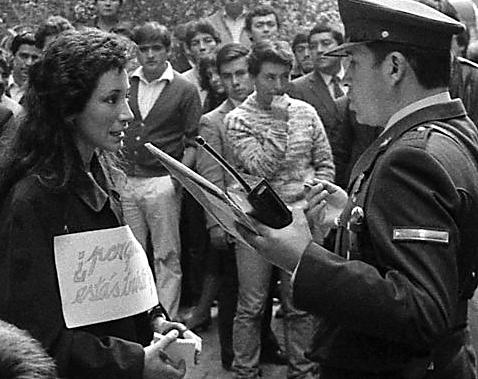
Moreover, a Chilean artist, Janet Toro, used a different form of art called performance art as a similar mode for political and social expression. In 1986, Toro held a performance in the busy streets of Paseo Ahumada in Santiago, Chile where she and a helper held signs that read “Why are you smiling?” and “Why are you sad?”. Although these questions seem trivial, this was seen as an act that challenged the censorship and limits of the Pinochet dictatorship at the time. These simple questions led to strong engagement from the audience who were pedestrians in Chile going about their day. Various people approached and shared their opinions and responses to the signs. This was interrupted soon after by a police officer who approached and confronted Janet Toro with a hostile and dismissive attitude. However, after engaging him in a deeper conversation about the question in her hand, there was a remarkable shift in his attitude. This humanizing conversation fostered a profound connection between the two, which led to the officer eventually letting her go without repercussions. This was a powerful interaction that resulted in a tranquil resolution between a protesting citizen and the police under this oppressive military dictatorship.
This next artwork is a piece by a feminist group called Polvo de Gallina Negra, where two of the leaders named Monica Mayer and Maris Bustamante worked together to build a political and artistic space where women could address various social and political issues. In this artwork, the issues of women's safety are presented in a uniquely artistic way to bring attention to the issues of safety. At first glance, this piece looks like a regular recipe with ingredients and steps, but a closer look reveals to the viewer information about an important issue that women face: rape. This is actually a recipe for giving the evil eye to rapists. In Latin America, the evil eye is a superstitious belief of a curse that is brought upon one which brings them bad luck. The use of this recipe as the format is very representative of the social standards women face in Latin America. Women are expected to follow the gender norms of the culture which include adopting a traditional role of caring for the home and the children with tasks that include cooking and providing for the rest of the family members. It is very mindful that the artists chose to make the artwork resemble the format of a recipe. A traditional man who conforms to the gender norms in Latin America would not bat an eye at the recipe and most likely not read it, whereas a woman or girl would take a closer look at this recipe. This is a way to bring awareness to the issue of rape prevalent inside and outside their homes of women while doing so in an intimate way that also invites women to join this feminist group. Through the use of art, this group was able to bring light to various social and political issues, such as rape, prevalent in these Latin communities while simultaneously uniting women in a supportive environment.
The next image is an exhibition by Johanna Hamann, a Peruvian artist, who works with sculptures. She began to work on this specific piece in around 1979, which is composed of plaster casts of very pregnant bellies hanging from large metal meat hooks that one would find at a butcher shop. These decaying bellies are torn with hanging threads which seem to be representing rotting meat. This artwork is a reference to childbirth and womanhood. The way it portrays a pregnant belly that once contained and gave life to a human being, into torn and shredded is very impactful and possibly symbolizes the trauma women endure during childbirth. In addition, this decay also signifies the neglect women suffer after giving birth, which suggests that women are seen as just hosts for babies. Furthermore, the use of hanging the bellies on meat hooks evokes the mistreatment of women and is reminiscent of how animals are treated solely for reproduction and human consumption. This artist uses sculptures to illustrate the pain women endure.
Lastly, Susana Thenon is an Argentine poet who used words as a form of self-expression and would explore various themes of identity, social, and political issues affecting women. One of her most famous poems is titled, “¿Por qué grita esa mujer?”. This youtube video shows an illustration version of the poem. In this poem, one can presume that the woman in this poem is screaming in a rebellious way with the means to be heard and take up space in a society where the ones who take up the most space are men. However, as the poem progresses, we see the woman’s screams being suppressed and ignored until eventually she is no longer heard or remembered. This poem is a powerful representation of the resistance of women and what they face in a patriarchal society. This serves as a reminder of the importance of recognizing women’s voices and the need for women's empowerment.
Art comes in various forms, from visual to performance, each piece on this page was carefully constructed as a form of self-expression by Latinas. In addition, these works of art have been used as an instrument for social activism where these women artists educate and shed light on cultural, social, and political injustices faced by women in Latin America. These are just a few of the many women who deserve the proper artistic celebration and recognition that many have given to Frida Kahlo.