Thanks for your patience during our recent outage at scalar.usc.edu. While Scalar content is loading normally now, saving is still slow, and Scalar's 'additional metadata' features have been disabled, which may interfere with features like timelines and maps that depend on metadata. This also means that saving a page or media item will remove its additional metadata. If this occurs, you can use the 'All versions' link at the bottom of the page to restore the earlier version. We are continuing to troubleshoot, and will provide further updates as needed. Note that this only affects Scalar projects at scalar.usc.edu, and not those hosted elsewhere.
Sound and Documentary in Cardiff and Miller's Pandemonium
Main Menu
Welcome
The Project
Chapter 1: Pandemonium—Sensory Assault and Deprivation
Chapter 2: Sound Art—Narrative and Noise
Chapter 3: Documentary—“Waking the Dead”
Conclusions: Pandemonium, Radical Proximity, and Protest
Acknowledgments
Bibliography
All Media
News + Updates
Cecilia Wichmann
570c894159ad998517c62537a60758b7099e0270
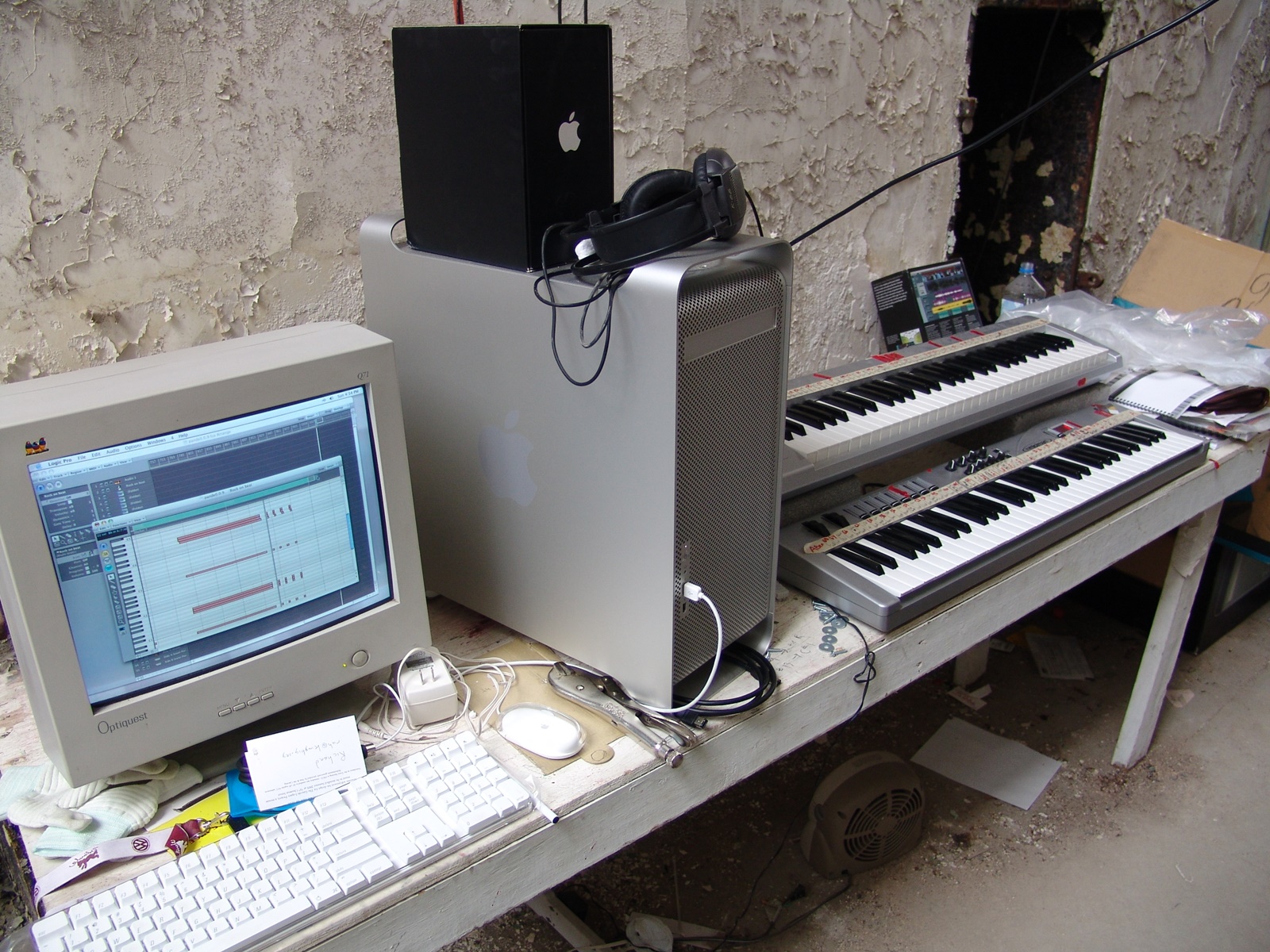
MIDI system and keyboards, Pandemonium.
1 2015-08-15T19:35:21-07:00 Cecilia Wichmann 570c894159ad998517c62537a60758b7099e0270 5542 3 MIDI system and keyboards, Pandemonium. Photo by Sean Kelley, 2005. Courtesy of Eastern State Penitentiary Historic Site. plain 2015-10-04T14:16:52-07:00 Cecilia Wichmann 570c894159ad998517c62537a60758b7099e0270This page has tags:
- 1 2015-08-16T21:23:08-07:00 Cecilia Wichmann 570c894159ad998517c62537a60758b7099e0270 All Images Cecilia Wichmann 11 All images plain 2015-09-30T22:35:43-07:00 Cecilia Wichmann 570c894159ad998517c62537a60758b7099e0270
This page is referenced by:
-
1
media/16_Control room exterior.jpg
2015-07-10T14:43:26-07:00
Sonic Force
9
plain
2015-08-20T22:19:59-07:00
Pandemonium performed a veritable hit parade of these representational strategies. Its episodic structure imitates programme music with allusive sounds that tell a riotous ghost story. At the same time, Pandemonium’s emphatic preference for the percussive and textural over the melodic and harmonic infuses the composition with noise that is obstinately musical. Following Russolo, Miller scaled percussive beats by relative pitch and built a mechanical instrument to administer their transmission. Pandemonium’s rumbling call-and-response politics evoked Rainey and Smith’s blues. Its all-percussion ensemble, textured with two dramatic glissandi, invoked Varèse, and its PianoDisc MIDI system referenced Antheil’s switchboards. Charged silences drew on Cage’s “all sound,” and a violent crescendo mimicked transgressive tactics from Debussy to Higgins to Hendrix to punk. Pandemonium’s found instruments referenced musique concrète and industrial noise rock’s counter-cultural salvage ethos. [136] Paradoxical for so acoustic a performance, Pandemonium’s pervasive sampling and MIDI control system managed to riff on electronic music as well.Along with these noise-music tactics, Pandemonium appropriated their range of meaningful, affective propositions, from military-inflected violence to joyful congregation. After all, music fails to absorb noise absolutely into some abstract system that would evacuate its worldly, corporeal qualities. Even alongside its musical meanings, sound signifies dynamic process, iterative perceptual experiences, and variegation of movement. Sound propels ecstatic collectivity, violent threat, and their interface in the mobilized, rhythmic body, positing a generalized protest against systems that would use the body against itself, channeling its force in a way that would neutralize this expansive capacity for sensorial experience. [137] Militaristic imagery accompanied noise music from Italian futurism’s “poetics of shell shock . . . and war machines” to Afrofuturism’s “guerrilla . . . warrior-clans.” [138] So too has sound all along excited rhythmic sensual dance, magnetizing bodies and collectivizing their sensations. [139] These two interwoven themes of rave and riot, and their mutually entangled affects of arousal and aggression, rage and joy, infuse Pandemonium with “sonic force” as theorized by music theorist and producer Steve Goodman in his 2012 book Sonic Warfare: Sound, Affect, and the Ecology of Fear.With sonic force, a concept Goodman adopts from the Black Audio Film Collective, Goodman demonstrates sound to be inseparable from its somatic functions. Sonic force denotes the ways in which sound is:. . . both seductive and violent, abstract and physical . . . a phenomenon . . . [with] power to caress the skin, to immerse, to sooth, beckon, and heal, to modulate brain waves and massage the release of certain hormones within the body. [140]Sonic force represents a continuum of sound’s potential, exceeding the boundaries of human hearing. At one pole, sound is deployed for “. . . the strategic aim of crowd dispersal, to the dissipation of a collective energy, to repulsion and dissolution of clusters, and to the individualization of the movement of bodies,” echoing Eastern State Penitentiary’s founding mission. [141] At the other pole, sound’s “objective is that of intensification, to the heightening of collective sensation, an attractive, almost magnetic, or vertical force, a force that sucks bodies in toward its source.” [142]
Rather than elevating one sonic trajectory over the other, Pandemonium spins them together as if spiraling threads along a single, curving amplitude—from sub-audible vibration to immersive eruption. Pandemonium’s looping repetitions are both semantic representations and concrete materializations of sonic force as matter’s roiling potential. In figuring this full spectrum, Pandemonium made one unequivocal statement against stilling the body. Pandemonium exposed as false those powers that would claim to discipline away the body's sensory relationships with a world that is ever in process.