Moringa oleifera: Domestication Histories and Emerging Deviations from Indian Origin
1 media/10.2307_community.24888724-1 (1).jpg 2022-05-11T11:20:58-07:00 George Vetushko 28ffcc03954a96f0b0b9a57b40c5655eb929accc 40688 82 The superfood, Moringa oleifera, has a rich history deeply rooted in its native Indian domestication and usage. Also widely known as “The Miracle Tree”, M. oleifera is often recognized by its white flowers and long-seed pods that are greatly sought after. Not only does M. oleifera provide an incomparable food source and multipurpose oil through its pods, but all parts of the plant may be used and consumed. The versatility of this plant is venerated in Indian culture where its consumption and, most importantly, medicinal usage involve all parts of the plant. Due to its spread across other countries, the species and its utilization have evolved to suit individual cultures and their own domestication desires. In the Philippines and North and South Africa, its nutritional value is greatly relied upon to treat malnourishment, purify water, and support community infrastructure while the Indian native medicinal usage is less emphasized and not well known. The Americas, on the other hand, have increasingly toyed with the novel M. oleifera ‘organic-superfood’ craze that tends to remove emphasis from its cultural value and multipurpose utilization to instead fawn over its supposed energy boosts, skin care implementations, and uses in its powder – likely less effective and increasingly more expensive than the original. Though its original purpose grows increasingly colonized, the domestication ventures globally of this superfood continue the legacy of the Moringa oleifera species itself – marked genetic increases in energy production associated with plastic to nucleus gene duplications. As each nation tends to and selects for various aspects of this energy contribution – whether for the nutritional, medicinal, or vanity value – the variation in these M. oleifera may grow towards eventual speciation. George Vetushko and Lauren Guevara #drumsticktree image_header 2022-05-26T23:50:23-07:00 George Vetushko 28ffcc03954a96f0b0b9a57b40c5655eb929acccNotes on Nomenclature
Common names: drumstick tree, horseradish tree, moringa
Indigenous names: Shobhanjana; murungai (Tamilian word); Shigru (hindi)
This super food is commonly known by the colloquial term moringa, but also widely known as the drumstick tree or hareradish tree. In South Asia, the indigenous name for this species is shobhanjana which means “the auspicious plant” because of its superfood benefits. The binomial name of the drumstick tree is M. oleifera. It is classified under the order Brassicales which includes cabbages, capers, mustard, and nasturtiums and the family Moringaceae, generally noted as the horseradish tree family (Germplasm Resources Information Network).
Eras of Evolution
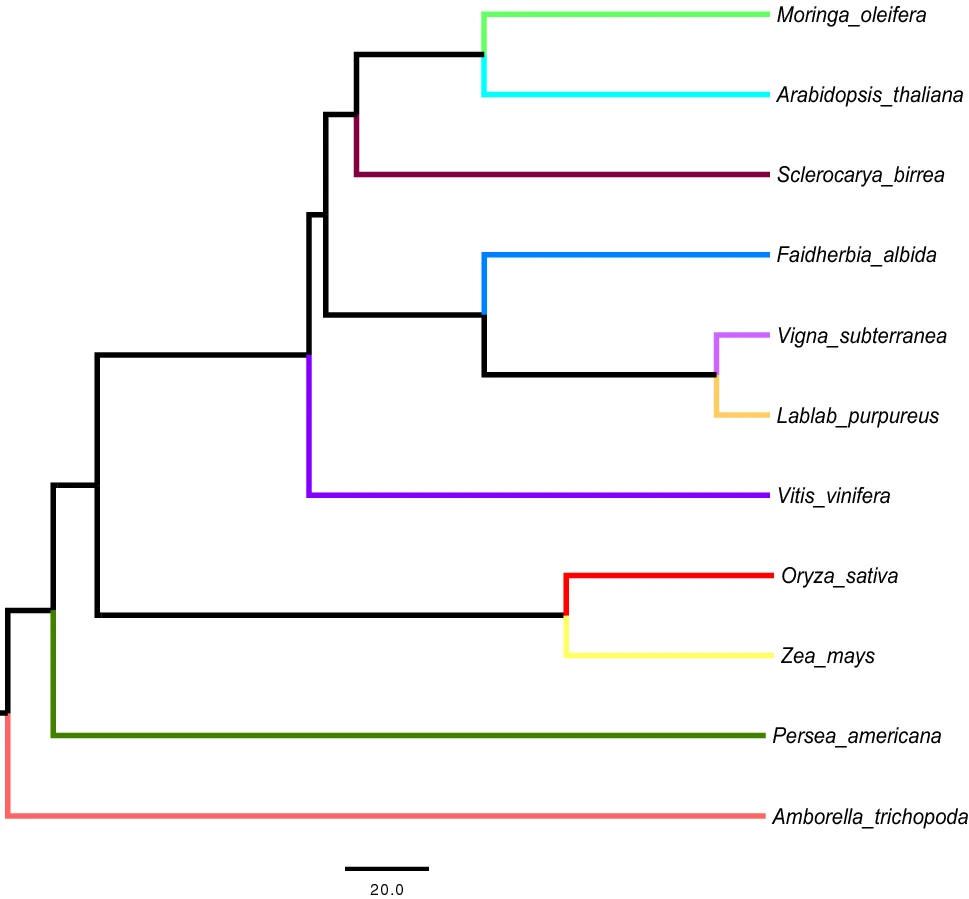
The figure on the right models the phylogenetic history of M. oleifera and 10 related angiosperm species. Multiple hypotheses have attempted to narrow down whether the magnoliids involved form “a sister clade either to eudicots or monocots” or if they formed a sister clade to the collective “supergroup formed by all eudicot and monocot plants”, but this figure prefers the latter hypothesis (Ojeda-Lopez et al., 2020).Taken in unison with the figure below, the evolutionary history of M. oleifera plots an increase of plastid to nucleus gene duplications – involving chloroplast functioning and increased energy production – with a recent burst in these energy-associated genes paralleling the Anthropocene and emergence of artificial selection. Via its evolutionary history, then, one may correlate the evolution of M. oleifera’s energy production on a genetic basis with the progression of agriculture and utilization of this superfood for its nutrient and medicinal potential (Olson, 2009).
Genetics and Genesis
M. oleifera grows best in semiarid, tropical, and subtropical areas and in neutral to lightly acidic sandy soil. Since seeds are collected for oil extraction, the M. oleifera is often grown by directly through cuttings. This species can grow anytime of year with sufficient water and M. oleifera can be grown by direct seeding and cuttings. If water is available for irrigation, the M. oleifera tree can be harvested 6 to 8 months after initial planting. However the fruits are not produced in the first year, and the yield is generally low during the first few years. By year two, it produces around 300 pods and by year three around 400–500. An older tree can yield 1000 or more pods (Azad et al., 2015).The wild ancestors of the domesticated M. oleifera are quite rare and only appear in Punjab and surrounding areas where the locals still cultivate them for their medical usage and are not consumed. In contrast to wild ancestors, the domesticated M. oleifera have shown to have increased levels of glucomoringin and reduction of glucosamine which has resulted in a change in taste. “Wild” M. oleifera has a bitter taste and is accepted as inedible (Chodur et al., 2018).
Marvelous Morphology
Below, we may observe the vegetative and reproductive attributes of Moringa oleifera.M. oleifera leaves are alternate, 7-60 cm long, tripinnately compound with each pinnate bearing 4-6 pairs of leaflets that are dark green, elliptical to obovate, and 1-2 cm in length (Britannica, 2018). Flowering of the M. oleifera is dichogamous and favors cross-pollination, but around 25% of plants self-pollinate. Cross-pollination occurs through bees and other insects attracted by the flowers (Krieg et al., 2017).
Divining the Domestication
As early as 2000 years BC, M. oleifera has been described as a medicinal herb in India.In the annals of Ayurvedic Medicine, one of the oldest healthcare systems in the world, M. oleifera has been mentioned as a cure for over 300 diseases.
Vélez-Gavilán reports that M. oleifera spread from India – likely the Tamil Nadu region – further throughout Southeast India and historical accounts further map its expansion pathways of throughout the Middle East, Mexico, and Island nations globally throughout the late 1800s and early 1900s.
Older records first note upon M. oleifera’s introduction to Africa and the Philippines via trade – regions where M. oleifera’s high nutritional value quickly became central to its domestication future. M. oleifera later made its way to the Americas from the Philippines due to Spanish colonization on the Manila-Acapulco galleon trade and thus the modern species of M. oleifera found in Mexico is likely a variant of the Philippine domesticated M. oleifera and not the native Indian variant (Chodur et al., 2018). Such variations may be integral to examining the motives and lasting effects of domestication – Indian native uses revolved around medicinal properties when compared to the nutritional value the crop held in the Philippines (Vélez-Gavilán, 2020).
The spread of M. oleifera to Africa may be further complicated by its later reintroduction by the British Empire utilizing the colonized Indian variant. Thus, differently domesticated M. oleifera arrived at multiple times in history – the British intent to its introduction is reported as “ornamental” in comparison to North African reliance on the nutritious value potential of the plant (Vélez-Gavilán, 2020).
The plant is ubiquitous in many tropical regions and is also present in the Caribbean, Mexico, Australia, and Central America – each region reporting diverging plant behaviors (i.e. Australian M. oleifera seem to form unique dense thickets around parent plants) as it is integrated for different agricultural purposes and into varying environments with varying invasive potential (Vélez-Gavilán, 2020).
Comparing Cultivations
Cultivation of M. oleifera within its native origin about Tamil Nadu and other Southern states seems to center about its medicinal properties. A perennial plant, it is able to be cultivated year round with a high yield in most of the Indian South – rich in tropical land.Though its pod is an integral vegetable to South Indian cuisine, M. oleifera may be most known for its implementation in Siddha medicine. Its pods in unison with its flowers and leaves are packed with nutrition – from vitamins to carbohydrates to essential proteins to fats and dietary fibers. M. oleifera’s high Vitamin C content has been ascribed to great usage in tending to wounds and irritable bowel disease (Pandiyan et al., 2020).
M. oleifera is also grown in the Caribbean, the Pacific Islands, Latin America, and across Africa, including Ethiopia and Sudan, where M. oleifera seeds are used for their water purification properties. Because of its nutritive value, its perennial nature, and its ability to withstand severe drought, M. oleifera trees have also been used to combat malnutrition. Bon Appetit’s Venugopal also dialogues their own experience with the plant as Tamilian, its nostalgic mysticism, and the awkward progressive corruption American trends have brought unto the origin and sanctity of the plant (Venugopal, 2018).
Venugopal delineates the utilization of the entire plant – the pod, flowers, and leaves for food and the roots and bark in medicine:
“The leaves cook down into a slightly bitter spinach-like stir fry. Its delicate white flowers come apart when simmered in sambar, a south Indian lentil stew, or steamed with basmati rice to make a fragrant pilaf.
The ribbed drumsticks, typically cut into finger-length pieces, are best eaten in sambars as well, or sautéed in a simple semi-dry curry, with onions, curry leaves, chopped tomatoes, and an assortment of whole and powdered spices. A signature dish of the southern state Kerala is avial, a traditionally thick coconut-based dish that prominently features drumsticks. Once cooked, the inedible exterior of the pod can be easily split to reveal a fleshy interior with pea-sized seeds. Scrape the pulp out and toss the rough skin. It’s slightly sweet, somewhat earthy, but subtle enough to melt into whatever it’s cooked with.”
Venugopal critiques the colonization of the name of the plant itself – from murungai, the plant they grew up with, to M. oleifera, the plant powder all the West is obsessed with for its vitamins, skincare potential, and energy boosts. In the U.S, M. oleifera is only sold in this powdered form – absent of its material, fleshy origins and deprived of its cultural origins – for prices around $15 in comparison to Indian sales around 15 cents.
Noteworthy Nutrition
M. oleifera is quite a very giving resource, as every part of the plant is consumed. The plant notably contains 15-20% protein and 50% nitrogen-free extract and is rich in micronutrients and vitamins making it a nutritious superfood (Vélez-Gavilán, 2020). Leaves are commonly used in salads or soups, for example in Africa the flavor of the leaves are used to flavor dishes and are added to meat preparations. As mentioned prior, dried leaves are often ground and can be used as tea or a health supplement. Besides the leaves, the pods are the most coveted part of the plant due to their versatility in consumption and usage. When green, the pods are picked and boiled similar to green beans to be used in dishes such as sambhar, south Indian curry. When the pods are dry, ben oil can be extracted from the seeds and used in a variety of ways such as cooking, as a lubricant, or burned in oil lamps. Seeds are also ground into a powder which is used mixed with water in order to purify and reduce the acidity of turbid water. Other parts of M. oleifera like the flowers and roots are also consumed, being made into drinks or ground to be used as a seasoning similar to horseradish (Vélez-Gavilán, 2020).The plant is often fed and consumed by livestock in order to increase milk yield and assist in nitrogen fixation in soil when used as manure. In addition to feed for animals, M. oleifera leaves are used in agricultural practices to enhance growth of peanuts, soybeans, sugarcane, and coffee (Vélez-Gavilán, 2020).
Harmony and Humanity
The future for the Human Experience is endless: the versatility of M. oleifera is immense and thus its global ramifications are multifaceted.Infrastructure
M. oleifera was introduced to rural communities in South Africa – notably Botswana – in the early 2000s to address malnutrition, alleviate hunger, treat renal failure and IBD, and replace other unprofitable crops (Mashamaite, 2021). M. oleifera seeds have also become used in water purification, a property immensely valuable to regions in mitigating contamination and associated viral outbreaks. Counteracting these obstacles allows fundamental progress to nations in building their infrastructure and consolidating resources, protecting traditions and culture, and elevating the overall standard of living.Economic Impact
M. oleifera is one of the host plants of Leveillula taurica, which causes major damage to papaya (Carica papaya) – a plant native to Mesoamerica. Caution is needed when the species occurs near papaya plantations, a crop growing in popularity in India -- a portentous sign of competition and inevitable agricultural dissonance (Vélez-Gavilán, 2020). Furthermore, M. oleifera may pose potential threat to other native species globally as it may take hold in unprepared tropical niches in Australia and cause devastating economic and ecological damage.Environmental Impact
In Australia, research is delving into the utilization of M. oleifera seeds as biodiesel fuel – a potential catalyst for commercial transition to renewable and plant-based energy. The seeds do not produce smoke or aerosols and thus have a markedly lower carbon footprint in comparison to fossil fuels (Azad et. al, 2015). In this figure, the M. oleifera seed oil itself is used as the paint for the tapestry. M. oleifera is also supposedly toxic to pests at high doses and further studies may investigate this implementation in pest control, according to Vélez-Gavilán.Collectively, the potential of M. oleifera is endless in its applications within agriculture, the food pyramid, medicine and public health, the colonization of South Asian medicine, and pest control. The deviations in domestication and selection pressures may therein contribute to an eventual speciation of these variants according to their geographic location and associated cultural purpose.
References
Azad, A. K., Rasul, M. G., Khan, M. M. K., Sharma, S. C., & Islam, R. (2015). Prospect of moringa seed oil as a sustainable biodiesel fuel in Australia: A Review. Procedia Engineering, 105, 601–606. https://doi.org/10.1016/j.proeng.2015.05.037Britannica, T. Editors of Encyclopaedia (2018, July 27). moringa. Encyclopedia Britannica. https://www.britannica.com/plant/horseradish-tree
Chodur, G. M., Olson, M. E., Wade, K. L., Stephenson, K. K., Nouman, W., Garima, & Fahey, J. W. (2018). Wild and domesticated moringa oleifera differ in taste, glucosinolate composition, and antioxidant potential, but not myrosinase activity or protein content. Scientific Reports, 8(1). https://doi.org/10.1038/s41598-018-26059-3
Germplasm Resources Information Network (GRIN). Agricultural Research Service (ARS), United States Department of Agriculture. Taxon: Moringa oleifera Lam. Moringa oleifera Lam. Retrieved May 24, 2022, from https://npgsweb.ars-grin.gov/gringlobal/taxon/taxonomydetail?id=24597
Krieg, J., Goetze, D., Porembski, S., Arnold, P., Linsenmair, K. E., & Stein, K. (2017). Floral and reproductive biology of Moringa oleifera (Moringaceae) in Burkina Faso, West Africa. Acta Horticulturae, (1158), 63–70. https://doi.org/10.17660/actahortic.2017.1158.8
Mashamaite, C. V., Pieterse, P. J., Mothapo, P. N., & Phiri, E. E. (2021). Moringa oleifera in South Africa: A review on its production, growing conditions and consumption as a food source. South African Journal of Science, 117(3/4). https://doi.org/10.17159/sajs.2021/8689
Olson, M. E. (2002). Combining Data from DNA Sequences and Morphology for a Phylogeny of Moringaceae (Brassicales). Systematic Botany, 27(1), 55–73. http://www.jstor.org/stable/3093895
Ojeda-López, J., Marczuk-Rojas, J. P., Polushkina, O. A., Purucker, D., Salinas, M., & Carretero-Paulet, L. (2020). Evolutionary analysis of the Moringa oleifera genome reveals a recent burst of plastid to nucleus gene duplications. Scientific reports, 10(1), 17646. https://doi.org/10.1038/s41598-020-73937-w
Pandiyan M, Sivakumar C, Radhakrishnan V, Krishnaveni A, Paramasivam V, et al. (2020) Collection and Conservation of Local Types of Moringa (Moringa oleifera (L.) Trees for Good Sources of Traditional Vegetable. J Plant Sci Curr Res 4: 010
Vélez-Gavilán, J. (2020). Moringa oleifera (horse radish tree). Invasive Species Compendium. https://doi.org/10.1079/isc.34868.20203483184
Venugopal, N. (2018, May 14). I grew up eating this common Indian vegetable. now it's a wellness 'superfood.'. Bon Appétit. Retrieved May 26, 2022, from https://www.bonappetit.com/story/moringa-plant-wellness-superfood
This page has paths:
- 1 2022-05-12T18:41:25-07:00 Christopher Gilman 1985b99a2acd541caa12a10c3ebf6896565283ab Project Pages Christopher Gilman 8 structured_gallery 1164646 2022-05-27T07:04:03-07:00 Christopher Gilman 1985b99a2acd541caa12a10c3ebf6896565283ab
This page has tags:
- 1 media/10.2307_community.24888724-1 (1).jpg 2022-05-11T11:20:58-07:00 George Vetushko 28ffcc03954a96f0b0b9a57b40c5655eb929accc Moringa oleifera: Domestication Histories and Emerging Deviations from Indian Origin George Vetushko 82 The superfood, Moringa oleifera, has a rich history deeply rooted in its native Indian domestication and usage. Also widely known as “The Miracle Tree”, M. oleifera is often recognized by its white flowers and long-seed pods that are greatly sought after. Not only does M. oleifera provide an incomparable food source and multipurpose oil through its pods, but all parts of the plant may be used and consumed. The versatility of this plant is venerated in Indian culture where its consumption and, most importantly, medicinal usage involve all parts of the plant. Due to its spread across other countries, the species and its utilization have evolved to suit individual cultures and their own domestication desires. In the Philippines and North and South Africa, its nutritional value is greatly relied upon to treat malnourishment, purify water, and support community infrastructure while the Indian native medicinal usage is less emphasized and not well known. The Americas, on the other hand, have increasingly toyed with the novel M. oleifera ‘organic-superfood’ craze that tends to remove emphasis from its cultural value and multipurpose utilization to instead fawn over its supposed energy boosts, skin care implementations, and uses in its powder – likely less effective and increasingly more expensive than the original. Though its original purpose grows increasingly colonized, the domestication ventures globally of this superfood continue the legacy of the Moringa oleifera species itself – marked genetic increases in energy production associated with plastic to nucleus gene duplications. As each nation tends to and selects for various aspects of this energy contribution – whether for the nutritional, medicinal, or vanity value – the variation in these M. oleifera may grow towards eventual speciation. George Vetushko and Lauren Guevara #drumsticktree image_header 2022-05-26T23:50:23-07:00 George Vetushko 28ffcc03954a96f0b0b9a57b40c5655eb929accc
- 1 media/10.2307_community.24888724-1 (1).jpg 2022-05-11T11:20:58-07:00 George Vetushko 28ffcc03954a96f0b0b9a57b40c5655eb929accc Moringa oleifera: Domestication Histories and Emerging Deviations from Indian Origin George Vetushko 82 The superfood, Moringa oleifera, has a rich history deeply rooted in its native Indian domestication and usage. Also widely known as “The Miracle Tree”, M. oleifera is often recognized by its white flowers and long-seed pods that are greatly sought after. Not only does M. oleifera provide an incomparable food source and multipurpose oil through its pods, but all parts of the plant may be used and consumed. The versatility of this plant is venerated in Indian culture where its consumption and, most importantly, medicinal usage involve all parts of the plant. Due to its spread across other countries, the species and its utilization have evolved to suit individual cultures and their own domestication desires. In the Philippines and North and South Africa, its nutritional value is greatly relied upon to treat malnourishment, purify water, and support community infrastructure while the Indian native medicinal usage is less emphasized and not well known. The Americas, on the other hand, have increasingly toyed with the novel M. oleifera ‘organic-superfood’ craze that tends to remove emphasis from its cultural value and multipurpose utilization to instead fawn over its supposed energy boosts, skin care implementations, and uses in its powder – likely less effective and increasingly more expensive than the original. Though its original purpose grows increasingly colonized, the domestication ventures globally of this superfood continue the legacy of the Moringa oleifera species itself – marked genetic increases in energy production associated with plastic to nucleus gene duplications. As each nation tends to and selects for various aspects of this energy contribution – whether for the nutritional, medicinal, or vanity value – the variation in these M. oleifera may grow towards eventual speciation. George Vetushko and Lauren Guevara #drumsticktree image_header 2022-05-26T23:50:23-07:00 George Vetushko 28ffcc03954a96f0b0b9a57b40c5655eb929accc
- 1 media/10.2307_community.24888724-1 (1).jpg 2022-05-11T11:20:58-07:00 George Vetushko 28ffcc03954a96f0b0b9a57b40c5655eb929accc Moringa oleifera: Domestication Histories and Emerging Deviations from Indian Origin George Vetushko 82 The superfood, Moringa oleifera, has a rich history deeply rooted in its native Indian domestication and usage. Also widely known as “The Miracle Tree”, M. oleifera is often recognized by its white flowers and long-seed pods that are greatly sought after. Not only does M. oleifera provide an incomparable food source and multipurpose oil through its pods, but all parts of the plant may be used and consumed. The versatility of this plant is venerated in Indian culture where its consumption and, most importantly, medicinal usage involve all parts of the plant. Due to its spread across other countries, the species and its utilization have evolved to suit individual cultures and their own domestication desires. In the Philippines and North and South Africa, its nutritional value is greatly relied upon to treat malnourishment, purify water, and support community infrastructure while the Indian native medicinal usage is less emphasized and not well known. The Americas, on the other hand, have increasingly toyed with the novel M. oleifera ‘organic-superfood’ craze that tends to remove emphasis from its cultural value and multipurpose utilization to instead fawn over its supposed energy boosts, skin care implementations, and uses in its powder – likely less effective and increasingly more expensive than the original. Though its original purpose grows increasingly colonized, the domestication ventures globally of this superfood continue the legacy of the Moringa oleifera species itself – marked genetic increases in energy production associated with plastic to nucleus gene duplications. As each nation tends to and selects for various aspects of this energy contribution – whether for the nutritional, medicinal, or vanity value – the variation in these M. oleifera may grow towards eventual speciation. George Vetushko and Lauren Guevara #drumsticktree image_header 2022-05-26T23:50:23-07:00 George Vetushko 28ffcc03954a96f0b0b9a57b40c5655eb929accc
- 1 media/10.2307_community.24888724-1 (1).jpg 2022-05-11T11:20:58-07:00 George Vetushko 28ffcc03954a96f0b0b9a57b40c5655eb929accc Moringa oleifera: Domestication Histories and Emerging Deviations from Indian Origin George Vetushko 82 The superfood, Moringa oleifera, has a rich history deeply rooted in its native Indian domestication and usage. Also widely known as “The Miracle Tree”, M. oleifera is often recognized by its white flowers and long-seed pods that are greatly sought after. Not only does M. oleifera provide an incomparable food source and multipurpose oil through its pods, but all parts of the plant may be used and consumed. The versatility of this plant is venerated in Indian culture where its consumption and, most importantly, medicinal usage involve all parts of the plant. Due to its spread across other countries, the species and its utilization have evolved to suit individual cultures and their own domestication desires. In the Philippines and North and South Africa, its nutritional value is greatly relied upon to treat malnourishment, purify water, and support community infrastructure while the Indian native medicinal usage is less emphasized and not well known. The Americas, on the other hand, have increasingly toyed with the novel M. oleifera ‘organic-superfood’ craze that tends to remove emphasis from its cultural value and multipurpose utilization to instead fawn over its supposed energy boosts, skin care implementations, and uses in its powder – likely less effective and increasingly more expensive than the original. Though its original purpose grows increasingly colonized, the domestication ventures globally of this superfood continue the legacy of the Moringa oleifera species itself – marked genetic increases in energy production associated with plastic to nucleus gene duplications. As each nation tends to and selects for various aspects of this energy contribution – whether for the nutritional, medicinal, or vanity value – the variation in these M. oleifera may grow towards eventual speciation. George Vetushko and Lauren Guevara #drumsticktree image_header 2022-05-26T23:50:23-07:00 George Vetushko 28ffcc03954a96f0b0b9a57b40c5655eb929accc
- 1 media/10.2307_community.24888724-1 (1).jpg 2022-05-11T11:20:58-07:00 George Vetushko 28ffcc03954a96f0b0b9a57b40c5655eb929accc Moringa oleifera: Domestication Histories and Emerging Deviations from Indian Origin George Vetushko 82 The superfood, Moringa oleifera, has a rich history deeply rooted in its native Indian domestication and usage. Also widely known as “The Miracle Tree”, M. oleifera is often recognized by its white flowers and long-seed pods that are greatly sought after. Not only does M. oleifera provide an incomparable food source and multipurpose oil through its pods, but all parts of the plant may be used and consumed. The versatility of this plant is venerated in Indian culture where its consumption and, most importantly, medicinal usage involve all parts of the plant. Due to its spread across other countries, the species and its utilization have evolved to suit individual cultures and their own domestication desires. In the Philippines and North and South Africa, its nutritional value is greatly relied upon to treat malnourishment, purify water, and support community infrastructure while the Indian native medicinal usage is less emphasized and not well known. The Americas, on the other hand, have increasingly toyed with the novel M. oleifera ‘organic-superfood’ craze that tends to remove emphasis from its cultural value and multipurpose utilization to instead fawn over its supposed energy boosts, skin care implementations, and uses in its powder – likely less effective and increasingly more expensive than the original. Though its original purpose grows increasingly colonized, the domestication ventures globally of this superfood continue the legacy of the Moringa oleifera species itself – marked genetic increases in energy production associated with plastic to nucleus gene duplications. As each nation tends to and selects for various aspects of this energy contribution – whether for the nutritional, medicinal, or vanity value – the variation in these M. oleifera may grow towards eventual speciation. George Vetushko and Lauren Guevara #drumsticktree image_header 2022-05-26T23:50:23-07:00 George Vetushko 28ffcc03954a96f0b0b9a57b40c5655eb929accc
- 1 media/10.2307_community.24888724-1 (1).jpg 2022-05-11T11:20:58-07:00 George Vetushko 28ffcc03954a96f0b0b9a57b40c5655eb929accc Moringa oleifera: Domestication Histories and Emerging Deviations from Indian Origin George Vetushko 82 The superfood, Moringa oleifera, has a rich history deeply rooted in its native Indian domestication and usage. Also widely known as “The Miracle Tree”, M. oleifera is often recognized by its white flowers and long-seed pods that are greatly sought after. Not only does M. oleifera provide an incomparable food source and multipurpose oil through its pods, but all parts of the plant may be used and consumed. The versatility of this plant is venerated in Indian culture where its consumption and, most importantly, medicinal usage involve all parts of the plant. Due to its spread across other countries, the species and its utilization have evolved to suit individual cultures and their own domestication desires. In the Philippines and North and South Africa, its nutritional value is greatly relied upon to treat malnourishment, purify water, and support community infrastructure while the Indian native medicinal usage is less emphasized and not well known. The Americas, on the other hand, have increasingly toyed with the novel M. oleifera ‘organic-superfood’ craze that tends to remove emphasis from its cultural value and multipurpose utilization to instead fawn over its supposed energy boosts, skin care implementations, and uses in its powder – likely less effective and increasingly more expensive than the original. Though its original purpose grows increasingly colonized, the domestication ventures globally of this superfood continue the legacy of the Moringa oleifera species itself – marked genetic increases in energy production associated with plastic to nucleus gene duplications. As each nation tends to and selects for various aspects of this energy contribution – whether for the nutritional, medicinal, or vanity value – the variation in these M. oleifera may grow towards eventual speciation. George Vetushko and Lauren Guevara #drumsticktree image_header 2022-05-26T23:50:23-07:00 George Vetushko 28ffcc03954a96f0b0b9a57b40c5655eb929accc
- 1 media/10.2307_community.24888724-1 (1).jpg 2022-05-11T11:20:58-07:00 George Vetushko 28ffcc03954a96f0b0b9a57b40c5655eb929accc Moringa oleifera: Domestication Histories and Emerging Deviations from Indian Origin George Vetushko 82 The superfood, Moringa oleifera, has a rich history deeply rooted in its native Indian domestication and usage. Also widely known as “The Miracle Tree”, M. oleifera is often recognized by its white flowers and long-seed pods that are greatly sought after. Not only does M. oleifera provide an incomparable food source and multipurpose oil through its pods, but all parts of the plant may be used and consumed. The versatility of this plant is venerated in Indian culture where its consumption and, most importantly, medicinal usage involve all parts of the plant. Due to its spread across other countries, the species and its utilization have evolved to suit individual cultures and their own domestication desires. In the Philippines and North and South Africa, its nutritional value is greatly relied upon to treat malnourishment, purify water, and support community infrastructure while the Indian native medicinal usage is less emphasized and not well known. The Americas, on the other hand, have increasingly toyed with the novel M. oleifera ‘organic-superfood’ craze that tends to remove emphasis from its cultural value and multipurpose utilization to instead fawn over its supposed energy boosts, skin care implementations, and uses in its powder – likely less effective and increasingly more expensive than the original. Though its original purpose grows increasingly colonized, the domestication ventures globally of this superfood continue the legacy of the Moringa oleifera species itself – marked genetic increases in energy production associated with plastic to nucleus gene duplications. As each nation tends to and selects for various aspects of this energy contribution – whether for the nutritional, medicinal, or vanity value – the variation in these M. oleifera may grow towards eventual speciation. George Vetushko and Lauren Guevara #drumsticktree image_header 2022-05-26T23:50:23-07:00 George Vetushko 28ffcc03954a96f0b0b9a57b40c5655eb929accc
- 1 media/10.2307_community.24888724-1 (1).jpg 2022-05-11T11:20:58-07:00 George Vetushko 28ffcc03954a96f0b0b9a57b40c5655eb929accc Moringa oleifera: Domestication Histories and Emerging Deviations from Indian Origin George Vetushko 82 The superfood, Moringa oleifera, has a rich history deeply rooted in its native Indian domestication and usage. Also widely known as “The Miracle Tree”, M. oleifera is often recognized by its white flowers and long-seed pods that are greatly sought after. Not only does M. oleifera provide an incomparable food source and multipurpose oil through its pods, but all parts of the plant may be used and consumed. The versatility of this plant is venerated in Indian culture where its consumption and, most importantly, medicinal usage involve all parts of the plant. Due to its spread across other countries, the species and its utilization have evolved to suit individual cultures and their own domestication desires. In the Philippines and North and South Africa, its nutritional value is greatly relied upon to treat malnourishment, purify water, and support community infrastructure while the Indian native medicinal usage is less emphasized and not well known. The Americas, on the other hand, have increasingly toyed with the novel M. oleifera ‘organic-superfood’ craze that tends to remove emphasis from its cultural value and multipurpose utilization to instead fawn over its supposed energy boosts, skin care implementations, and uses in its powder – likely less effective and increasingly more expensive than the original. Though its original purpose grows increasingly colonized, the domestication ventures globally of this superfood continue the legacy of the Moringa oleifera species itself – marked genetic increases in energy production associated with plastic to nucleus gene duplications. As each nation tends to and selects for various aspects of this energy contribution – whether for the nutritional, medicinal, or vanity value – the variation in these M. oleifera may grow towards eventual speciation. George Vetushko and Lauren Guevara #drumsticktree image_header 2022-05-26T23:50:23-07:00 George Vetushko 28ffcc03954a96f0b0b9a57b40c5655eb929accc
- 1 media/10.2307_community.24888724-1 (1).jpg 2022-05-11T11:20:58-07:00 George Vetushko 28ffcc03954a96f0b0b9a57b40c5655eb929accc Moringa oleifera: Domestication Histories and Emerging Deviations from Indian Origin George Vetushko 82 The superfood, Moringa oleifera, has a rich history deeply rooted in its native Indian domestication and usage. Also widely known as “The Miracle Tree”, M. oleifera is often recognized by its white flowers and long-seed pods that are greatly sought after. Not only does M. oleifera provide an incomparable food source and multipurpose oil through its pods, but all parts of the plant may be used and consumed. The versatility of this plant is venerated in Indian culture where its consumption and, most importantly, medicinal usage involve all parts of the plant. Due to its spread across other countries, the species and its utilization have evolved to suit individual cultures and their own domestication desires. In the Philippines and North and South Africa, its nutritional value is greatly relied upon to treat malnourishment, purify water, and support community infrastructure while the Indian native medicinal usage is less emphasized and not well known. The Americas, on the other hand, have increasingly toyed with the novel M. oleifera ‘organic-superfood’ craze that tends to remove emphasis from its cultural value and multipurpose utilization to instead fawn over its supposed energy boosts, skin care implementations, and uses in its powder – likely less effective and increasingly more expensive than the original. Though its original purpose grows increasingly colonized, the domestication ventures globally of this superfood continue the legacy of the Moringa oleifera species itself – marked genetic increases in energy production associated with plastic to nucleus gene duplications. As each nation tends to and selects for various aspects of this energy contribution – whether for the nutritional, medicinal, or vanity value – the variation in these M. oleifera may grow towards eventual speciation. George Vetushko and Lauren Guevara #drumsticktree image_header 2022-05-26T23:50:23-07:00 George Vetushko 28ffcc03954a96f0b0b9a57b40c5655eb929accc
- 1 media/10.2307_community.24888724-1 (1).jpg 2022-05-11T11:20:58-07:00 George Vetushko 28ffcc03954a96f0b0b9a57b40c5655eb929accc Moringa oleifera: Domestication Histories and Emerging Deviations from Indian Origin George Vetushko 82 The superfood, Moringa oleifera, has a rich history deeply rooted in its native Indian domestication and usage. Also widely known as “The Miracle Tree”, M. oleifera is often recognized by its white flowers and long-seed pods that are greatly sought after. Not only does M. oleifera provide an incomparable food source and multipurpose oil through its pods, but all parts of the plant may be used and consumed. The versatility of this plant is venerated in Indian culture where its consumption and, most importantly, medicinal usage involve all parts of the plant. Due to its spread across other countries, the species and its utilization have evolved to suit individual cultures and their own domestication desires. In the Philippines and North and South Africa, its nutritional value is greatly relied upon to treat malnourishment, purify water, and support community infrastructure while the Indian native medicinal usage is less emphasized and not well known. The Americas, on the other hand, have increasingly toyed with the novel M. oleifera ‘organic-superfood’ craze that tends to remove emphasis from its cultural value and multipurpose utilization to instead fawn over its supposed energy boosts, skin care implementations, and uses in its powder – likely less effective and increasingly more expensive than the original. Though its original purpose grows increasingly colonized, the domestication ventures globally of this superfood continue the legacy of the Moringa oleifera species itself – marked genetic increases in energy production associated with plastic to nucleus gene duplications. As each nation tends to and selects for various aspects of this energy contribution – whether for the nutritional, medicinal, or vanity value – the variation in these M. oleifera may grow towards eventual speciation. George Vetushko and Lauren Guevara #drumsticktree image_header 2022-05-26T23:50:23-07:00 George Vetushko 28ffcc03954a96f0b0b9a57b40c5655eb929accc
- 1 media/10.2307_community.24888724-1 (1).jpg 2022-05-11T11:20:58-07:00 George Vetushko 28ffcc03954a96f0b0b9a57b40c5655eb929accc Moringa oleifera: Domestication Histories and Emerging Deviations from Indian Origin George Vetushko 82 The superfood, Moringa oleifera, has a rich history deeply rooted in its native Indian domestication and usage. Also widely known as “The Miracle Tree”, M. oleifera is often recognized by its white flowers and long-seed pods that are greatly sought after. Not only does M. oleifera provide an incomparable food source and multipurpose oil through its pods, but all parts of the plant may be used and consumed. The versatility of this plant is venerated in Indian culture where its consumption and, most importantly, medicinal usage involve all parts of the plant. Due to its spread across other countries, the species and its utilization have evolved to suit individual cultures and their own domestication desires. In the Philippines and North and South Africa, its nutritional value is greatly relied upon to treat malnourishment, purify water, and support community infrastructure while the Indian native medicinal usage is less emphasized and not well known. The Americas, on the other hand, have increasingly toyed with the novel M. oleifera ‘organic-superfood’ craze that tends to remove emphasis from its cultural value and multipurpose utilization to instead fawn over its supposed energy boosts, skin care implementations, and uses in its powder – likely less effective and increasingly more expensive than the original. Though its original purpose grows increasingly colonized, the domestication ventures globally of this superfood continue the legacy of the Moringa oleifera species itself – marked genetic increases in energy production associated with plastic to nucleus gene duplications. As each nation tends to and selects for various aspects of this energy contribution – whether for the nutritional, medicinal, or vanity value – the variation in these M. oleifera may grow towards eventual speciation. George Vetushko and Lauren Guevara #drumsticktree image_header 2022-05-26T23:50:23-07:00 George Vetushko 28ffcc03954a96f0b0b9a57b40c5655eb929accc
- 1 media/10.2307_community.24888724-1 (1).jpg 2022-05-11T11:20:58-07:00 George Vetushko 28ffcc03954a96f0b0b9a57b40c5655eb929accc Moringa oleifera: Domestication Histories and Emerging Deviations from Indian Origin George Vetushko 82 The superfood, Moringa oleifera, has a rich history deeply rooted in its native Indian domestication and usage. Also widely known as “The Miracle Tree”, M. oleifera is often recognized by its white flowers and long-seed pods that are greatly sought after. Not only does M. oleifera provide an incomparable food source and multipurpose oil through its pods, but all parts of the plant may be used and consumed. The versatility of this plant is venerated in Indian culture where its consumption and, most importantly, medicinal usage involve all parts of the plant. Due to its spread across other countries, the species and its utilization have evolved to suit individual cultures and their own domestication desires. In the Philippines and North and South Africa, its nutritional value is greatly relied upon to treat malnourishment, purify water, and support community infrastructure while the Indian native medicinal usage is less emphasized and not well known. The Americas, on the other hand, have increasingly toyed with the novel M. oleifera ‘organic-superfood’ craze that tends to remove emphasis from its cultural value and multipurpose utilization to instead fawn over its supposed energy boosts, skin care implementations, and uses in its powder – likely less effective and increasingly more expensive than the original. Though its original purpose grows increasingly colonized, the domestication ventures globally of this superfood continue the legacy of the Moringa oleifera species itself – marked genetic increases in energy production associated with plastic to nucleus gene duplications. As each nation tends to and selects for various aspects of this energy contribution – whether for the nutritional, medicinal, or vanity value – the variation in these M. oleifera may grow towards eventual speciation. George Vetushko and Lauren Guevara #drumsticktree image_header 2022-05-26T23:50:23-07:00 George Vetushko 28ffcc03954a96f0b0b9a57b40c5655eb929accc
- 1 media/10.2307_community.24888724-1 (1).jpg 2022-05-11T11:20:58-07:00 George Vetushko 28ffcc03954a96f0b0b9a57b40c5655eb929accc Moringa oleifera: Domestication Histories and Emerging Deviations from Indian Origin George Vetushko 82 The superfood, Moringa oleifera, has a rich history deeply rooted in its native Indian domestication and usage. Also widely known as “The Miracle Tree”, M. oleifera is often recognized by its white flowers and long-seed pods that are greatly sought after. Not only does M. oleifera provide an incomparable food source and multipurpose oil through its pods, but all parts of the plant may be used and consumed. The versatility of this plant is venerated in Indian culture where its consumption and, most importantly, medicinal usage involve all parts of the plant. Due to its spread across other countries, the species and its utilization have evolved to suit individual cultures and their own domestication desires. In the Philippines and North and South Africa, its nutritional value is greatly relied upon to treat malnourishment, purify water, and support community infrastructure while the Indian native medicinal usage is less emphasized and not well known. The Americas, on the other hand, have increasingly toyed with the novel M. oleifera ‘organic-superfood’ craze that tends to remove emphasis from its cultural value and multipurpose utilization to instead fawn over its supposed energy boosts, skin care implementations, and uses in its powder – likely less effective and increasingly more expensive than the original. Though its original purpose grows increasingly colonized, the domestication ventures globally of this superfood continue the legacy of the Moringa oleifera species itself – marked genetic increases in energy production associated with plastic to nucleus gene duplications. As each nation tends to and selects for various aspects of this energy contribution – whether for the nutritional, medicinal, or vanity value – the variation in these M. oleifera may grow towards eventual speciation. George Vetushko and Lauren Guevara #drumsticktree image_header 2022-05-26T23:50:23-07:00 George Vetushko 28ffcc03954a96f0b0b9a57b40c5655eb929accc
- 1 media/10.2307_community.24888724-1 (1).jpg 2022-05-11T11:20:58-07:00 George Vetushko 28ffcc03954a96f0b0b9a57b40c5655eb929accc Moringa oleifera: Domestication Histories and Emerging Deviations from Indian Origin George Vetushko 82 The superfood, Moringa oleifera, has a rich history deeply rooted in its native Indian domestication and usage. Also widely known as “The Miracle Tree”, M. oleifera is often recognized by its white flowers and long-seed pods that are greatly sought after. Not only does M. oleifera provide an incomparable food source and multipurpose oil through its pods, but all parts of the plant may be used and consumed. The versatility of this plant is venerated in Indian culture where its consumption and, most importantly, medicinal usage involve all parts of the plant. Due to its spread across other countries, the species and its utilization have evolved to suit individual cultures and their own domestication desires. In the Philippines and North and South Africa, its nutritional value is greatly relied upon to treat malnourishment, purify water, and support community infrastructure while the Indian native medicinal usage is less emphasized and not well known. The Americas, on the other hand, have increasingly toyed with the novel M. oleifera ‘organic-superfood’ craze that tends to remove emphasis from its cultural value and multipurpose utilization to instead fawn over its supposed energy boosts, skin care implementations, and uses in its powder – likely less effective and increasingly more expensive than the original. Though its original purpose grows increasingly colonized, the domestication ventures globally of this superfood continue the legacy of the Moringa oleifera species itself – marked genetic increases in energy production associated with plastic to nucleus gene duplications. As each nation tends to and selects for various aspects of this energy contribution – whether for the nutritional, medicinal, or vanity value – the variation in these M. oleifera may grow towards eventual speciation. George Vetushko and Lauren Guevara #drumsticktree image_header 2022-05-26T23:50:23-07:00 George Vetushko 28ffcc03954a96f0b0b9a57b40c5655eb929accc
- 1 media/10.2307_community.24888724-1 (1).jpg 2022-05-11T11:20:58-07:00 George Vetushko 28ffcc03954a96f0b0b9a57b40c5655eb929accc Moringa oleifera: Domestication Histories and Emerging Deviations from Indian Origin George Vetushko 82 The superfood, Moringa oleifera, has a rich history deeply rooted in its native Indian domestication and usage. Also widely known as “The Miracle Tree”, M. oleifera is often recognized by its white flowers and long-seed pods that are greatly sought after. Not only does M. oleifera provide an incomparable food source and multipurpose oil through its pods, but all parts of the plant may be used and consumed. The versatility of this plant is venerated in Indian culture where its consumption and, most importantly, medicinal usage involve all parts of the plant. Due to its spread across other countries, the species and its utilization have evolved to suit individual cultures and their own domestication desires. In the Philippines and North and South Africa, its nutritional value is greatly relied upon to treat malnourishment, purify water, and support community infrastructure while the Indian native medicinal usage is less emphasized and not well known. The Americas, on the other hand, have increasingly toyed with the novel M. oleifera ‘organic-superfood’ craze that tends to remove emphasis from its cultural value and multipurpose utilization to instead fawn over its supposed energy boosts, skin care implementations, and uses in its powder – likely less effective and increasingly more expensive than the original. Though its original purpose grows increasingly colonized, the domestication ventures globally of this superfood continue the legacy of the Moringa oleifera species itself – marked genetic increases in energy production associated with plastic to nucleus gene duplications. As each nation tends to and selects for various aspects of this energy contribution – whether for the nutritional, medicinal, or vanity value – the variation in these M. oleifera may grow towards eventual speciation. George Vetushko and Lauren Guevara #drumsticktree image_header 2022-05-26T23:50:23-07:00 George Vetushko 28ffcc03954a96f0b0b9a57b40c5655eb929accc
- 1 media/10.2307_community.24888724-1 (1).jpg 2022-05-11T11:20:58-07:00 George Vetushko 28ffcc03954a96f0b0b9a57b40c5655eb929accc Moringa oleifera: Domestication Histories and Emerging Deviations from Indian Origin George Vetushko 82 The superfood, Moringa oleifera, has a rich history deeply rooted in its native Indian domestication and usage. Also widely known as “The Miracle Tree”, M. oleifera is often recognized by its white flowers and long-seed pods that are greatly sought after. Not only does M. oleifera provide an incomparable food source and multipurpose oil through its pods, but all parts of the plant may be used and consumed. The versatility of this plant is venerated in Indian culture where its consumption and, most importantly, medicinal usage involve all parts of the plant. Due to its spread across other countries, the species and its utilization have evolved to suit individual cultures and their own domestication desires. In the Philippines and North and South Africa, its nutritional value is greatly relied upon to treat malnourishment, purify water, and support community infrastructure while the Indian native medicinal usage is less emphasized and not well known. The Americas, on the other hand, have increasingly toyed with the novel M. oleifera ‘organic-superfood’ craze that tends to remove emphasis from its cultural value and multipurpose utilization to instead fawn over its supposed energy boosts, skin care implementations, and uses in its powder – likely less effective and increasingly more expensive than the original. Though its original purpose grows increasingly colonized, the domestication ventures globally of this superfood continue the legacy of the Moringa oleifera species itself – marked genetic increases in energy production associated with plastic to nucleus gene duplications. As each nation tends to and selects for various aspects of this energy contribution – whether for the nutritional, medicinal, or vanity value – the variation in these M. oleifera may grow towards eventual speciation. George Vetushko and Lauren Guevara #drumsticktree image_header 2022-05-26T23:50:23-07:00 George Vetushko 28ffcc03954a96f0b0b9a57b40c5655eb929accc
- 1 media/10.2307_community.24888724-1 (1).jpg 2022-05-11T11:20:58-07:00 George Vetushko 28ffcc03954a96f0b0b9a57b40c5655eb929accc Moringa oleifera: Domestication Histories and Emerging Deviations from Indian Origin George Vetushko 82 The superfood, Moringa oleifera, has a rich history deeply rooted in its native Indian domestication and usage. Also widely known as “The Miracle Tree”, M. oleifera is often recognized by its white flowers and long-seed pods that are greatly sought after. Not only does M. oleifera provide an incomparable food source and multipurpose oil through its pods, but all parts of the plant may be used and consumed. The versatility of this plant is venerated in Indian culture where its consumption and, most importantly, medicinal usage involve all parts of the plant. Due to its spread across other countries, the species and its utilization have evolved to suit individual cultures and their own domestication desires. In the Philippines and North and South Africa, its nutritional value is greatly relied upon to treat malnourishment, purify water, and support community infrastructure while the Indian native medicinal usage is less emphasized and not well known. The Americas, on the other hand, have increasingly toyed with the novel M. oleifera ‘organic-superfood’ craze that tends to remove emphasis from its cultural value and multipurpose utilization to instead fawn over its supposed energy boosts, skin care implementations, and uses in its powder – likely less effective and increasingly more expensive than the original. Though its original purpose grows increasingly colonized, the domestication ventures globally of this superfood continue the legacy of the Moringa oleifera species itself – marked genetic increases in energy production associated with plastic to nucleus gene duplications. As each nation tends to and selects for various aspects of this energy contribution – whether for the nutritional, medicinal, or vanity value – the variation in these M. oleifera may grow towards eventual speciation. George Vetushko and Lauren Guevara #drumsticktree image_header 2022-05-26T23:50:23-07:00 George Vetushko 28ffcc03954a96f0b0b9a57b40c5655eb929accc
- 1 media/10.2307_community.24888724-1 (1).jpg 2022-05-11T11:20:58-07:00 George Vetushko 28ffcc03954a96f0b0b9a57b40c5655eb929accc Moringa oleifera: Domestication Histories and Emerging Deviations from Indian Origin George Vetushko 82 The superfood, Moringa oleifera, has a rich history deeply rooted in its native Indian domestication and usage. Also widely known as “The Miracle Tree”, M. oleifera is often recognized by its white flowers and long-seed pods that are greatly sought after. Not only does M. oleifera provide an incomparable food source and multipurpose oil through its pods, but all parts of the plant may be used and consumed. The versatility of this plant is venerated in Indian culture where its consumption and, most importantly, medicinal usage involve all parts of the plant. Due to its spread across other countries, the species and its utilization have evolved to suit individual cultures and their own domestication desires. In the Philippines and North and South Africa, its nutritional value is greatly relied upon to treat malnourishment, purify water, and support community infrastructure while the Indian native medicinal usage is less emphasized and not well known. The Americas, on the other hand, have increasingly toyed with the novel M. oleifera ‘organic-superfood’ craze that tends to remove emphasis from its cultural value and multipurpose utilization to instead fawn over its supposed energy boosts, skin care implementations, and uses in its powder – likely less effective and increasingly more expensive than the original. Though its original purpose grows increasingly colonized, the domestication ventures globally of this superfood continue the legacy of the Moringa oleifera species itself – marked genetic increases in energy production associated with plastic to nucleus gene duplications. As each nation tends to and selects for various aspects of this energy contribution – whether for the nutritional, medicinal, or vanity value – the variation in these M. oleifera may grow towards eventual speciation. George Vetushko and Lauren Guevara #drumsticktree image_header 2022-05-26T23:50:23-07:00 George Vetushko 28ffcc03954a96f0b0b9a57b40c5655eb929accc
- 1 media/10.2307_community.24888724-1 (1).jpg 2022-05-11T11:20:58-07:00 George Vetushko 28ffcc03954a96f0b0b9a57b40c5655eb929accc Moringa oleifera: Domestication Histories and Emerging Deviations from Indian Origin George Vetushko 82 The superfood, Moringa oleifera, has a rich history deeply rooted in its native Indian domestication and usage. Also widely known as “The Miracle Tree”, M. oleifera is often recognized by its white flowers and long-seed pods that are greatly sought after. Not only does M. oleifera provide an incomparable food source and multipurpose oil through its pods, but all parts of the plant may be used and consumed. The versatility of this plant is venerated in Indian culture where its consumption and, most importantly, medicinal usage involve all parts of the plant. Due to its spread across other countries, the species and its utilization have evolved to suit individual cultures and their own domestication desires. In the Philippines and North and South Africa, its nutritional value is greatly relied upon to treat malnourishment, purify water, and support community infrastructure while the Indian native medicinal usage is less emphasized and not well known. The Americas, on the other hand, have increasingly toyed with the novel M. oleifera ‘organic-superfood’ craze that tends to remove emphasis from its cultural value and multipurpose utilization to instead fawn over its supposed energy boosts, skin care implementations, and uses in its powder – likely less effective and increasingly more expensive than the original. Though its original purpose grows increasingly colonized, the domestication ventures globally of this superfood continue the legacy of the Moringa oleifera species itself – marked genetic increases in energy production associated with plastic to nucleus gene duplications. As each nation tends to and selects for various aspects of this energy contribution – whether for the nutritional, medicinal, or vanity value – the variation in these M. oleifera may grow towards eventual speciation. George Vetushko and Lauren Guevara #drumsticktree image_header 2022-05-26T23:50:23-07:00 George Vetushko 28ffcc03954a96f0b0b9a57b40c5655eb929accc
- 1 media/10.2307_community.24888724-1 (1).jpg 2022-05-11T11:20:58-07:00 George Vetushko 28ffcc03954a96f0b0b9a57b40c5655eb929accc Moringa oleifera: Domestication Histories and Emerging Deviations from Indian Origin George Vetushko 82 The superfood, Moringa oleifera, has a rich history deeply rooted in its native Indian domestication and usage. Also widely known as “The Miracle Tree”, M. oleifera is often recognized by its white flowers and long-seed pods that are greatly sought after. Not only does M. oleifera provide an incomparable food source and multipurpose oil through its pods, but all parts of the plant may be used and consumed. The versatility of this plant is venerated in Indian culture where its consumption and, most importantly, medicinal usage involve all parts of the plant. Due to its spread across other countries, the species and its utilization have evolved to suit individual cultures and their own domestication desires. In the Philippines and North and South Africa, its nutritional value is greatly relied upon to treat malnourishment, purify water, and support community infrastructure while the Indian native medicinal usage is less emphasized and not well known. The Americas, on the other hand, have increasingly toyed with the novel M. oleifera ‘organic-superfood’ craze that tends to remove emphasis from its cultural value and multipurpose utilization to instead fawn over its supposed energy boosts, skin care implementations, and uses in its powder – likely less effective and increasingly more expensive than the original. Though its original purpose grows increasingly colonized, the domestication ventures globally of this superfood continue the legacy of the Moringa oleifera species itself – marked genetic increases in energy production associated with plastic to nucleus gene duplications. As each nation tends to and selects for various aspects of this energy contribution – whether for the nutritional, medicinal, or vanity value – the variation in these M. oleifera may grow towards eventual speciation. George Vetushko and Lauren Guevara #drumsticktree image_header 2022-05-26T23:50:23-07:00 George Vetushko 28ffcc03954a96f0b0b9a57b40c5655eb929accc
- 1 media/10.2307_community.24888724-1 (1).jpg 2022-05-11T11:20:58-07:00 George Vetushko 28ffcc03954a96f0b0b9a57b40c5655eb929accc Moringa oleifera: Domestication Histories and Emerging Deviations from Indian Origin George Vetushko 82 The superfood, Moringa oleifera, has a rich history deeply rooted in its native Indian domestication and usage. Also widely known as “The Miracle Tree”, M. oleifera is often recognized by its white flowers and long-seed pods that are greatly sought after. Not only does M. oleifera provide an incomparable food source and multipurpose oil through its pods, but all parts of the plant may be used and consumed. The versatility of this plant is venerated in Indian culture where its consumption and, most importantly, medicinal usage involve all parts of the plant. Due to its spread across other countries, the species and its utilization have evolved to suit individual cultures and their own domestication desires. In the Philippines and North and South Africa, its nutritional value is greatly relied upon to treat malnourishment, purify water, and support community infrastructure while the Indian native medicinal usage is less emphasized and not well known. The Americas, on the other hand, have increasingly toyed with the novel M. oleifera ‘organic-superfood’ craze that tends to remove emphasis from its cultural value and multipurpose utilization to instead fawn over its supposed energy boosts, skin care implementations, and uses in its powder – likely less effective and increasingly more expensive than the original. Though its original purpose grows increasingly colonized, the domestication ventures globally of this superfood continue the legacy of the Moringa oleifera species itself – marked genetic increases in energy production associated with plastic to nucleus gene duplications. As each nation tends to and selects for various aspects of this energy contribution – whether for the nutritional, medicinal, or vanity value – the variation in these M. oleifera may grow towards eventual speciation. George Vetushko and Lauren Guevara #drumsticktree image_header 2022-05-26T23:50:23-07:00 George Vetushko 28ffcc03954a96f0b0b9a57b40c5655eb929accc
- 1 media/10.2307_community.24888724-1 (1).jpg 2022-05-11T11:20:58-07:00 George Vetushko 28ffcc03954a96f0b0b9a57b40c5655eb929accc Moringa oleifera: Domestication Histories and Emerging Deviations from Indian Origin George Vetushko 82 The superfood, Moringa oleifera, has a rich history deeply rooted in its native Indian domestication and usage. Also widely known as “The Miracle Tree”, M. oleifera is often recognized by its white flowers and long-seed pods that are greatly sought after. Not only does M. oleifera provide an incomparable food source and multipurpose oil through its pods, but all parts of the plant may be used and consumed. The versatility of this plant is venerated in Indian culture where its consumption and, most importantly, medicinal usage involve all parts of the plant. Due to its spread across other countries, the species and its utilization have evolved to suit individual cultures and their own domestication desires. In the Philippines and North and South Africa, its nutritional value is greatly relied upon to treat malnourishment, purify water, and support community infrastructure while the Indian native medicinal usage is less emphasized and not well known. The Americas, on the other hand, have increasingly toyed with the novel M. oleifera ‘organic-superfood’ craze that tends to remove emphasis from its cultural value and multipurpose utilization to instead fawn over its supposed energy boosts, skin care implementations, and uses in its powder – likely less effective and increasingly more expensive than the original. Though its original purpose grows increasingly colonized, the domestication ventures globally of this superfood continue the legacy of the Moringa oleifera species itself – marked genetic increases in energy production associated with plastic to nucleus gene duplications. As each nation tends to and selects for various aspects of this energy contribution – whether for the nutritional, medicinal, or vanity value – the variation in these M. oleifera may grow towards eventual speciation. George Vetushko and Lauren Guevara #drumsticktree image_header 2022-05-26T23:50:23-07:00 George Vetushko 28ffcc03954a96f0b0b9a57b40c5655eb929accc
- 1 media/10.2307_community.24888724-1 (1).jpg 2022-05-11T11:20:58-07:00 George Vetushko 28ffcc03954a96f0b0b9a57b40c5655eb929accc Moringa oleifera: Domestication Histories and Emerging Deviations from Indian Origin George Vetushko 82 The superfood, Moringa oleifera, has a rich history deeply rooted in its native Indian domestication and usage. Also widely known as “The Miracle Tree”, M. oleifera is often recognized by its white flowers and long-seed pods that are greatly sought after. Not only does M. oleifera provide an incomparable food source and multipurpose oil through its pods, but all parts of the plant may be used and consumed. The versatility of this plant is venerated in Indian culture where its consumption and, most importantly, medicinal usage involve all parts of the plant. Due to its spread across other countries, the species and its utilization have evolved to suit individual cultures and their own domestication desires. In the Philippines and North and South Africa, its nutritional value is greatly relied upon to treat malnourishment, purify water, and support community infrastructure while the Indian native medicinal usage is less emphasized and not well known. The Americas, on the other hand, have increasingly toyed with the novel M. oleifera ‘organic-superfood’ craze that tends to remove emphasis from its cultural value and multipurpose utilization to instead fawn over its supposed energy boosts, skin care implementations, and uses in its powder – likely less effective and increasingly more expensive than the original. Though its original purpose grows increasingly colonized, the domestication ventures globally of this superfood continue the legacy of the Moringa oleifera species itself – marked genetic increases in energy production associated with plastic to nucleus gene duplications. As each nation tends to and selects for various aspects of this energy contribution – whether for the nutritional, medicinal, or vanity value – the variation in these M. oleifera may grow towards eventual speciation. George Vetushko and Lauren Guevara #drumsticktree image_header 2022-05-26T23:50:23-07:00 George Vetushko 28ffcc03954a96f0b0b9a57b40c5655eb929accc
- 1 media/10.2307_community.24888724-1 (1).jpg 2022-05-11T11:20:58-07:00 George Vetushko 28ffcc03954a96f0b0b9a57b40c5655eb929accc Moringa oleifera: Domestication Histories and Emerging Deviations from Indian Origin George Vetushko 82 The superfood, Moringa oleifera, has a rich history deeply rooted in its native Indian domestication and usage. Also widely known as “The Miracle Tree”, M. oleifera is often recognized by its white flowers and long-seed pods that are greatly sought after. Not only does M. oleifera provide an incomparable food source and multipurpose oil through its pods, but all parts of the plant may be used and consumed. The versatility of this plant is venerated in Indian culture where its consumption and, most importantly, medicinal usage involve all parts of the plant. Due to its spread across other countries, the species and its utilization have evolved to suit individual cultures and their own domestication desires. In the Philippines and North and South Africa, its nutritional value is greatly relied upon to treat malnourishment, purify water, and support community infrastructure while the Indian native medicinal usage is less emphasized and not well known. The Americas, on the other hand, have increasingly toyed with the novel M. oleifera ‘organic-superfood’ craze that tends to remove emphasis from its cultural value and multipurpose utilization to instead fawn over its supposed energy boosts, skin care implementations, and uses in its powder – likely less effective and increasingly more expensive than the original. Though its original purpose grows increasingly colonized, the domestication ventures globally of this superfood continue the legacy of the Moringa oleifera species itself – marked genetic increases in energy production associated with plastic to nucleus gene duplications. As each nation tends to and selects for various aspects of this energy contribution – whether for the nutritional, medicinal, or vanity value – the variation in these M. oleifera may grow towards eventual speciation. George Vetushko and Lauren Guevara #drumsticktree image_header 2022-05-26T23:50:23-07:00 George Vetushko 28ffcc03954a96f0b0b9a57b40c5655eb929accc
- 1 media/10.2307_community.24888724-1 (1).jpg 2022-05-11T11:20:58-07:00 George Vetushko 28ffcc03954a96f0b0b9a57b40c5655eb929accc Moringa oleifera: Domestication Histories and Emerging Deviations from Indian Origin George Vetushko 82 The superfood, Moringa oleifera, has a rich history deeply rooted in its native Indian domestication and usage. Also widely known as “The Miracle Tree”, M. oleifera is often recognized by its white flowers and long-seed pods that are greatly sought after. Not only does M. oleifera provide an incomparable food source and multipurpose oil through its pods, but all parts of the plant may be used and consumed. The versatility of this plant is venerated in Indian culture where its consumption and, most importantly, medicinal usage involve all parts of the plant. Due to its spread across other countries, the species and its utilization have evolved to suit individual cultures and their own domestication desires. In the Philippines and North and South Africa, its nutritional value is greatly relied upon to treat malnourishment, purify water, and support community infrastructure while the Indian native medicinal usage is less emphasized and not well known. The Americas, on the other hand, have increasingly toyed with the novel M. oleifera ‘organic-superfood’ craze that tends to remove emphasis from its cultural value and multipurpose utilization to instead fawn over its supposed energy boosts, skin care implementations, and uses in its powder – likely less effective and increasingly more expensive than the original. Though its original purpose grows increasingly colonized, the domestication ventures globally of this superfood continue the legacy of the Moringa oleifera species itself – marked genetic increases in energy production associated with plastic to nucleus gene duplications. As each nation tends to and selects for various aspects of this energy contribution – whether for the nutritional, medicinal, or vanity value – the variation in these M. oleifera may grow towards eventual speciation. George Vetushko and Lauren Guevara #drumsticktree image_header 2022-05-26T23:50:23-07:00 George Vetushko 28ffcc03954a96f0b0b9a57b40c5655eb929accc
- 1 media/10.2307_community.24888724-1 (1).jpg 2022-05-11T11:20:58-07:00 George Vetushko 28ffcc03954a96f0b0b9a57b40c5655eb929accc Moringa oleifera: Domestication Histories and Emerging Deviations from Indian Origin George Vetushko 82 The superfood, Moringa oleifera, has a rich history deeply rooted in its native Indian domestication and usage. Also widely known as “The Miracle Tree”, M. oleifera is often recognized by its white flowers and long-seed pods that are greatly sought after. Not only does M. oleifera provide an incomparable food source and multipurpose oil through its pods, but all parts of the plant may be used and consumed. The versatility of this plant is venerated in Indian culture where its consumption and, most importantly, medicinal usage involve all parts of the plant. Due to its spread across other countries, the species and its utilization have evolved to suit individual cultures and their own domestication desires. In the Philippines and North and South Africa, its nutritional value is greatly relied upon to treat malnourishment, purify water, and support community infrastructure while the Indian native medicinal usage is less emphasized and not well known. The Americas, on the other hand, have increasingly toyed with the novel M. oleifera ‘organic-superfood’ craze that tends to remove emphasis from its cultural value and multipurpose utilization to instead fawn over its supposed energy boosts, skin care implementations, and uses in its powder – likely less effective and increasingly more expensive than the original. Though its original purpose grows increasingly colonized, the domestication ventures globally of this superfood continue the legacy of the Moringa oleifera species itself – marked genetic increases in energy production associated with plastic to nucleus gene duplications. As each nation tends to and selects for various aspects of this energy contribution – whether for the nutritional, medicinal, or vanity value – the variation in these M. oleifera may grow towards eventual speciation. George Vetushko and Lauren Guevara #drumsticktree image_header 2022-05-26T23:50:23-07:00 George Vetushko 28ffcc03954a96f0b0b9a57b40c5655eb929accc
- 1 media/10.2307_community.24888724-1 (1).jpg 2022-05-11T11:20:58-07:00 George Vetushko 28ffcc03954a96f0b0b9a57b40c5655eb929accc Moringa oleifera: Domestication Histories and Emerging Deviations from Indian Origin George Vetushko 82 The superfood, Moringa oleifera, has a rich history deeply rooted in its native Indian domestication and usage. Also widely known as “The Miracle Tree”, M. oleifera is often recognized by its white flowers and long-seed pods that are greatly sought after. Not only does M. oleifera provide an incomparable food source and multipurpose oil through its pods, but all parts of the plant may be used and consumed. The versatility of this plant is venerated in Indian culture where its consumption and, most importantly, medicinal usage involve all parts of the plant. Due to its spread across other countries, the species and its utilization have evolved to suit individual cultures and their own domestication desires. In the Philippines and North and South Africa, its nutritional value is greatly relied upon to treat malnourishment, purify water, and support community infrastructure while the Indian native medicinal usage is less emphasized and not well known. The Americas, on the other hand, have increasingly toyed with the novel M. oleifera ‘organic-superfood’ craze that tends to remove emphasis from its cultural value and multipurpose utilization to instead fawn over its supposed energy boosts, skin care implementations, and uses in its powder – likely less effective and increasingly more expensive than the original. Though its original purpose grows increasingly colonized, the domestication ventures globally of this superfood continue the legacy of the Moringa oleifera species itself – marked genetic increases in energy production associated with plastic to nucleus gene duplications. As each nation tends to and selects for various aspects of this energy contribution – whether for the nutritional, medicinal, or vanity value – the variation in these M. oleifera may grow towards eventual speciation. George Vetushko and Lauren Guevara #drumsticktree image_header 2022-05-26T23:50:23-07:00 George Vetushko 28ffcc03954a96f0b0b9a57b40c5655eb929accc
- 1 media/10.2307_community.24888724-1 (1).jpg 2022-05-11T11:20:58-07:00 George Vetushko 28ffcc03954a96f0b0b9a57b40c5655eb929accc Moringa oleifera: Domestication Histories and Emerging Deviations from Indian Origin George Vetushko 82 The superfood, Moringa oleifera, has a rich history deeply rooted in its native Indian domestication and usage. Also widely known as “The Miracle Tree”, M. oleifera is often recognized by its white flowers and long-seed pods that are greatly sought after. Not only does M. oleifera provide an incomparable food source and multipurpose oil through its pods, but all parts of the plant may be used and consumed. The versatility of this plant is venerated in Indian culture where its consumption and, most importantly, medicinal usage involve all parts of the plant. Due to its spread across other countries, the species and its utilization have evolved to suit individual cultures and their own domestication desires. In the Philippines and North and South Africa, its nutritional value is greatly relied upon to treat malnourishment, purify water, and support community infrastructure while the Indian native medicinal usage is less emphasized and not well known. The Americas, on the other hand, have increasingly toyed with the novel M. oleifera ‘organic-superfood’ craze that tends to remove emphasis from its cultural value and multipurpose utilization to instead fawn over its supposed energy boosts, skin care implementations, and uses in its powder – likely less effective and increasingly more expensive than the original. Though its original purpose grows increasingly colonized, the domestication ventures globally of this superfood continue the legacy of the Moringa oleifera species itself – marked genetic increases in energy production associated with plastic to nucleus gene duplications. As each nation tends to and selects for various aspects of this energy contribution – whether for the nutritional, medicinal, or vanity value – the variation in these M. oleifera may grow towards eventual speciation. George Vetushko and Lauren Guevara #drumsticktree image_header 2022-05-26T23:50:23-07:00 George Vetushko 28ffcc03954a96f0b0b9a57b40c5655eb929accc
- 1 media/10.2307_community.24888724-1 (1).jpg 2022-05-11T11:20:58-07:00 George Vetushko 28ffcc03954a96f0b0b9a57b40c5655eb929accc Moringa oleifera: Domestication Histories and Emerging Deviations from Indian Origin George Vetushko 82 The superfood, Moringa oleifera, has a rich history deeply rooted in its native Indian domestication and usage. Also widely known as “The Miracle Tree”, M. oleifera is often recognized by its white flowers and long-seed pods that are greatly sought after. Not only does M. oleifera provide an incomparable food source and multipurpose oil through its pods, but all parts of the plant may be used and consumed. The versatility of this plant is venerated in Indian culture where its consumption and, most importantly, medicinal usage involve all parts of the plant. Due to its spread across other countries, the species and its utilization have evolved to suit individual cultures and their own domestication desires. In the Philippines and North and South Africa, its nutritional value is greatly relied upon to treat malnourishment, purify water, and support community infrastructure while the Indian native medicinal usage is less emphasized and not well known. The Americas, on the other hand, have increasingly toyed with the novel M. oleifera ‘organic-superfood’ craze that tends to remove emphasis from its cultural value and multipurpose utilization to instead fawn over its supposed energy boosts, skin care implementations, and uses in its powder – likely less effective and increasingly more expensive than the original. Though its original purpose grows increasingly colonized, the domestication ventures globally of this superfood continue the legacy of the Moringa oleifera species itself – marked genetic increases in energy production associated with plastic to nucleus gene duplications. As each nation tends to and selects for various aspects of this energy contribution – whether for the nutritional, medicinal, or vanity value – the variation in these M. oleifera may grow towards eventual speciation. George Vetushko and Lauren Guevara #drumsticktree image_header 2022-05-26T23:50:23-07:00 George Vetushko 28ffcc03954a96f0b0b9a57b40c5655eb929accc
- 1 media/10.2307_community.24888724-1 (1).jpg 2022-05-11T11:20:58-07:00 George Vetushko 28ffcc03954a96f0b0b9a57b40c5655eb929accc Moringa oleifera: Domestication Histories and Emerging Deviations from Indian Origin George Vetushko 82 The superfood, Moringa oleifera, has a rich history deeply rooted in its native Indian domestication and usage. Also widely known as “The Miracle Tree”, M. oleifera is often recognized by its white flowers and long-seed pods that are greatly sought after. Not only does M. oleifera provide an incomparable food source and multipurpose oil through its pods, but all parts of the plant may be used and consumed. The versatility of this plant is venerated in Indian culture where its consumption and, most importantly, medicinal usage involve all parts of the plant. Due to its spread across other countries, the species and its utilization have evolved to suit individual cultures and their own domestication desires. In the Philippines and North and South Africa, its nutritional value is greatly relied upon to treat malnourishment, purify water, and support community infrastructure while the Indian native medicinal usage is less emphasized and not well known. The Americas, on the other hand, have increasingly toyed with the novel M. oleifera ‘organic-superfood’ craze that tends to remove emphasis from its cultural value and multipurpose utilization to instead fawn over its supposed energy boosts, skin care implementations, and uses in its powder – likely less effective and increasingly more expensive than the original. Though its original purpose grows increasingly colonized, the domestication ventures globally of this superfood continue the legacy of the Moringa oleifera species itself – marked genetic increases in energy production associated with plastic to nucleus gene duplications. As each nation tends to and selects for various aspects of this energy contribution – whether for the nutritional, medicinal, or vanity value – the variation in these M. oleifera may grow towards eventual speciation. George Vetushko and Lauren Guevara #drumsticktree image_header 2022-05-26T23:50:23-07:00 George Vetushko 28ffcc03954a96f0b0b9a57b40c5655eb929accc
- 1 media/10.2307_community.24888724-1 (1).jpg 2022-05-11T11:20:58-07:00 George Vetushko 28ffcc03954a96f0b0b9a57b40c5655eb929accc Moringa oleifera: Domestication Histories and Emerging Deviations from Indian Origin George Vetushko 82 The superfood, Moringa oleifera, has a rich history deeply rooted in its native Indian domestication and usage. Also widely known as “The Miracle Tree”, M. oleifera is often recognized by its white flowers and long-seed pods that are greatly sought after. Not only does M. oleifera provide an incomparable food source and multipurpose oil through its pods, but all parts of the plant may be used and consumed. The versatility of this plant is venerated in Indian culture where its consumption and, most importantly, medicinal usage involve all parts of the plant. Due to its spread across other countries, the species and its utilization have evolved to suit individual cultures and their own domestication desires. In the Philippines and North and South Africa, its nutritional value is greatly relied upon to treat malnourishment, purify water, and support community infrastructure while the Indian native medicinal usage is less emphasized and not well known. The Americas, on the other hand, have increasingly toyed with the novel M. oleifera ‘organic-superfood’ craze that tends to remove emphasis from its cultural value and multipurpose utilization to instead fawn over its supposed energy boosts, skin care implementations, and uses in its powder – likely less effective and increasingly more expensive than the original. Though its original purpose grows increasingly colonized, the domestication ventures globally of this superfood continue the legacy of the Moringa oleifera species itself – marked genetic increases in energy production associated with plastic to nucleus gene duplications. As each nation tends to and selects for various aspects of this energy contribution – whether for the nutritional, medicinal, or vanity value – the variation in these M. oleifera may grow towards eventual speciation. George Vetushko and Lauren Guevara #drumsticktree image_header 2022-05-26T23:50:23-07:00 George Vetushko 28ffcc03954a96f0b0b9a57b40c5655eb929accc
- 1 media/10.2307_community.24888724-1 (1).jpg 2022-05-11T11:20:58-07:00 George Vetushko 28ffcc03954a96f0b0b9a57b40c5655eb929accc Moringa oleifera: Domestication Histories and Emerging Deviations from Indian Origin George Vetushko 82 The superfood, Moringa oleifera, has a rich history deeply rooted in its native Indian domestication and usage. Also widely known as “The Miracle Tree”, M. oleifera is often recognized by its white flowers and long-seed pods that are greatly sought after. Not only does M. oleifera provide an incomparable food source and multipurpose oil through its pods, but all parts of the plant may be used and consumed. The versatility of this plant is venerated in Indian culture where its consumption and, most importantly, medicinal usage involve all parts of the plant. Due to its spread across other countries, the species and its utilization have evolved to suit individual cultures and their own domestication desires. In the Philippines and North and South Africa, its nutritional value is greatly relied upon to treat malnourishment, purify water, and support community infrastructure while the Indian native medicinal usage is less emphasized and not well known. The Americas, on the other hand, have increasingly toyed with the novel M. oleifera ‘organic-superfood’ craze that tends to remove emphasis from its cultural value and multipurpose utilization to instead fawn over its supposed energy boosts, skin care implementations, and uses in its powder – likely less effective and increasingly more expensive than the original. Though its original purpose grows increasingly colonized, the domestication ventures globally of this superfood continue the legacy of the Moringa oleifera species itself – marked genetic increases in energy production associated with plastic to nucleus gene duplications. As each nation tends to and selects for various aspects of this energy contribution – whether for the nutritional, medicinal, or vanity value – the variation in these M. oleifera may grow towards eventual speciation. George Vetushko and Lauren Guevara #drumsticktree image_header 2022-05-26T23:50:23-07:00 George Vetushko 28ffcc03954a96f0b0b9a57b40c5655eb929accc
- 1 media/10.2307_community.24888724-1 (1).jpg 2022-05-11T11:20:58-07:00 George Vetushko 28ffcc03954a96f0b0b9a57b40c5655eb929accc Moringa oleifera: Domestication Histories and Emerging Deviations from Indian Origin George Vetushko 82 The superfood, Moringa oleifera, has a rich history deeply rooted in its native Indian domestication and usage. Also widely known as “The Miracle Tree”, M. oleifera is often recognized by its white flowers and long-seed pods that are greatly sought after. Not only does M. oleifera provide an incomparable food source and multipurpose oil through its pods, but all parts of the plant may be used and consumed. The versatility of this plant is venerated in Indian culture where its consumption and, most importantly, medicinal usage involve all parts of the plant. Due to its spread across other countries, the species and its utilization have evolved to suit individual cultures and their own domestication desires. In the Philippines and North and South Africa, its nutritional value is greatly relied upon to treat malnourishment, purify water, and support community infrastructure while the Indian native medicinal usage is less emphasized and not well known. The Americas, on the other hand, have increasingly toyed with the novel M. oleifera ‘organic-superfood’ craze that tends to remove emphasis from its cultural value and multipurpose utilization to instead fawn over its supposed energy boosts, skin care implementations, and uses in its powder – likely less effective and increasingly more expensive than the original. Though its original purpose grows increasingly colonized, the domestication ventures globally of this superfood continue the legacy of the Moringa oleifera species itself – marked genetic increases in energy production associated with plastic to nucleus gene duplications. As each nation tends to and selects for various aspects of this energy contribution – whether for the nutritional, medicinal, or vanity value – the variation in these M. oleifera may grow towards eventual speciation. George Vetushko and Lauren Guevara #drumsticktree image_header 2022-05-26T23:50:23-07:00 George Vetushko 28ffcc03954a96f0b0b9a57b40c5655eb929accc
- 1 media/10.2307_community.24888724-1 (1).jpg 2022-05-11T11:20:58-07:00 George Vetushko 28ffcc03954a96f0b0b9a57b40c5655eb929accc Moringa oleifera: Domestication Histories and Emerging Deviations from Indian Origin George Vetushko 82 The superfood, Moringa oleifera, has a rich history deeply rooted in its native Indian domestication and usage. Also widely known as “The Miracle Tree”, M. oleifera is often recognized by its white flowers and long-seed pods that are greatly sought after. Not only does M. oleifera provide an incomparable food source and multipurpose oil through its pods, but all parts of the plant may be used and consumed. The versatility of this plant is venerated in Indian culture where its consumption and, most importantly, medicinal usage involve all parts of the plant. Due to its spread across other countries, the species and its utilization have evolved to suit individual cultures and their own domestication desires. In the Philippines and North and South Africa, its nutritional value is greatly relied upon to treat malnourishment, purify water, and support community infrastructure while the Indian native medicinal usage is less emphasized and not well known. The Americas, on the other hand, have increasingly toyed with the novel M. oleifera ‘organic-superfood’ craze that tends to remove emphasis from its cultural value and multipurpose utilization to instead fawn over its supposed energy boosts, skin care implementations, and uses in its powder – likely less effective and increasingly more expensive than the original. Though its original purpose grows increasingly colonized, the domestication ventures globally of this superfood continue the legacy of the Moringa oleifera species itself – marked genetic increases in energy production associated with plastic to nucleus gene duplications. As each nation tends to and selects for various aspects of this energy contribution – whether for the nutritional, medicinal, or vanity value – the variation in these M. oleifera may grow towards eventual speciation. George Vetushko and Lauren Guevara #drumsticktree image_header 2022-05-26T23:50:23-07:00 George Vetushko 28ffcc03954a96f0b0b9a57b40c5655eb929accc
- 1 media/10.2307_community.24888724-1 (1).jpg 2022-05-11T11:20:58-07:00 George Vetushko 28ffcc03954a96f0b0b9a57b40c5655eb929accc Moringa oleifera: Domestication Histories and Emerging Deviations from Indian Origin George Vetushko 82 The superfood, Moringa oleifera, has a rich history deeply rooted in its native Indian domestication and usage. Also widely known as “The Miracle Tree”, M. oleifera is often recognized by its white flowers and long-seed pods that are greatly sought after. Not only does M. oleifera provide an incomparable food source and multipurpose oil through its pods, but all parts of the plant may be used and consumed. The versatility of this plant is venerated in Indian culture where its consumption and, most importantly, medicinal usage involve all parts of the plant. Due to its spread across other countries, the species and its utilization have evolved to suit individual cultures and their own domestication desires. In the Philippines and North and South Africa, its nutritional value is greatly relied upon to treat malnourishment, purify water, and support community infrastructure while the Indian native medicinal usage is less emphasized and not well known. The Americas, on the other hand, have increasingly toyed with the novel M. oleifera ‘organic-superfood’ craze that tends to remove emphasis from its cultural value and multipurpose utilization to instead fawn over its supposed energy boosts, skin care implementations, and uses in its powder – likely less effective and increasingly more expensive than the original. Though its original purpose grows increasingly colonized, the domestication ventures globally of this superfood continue the legacy of the Moringa oleifera species itself – marked genetic increases in energy production associated with plastic to nucleus gene duplications. As each nation tends to and selects for various aspects of this energy contribution – whether for the nutritional, medicinal, or vanity value – the variation in these M. oleifera may grow towards eventual speciation. George Vetushko and Lauren Guevara #drumsticktree image_header 2022-05-26T23:50:23-07:00 George Vetushko 28ffcc03954a96f0b0b9a57b40c5655eb929accc
- 1 media/10.2307_community.24888724-1 (1).jpg 2022-05-11T11:20:58-07:00 George Vetushko 28ffcc03954a96f0b0b9a57b40c5655eb929accc Moringa oleifera: Domestication Histories and Emerging Deviations from Indian Origin George Vetushko 82 The superfood, Moringa oleifera, has a rich history deeply rooted in its native Indian domestication and usage. Also widely known as “The Miracle Tree”, M. oleifera is often recognized by its white flowers and long-seed pods that are greatly sought after. Not only does M. oleifera provide an incomparable food source and multipurpose oil through its pods, but all parts of the plant may be used and consumed. The versatility of this plant is venerated in Indian culture where its consumption and, most importantly, medicinal usage involve all parts of the plant. Due to its spread across other countries, the species and its utilization have evolved to suit individual cultures and their own domestication desires. In the Philippines and North and South Africa, its nutritional value is greatly relied upon to treat malnourishment, purify water, and support community infrastructure while the Indian native medicinal usage is less emphasized and not well known. The Americas, on the other hand, have increasingly toyed with the novel M. oleifera ‘organic-superfood’ craze that tends to remove emphasis from its cultural value and multipurpose utilization to instead fawn over its supposed energy boosts, skin care implementations, and uses in its powder – likely less effective and increasingly more expensive than the original. Though its original purpose grows increasingly colonized, the domestication ventures globally of this superfood continue the legacy of the Moringa oleifera species itself – marked genetic increases in energy production associated with plastic to nucleus gene duplications. As each nation tends to and selects for various aspects of this energy contribution – whether for the nutritional, medicinal, or vanity value – the variation in these M. oleifera may grow towards eventual speciation. George Vetushko and Lauren Guevara #drumsticktree image_header 2022-05-26T23:50:23-07:00 George Vetushko 28ffcc03954a96f0b0b9a57b40c5655eb929accc
- 1 media/10.2307_community.24888724-1 (1).jpg 2022-05-11T11:20:58-07:00 George Vetushko 28ffcc03954a96f0b0b9a57b40c5655eb929accc Moringa oleifera: Domestication Histories and Emerging Deviations from Indian Origin George Vetushko 82 The superfood, Moringa oleifera, has a rich history deeply rooted in its native Indian domestication and usage. Also widely known as “The Miracle Tree”, M. oleifera is often recognized by its white flowers and long-seed pods that are greatly sought after. Not only does M. oleifera provide an incomparable food source and multipurpose oil through its pods, but all parts of the plant may be used and consumed. The versatility of this plant is venerated in Indian culture where its consumption and, most importantly, medicinal usage involve all parts of the plant. Due to its spread across other countries, the species and its utilization have evolved to suit individual cultures and their own domestication desires. In the Philippines and North and South Africa, its nutritional value is greatly relied upon to treat malnourishment, purify water, and support community infrastructure while the Indian native medicinal usage is less emphasized and not well known. The Americas, on the other hand, have increasingly toyed with the novel M. oleifera ‘organic-superfood’ craze that tends to remove emphasis from its cultural value and multipurpose utilization to instead fawn over its supposed energy boosts, skin care implementations, and uses in its powder – likely less effective and increasingly more expensive than the original. Though its original purpose grows increasingly colonized, the domestication ventures globally of this superfood continue the legacy of the Moringa oleifera species itself – marked genetic increases in energy production associated with plastic to nucleus gene duplications. As each nation tends to and selects for various aspects of this energy contribution – whether for the nutritional, medicinal, or vanity value – the variation in these M. oleifera may grow towards eventual speciation. George Vetushko and Lauren Guevara #drumsticktree image_header 2022-05-26T23:50:23-07:00 George Vetushko 28ffcc03954a96f0b0b9a57b40c5655eb929accc
- 1 media/10.2307_community.24888724-1 (1).jpg 2022-05-11T11:20:58-07:00 George Vetushko 28ffcc03954a96f0b0b9a57b40c5655eb929accc Moringa oleifera: Domestication Histories and Emerging Deviations from Indian Origin George Vetushko 82 The superfood, Moringa oleifera, has a rich history deeply rooted in its native Indian domestication and usage. Also widely known as “The Miracle Tree”, M. oleifera is often recognized by its white flowers and long-seed pods that are greatly sought after. Not only does M. oleifera provide an incomparable food source and multipurpose oil through its pods, but all parts of the plant may be used and consumed. The versatility of this plant is venerated in Indian culture where its consumption and, most importantly, medicinal usage involve all parts of the plant. Due to its spread across other countries, the species and its utilization have evolved to suit individual cultures and their own domestication desires. In the Philippines and North and South Africa, its nutritional value is greatly relied upon to treat malnourishment, purify water, and support community infrastructure while the Indian native medicinal usage is less emphasized and not well known. The Americas, on the other hand, have increasingly toyed with the novel M. oleifera ‘organic-superfood’ craze that tends to remove emphasis from its cultural value and multipurpose utilization to instead fawn over its supposed energy boosts, skin care implementations, and uses in its powder – likely less effective and increasingly more expensive than the original. Though its original purpose grows increasingly colonized, the domestication ventures globally of this superfood continue the legacy of the Moringa oleifera species itself – marked genetic increases in energy production associated with plastic to nucleus gene duplications. As each nation tends to and selects for various aspects of this energy contribution – whether for the nutritional, medicinal, or vanity value – the variation in these M. oleifera may grow towards eventual speciation. George Vetushko and Lauren Guevara #drumsticktree image_header 2022-05-26T23:50:23-07:00 George Vetushko 28ffcc03954a96f0b0b9a57b40c5655eb929accc
- 1 media/10.2307_community.24888724-1 (1).jpg 2022-05-11T11:20:58-07:00 George Vetushko 28ffcc03954a96f0b0b9a57b40c5655eb929accc Moringa oleifera: Domestication Histories and Emerging Deviations from Indian Origin George Vetushko 82 The superfood, Moringa oleifera, has a rich history deeply rooted in its native Indian domestication and usage. Also widely known as “The Miracle Tree”, M. oleifera is often recognized by its white flowers and long-seed pods that are greatly sought after. Not only does M. oleifera provide an incomparable food source and multipurpose oil through its pods, but all parts of the plant may be used and consumed. The versatility of this plant is venerated in Indian culture where its consumption and, most importantly, medicinal usage involve all parts of the plant. Due to its spread across other countries, the species and its utilization have evolved to suit individual cultures and their own domestication desires. In the Philippines and North and South Africa, its nutritional value is greatly relied upon to treat malnourishment, purify water, and support community infrastructure while the Indian native medicinal usage is less emphasized and not well known. The Americas, on the other hand, have increasingly toyed with the novel M. oleifera ‘organic-superfood’ craze that tends to remove emphasis from its cultural value and multipurpose utilization to instead fawn over its supposed energy boosts, skin care implementations, and uses in its powder – likely less effective and increasingly more expensive than the original. Though its original purpose grows increasingly colonized, the domestication ventures globally of this superfood continue the legacy of the Moringa oleifera species itself – marked genetic increases in energy production associated with plastic to nucleus gene duplications. As each nation tends to and selects for various aspects of this energy contribution – whether for the nutritional, medicinal, or vanity value – the variation in these M. oleifera may grow towards eventual speciation. George Vetushko and Lauren Guevara #drumsticktree image_header 2022-05-26T23:50:23-07:00 George Vetushko 28ffcc03954a96f0b0b9a57b40c5655eb929accc
- 1 media/10.2307_community.24888724-1 (1).jpg 2022-05-11T11:20:58-07:00 George Vetushko 28ffcc03954a96f0b0b9a57b40c5655eb929accc Moringa oleifera: Domestication Histories and Emerging Deviations from Indian Origin George Vetushko 82 The superfood, Moringa oleifera, has a rich history deeply rooted in its native Indian domestication and usage. Also widely known as “The Miracle Tree”, M. oleifera is often recognized by its white flowers and long-seed pods that are greatly sought after. Not only does M. oleifera provide an incomparable food source and multipurpose oil through its pods, but all parts of the plant may be used and consumed. The versatility of this plant is venerated in Indian culture where its consumption and, most importantly, medicinal usage involve all parts of the plant. Due to its spread across other countries, the species and its utilization have evolved to suit individual cultures and their own domestication desires. In the Philippines and North and South Africa, its nutritional value is greatly relied upon to treat malnourishment, purify water, and support community infrastructure while the Indian native medicinal usage is less emphasized and not well known. The Americas, on the other hand, have increasingly toyed with the novel M. oleifera ‘organic-superfood’ craze that tends to remove emphasis from its cultural value and multipurpose utilization to instead fawn over its supposed energy boosts, skin care implementations, and uses in its powder – likely less effective and increasingly more expensive than the original. Though its original purpose grows increasingly colonized, the domestication ventures globally of this superfood continue the legacy of the Moringa oleifera species itself – marked genetic increases in energy production associated with plastic to nucleus gene duplications. As each nation tends to and selects for various aspects of this energy contribution – whether for the nutritional, medicinal, or vanity value – the variation in these M. oleifera may grow towards eventual speciation. George Vetushko and Lauren Guevara #drumsticktree image_header 2022-05-26T23:50:23-07:00 George Vetushko 28ffcc03954a96f0b0b9a57b40c5655eb929accc
- 1 media/10.2307_community.24888724-1 (1).jpg 2022-05-11T11:20:58-07:00 George Vetushko 28ffcc03954a96f0b0b9a57b40c5655eb929accc Moringa oleifera: Domestication Histories and Emerging Deviations from Indian Origin George Vetushko 82 The superfood, Moringa oleifera, has a rich history deeply rooted in its native Indian domestication and usage. Also widely known as “The Miracle Tree”, M. oleifera is often recognized by its white flowers and long-seed pods that are greatly sought after. Not only does M. oleifera provide an incomparable food source and multipurpose oil through its pods, but all parts of the plant may be used and consumed. The versatility of this plant is venerated in Indian culture where its consumption and, most importantly, medicinal usage involve all parts of the plant. Due to its spread across other countries, the species and its utilization have evolved to suit individual cultures and their own domestication desires. In the Philippines and North and South Africa, its nutritional value is greatly relied upon to treat malnourishment, purify water, and support community infrastructure while the Indian native medicinal usage is less emphasized and not well known. The Americas, on the other hand, have increasingly toyed with the novel M. oleifera ‘organic-superfood’ craze that tends to remove emphasis from its cultural value and multipurpose utilization to instead fawn over its supposed energy boosts, skin care implementations, and uses in its powder – likely less effective and increasingly more expensive than the original. Though its original purpose grows increasingly colonized, the domestication ventures globally of this superfood continue the legacy of the Moringa oleifera species itself – marked genetic increases in energy production associated with plastic to nucleus gene duplications. As each nation tends to and selects for various aspects of this energy contribution – whether for the nutritional, medicinal, or vanity value – the variation in these M. oleifera may grow towards eventual speciation. George Vetushko and Lauren Guevara #drumsticktree image_header 2022-05-26T23:50:23-07:00 George Vetushko 28ffcc03954a96f0b0b9a57b40c5655eb929accc
- 1 media/10.2307_community.24888724-1 (1).jpg 2022-05-11T11:20:58-07:00 George Vetushko 28ffcc03954a96f0b0b9a57b40c5655eb929accc Moringa oleifera: Domestication Histories and Emerging Deviations from Indian Origin George Vetushko 82 The superfood, Moringa oleifera, has a rich history deeply rooted in its native Indian domestication and usage. Also widely known as “The Miracle Tree”, M. oleifera is often recognized by its white flowers and long-seed pods that are greatly sought after. Not only does M. oleifera provide an incomparable food source and multipurpose oil through its pods, but all parts of the plant may be used and consumed. The versatility of this plant is venerated in Indian culture where its consumption and, most importantly, medicinal usage involve all parts of the plant. Due to its spread across other countries, the species and its utilization have evolved to suit individual cultures and their own domestication desires. In the Philippines and North and South Africa, its nutritional value is greatly relied upon to treat malnourishment, purify water, and support community infrastructure while the Indian native medicinal usage is less emphasized and not well known. The Americas, on the other hand, have increasingly toyed with the novel M. oleifera ‘organic-superfood’ craze that tends to remove emphasis from its cultural value and multipurpose utilization to instead fawn over its supposed energy boosts, skin care implementations, and uses in its powder – likely less effective and increasingly more expensive than the original. Though its original purpose grows increasingly colonized, the domestication ventures globally of this superfood continue the legacy of the Moringa oleifera species itself – marked genetic increases in energy production associated with plastic to nucleus gene duplications. As each nation tends to and selects for various aspects of this energy contribution – whether for the nutritional, medicinal, or vanity value – the variation in these M. oleifera may grow towards eventual speciation. George Vetushko and Lauren Guevara #drumsticktree image_header 2022-05-26T23:50:23-07:00 George Vetushko 28ffcc03954a96f0b0b9a57b40c5655eb929accc
- 1 media/10.2307_community.24888724-1 (1).jpg 2022-05-11T11:20:58-07:00 George Vetushko 28ffcc03954a96f0b0b9a57b40c5655eb929accc Moringa oleifera: Domestication Histories and Emerging Deviations from Indian Origin George Vetushko 82 The superfood, Moringa oleifera, has a rich history deeply rooted in its native Indian domestication and usage. Also widely known as “The Miracle Tree”, M. oleifera is often recognized by its white flowers and long-seed pods that are greatly sought after. Not only does M. oleifera provide an incomparable food source and multipurpose oil through its pods, but all parts of the plant may be used and consumed. The versatility of this plant is venerated in Indian culture where its consumption and, most importantly, medicinal usage involve all parts of the plant. Due to its spread across other countries, the species and its utilization have evolved to suit individual cultures and their own domestication desires. In the Philippines and North and South Africa, its nutritional value is greatly relied upon to treat malnourishment, purify water, and support community infrastructure while the Indian native medicinal usage is less emphasized and not well known. The Americas, on the other hand, have increasingly toyed with the novel M. oleifera ‘organic-superfood’ craze that tends to remove emphasis from its cultural value and multipurpose utilization to instead fawn over its supposed energy boosts, skin care implementations, and uses in its powder – likely less effective and increasingly more expensive than the original. Though its original purpose grows increasingly colonized, the domestication ventures globally of this superfood continue the legacy of the Moringa oleifera species itself – marked genetic increases in energy production associated with plastic to nucleus gene duplications. As each nation tends to and selects for various aspects of this energy contribution – whether for the nutritional, medicinal, or vanity value – the variation in these M. oleifera may grow towards eventual speciation. George Vetushko and Lauren Guevara #drumsticktree image_header 2022-05-26T23:50:23-07:00 George Vetushko 28ffcc03954a96f0b0b9a57b40c5655eb929accc
- 1 media/10.2307_community.24888724-1 (1).jpg 2022-05-11T11:20:58-07:00 George Vetushko 28ffcc03954a96f0b0b9a57b40c5655eb929accc Moringa oleifera: Domestication Histories and Emerging Deviations from Indian Origin George Vetushko 82 The superfood, Moringa oleifera, has a rich history deeply rooted in its native Indian domestication and usage. Also widely known as “The Miracle Tree”, M. oleifera is often recognized by its white flowers and long-seed pods that are greatly sought after. Not only does M. oleifera provide an incomparable food source and multipurpose oil through its pods, but all parts of the plant may be used and consumed. The versatility of this plant is venerated in Indian culture where its consumption and, most importantly, medicinal usage involve all parts of the plant. Due to its spread across other countries, the species and its utilization have evolved to suit individual cultures and their own domestication desires. In the Philippines and North and South Africa, its nutritional value is greatly relied upon to treat malnourishment, purify water, and support community infrastructure while the Indian native medicinal usage is less emphasized and not well known. The Americas, on the other hand, have increasingly toyed with the novel M. oleifera ‘organic-superfood’ craze that tends to remove emphasis from its cultural value and multipurpose utilization to instead fawn over its supposed energy boosts, skin care implementations, and uses in its powder – likely less effective and increasingly more expensive than the original. Though its original purpose grows increasingly colonized, the domestication ventures globally of this superfood continue the legacy of the Moringa oleifera species itself – marked genetic increases in energy production associated with plastic to nucleus gene duplications. As each nation tends to and selects for various aspects of this energy contribution – whether for the nutritional, medicinal, or vanity value – the variation in these M. oleifera may grow towards eventual speciation. George Vetushko and Lauren Guevara #drumsticktree image_header 2022-05-26T23:50:23-07:00 George Vetushko 28ffcc03954a96f0b0b9a57b40c5655eb929accc
Contents of this tag:
- 1 media/10.2307_community.24888724-1 (1).jpg 2022-05-11T11:20:58-07:00 George Vetushko 28ffcc03954a96f0b0b9a57b40c5655eb929accc Moringa oleifera: Domestication Histories and Emerging Deviations from Indian Origin 82 The superfood, Moringa oleifera, has a rich history deeply rooted in its native Indian domestication and usage. Also widely known as “The Miracle Tree”, M. oleifera is often recognized by its white flowers and long-seed pods that are greatly sought after. Not only does M. oleifera provide an incomparable food source and multipurpose oil through its pods, but all parts of the plant may be used and consumed. The versatility of this plant is venerated in Indian culture where its consumption and, most importantly, medicinal usage involve all parts of the plant. Due to its spread across other countries, the species and its utilization have evolved to suit individual cultures and their own domestication desires. In the Philippines and North and South Africa, its nutritional value is greatly relied upon to treat malnourishment, purify water, and support community infrastructure while the Indian native medicinal usage is less emphasized and not well known. The Americas, on the other hand, have increasingly toyed with the novel M. oleifera ‘organic-superfood’ craze that tends to remove emphasis from its cultural value and multipurpose utilization to instead fawn over its supposed energy boosts, skin care implementations, and uses in its powder – likely less effective and increasingly more expensive than the original. Though its original purpose grows increasingly colonized, the domestication ventures globally of this superfood continue the legacy of the Moringa oleifera species itself – marked genetic increases in energy production associated with plastic to nucleus gene duplications. As each nation tends to and selects for various aspects of this energy contribution – whether for the nutritional, medicinal, or vanity value – the variation in these M. oleifera may grow towards eventual speciation. George Vetushko and Lauren Guevara #drumsticktree image_header 2022-05-26T23:50:23-07:00 George Vetushko 28ffcc03954a96f0b0b9a57b40c5655eb929accc
- 1 2022-05-26T23:13:38-07:00 Lauren Guevara d3ab8c0eaac1066e5e591b0e15c4cfbc6d85e4ed Pistol of M. oleifera flower 5 plain 2022-05-26T23:27:27-07:00 Lauren Guevara d3ab8c0eaac1066e5e591b0e15c4cfbc6d85e4ed
- 1 2022-05-26T23:41:08-07:00 Lauren Guevara d3ab8c0eaac1066e5e591b0e15c4cfbc6d85e4ed M. oleifera's Evolutionary Branch 2 plain 2022-05-26T23:43:45-07:00 Lauren Guevara d3ab8c0eaac1066e5e591b0e15c4cfbc6d85e4ed
This page references:
- 1 media/Moringa oleifera.jpg 2022-05-24T12:01:04-07:00 1940 Collection of M. oleifera 5 Collected specimen. #drumsticktree media/Moringa oleifera.jpg plain 2022-05-26T22:51:49-07:00
- 1 media/moringa flowers.jpg 2022-05-25T12:24:13-07:00 Moringa oleifera Flower Morphology 4 Structure of stigma and style of Moringa oleifera. #drumsticktree media/moringa flowers.jpg plain 2022-05-26T23:03:18-07:00
- 1 media/10.2307_community.24888724-1 (1).jpg 2022-05-24T12:06:29-07:00 Horse radish tree, color line engraving 3 Ben oil from the moringa seeds were used in the artists paint. #drumsticktree media/10.2307_community.24888724-1 (1).jpg plain 2022-05-24T12:16:43-07:00
- 1 2022-05-25T12:08:48-07:00 Evolutionary Tree of Moringa oleifera 2 #drumsticktree plain 2022-05-26T23:02:04-07:00
- 1 2022-05-11T11:41:52-07:00 Renal Impairment Mitigation 2 #drumsticktree plain 2022-05-23T11:18:53-07:00
- 1 2022-05-26T22:30:39-07:00 Moringa Map Plot 1 #drumsticktree plain 2022-05-26T22:30:39-07:00