Thanks for your patience during our recent outage at scalar.usc.edu. While Scalar content is loading normally now, saving is still slow, and Scalar's 'additional metadata' features have been disabled, which may interfere with features like timelines and maps that depend on metadata. This also means that saving a page or media item will remove its additional metadata. If this occurs, you can use the 'All versions' link at the bottom of the page to restore the earlier version. We are continuing to troubleshoot, and will provide further updates as needed. Note that this only affects Scalar projects at scalar.usc.edu, and not those hosted elsewhere.
Embodying Japan: Cultures of Sport, Beauty, and Medicine 2017Main MenuEugenics: Creating a Japanese RaceA discussion of the "Japanese Race" and Japan's Eugenics MovementGenderless Beauty? Shiseido's "High School Girl?" AdvertisementA Sign of Progress in a Traditional CountryAre You Considered Beautiful In Japan?Exploring Some East-Asian Beauty Standards & Their MeaningsHope for the Future: Beauty is in the Eye of the BeholderThe Future of Beauty in Japan100 Years of Japanese BeautyExploring The Truth, Meaning and Evolution Behind The '100 Years of Japanese Beauty" videoNot Beautiful Enough To Live in Korea?Dismembering over-broad arguments and assumptions against and about Koreans - and Asians in generalQ&A Session With Dr. Kim Soo Shin: A Renowned Korean Plastic Surgeon's PerspectiveI asked Dr. Kim Soo Shin, a South Korean plastic surgeon, for his thoughts on beauty and the popularity of cosmetic surgery in South Korea and East Asian in general.The Salaryman, Hikikomori, and HostessesJapan's capitalist driven gender identities and the consquences that resultHafus: Mixed Race People in Japan (Part 1)Bodies and Hygiene in JapanSalaryman Culture and Masculine IdentityAnalysis of salaryman culture and how changes lead to development of other masculinities, mainly "herbivore" masculinityGender and Identity in Modern JapanGlobalization, nationalized pressures, and how Japanese youth are responding to a history of genderJapanese Beauty Standards in Music and FashionHow are Japanese beauty standards conveyed through alternative youth street fashions and pop music in Japan?Beauty RegimeThe main page for the Beauty in Japan GroupSex & SexualityDwayne Dixon5129acc1d78d02bed532993adeb2cc39f7be6920
Karoshi: Consequences of the Salaryman Identity
1media/sad salaryman.jpg2017-04-27T18:51:42-07:00Shannon Wu92b61b4615317d9a5a58f818c17498962842e3ea174828Does the salaryman identity dehumanize the Japanese citizen?image_header2017-04-30T20:47:07-07:00Shannon Wu92b61b4615317d9a5a58f818c17498962842e3eaIn this next page, we will see how an increase in the salaryman identity has also increased rates of karoshi. This is indicative of how salaryman are overworked, and how Japan disregards the wellbeing of the laborer in order to promote economic growth.
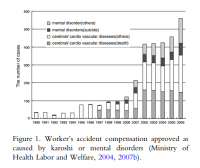
Karoshi syndromes are characterized by stroke and ischemia, and other cardiovascular attacks due to physical fatigue. It also includes mental fatigue as a factor, causing higher amounts of mental disorders. It is an ultimately fatal condition, with causes of death ranging from having a stroke to committing suicide (Demetriou 7). In 2016, over 1456 cases were reported to result from karoshi (Demetriou 2). Karoshi is still and issue today and is becoming more and more severe as Japanese work longer hours, indicating characteristics of salaryman culture that can be extremely detrimental to one’s health.
However, the government was shown to be very reluctant with attributing karoshi to poor working conditions. Karo-jujitsu, the term coined for worker suicide due to overload, was not considered a valid medical condition because suicide was stigmatized and seen as a choice made of free will without any surrounding influences (Kanai 209). In addition, the standards for diagnosing mental disorders were much more relaxed, lowering the occurrence of karoshi in statistical data even if the data is incorrect (Kanai 210).
The actions of the governmental institutions indicate Japan’s unwillingness to admit that their working standards for laborers and salarymen are harmful. Because the salaryman brings in the most capital and supports most of Japan's economic growth, it is believed that by allowing the salaryman to work less, the Japanese economy will suffer or regress (Nemeth 14). In addition, salarymen may not be so ready to complain against long work hours, as they are idolized and feel there is a certain standard they must uphold. David's path goes more into what standards are expected of the salaryman, and Shannon Brook's path explains how this nationalistic identity is not always achievable. This societal pressure of being perfect can ultimately cause salarymen harm, and to even take their own life. In the next path, we will see how the consequences of the salaryman identity cause Japanese male youth to be fearful of the future that lies before them and bring about a new identity: the hikikomori.
Works Cited Demetriou, Danielle. "'Death from overworking' claims hit record high in Japan." The Telegraph, 4 Apr. 2016. Web. 27 Apr. 2017. <http://www.telegraph.co.uk/news/2016/04/04/death-from-overworking-claims-hit-record-high-in-japan/>.
Kanai, Atsuko. "“Karoshi (Work to Death)” in Japan." Journal of Business Ethics(2009): 209-15. Web. 26 Apr. 2017.
Nemeth, Barbara. "Masculinities in Japan." (2014): n. pag. Web. 27 Apr. 2017. <http://theses.cz/id/w3ov0n/Diplomova_Praca_Barbara_Nemeth.pdf>.
This page has paths:
1media/salaryman works long hours.jpg2017-04-26T08:30:52-07:00Shannon Wu92b61b4615317d9a5a58f818c17498962842e3eaThe Salaryman, Hikikomori, and HostessesShannon Wu14Japan's capitalist driven gender identities and the consquences that resultimage_header2017-04-30T20:34:00-07:00Shannon Wu92b61b4615317d9a5a58f818c17498962842e3ea
This page has tags:
12017-04-25T08:09:12-07:00David Takamiya5b7975db77248f201648d69017cc6f40476dff7fWho is a salaryman?David Takamiya10The characteristics of a typical salarymanimage_header2017-04-29T07:00:09-07:00David Takamiya5b7975db77248f201648d69017cc6f40476dff7f
1media/index.png2017-04-24T09:04:11-07:00Shannon Brooks701a5bb1ea207b0327d3a992b9b5eb2862b0d9ecGender and Identity in Modern JapanShannon Brooks9Globalization, nationalized pressures, and how Japanese youth are responding to a history of genderplain4308192017-04-28T08:39:00-07:00Shannon Brooks701a5bb1ea207b0327d3a992b9b5eb2862b0d9ec
12017-04-24T14:54:21-07:00Shannon Brooks701a5bb1ea207b0327d3a992b9b5eb2862b0d9ecThe SalarymanShannon Brooks5Japan's most over-utilized renewable resourceplain2017-04-28T10:11:07-07:00Shannon Brooks701a5bb1ea207b0327d3a992b9b5eb2862b0d9ec
1media/edd0b62d41096d72747626bb80ce1a15.jpg2017-04-24T10:11:21-07:00Shannon Brooks701a5bb1ea207b0327d3a992b9b5eb2862b0d9ecRejecting Japanese Nationalist Gender IdentitiesShannon Brooks5Are the "Salaryman" and "Good Wife, Wise Mother" models dead?plain2017-04-27T15:46:09-07:00Shannon Brooks701a5bb1ea207b0327d3a992b9b5eb2862b0d9ec
1media/4e38de4418686a2cb977580749495432.jpg2017-04-14T08:39:56-07:00Dwayne Dixon5129acc1d78d02bed532993adeb2cc39f7be6920Embodying JapanShannon Wu5Networked final project of UNC undergraduates exploring issues of the body in Japan, from the post-war to the contemporary momentsplash2017-04-30T16:44:52-07:00Shannon Wu92b61b4615317d9a5a58f818c17498962842e3ea
12017-04-25T20:29:52-07:00David Takamiya5b7975db77248f201648d69017cc6f40476dff7fHow the body of the salaryman is utilized13image_header2017-04-28T21:22:34-07:00David Takamiya5b7975db77248f201648d69017cc6f40476dff7f
This page references:
12017-04-30T13:56:36-07:00rates of karoshi1Rates of Karoshi have increased over the years. (Source: Kanai)media/increasing rates of karoshi.pngplain2017-04-30T13:56:36-07:00