Scalar's 'additional metadata' features have been disabled on this install. Learn more.
Race and the Digital: Racial Formation and 21st Century Technologies
Main Menu
"From Tweets to Streets?" A Research Project with Digital Supplement
"The Digital Divide" Research Projects
Race and the Digital Blog
Intersectionality and Tagging
Course Syllabus
Syllabus for Race and the Digital at UCLA
Statement of Values: Digital Ethnic Studies
Contributors' Portfolios
About "Race and the Digital"
Genevieve Carpio
cbaef6f4fe1847cc774ee8ef5c2d6efb0a58fda3
Kid Comet
b62a4423d252f961609f416b7188ffbc7d84a7d3
Yesenia Melgoza-Fernandez
a6a8d8933b14c7be3a522d5102f92c9dfe52e9b2
Michie Ortiz
25daabac1577ec1d12a68b2c0b0a15c4dba1374b
Eduardo D. Garcia
6e60d0784abf2b990f3510cceb60101259a8bdd3
Alan Evangelista
f3e41e7c002a037bb13d71a1e837eb5bf5bef12f
Ana Victoria H.
37ae5307effd9bccccea4f0fe7958d15cee30e07
Arturo Sotelo
38025c1bb15e36f2beff44b22df47fac513c339f
aa
de8e08161ecdfbe4206b74479dee1c1d007a58c4
Ashley Martinez-Munoz
a5a71a08c4c1c5dc7904ffcbc148c4f2edb1e723
Ebony Paramo
dca8ce0b7a38097adb1b511e4c75690f833171f0
"Beyond Margins: Intersectionality and the Digital Humanities By Kid Comet"
1 media/Screenshot (89).png 2016-05-04T05:38:08-07:00 Kid Comet b62a4423d252f961609f416b7188ffbc7d84a7d3 8877 18 An Overview of, Risam Roopika's piece on Intersectionality and Digital Humanities plain 2016-05-18T05:19:01-07:00 Kid Comet b62a4423d252f961609f416b7188ffbc7d84a7d3Page
| resource | rdf:resource | https://scalar.usc.edu/works/race-and-the-digital/beyond-margins-intersectionality-and-the-digital-humanities |
| type | rdf:type | http://scalar.usc.edu/2012/01/scalar-ns#Composite |
| is live | scalar:isLive | 1 |
| banner | scalar:banner | media/Screenshot (89).png |
| was attributed to | prov:wasAttributedTo | https://scalar.usc.edu/works/race-and-the-digital/users/11116 |
| created | dcterms:created | 2016-05-04T05:38:08-07:00 |
Version 18
| resource | rdf:resource | https://scalar.usc.edu/works/race-and-the-digital/beyond-margins-intersectionality-and-the-digital-humanities.18 |
| versionnumber | ov:versionnumber | 18 |
| title | dcterms:title | "Beyond Margins: Intersectionality and the Digital Humanities By Kid Comet" |
| description | dcterms:description | An Overview of, Risam Roopika's piece on Intersectionality and Digital Humanities |
| content | sioc:content | GothCitation:
Citation: Risam, Roopika. "Beyond the Margins: Intersectionality and the Digital Humanities." Digitalhumanities.org. The Alliance Of Digital Humanities Organizations, 2015. Web. 04 May 2016. http://www.digitalhumanities.org/dhq/vol/9/2/000208/000208.html Analysis:In answering the Analysis question of how these two pieces may relate to each other:Discussion Questions: |
| default view | scalar:defaultView | plain |
| was attributed to | prov:wasAttributedTo | https://scalar.usc.edu/works/race-and-the-digital/users/11116 |
| created | dcterms:created | 2016-05-18T05:19:01-07:00 |
| type | rdf:type | http://scalar.usc.edu/2012/01/scalar-ns#Version |
This page has paths:
- 1 2016-04-07T10:57:16-07:00 Kid Comet b62a4423d252f961609f416b7188ffbc7d84a7d3 Kid Comet (Reginald Jones) Kid Comet 12 Home Page image_header 2016-05-09T09:30:05-07:00 Kid Comet b62a4423d252f961609f416b7188ffbc7d84a7d3
- 1 2016-03-18T13:52:38-07:00 Genevieve Carpio cbaef6f4fe1847cc774ee8ef5c2d6efb0a58fda3 Race and the Digital Blog Genevieve Carpio 28 plain 253675 2016-06-02T15:05:59-07:00 Genevieve Carpio cbaef6f4fe1847cc774ee8ef5c2d6efb0a58fda3
This page has tags:
- 1 2016-05-05T15:31:24-07:00 Genevieve Carpio cbaef6f4fe1847cc774ee8ef5c2d6efb0a58fda3 Intersectionality and Tagging Genevieve Carpio 19 plain 2018-04-04T23:35:53-07:00 Genevieve Carpio cbaef6f4fe1847cc774ee8ef5c2d6efb0a58fda3
- 1 2016-05-04T15:50:11-07:00 Genevieve Carpio cbaef6f4fe1847cc774ee8ef5c2d6efb0a58fda3 Race and ethnicity Genevieve Carpio 2 plain 2016-05-04T15:51:43-07:00 Genevieve Carpio cbaef6f4fe1847cc774ee8ef5c2d6efb0a58fda3
- 1 2016-05-05T12:25:38-07:00 Genevieve Carpio cbaef6f4fe1847cc774ee8ef5c2d6efb0a58fda3 Intersectionality Genevieve Carpio 2 plain 2016-05-05T12:26:03-07:00 Genevieve Carpio cbaef6f4fe1847cc774ee8ef5c2d6efb0a58fda3
- 1 2016-05-05T12:27:00-07:00 Genevieve Carpio cbaef6f4fe1847cc774ee8ef5c2d6efb0a58fda3 Gender Genevieve Carpio 1 plain 2016-05-05T12:27:00-07:00 Genevieve Carpio cbaef6f4fe1847cc774ee8ef5c2d6efb0a58fda3
- 1 2016-05-05T14:29:16-07:00 Genevieve Carpio cbaef6f4fe1847cc774ee8ef5c2d6efb0a58fda3 Alternative Genevieve Carpio 1 plain 2016-05-05T14:29:16-07:00 Genevieve Carpio cbaef6f4fe1847cc774ee8ef5c2d6efb0a58fda3
- 1 2016-05-05T12:16:42-07:00 Genevieve Carpio cbaef6f4fe1847cc774ee8ef5c2d6efb0a58fda3 Minority Genevieve Carpio 1 plain 2016-05-05T12:16:42-07:00 Genevieve Carpio cbaef6f4fe1847cc774ee8ef5c2d6efb0a58fda3
- 1 2016-05-05T12:17:19-07:00 Genevieve Carpio cbaef6f4fe1847cc774ee8ef5c2d6efb0a58fda3 Digital Divide Genevieve Carpio 1 plain 2016-05-05T12:17:19-07:00 Genevieve Carpio cbaef6f4fe1847cc774ee8ef5c2d6efb0a58fda3
- 1 2016-05-05T12:18:02-07:00 Genevieve Carpio cbaef6f4fe1847cc774ee8ef5c2d6efb0a58fda3 People of Color Genevieve Carpio 1 plain 2016-05-05T12:18:02-07:00 Genevieve Carpio cbaef6f4fe1847cc774ee8ef5c2d6efb0a58fda3
- 1 2016-05-05T12:25:21-07:00 Genevieve Carpio cbaef6f4fe1847cc774ee8ef5c2d6efb0a58fda3 Afro-American Genevieve Carpio 1 plain 2016-05-05T12:25:22-07:00 Genevieve Carpio cbaef6f4fe1847cc774ee8ef5c2d6efb0a58fda3
This page has replies:
- 1 2016-05-04T12:26:59-07:00 Arturo Sotelo 38025c1bb15e36f2beff44b22df47fac513c339f Sub groups Arturo Sotelo 1 plain 2016-05-04T12:26:59-07:00 I think that we have done a good job of creating a thriving place online where people can communicate and have a creative space to express themselves. Again, one of the large issues that is present is the fact that some people do not have access to technologies that allow for this creative space to truly thrive and prosper. This is very limiting in lots of different aspects in the sense that a lot of voices are being stopped from expressing themselves. I think that the people who do have access to these technologies will have an unfair advantage and ability to create more and add to these cyber spaces. I think that I do belong to certain groups that celebrate their differences. I think it is important for these subgroups to exist in order for other people to celebrate their identity and to find something they like about themselves. People need a certain reinforcement and subgroups serve exactly that purpose. Arturo Sotelo 38025c1bb15e36f2beff44b22df47fac513c339f
-
1
2016-05-04T14:53:29-07:00
aa
de8e08161ecdfbe4206b74479dee1c1d007a58c4
Little bit of DH and Little bit of me
aa
2
plain
2016-05-04T15:02:39-07:00
After reading the articles and attending lecture, I strongly believe that the Digital Humanities are not successful nor diverse. This is due to the Digital Divide. Access to ICTs is still unevenly disproportionate. There are household and areas with no internet access. And if people are unable to access the internet, they really can't participate or interact with the Digital Humanities. So no, there should be improvement in making the DH more accessible, social justice driven, and diverse.
I do consider myself apart of many inter-sectional groups. I think the main one is as a Chicana. Chicana is a political identity for women who are of Mexican American descent and want equal treatment compared to white, and male. I think it is important to have a space where I can feel accepted and kind of as a support system. On Facebook and other social media sites, there are many pages that are devoted to Chicana/Latina feminists. Knowing that these pages exists shows some growth in accessibility to women of color.
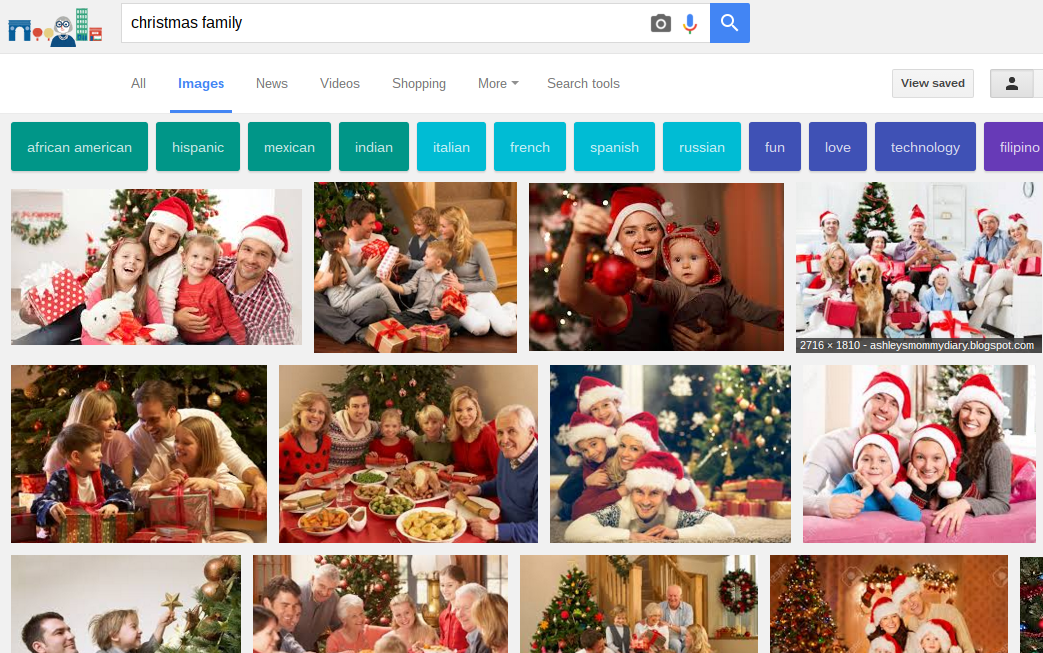
I also wanted to comment on your Media. When doing a general search of any thing, the result is usually white-oriented. If you want people of color, you do have to type in the ethnic group you want. I did the same thing by typing in Christmas family, and the results were the same. It was definitely a White Christmas. And if I wanted to see more people of color, I had to alter my search. It's actually unbelievable, but it furthers the point that the internet hasn't caught up with equal representation yet. aa de8e08161ecdfbe4206b74479dee1c1d007a58c4 - 1 2016-05-04T21:02:33-07:00 Ashley Martinez-Munoz a5a71a08c4c1c5dc7904ffcbc148c4f2edb1e723 Individual vs the group Ashley Martinez-Munoz 1 plain 2016-05-04T21:02:33-07:00 You made a good point of “retro-humanism” not being defined, in fact multiple terms that I was unfamiliar with were not defined which hindered the article’s message for me. Anyway, I think as the prefix suggests “retro” it may be the “old-fashioned” humanities before any digital technology/advancements surfaced within our society. Within Risam’s article she gave brief history on what it was like within the 60s-80s when scholars were introduced to the idea of theory and the rise of digital humanities. I think all fields within today’s society are diverse, but there is a controversy of if the different fields not being diverse enough. We see different races, genders, and ethnicities within each field, but we are in shock when statistics come out and we see that there is such a low percentage of colored (women) within a field. I believe we are made to think that fields are never diverse enough unless the demographics are all on an equal spectrum. This may be a far stretch or perhaps I am applying the term wrong, but I think that I am a part of a group of intersectionality at UCLA. We can all say the campus is diverse, as many other universities, and due to this we are allowed to view the differences and similarities all among us yet we are all a part of the same educational institution. It may be more difficult for an individual to get recognized for their differences compared to a group, but it is possibly. For example, such as in our class where there is only about 10 of us. Ashley Martinez-Munoz a5a71a08c4c1c5dc7904ffcbc148c4f2edb1e723
- 1 2016-05-04T23:12:49-07:00 Eduardo D. Garcia 6e60d0784abf2b990f3510cceb60101259a8bdd3 Retro-Humanism Eduardo D. Garcia 1 plain 2016-05-04T23:12:49-07:00 To answer the second question about retro-humanism, I think Risam meaning of "retro-humanism" is the old classic definition of humanism without the digital factor. On Arturo's comment, cyberspace is a thriving place for communities to interact and there is an inequality for people to join these online communities. I do not belong in an online community that has intersectionality tenets. The idea of these types of communities are a great idea such as FemTechNet. In their manifesto they proclaimed they are"committed to making the accessible, open, accountable, transformative and transforming educational institutions of our dreams." These type of groups are great and open up conversations about issues affecting minorities. Eduardo D. Garcia 6e60d0784abf2b990f3510cceb60101259a8bdd3
- 1 2016-05-05T00:43:38-07:00 Yesenia Melgoza-Fernandez a6a8d8933b14c7be3a522d5102f92c9dfe52e9b2 "White" is "Normal" Yesenia Melgoza-Fernandez 1 plain 2016-05-05T00:43:38-07:00 I too, like Addie, have realized that the cyber world has a lack of diversity. I believe there was an experiment done through Google where they would do a search of things on google such as "beautiful women" and, when searching through images it would consist of mainly white women. That right there proves that the cyber world is geared toward a certain type of person (white, male, upper/middle class) like most things are. I do have many different intersectionalities and I believe it is very important to be aware of them and to be recognized from them. Referencing back to Maria Fernandez's reading, when intersectionalities are ignored, the people that belong to those categories are ultimately ignored as well. Yesenia Melgoza-Fernandez a6a8d8933b14c7be3a522d5102f92c9dfe52e9b2
- 1 2016-05-05T00:44:25-07:00 Alan Evangelista f3e41e7c002a037bb13d71a1e837eb5bf5bef12f Moving forward Alan Evangelista 1 plain 2016-05-05T00:44:25-07:00 First off, I want to mention that your blog was very thought-provoking and you posed some great questions. In regards to your first question, I believe that to a certain extent we have been successful in creating a diverse and creative place online. There are hundreds of webpages online that are catered to individuals' distinct interests, backgrounds, cultures, etc. With that being said however, I do not believe that every individual has equal opportunity to engage and participate online. Furthermore, many of the webpages that are created by "subgroups" are not easy to find. They are often hidden behind pages and pages of more "mainstream" media pages. As Addie mentioned, much of the content found online is "white-oriented," which means that if one wants to find content created by or design for minorities or even women, one must specify that in their search. Now, in regards to intersectionality, I believe that as more and more minorities and women gain access to ICTs and new media platforms, discussion on intersectionality will continue to grow as it has already. Alan Evangelista f3e41e7c002a037bb13d71a1e837eb5bf5bef12f
- 1 2016-05-06T23:13:15-07:00 Ebony Paramo dca8ce0b7a38097adb1b511e4c75690f833171f0 Colorful Future Ebony Paramo 2 plain 2016-05-06T23:14:30-07:00 Your blog was very helpful in understanding Risam's work. Again she is yet another author/scholar that is aware of how the online world mirrors the offline world. The second question that you posed stood out to me, partly because the term "Retro-Humanities" includes a word in which I use to describe my personality and interests, which is retro (I like the twentieth century, though people of color could have been treated differently). I automatically thought of past decades when I came across that term, thinking of the eighties, seventies, sixties and so on and so forth. I then decided to investigate other definitions of the term, finding out that it means "denoting action that is directed backward or is reciprocal" and "denoting location behind". I proceeded to do the same thing with the word "humanities", which I found to mean "humaneness; benevolence" and "learning or literature concerned with human culture, especially literature, history, art, music, and philosophy". [I obtained these definitions by searching for them on Google]. What "Retro-Humanities" literally signifies using the definitions above is "human culture that retrocedes". But in my opinion, I believe "Retro-Humanities" asks and focuses on other points. They are the following: are we living in a digital age where we are not progressing, trying to create an equal world for all? Perhaps "Retro-Humanities" indicates our neutral circumstance for progress. We are not inclusive of all people, society is not welcoming everyone online. It is as if we are still living in past eras where this digital technology was not available, and where people were fighting for their civil rights. Very amazing that those scenarios still apply to people's lives in the 2010s. The fact that the term was mentioned once may be due to it being a first step for online inclusion for all. Ebony Paramo dca8ce0b7a38097adb1b511e4c75690f833171f0
- 1 2016-05-07T15:39:03-07:00 Ana Victoria H. 37ae5307effd9bccccea4f0fe7958d15cee30e07 Intersectionality- Coalition & Celebration in Differences Ana Victoria H. 1 plain 2016-05-07T15:39:04-07:00 I googled NUCLEAR FAMILY and actually found a nice mix of families. There were more than the "white" families, there were African-American, Asian-American, Latino, etc. (or that I am assuming were, but the point is that they were more than blonde people on my screen). I wonder if this has to do with the fact that Google has registered the kind of content I gravitate to (which is social justice, inclusiveness, global affairs, etc). It makes me think of how it may be making me blind to how exclusive the internet actually is, because it knows what I like to see. Moreover, I want to address question #3. I think every person has intersectionality present in their lives. Your gender and your ethnicity alone are two points of intersection, and are most definitely not the only parts of your identity. Therefore, I do consider myself a person who is a part of groups of intersectionality. I am a Latina, I am Mexican, I am American, I am young, I am college-educated, I am a scholar, I am a daughter, I am an elder sister, I am socio-politically conscious, I am multi-lingual, I am a traveler, I am heterosexual, I am an activist, I am a writer, I am a friend, the list goes on and on... and these traits all intersect to make my experience unique and more different than if only one or a few of those traits defined me. Finally, I think it is important to celebrate similarities and find coalition-building incentives in those similarities. On the same token, it is also important to acknowledge differences and to use those to strengthen and fill in the gaps that the similarities might have. For example Latinos should unite through bonds of culture but we must also not neglect the fact that Mexicans are different from Salvadoreans and that that is an asset because each culture has something different to bring to the table. Ana Victoria H. 37ae5307effd9bccccea4f0fe7958d15cee30e07