Thanks for your patience during our recent outage at scalar.usc.edu. While Scalar content is loading normally now, saving is still slow, and Scalar's 'additional metadata' features have been disabled, which may interfere with features like timelines and maps that depend on metadata. This also means that saving a page or media item will remove its additional metadata. If this occurs, you can use the 'All versions' link at the bottom of the page to restore the earlier version. We are continuing to troubleshoot, and will provide further updates as needed. Note that this only affects Scalar projects at scalar.usc.edu, and not those hosted elsewhere.
The Evolution of the American DinerMain MenuThe Original Lunch WagonsWhere the American Diner found its audience and purpose.T. H. Buckley- Come Get Your American DreamFinding success in a new business.The Transition from Horse-Drawn to StationaryWhy Lunch Wagons found themselves abandoning the horse.The Classic American EntrepreneurshipThe appeal of owning a lunch wagon to working-class Americans.The Masters of the Booming Lunch Car IndustryAppealing to the customersThe effort to appeal to a wider customer base.Decline of the American DinerCultural Relics of the Twenty-First CenturyMedia GalleryMedia Used and Collected in the Making of this ProjectCreditsSources Used in ResearchCassidy Nemickcf80a2fbfbf26cc0303a79834a26a4cb79a11a9b
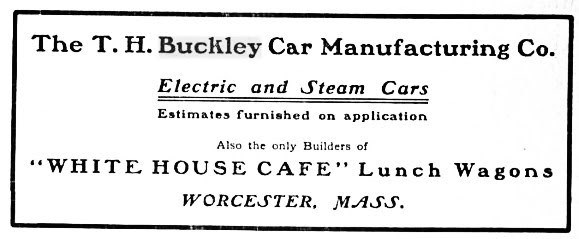
T. H Buckley 1905 Advertisement
12016-11-02T22:27:47-07:00Cassidy Nemickcf80a2fbfbf26cc0303a79834a26a4cb79a11a9b115201Advertisment for the T. H Buckley Car Manufacturing Company from 1905. Accessed from https://dinerhunter.com/2010/07/14/motorized-lunch-wagons-the-missing-linkplain2016-11-02T22:27:47-07:00Cassidy Nemickcf80a2fbfbf26cc0303a79834a26a4cb79a11a9b
This page has tags:
12016-11-26T20:44:50-08:00Cassidy Nemickcf80a2fbfbf26cc0303a79834a26a4cb79a11a9bMedia GalleryCassidy Nemick1Media Used and Collected in the Making of this Projectgallery2016-11-26T20:44:50-08:00Cassidy Nemickcf80a2fbfbf26cc0303a79834a26a4cb79a11a9b
This page is referenced by:
14602097050_319ae2cc27_b.jpgmedia/thbuckleycafeinterior.jpg2016-09-22T08:51:02-07:00T. H. Buckley- Come Get Your American Dream23Finding success in a new business.image_header2016-11-14T12:38:23-08:00 Worcester, Massachusetts is commonly thought of as where the lunch wagon began, and often the credit is not given to Walter Scott.
Despite the lunch wagon finding its true beginnings in Providence, Rhode Island, Worchester is where the lunch wagon caught fire, and ignited a successful industry. One of the most important people who furthered the success of a quick bite to eat, was Thomas H. Buckley.
A common attribute to early American lunch wagons was the name choice which related to the evening. The night theme was for lunch wagons, due to their popularity late at night. This was no exception to Thomas H. Buckley who built his first lunch wagon in 1888, and appropriately named it “The Owl.” While owning, and running "The Owl," Buckley began producing his own lunch wagon designs in Worcester, Massachusetts.[1]
Thomas H. Buckley’s first wagon was taken to Denver, Colorado where its new owner W. A. Bowen began the lunch business further into the West.[2]
Buckley’s blooming lunch wagon company went through many name changes and adjustments before finding the right formula. His company first began as the New England Night Lunch Wagon Company, and by 1898 emerged as the T.H Buckley Lunch Wagon Manufacturing and Catering Company.
Not only did the T.H Buckley Lunch Wagon Manufacturing and Catering Company manufacture lunch wagons for purchase, but they also built supplies for the wagons that they sold. Richard J.S Gutman provides a few examples of these items in his book, American Diner; Then and now. Gutman states, “In addition to building lunch carts, the company also dealt in launch cart supplies, including dishes and urns, Sabatier knives “specially imported for Lunch Wagon Business,” French plate mirrors and decorated glass, linoleum, wagon jacks and standard fire pails.”[3] Not only did he make the lunch wagon business available for purchase for others but Buckley also was the first to add cooking stoves to lunch wagons, which broadened menus considerably.
Buckley’s wagon business is a perfect example of the early American entrepreneur. Buckley started off as a lunch wagon counter boy who also dabbled in being a hack driver, and assistant janitor, built his own first lunch wagon, and created a successful business. Buckley’s success story not only gave other working class Americans hope, but it undoubtedly changed the course of the American food experience for the better.
Buckley’s first majorly successful line of lunch wagons were called, “White House Cafe's”. Michael Karl Witzel states in his book, The American Diner, that this line of wagons was “a procession of lunch wagons that mimicked the Palmer models in basic design and decoration save a few aesthetic variations.”[4] Now despite the wagons resembling the earlier Palmer models, Buckley had two original patents for them. These original patents featured wagons with windows that encircled the entire structure.[5]
The name of these wagons strayed from the traditional night theme from before. These wagons embraced a patriotic theme, not only with the name but also the scenes painted on the outside of them. The glass of the windows was red and blue, and along with the white of the wagon represented the national colors. Many designs on the outsides of the wagons included scenes of hunting, moments of historical importance, and various landscapes.[6]
Thomas H. Buckley died on December 1st, 1903 of peritonitis at the age of 35. Even after his death, his company was carried on to continue producing lunch wagons.
By December or 1906, a new champion of the lunch car business emerged. Philip H. Duprey, a real-estate agent who formed the Worcester Lunch Car and Carriage Manufacturing Company.[7]
Despite new manufacturing companies popping up to provide lunch wagons to an eager market of hopeful working class entrepreneurs, none of their progress would have been possible without Thomas H. Buckley and his lunch car company. He mass produced wagons for those that desired to try their hand in the lunch wagon business, he altered the design and size of the wagon to allow for more customers, and added cooking stoves to the wagons. Buckley set up lunch wagons in roughly 275 towns between 1893 and 1898[8], furthering the popularity and spread of the lunch wagon business in America. His contributions furthered the progress of the lunch wagon and made it possible for others to further the business.