List of Large Plates Supplementing Volume Two
1 2018-03-16T21:13:03-07:00 Erik Loyer f862727c4b34febd6a0341bffd27f168a35aa637 29482 1 Media Gallery structured_gallery 2018-03-16T21:13:03-07:00 Erik Loyer f862727c4b34febd6a0341bffd27f168a35aa637This page has paths:
- 1 2018-03-16T21:13:11-07:00 Erik Loyer f862727c4b34febd6a0341bffd27f168a35aa637 Volume Two Illustrations and Portfolio Images Erik Loyer 1 Media Galleries structured_gallery 2018-03-16T21:13:11-07:00 Erik Loyer f862727c4b34febd6a0341bffd27f168a35aa637
Contents of this path:
-
1
2018-03-16T21:11:19-07:00
Erik Loyer
f862727c4b34febd6a0341bffd27f168a35aa637
Saguaro harvest - Pima
1
The fruit of the saguaro, or giant cactus, called "hasen" by the Pima, forms a very important source of the food supply of the tribes of southern Arizona. This fruit is of about the size of a small pear, and is very sweet. It is eaten fresh, dried, or in the form of syrup, and a sort of wine is made from its juice. In gathering it the natives use a long pole with a wooden blade at the end.
plain
2018-03-16T21:11:19-07:00
Curtis, Edward S. 1868-1952
1907
Digital images of the plates supported by an award from the Library of Congress/Ameritech National Digital Library Competition, and mounted in American Memory. See http://memory.loc.gov/ammem/award98/ienhtml/curthome.html
Digital reproduction of the photomechanical print cp02001 - portfolio 2 plate no. 40 For educational, non-commercial use only. Written permission required for any reproduction beyond fair use. Credit: Northwestern University Library, Edward S. Curtis's "The North American Indian," 2003.
http://digital.library.northwestern.edu/curtis/ The North American Indian (1907-1930) v.02, The Pima. The Papago. The Qahatika. The Mohave. The Yuma. The Maricopa. The Walapai. The Havasupai. The Apache-Mohave, or Yavapai ([Seattle] : E.S. Curtis ; [Cambridge, Mass. : The University Press], 1908), plate no. 40 1 photogravure : brown ink ; 46 x 34 cm [plate size]
Original photogravure produced in Boston by John Andrew & Son http://curtis.library.northwestern.edu/curtis/info.cgi?id=nai.02.port.00000002.p Erik Loyer f862727c4b34febd6a0341bffd27f168a35aa637 -
1
2018-03-16T21:11:20-07:00
Erik Loyer
f862727c4b34febd6a0341bffd27f168a35aa637
Pima baskets
1
The baskets made by the Pima, Papago, and Qahatika, as well as by their Maricopa neighbors, are practically identical in form and design, but the Maricopa basketry is of somewhat superior workmanship. The four-armed cross, a form of the swastika, appears as the central feature in the decoration of a majority of the Piman and Maricopa baskets of to-day, and while the true signification here is not known with certainty, it is not impossible that it was designed originally to represent the winds of the four cardinal directions. Less than a generation ago the swastika was employed by the Pima to decorate their shields, and as a brand for their horses.
plain
2018-03-16T21:11:20-07:00
Curtis, Edward S. 1868-1952
1907
Digital images of the plates supported by an award from the Library of Congress/Ameritech National Digital Library Competition, and mounted in American Memory. See http://memory.loc.gov/ammem/award98/ienhtml/curthome.html
Digital reproduction of the photomechanical print cp02002 - portfolio 2 plate no. 41 For educational, non-commercial use only. Written permission required for any reproduction beyond fair use. Credit: Northwestern University Library, Edward S. Curtis's "The North American Indian," 2003.
http://digital.library.northwestern.edu/curtis/ The North American Indian (1907-1930) v.02, The Pima. The Papago. The Qahatika. The Mohave. The Yuma. The Maricopa. The Walapai. The Havasupai. The Apache-Mohave, or Yavapai ([Seattle] : E.S. Curtis ; [Cambridge, Mass. : The University Press], 1908), plate no. 41 1 photogravure : brown ink ; 31 x 44 cm [plate size]
Original photogravure produced in Boston by John Andrew & Son http://curtis.library.northwestern.edu/curtis/info.cgi?id=nai.02.port.00000003.p Erik Loyer f862727c4b34febd6a0341bffd27f168a35aa637 -
1
2018-03-16T21:11:20-07:00
Erik Loyer
f862727c4b34febd6a0341bffd27f168a35aa637
Kaviu - Pima
1
The Pima are bright, active, progressive Indians, as the portrait of the typical man of the tribe attests.
plain
2018-03-16T21:11:20-07:00
Curtis, Edward S. 1868-1952
1907
Digital images of the plates supported by an award from the Library of Congress/Ameritech National Digital Library Competition, and mounted in American Memory. See http://memory.loc.gov/ammem/award98/ienhtml/curthome.html
Digital reproduction of the photomechanical print cp02003 - portfolio 2 plate no. 42 For educational, non-commercial use only. Written permission required for any reproduction beyond fair use. Credit: Northwestern University Library, Edward S. Curtis's "The North American Indian," 2003.
http://digital.library.northwestern.edu/curtis/ The North American Indian (1907-1930) v.02, The Pima. The Papago. The Qahatika. The Mohave. The Yuma. The Maricopa. The Walapai. The Havasupai. The Apache-Mohave, or Yavapai ([Seattle] : E.S. Curtis ; [Cambridge, Mass. : The University Press], 1908), plate no. 42 1 photogravure : brown ink ; 46 x 34 cm [plate size]
Original photogravure produced in Boston by John Andrew & Son http://curtis.library.northwestern.edu/curtis/info.cgi?id=nai.02.port.00000004.p Erik Loyer f862727c4b34febd6a0341bffd27f168a35aa637 -
1
2018-03-16T21:11:20-07:00
Erik Loyer
f862727c4b34febd6a0341bffd27f168a35aa637
Burden-bearer - Pima
1
This illustration shows the typical burden basket of the several Piman tribes of southern Arizona, called kiho in the Piman language. Their mythology relates that once the kiho was an animate being, but owing to disobedience of divine laws when the people emerged from the under-world, it became inanimate, and has since been carried on the backs of women.
plain
2018-03-16T21:11:20-07:00
Curtis, Edward S. 1868-1952
1907
Digital images of the plates supported by an award from the Library of Congress/Ameritech National Digital Library Competition, and mounted in American Memory. See http://memory.loc.gov/ammem/award98/ienhtml/curthome.html
Digital reproduction of the photomechanical print cp02004 - portfolio 2 plate no. 43 For educational, non-commercial use only. Written permission required for any reproduction beyond fair use. Credit: Northwestern University Library, Edward S. Curtis's "The North American Indian," 2003.
http://digital.library.northwestern.edu/curtis/ The North American Indian (1907-1930) v.02, The Pima. The Papago. The Qahatika. The Mohave. The Yuma. The Maricopa. The Walapai. The Havasupai. The Apache-Mohave, or Yavapai ([Seattle] : E.S. Curtis ; [Cambridge, Mass. : The University Press], 1908), plate no. 43 1 photogravure : brown ink ; 46 x 34 cm [plate size]
Original photogravure produced in Boston by John Andrew & Son http://curtis.library.northwestern.edu/curtis/info.cgi?id=nai.02.port.00000005.p Erik Loyer f862727c4b34febd6a0341bffd27f168a35aa637 -
1
2018-03-16T21:11:20-07:00
Erik Loyer
f862727c4b34febd6a0341bffd27f168a35aa637
Pima woman
1
This pictures gives also an idea of the size attained by the giant cactus, or saguaro.
plain
2018-03-16T21:11:20-07:00
Curtis, Edward S. 1868-1952
1907
Digital images of the plates supported by an award from the Library of Congress/Ameritech National Digital Library Competition, and mounted in American Memory. See http://memory.loc.gov/ammem/award98/ienhtml/curthome.html
Digital reproduction of the photomechanical print cp02005 - portfolio 2 plate no. 44 The For educational, non-commercial use only. Written permission required for any reproduction beyond fair use. Credit: Northwestern University Library, Edward S. Curtis's "The North American Indian," 2003.
http://digital.library.northwestern.edu/curtis/ The North American Indian (1907-1930) v.02, The Pima. The Papago. The Qahatika. The Mohave. The Yuma. The Maricopa. The Walapai. The Havasupai. The Apache-Mohave, or Yavapai ([Seattle] : E.S. Curtis ; [Cambridge, Mass. : The University Press], 1908), plate no. 44 1 photogravure : brown ink ; 45 x 33 cm [plate size]
Original photogravure produced in Boston by John Andrew & Son http://curtis.library.northwestern.edu/curtis/info.cgi?id=nai.02.port.00000006.p Erik Loyer f862727c4b34febd6a0341bffd27f168a35aa637 -
1
2018-03-16T21:11:20-07:00
Erik Loyer
f862727c4b34febd6a0341bffd27f168a35aa637
Pima ki
1
The old-time round dwelling of the Pima tribes. In construction it was much the same as the earth lodge of the tribes of the northern plains, the chief difference lying in the fact that its top is practically flat and it is not provided with an opening for the escape of the smoke, as well as in the lack of an extended or built-out entrance way. The ki was usually about 15 feet in diameter. As the winter climate of southern Arizona is very mild, only a small fire was needed to keep the ki warm in even the coldest weather, the smoke from which became absorbed in part by the earthen roof, or escaped through the doorway.
plain
2018-03-16T21:11:20-07:00
Curtis, Edward S. 1868-1952
1907
Digital images of the plates supported by an award from the Library of Congress/Ameritech National Digital Library Competition, and mounted in American Memory. See http://memory.loc.gov/ammem/award98/ienhtml/curthome.html
Digital reproduction of the photomechanical print cp02006 - portfolio 2 plate no. 45 For educational, non-commercial use only. Written permission required for any reproduction beyond fair use. Credit: Northwestern University Library, Edward S. Curtis's "The North American Indian," 2003.
http://digital.library.northwestern.edu/curtis/ The North American Indian (1907-1930) v.02, The Pima. The Papago. The Qahatika. The Mohave. The Yuma. The Maricopa. The Walapai. The Havasupai. The Apache-Mohave, or Yavapai ([Seattle] : E.S. Curtis ; [Cambridge, Mass. : The University Press], 1908), plate no. 45 1 photogravure : brown ink ; 36 x 44 cm [plate size]
Original photogravure produced in Boston by John Andrew & Son http://curtis.library.northwestern.edu/curtis/info.cgi?id=nai.02.port.00000007.p Erik Loyer f862727c4b34febd6a0341bffd27f168a35aa637 -
1
2018-03-16T21:11:20-07:00
Erik Loyer
f862727c4b34febd6a0341bffd27f168a35aa637
Pima matron
1
A representative Pima woman of middle age.
plain
2018-03-16T21:11:20-07:00
Curtis, Edward S. 1868-1952
1907
Digital images of the plates supported by an award from the Library of Congress/Ameritech National Digital Library Competition, and mounted in American Memory. See http://memory.loc.gov/ammem/award98/ienhtml/curthome.html
Digital reproduction of the photomechanical print cp02007 - portfolio 2 plate no. 46 For educational, non-commercial use only. Written permission required for any reproduction beyond fair use. Credit: Northwestern University Library, Edward S. Curtis's "The North American Indian," 2003.
http://digital.library.northwestern.edu/curtis/ The North American Indian (1907-1930) v.02, The Pima. The Papago. The Qahatika. The Mohave. The Yuma. The Maricopa. The Walapai. The Havasupai. The Apache-Mohave, or Yavapai ([Seattle] : E.S. Curtis ; [Cambridge, Mass. : The University Press], 1908), plate no. 46 1 photogravure : brown ink ; 42 x 34 cm [plate size]
Original photogravure produced in Boston by John Andrew & Son http://curtis.library.northwestern.edu/curtis/info.cgi?id=nai.02.port.00000008.p Erik Loyer f862727c4b34febd6a0341bffd27f168a35aa637 -
1
2018-03-16T21:11:21-07:00
Erik Loyer
f862727c4b34febd6a0341bffd27f168a35aa637
Chijako - Pima
1
A representative Pima man of middle age.
plain
2018-03-16T21:11:21-07:00
Curtis, Edward S. 1868-1952
1907
Digital images of the plates supported by an award from the Library of Congress/Ameritech National Digital Library Competition, and mounted in American Memory. See http://memory.loc.gov/ammem/award98/ienhtml/curthome.html
Digital reproduction of the photomechanical print cp02008 - portfolio 2 plate no. 47 For educational, non-commercial use only. Written permission required for any reproduction beyond fair use. Credit: Northwestern University Library, Edward S. Curtis's "The North American Indian," 2003.
http://digital.library.northwestern.edu/curtis/ The North American Indian (1907-1930) v.02, The Pima. The Papago. The Qahatika. The Mohave. The Yuma. The Maricopa. The Walapai. The Havasupai. The Apache-Mohave, or Yavapai ([Seattle] : E.S. Curtis ; [Cambridge, Mass. : The University Press], 1908), plate no. 47 1 photogravure : brown ink ; 45 x 34 cm [plate size]
Original photogravure produced in Boston by John Andrew & Son http://curtis.library.northwestern.edu/curtis/info.cgi?id=nai.02.port.00000009.p Erik Loyer f862727c4b34febd6a0341bffd27f168a35aa637 -
1
2018-03-16T21:11:21-07:00
Erik Loyer
f862727c4b34febd6a0341bffd27f168a35aa637
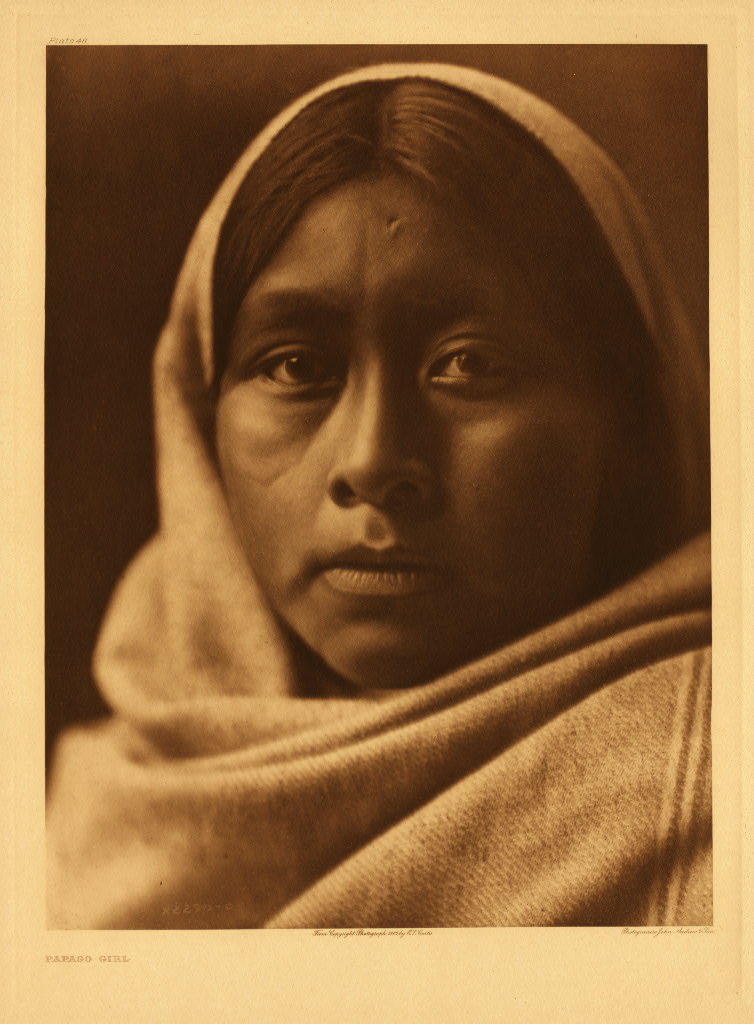
Papago girl
1
A particularly fine-looking Papago girl of as nearly pure blood as can be found in the region. The northern Piman tribes have been in direct contact with Spanish people for more than two centuries. Much of the early foreign blood, however, has become so blended that its physical influence is no longer apparent. Indeed there are many instances in which the Indians insist that their blood is entirely aboriginal, whereas in fact an infusion of alien blood is traceable several generations back.
plain
2018-03-16T21:11:21-07:00
Curtis, Edward S. 1868-1952
1907
Digital images of the plates supported by an award from the Library of Congress/Ameritech National Digital Library Competition, and mounted in American Memory. See http://memory.loc.gov/ammem/award98/ienhtml/curthome.html
Digital reproduction of the photomechanical print cp02009 - portfolio 2 plate no. 48 For educational, non-commercial use only. Written permission required for any reproduction beyond fair use. Credit: Northwestern University Library, Edward S. Curtis's "The North American Indian," 2003.
http://digital.library.northwestern.edu/curtis/ The North American Indian (1907-1930) v.02, The Pima. The Papago. The Qahatika. The Mohave. The Yuma. The Maricopa. The Walapai. The Havasupai. The Apache-Mohave, or Yavapai ([Seattle] : E.S. Curtis ; [Cambridge, Mass. : The University Press], 1908), plate no. 48 1 photogravure : brown ink ; 46 x 34 cm [plate size]
Original photogravure produced in Boston by John Andrew & Son http://curtis.library.northwestern.edu/curtis/info.cgi?id=nai.02.port.00000010.p Erik Loyer f862727c4b34febd6a0341bffd27f168a35aa637 -
1
2018-03-16T21:11:21-07:00
Erik Loyer
f862727c4b34febd6a0341bffd27f168a35aa637
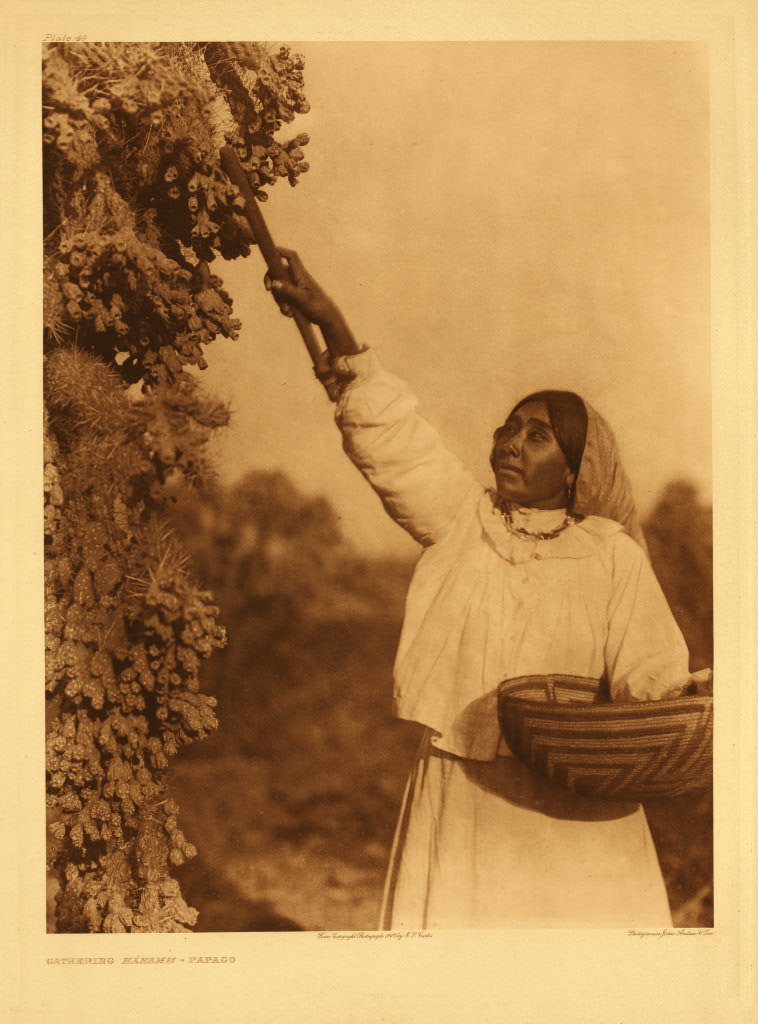
Gathering hanamh - Papago
1
Hanamh is the Piman name for the cholla cactus and its fruit. The natives gather the fruit of this spiny plant in large quantities, and it forms a food of material importance to the several tribes living within its habitat. In gathering it they use rude tongs made from a split stick. After a basket is filled, the fruit is spread on the ground and bushed about with a small, stiff besom until the spines are worn off, or the spines are burned of in an open fire.
plain
2018-03-16T21:11:21-07:00
Curtis, Edward S. 1868-1952
1907
Digital images of the plates supported by an award from the Library of Congress/Ameritech National Digital Library Competition, and mounted in American Memory. See http://memory.loc.gov/ammem/award98/ienhtml/curthome.html
Digital reproduction of the photomechanical print cp02010 - portfolio 2 plate no. 49 For educational, non-commercial use only. Written permission required for any reproduction beyond fair use. Credit: Northwestern University Library, Edward S. Curtis's "The North American Indian," 2003.
http://digital.library.northwestern.edu/curtis/ The North American Indian (1907-1930) v.02, The Pima. The Papago. The Qahatika. The Mohave. The Yuma. The Maricopa. The Walapai. The Havasupai. The Apache-Mohave, or Yavapai ([Seattle] : E.S. Curtis ; [Cambridge, Mass. : The University Press], 1908), plate no. 49 1 photogravure : brown ink ; 46 x 34 cm [plate size]
Original photogravure produced in Boston by John Andrew & Son http://curtis.library.northwestern.edu/curtis/info.cgi?id=nai.02.port.00000011.p Erik Loyer f862727c4b34febd6a0341bffd27f168a35aa637 -
1
2018-03-16T21:11:21-07:00
Erik Loyer
f862727c4b34febd6a0341bffd27f168a35aa637
Carlos Rios - Papago chief
1
plain
2018-03-16T21:11:21-07:00
Curtis, Edward S. 1868-1952
1907
Digital images of the plates supported by an award from the Library of Congress/Ameritech National Digital Library Competition, and mounted in American Memory. See http://memory.loc.gov/ammem/award98/ienhtml/curthome.html
Digital reproduction of the photomechanical print cp02011 - portfolio 2 plate no. 50 For educational, non-commercial use only. Written permission required for any reproduction beyond fair use. Credit: Northwestern University Library, Edward S. Curtis's "The North American Indian," 2003.
http://digital.library.northwestern.edu/curtis/ The North American Indian (1907-1930) v.02, The Pima. The Papago. The Qahatika. The Mohave. The Yuma. The Maricopa. The Walapai. The Havasupai. The Apache-Mohave, or Yavapai ([Seattle] : E.S. Curtis ; [Cambridge, Mass. : The University Press], 1908), plate no. 50 1 photogravure : brown ink ; 46 x 30 cm [plate size]
Original photogravure produced in Boston by John Andrew & Son http://curtis.library.northwestern.edu/curtis/info.cgi?id=nai.02.port.00000012.p Erik Loyer f862727c4b34febd6a0341bffd27f168a35aa637 -
1
2018-03-16T21:11:22-07:00
Erik Loyer
f862727c4b34febd6a0341bffd27f168a35aa637
Facade - San Xavier del Bac Mission
1
plain
2018-03-16T21:11:22-07:00
Curtis, Edward S. 1868-1952
1907
Digital images of the plates supported by an award from the Library of Congress/Ameritech National Digital Library Competition, and mounted in American Memory. See http://memory.loc.gov/ammem/award98/ienhtml/curthome.html
Digital reproduction of the photomechanical print cp02012 - portfolio 2 plate no. 51 For educational, non-commercial use only. Written permission required for any reproduction beyond fair use. Credit: Northwestern University Library, Edward S. Curtis's "The North American Indian," 2003.
http://digital.library.northwestern.edu/curtis/ The North American Indian (1907-1930) v.02, The Pima. The Papago. The Qahatika. The Mohave. The Yuma. The Maricopa. The Walapai. The Havasupai. The Apache-Mohave, or Yavapai ([Seattle] : E.S. Curtis ; [Cambridge, Mass. : The University Press], 1908), plate no. 51 1 photogravure : brown ink ; 46 x 34 cm [plate size]
Original photogravure produced in Boston by John Andrew & Son http://curtis.library.northwestern.edu/curtis/info.cgi?id=nai.02.port.00000013.p Erik Loyer f862727c4b34febd6a0341bffd27f168a35aa637 -
1
2018-03-16T21:11:22-07:00
Erik Loyer
f862727c4b34febd6a0341bffd27f168a35aa637
Luzi - Papago
1
The Papago women always carry their burdens on, or supported from, their heads. When the burden - be it a basket, pottery, or a box - has a flat or a rounded bottom, the ring of the woven yucca is placed on the head in order to give the load a firm position for carrying, and to relieve the bearer of pressure.
plain
2018-03-16T21:11:22-07:00
Curtis, Edward S. 1868-1952
1907
Digital images of the plates supported by an award from the Library of Congress/Ameritech National Digital Library Competition, and mounted in American Memory. See http://memory.loc.gov/ammem/award98/ienhtml/curthome.html
Digital reproduction of the photomechanical print cp02014 - portfolio 2 plate no. 53 For educational, non-commercial use only. Written permission required for any reproduction beyond fair use. Credit: Northwestern University Library, Edward S. Curtis's "The North American Indian," 2003.
http://digital.library.northwestern.edu/curtis/ The North American Indian (1907-1930) v.02, The Pima. The Papago. The Qahatika. The Mohave. The Yuma. The Maricopa. The Walapai. The Havasupai. The Apache-Mohave, or Yavapai ([Seattle] : E.S. Curtis ; [Cambridge, Mass. : The University Press], 1908), plate no. 53 1 photogravure : brown ink ; 45 x 30 cm [plate size]
Original photogravure produced in Boston by John Andrew & Son http://curtis.library.northwestern.edu/curtis/info.cgi?id=nai.02.port.00000015.p Erik Loyer f862727c4b34febd6a0341bffd27f168a35aa637 -
1
2018-03-16T21:11:22-07:00
Erik Loyer
f862727c4b34febd6a0341bffd27f168a35aa637
Qahatika water girl
1
plain
2018-03-16T21:11:22-07:00
Curtis, Edward S. 1868-1952
1907
Digital images of the plates supported by an award from the Library of Congress/Ameritech National Digital Library Competition, and mounted in American Memory. See http://memory.loc.gov/ammem/award98/ienhtml/curthome.html
Digital reproduction of the photomechanical print cp02015 - portfolio 2 plate no. 54 For educational, non-commercial use only. Written permission required for any reproduction beyond fair use. Credit: Northwestern University Library, Edward S. Curtis's "The North American Indian," 2003.
http://digital.library.northwestern.edu/curtis/ The North American Indian (1907-1930) v.02, The Pima. The Papago. The Qahatika. The Mohave. The Yuma. The Maricopa. The Walapai. The Havasupai. The Apache-Mohave, or Yavapai ([Seattle] : E.S. Curtis ; [Cambridge, Mass. : The University Press], 1908), plate no. 54 1 photogravure : brown ink ; 45 x 30 cm [plate size]
Original photogravure produced in Boston by John Andrew & Son http://curtis.library.northwestern.edu/curtis/info.cgi?id=nai.02.port.00000016.p Erik Loyer f862727c4b34febd6a0341bffd27f168a35aa637 -
1
2018-03-16T21:11:22-07:00
Erik Loyer
f862727c4b34febd6a0341bffd27f168a35aa637
Qahatika girl
1
plain
2018-03-16T21:11:22-07:00
Curtis, Edward S. 1868-1952
1907
Digital images of the plates supported by an award from the Library of Congress/Ameritech National Digital Library Competition, and mounted in American Memory. See http://memory.loc.gov/ammem/award98/ienhtml/curthome.html
Digital reproduction of the photomechanical print cp02017 - portfolio 2 plate no. 56 For educational, non-commercial use only. Written permission required for any reproduction beyond fair use. Credit: Northwestern University Library, Edward S. Curtis's "The North American Indian," 2003.
http://digital.library.northwestern.edu/curtis/ The North American Indian (1907-1930) v.02, The Pima. The Papago. The Qahatika. The Mohave. The Yuma. The Maricopa. The Walapai. The Havasupai. The Apache-Mohave, or Yavapai ([Seattle] : E.S. Curtis ; [Cambridge, Mass. : The University Press], 1908), plate no. 56 1 photogravure : brown ink ; 46 x 34 cm [plate size]
Original photogravure produced in Boston by John Andrew & Son http://curtis.library.northwestern.edu/curtis/info.cgi?id=nai.02.port.00000018.p Erik Loyer f862727c4b34febd6a0341bffd27f168a35aa637 -
1
2018-03-16T21:11:22-07:00
Erik Loyer
f862727c4b34febd6a0341bffd27f168a35aa637
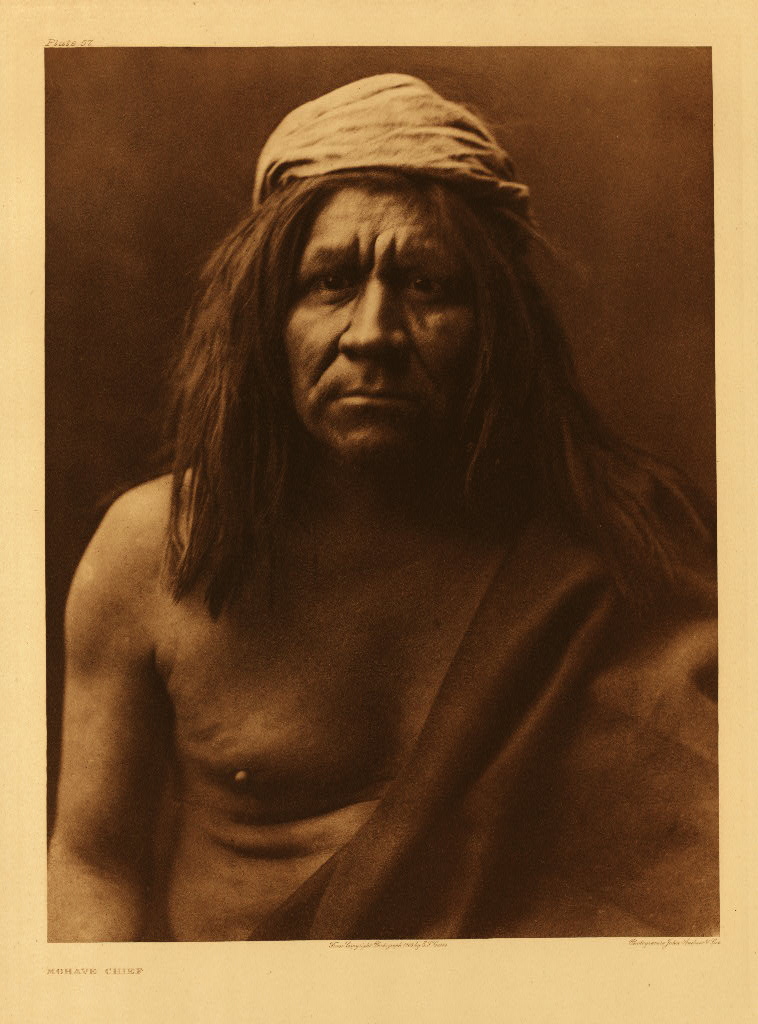
Mohave chief
1
A representative type of the Mohave men.
plain
2018-03-16T21:11:22-07:00
Curtis, Edward S. 1868-1952
1903
Digital images of the plates supported by an award from the Library of Congress/Ameritech National Digital Library Competition, and mounted in American Memory. See http://memory.loc.gov/ammem/award98/ienhtml/curthome.html
Digital reproduction of the photomechanical print cp02018 - portfolio 2 plate no. 57 For educational, non-commercial use only. Written permission required for any reproduction beyond fair use. Credit: Northwestern University Library, Edward S. Curtis's "The North American Indian," 2003.
http://digital.library.northwestern.edu/curtis/ The North American Indian (1907-1930) v.02, The Pima. The Papago. The Qahatika. The Mohave. The Yuma. The Maricopa. The Walapai. The Havasupai. The Apache-Mohave, or Yavapai ([Seattle] : E.S. Curtis ; [Cambridge, Mass. : The University Press], 1908), plate no. 57 1 photogravure : brown ink ; 46 x 34 cm [plate size]
Original photogravure produced in Boston by John Andrew & Son http://curtis.library.northwestern.edu/curtis/info.cgi?id=nai.02.port.00000019.p Erik Loyer f862727c4b34febd6a0341bffd27f168a35aa637 -
1
2018-03-16T21:11:23-07:00
Erik Loyer
f862727c4b34febd6a0341bffd27f168a35aa637
Mohave water carrier
1
A Mohave mother on the bank of the Colorado river. The Mohave carry practically all burdens on their heads. Being unusually large and strongly built, the women thus bear immense loads with apparent ease. A woman has been seen to balance on her head a railroad tie of such weight that a strong man could do no more than pick it up, and addition a heavy load in each hand.
plain
2018-03-16T21:11:23-07:00
Curtis, Edward S. 1868-1952
1903
Digital images of the plates supported by an award from the Library of Congress/Ameritech National Digital Library Competition, and mounted in American Memory. See http://memory.loc.gov/ammem/award98/ienhtml/curthome.html
Digital reproduction of the photomechanical print cp02019 - portfolio 2 plate no. 58 For educational, non-commercial use only. Written permission required for any reproduction beyond fair use. Credit: Northwestern University Library, Edward S. Curtis's "The North American Indian," 2003.
http://digital.library.northwestern.edu/curtis/ The North American Indian (1907-1930) v.02, The Pima. The Papago. The Qahatika. The Mohave. The Yuma. The Maricopa. The Walapai. The Havasupai. The Apache-Mohave, or Yavapai ([Seattle] : E.S. Curtis ; [Cambridge, Mass. : The University Press], 1908), plate no. 58 1 photogravure : brown ink ; 45 x 30 cm [plate size]
Original photogravure produced in Boston by John Andrew & Son http://curtis.library.northwestern.edu/curtis/info.cgi?id=nai.02.port.00000020.p Erik Loyer f862727c4b34febd6a0341bffd27f168a35aa637 -
1
2018-03-16T21:11:23-07:00
Erik Loyer
f862727c4b34febd6a0341bffd27f168a35aa637
Judith - Mohave
1
A young Mohave woman about eighteen years of age.
plain
2018-03-16T21:11:23-07:00
Curtis, Edward S. 1868-1952
1903
Digital images of the plates supported by an award from the Library of Congress/Ameritech National Digital Library Competition, and mounted in American Memory. See http://memory.loc.gov/ammem/award98/ienhtml/curthome.html
Digital reproduction of the photomechanical print cp02020 - portfolio 2 plate no. 59 For educational, non-commercial use only. Written permission required for any reproduction beyond fair use. Credit: Northwestern University Library, Edward S. Curtis's "The North American Indian," 2003.
http://digital.library.northwestern.edu/curtis/ The North American Indian (1907-1930) v.02, The Pima. The Papago. The Qahatika. The Mohave. The Yuma. The Maricopa. The Walapai. The Havasupai. The Apache-Mohave, or Yavapai ([Seattle] : E.S. Curtis ; [Cambridge, Mass. : The University Press], 1908), plate no. 59 1 photogravure : brown ink ; 45 x 30 cm [plate size]
Original photogravure produced in Boston by John Andrew & Son http://curtis.library.northwestern.edu/curtis/info.cgi?id=nai.02.port.00000021.p Erik Loyer f862727c4b34febd6a0341bffd27f168a35aa637 -
1
2018-03-16T21:11:23-07:00
Erik Loyer
f862727c4b34febd6a0341bffd27f168a35aa637
Quniaika - Mohave
1
Although this pictures one of the best of his tribe, it serves as well to illustrate a man of the Age of Stone.
plain
2018-03-16T21:11:23-07:00
Curtis, Edward S. 1868-1952
1903
Digital images of the plates supported by an award from the Library of Congress/Ameritech National Digital Library Competition, and mounted in American Memory. See http://memory.loc.gov/ammem/award98/ienhtml/curthome.html
Digital reproduction of the photomechanical print cp02021 - portfolio 2 plate no. 60 For educational, non-commercial use only. Written permission required for any reproduction beyond fair use. Credit: Northwestern University Library, Edward S. Curtis's "The North American Indian," 2003.
http://digital.library.northwestern.edu/curtis/ The North American Indian (1907-1930) v.02, The Pima. The Papago. The Qahatika. The Mohave. The Yuma. The Maricopa. The Walapai. The Havasupai. The Apache-Mohave, or Yavapai ([Seattle] : E.S. Curtis ; [Cambridge, Mass. : The University Press], 1908), plate no. 60 1 photogravure : brown ink ; 46 x 34 cm [plate size]
Original photogravure produced in Boston by John Andrew & Son http://curtis.library.northwestern.edu/curtis/info.cgi?id=nai.02.port.00000022.p Erik Loyer f862727c4b34febd6a0341bffd27f168a35aa637 -
1
2018-03-16T21:11:24-07:00
Erik Loyer
f862727c4b34febd6a0341bffd27f168a35aa637
Mosa - Mohave
1
It would be difficult to conceive of a more aboriginal than this Mohave girl. Her eyes are those of the fawn of the forest, questioning the strange things of civilization upon which it gazes for the first time. She is such a type as Father Garces may have viewed on his journey through the Mohave country in 1776.
plain
2018-03-16T21:11:24-07:00
Curtis, Edward S. 1868-1952
1903
Digital images of the plates supported by an award from the Library of Congress/Ameritech National Digital Library Competition, and mounted in American Memory. See http://memory.loc.gov/ammem/award98/ienhtml/curthome.html
Digital reproduction of the photomechanical print cp02022 - portfolio 2 plate no. 61 For educational, non-commercial use only. Written permission required for any reproduction beyond fair use. Credit: Northwestern University Library, Edward S. Curtis's "The North American Indian," 2003.
http://digital.library.northwestern.edu/curtis/ The North American Indian (1907-1930) v.02, The Pima. The Papago. The Qahatika. The Mohave. The Yuma. The Maricopa. The Walapai. The Havasupai. The Apache-Mohave, or Yavapai ([Seattle] : E.S. Curtis ; [Cambridge, Mass. : The University Press], 1908), plate no. 61 1 photogravure : brown ink ; 43 x 36 cm [plate size]
Original photogravure produced in Boston by John Andrew & Son http://curtis.library.northwestern.edu/curtis/info.cgi?id=nai.02.port.00000023.p Erik Loyer f862727c4b34febd6a0341bffd27f168a35aa637 -
1
2018-03-16T21:11:24-07:00
Erik Loyer
f862727c4b34febd6a0341bffd27f168a35aa637
Yuma
1
plain
2018-03-16T21:11:24-07:00
Curtis, Edward S. 1868-1952
1907
Digital images of the plates supported by an award from the Library of Congress/Ameritech National Digital Library Competition, and mounted in American Memory. See http://memory.loc.gov/ammem/award98/ienhtml/curthome.html
Digital reproduction of the photomechanical print cp02023 - portfolio 2 plate no. 62 For educational, non-commercial use only. Written permission required for any reproduction beyond fair use. Credit: Northwestern University Library, Edward S. Curtis's "The North American Indian," 2003.
http://digital.library.northwestern.edu/curtis/ The North American Indian (1907-1930) v.02, The Pima. The Papago. The Qahatika. The Mohave. The Yuma. The Maricopa. The Walapai. The Havasupai. The Apache-Mohave, or Yavapai ([Seattle] : E.S. Curtis ; [Cambridge, Mass. : The University Press], 1908), plate no. 62 1 photogravure : brown ink ; 45 x 24 cm [plate size]
Original photogravure produced in Boston by John Andrew & Son http://curtis.library.northwestern.edu/curtis/info.cgi?id=nai.02.port.00000024.p Erik Loyer f862727c4b34febd6a0341bffd27f168a35aa637 -
1
2018-03-16T21:11:24-07:00
Erik Loyer
f862727c4b34febd6a0341bffd27f168a35aa637
Hwalya - Yuma
1
A Yuma girl, characteristic of southern Yuman maidenhood.
plain
2018-03-16T21:11:24-07:00
Curtis, Edward S. 1868-1952
1907
Digital images of the plates supported by an award from the Library of Congress/Ameritech National Digital Library Competition, and mounted in American Memory. See http://memory.loc.gov/ammem/award98/ienhtml/curthome.html
Digital reproduction of the photomechanical print cp02024 - portfolio 2 plate no. 63 For educational, non-commercial use only. Written permission required for any reproduction beyond fair use. Credit: Northwestern University Library, Edward S. Curtis's "The North American Indian," 2003.
http://digital.library.northwestern.edu/curtis/ The North American Indian (1907-1930) v.02, The Pima. The Papago. The Qahatika. The Mohave. The Yuma. The Maricopa. The Walapai. The Havasupai. The Apache-Mohave, or Yavapai ([Seattle] : E.S. Curtis ; [Cambridge, Mass. : The University Press], 1908), plate no. 63 1 photogravure : brown ink ; 46 x 30 cm [plate size]
Original photogravure produced in Boston by John Andrew & Son http://curtis.library.northwestern.edu/curtis/info.cgi?id=nai.02.port.00000025.p Erik Loyer f862727c4b34febd6a0341bffd27f168a35aa637 -
1
2018-03-16T21:11:24-07:00
Erik Loyer
f862727c4b34febd6a0341bffd27f168a35aa637
Havachachi - Maricopa
1
plain
2018-03-16T21:11:24-07:00
Curtis, Edward S. 1868-1952
1907
Digital images of the plates supported by an award from the Library of Congress/Ameritech National Digital Library Competition, and mounted in American Memory. See http://memory.loc.gov/ammem/award98/ienhtml/curthome.html
Digital reproduction of the photomechanical print cp02025 - portfolio 2 plate no. 64 For educational, non-commercial use only. Written permission required for any reproduction beyond fair use. Credit: Northwestern University Library, Edward S. Curtis's "The North American Indian," 2003.
http://digital.library.northwestern.edu/curtis/ The North American Indian (1907-1930) v.02, The Pima. The Papago. The Qahatika. The Mohave. The Yuma. The Maricopa. The Walapai. The Havasupai. The Apache-Mohave, or Yavapai ([Seattle] : E.S. Curtis ; [Cambridge, Mass. : The University Press], 1908), plate no. 64 1 photogravure : brown ink ; 46 x 30 cm [plate size]
Original photogravure produced in Boston by John Andrew & Son http://curtis.library.northwestern.edu/curtis/info.cgi?id=nai.02.port.00000026.p Erik Loyer f862727c4b34febd6a0341bffd27f168a35aa637 -
1
2018-03-16T21:11:24-07:00
Erik Loyer
f862727c4b34febd6a0341bffd27f168a35aa637
Maricopa girl
1
The young Maricopa women affect the Mexican more than the Indian dress; but they are by no means unpicturesque in their garb of many colors as they gracefully bear their burden on their heads.
plain
2018-03-16T21:11:24-07:00
Curtis, Edward S. 1868-1952
1907
Digital images of the plates supported by an award from the Library of Congress/Ameritech National Digital Library Competition, and mounted in American Memory. See http://memory.loc.gov/ammem/award98/ienhtml/curthome.html
Digital reproduction of the photomechanical print cp02026 - portfolio 2 plate no. 65 For educational, non-commercial use only. Written permission required for any reproduction beyond fair use. Credit: Northwestern University Library, Edward S. Curtis's "The North American Indian," 2003.
http://digital.library.northwestern.edu/curtis/ The North American Indian (1907-1930) v.02, The Pima. The Papago. The Qahatika. The Mohave. The Yuma. The Maricopa. The Walapai. The Havasupai. The Apache-Mohave, or Yavapai ([Seattle] : E.S. Curtis ; [Cambridge, Mass. : The University Press], 1908), plate no. 65 1 photogravure : brown ink ; 45 x 34 cm [plate size]
Original photogravure produced in Boston by John Andrew & Son http://curtis.library.northwestern.edu/curtis/info.cgi?id=nai.02.port.00000027.p Erik Loyer f862727c4b34febd6a0341bffd27f168a35aa637 -
1
2018-03-16T21:11:24-07:00
Erik Loyer
f862727c4b34febd6a0341bffd27f168a35aa637
Mat Stams - Maricopa
1
This individual exhibits strongly the characteristics of the Yuman stock to which he belongs.
plain
2018-03-16T21:11:24-07:00
Curtis, Edward S. 1868-1952
1907
Digital images of the plates supported by an award from the Library of Congress/Ameritech National Digital Library Competition, and mounted in American Memory. See http://memory.loc.gov/ammem/award98/ienhtml/curthome.html
Digital reproduction of the photomechanical print cp02027 - portfolio 2 plate no. 66 For educational, non-commercial use only. Written permission required for any reproduction beyond fair use. Credit: Northwestern University Library, Edward S. Curtis's "The North American Indian," 2003.
http://digital.library.northwestern.edu/curtis/ The North American Indian (1907-1930) v.02, The Pima. The Papago. The Qahatika. The Mohave. The Yuma. The Maricopa. The Walapai. The Havasupai. The Apache-Mohave, or Yavapai ([Seattle] : E.S. Curtis ; [Cambridge, Mass. : The University Press], 1908), plate no. 66 1 photogravure : brown ink ; 45 x 34 cm [plate size]
Original photogravure produced in Boston by John Andrew & Son http://curtis.library.northwestern.edu/curtis/info.cgi?id=nai.02.port.00000028.p Erik Loyer f862727c4b34febd6a0341bffd27f168a35aa637 -
1
2018-03-16T21:11:24-07:00
Erik Loyer
f862727c4b34febd6a0341bffd27f168a35aa637
Hipah with arrow-brush - Maricopa
1
Arrow-brush is extensively used by the tribes of this region as a covering for their houses. In earlier time they lived in circular houses constructed of a framework of heavy poles covered with arrow-brush and coated with mud. In many of the modern rectangular houses, also, the arrow-brush is used, bound together closely with withes, and plastered on the outside with adobe.
plain
2018-03-16T21:11:24-07:00
Curtis, Edward S. 1868-1952
1907
Digital images of the plates supported by an award from the Library of Congress/Ameritech National Digital Library Competition, and mounted in American Memory. See http://memory.loc.gov/ammem/award98/ienhtml/curthome.html
Digital reproduction of the photomechanical print cp02028 - portfolio 2 plate no. 67 For educational, non-commercial use only. Written permission required for any reproduction beyond fair use. Credit: Northwestern University Library, Edward S. Curtis's "The North American Indian," 2003.
http://digital.library.northwestern.edu/curtis/ The North American Indian (1907-1930) v.02, The Pima. The Papago. The Qahatika. The Mohave. The Yuma. The Maricopa. The Walapai. The Havasupai. The Apache-Mohave, or Yavapai ([Seattle] : E.S. Curtis ; [Cambridge, Mass. : The University Press], 1908), plate no. 67 1 photogravure : brown ink ; 46 x 34 cm [plate size]
Original photogravure produced in Boston by John Andrew & Son http://curtis.library.northwestern.edu/curtis/info.cgi?id=nai.02.port.00000029.p Erik Loyer f862727c4b34febd6a0341bffd27f168a35aa637 -
1
2018-03-16T21:11:24-07:00
Erik Loyer
f862727c4b34febd6a0341bffd27f168a35aa637
By the canal - Maricopa
1
Earthen utensils of native manufacture are in general use among the Maricopa. Large jars are kept in the houses to be filled with a day's supply of water; smaller ones are used for conveying water, and as cooking utensils.
plain
2018-03-16T21:11:24-07:00
Curtis, Edward S. 1868-1952
1907
Digital images of the plates supported by an award from the Library of Congress/Ameritech National Digital Library Competition, and mounted in American Memory. See http://memory.loc.gov/ammem/award98/ienhtml/curthome.html
Digital reproduction of the photomechanical print cp02029 - portfolio 2 plate no. 68 For educational, non-commercial use only. Written permission required for any reproduction beyond fair use. Credit: Northwestern University Library, Edward S. Curtis's "The North American Indian," 2003.
http://digital.library.northwestern.edu/curtis/ The North American Indian (1907-1930) v.02, The Pima. The Papago. The Qahatika. The Mohave. The Yuma. The Maricopa. The Walapai. The Havasupai. The Apache-Mohave, or Yavapai ([Seattle] : E.S. Curtis ; [Cambridge, Mass. : The University Press], 1908), plate no. 68 1 photogravure : brown ink ; 46 x 34 cm [plate size]
Original photogravure produced in Boston by John Andrew & Son http://curtis.library.northwestern.edu/curtis/info.cgi?id=nai.02.port.00000030.p Erik Loyer f862727c4b34febd6a0341bffd27f168a35aa637 -
1
2018-03-16T21:11:24-07:00
Erik Loyer
f862727c4b34febd6a0341bffd27f168a35aa637
Saguaro fruit-gatherers - Maricopa
1
Like their Piman neighbors, the Maricopa gather large quantities of the fruit of the saguaro, or giant cactus, which they relish in its natural state as well as in the form of wine or preserve.
plain
2018-03-16T21:11:24-07:00
Curtis, Edward S. 1868-1952
1907
Digital images of the plates supported by an award from the Library of Congress/Ameritech National Digital Library Competition, and mounted in American Memory. See http://memory.loc.gov/ammem/award98/ienhtml/curthome.html
Digital reproduction of the photomechanical print cp02030 - portfolio 2 plate no. 69 For educational, non-commercial use only. Written permission required for any reproduction beyond fair use. Credit: Northwestern University Library, Edward S. Curtis's "The North American Indian," 2003.
http://digital.library.northwestern.edu/curtis/ The North American Indian (1907-1930) v.02, The Pima. The Papago. The Qahatika. The Mohave. The Yuma. The Maricopa. The Walapai. The Havasupai. The Apache-Mohave, or Yavapai ([Seattle] : E.S. Curtis ; [Cambridge, Mass. : The University Press], 1907), plate no. 69 1 photogravure : brown ink ; 36 x 43 cm [plate size]
Original photogravure produced in Boston by John Andrew & Son http://curtis.library.northwestern.edu/curtis/info.cgi?id=nai.02.port.00000031.p Erik Loyer f862727c4b34febd6a0341bffd27f168a35aa637 -
1
2018-03-16T21:11:24-07:00
Erik Loyer
f862727c4b34febd6a0341bffd27f168a35aa637
Pakit - Maricopa
1
plain
2018-03-16T21:11:24-07:00
Curtis, Edward S. 1868-1952
1907
Digital images of the plates supported by an award from the Library of Congress/Ameritech National Digital Library Competition, and mounted in American Memory. See http://memory.loc.gov/ammem/award98/ienhtml/curthome.html
Digital reproduction of the photomechanical print cp02031 - portfolio 2 plate no. 70 For educational, non-commercial use only. Written permission required for any reproduction beyond fair use. Credit: Northwestern University Library, Edward S. Curtis's "The North American Indian," 2003.
http://digital.library.northwestern.edu/curtis/ The North American Indian (1907-1930) v.02, The Pima. The Papago. The Qahatika. The Mohave. The Yuma. The Maricopa. The Walapai. The Havasupai. The Apache-Mohave, or Yavapai ([Seattle] : E.S. Curtis ; [Cambridge, Mass. : The University Press], 1908), plate no. 70 1 photogravure : brown ink ; 46 x 30 cm [plate size]
Original photogravure produced in Boston by John Andrew & Son http://curtis.library.northwestern.edu/curtis/info.cgi?id=nai.02.port.00000032.p Erik Loyer f862727c4b34febd6a0341bffd27f168a35aa637 -
1
2018-03-16T21:11:24-07:00
Erik Loyer
f862727c4b34febd6a0341bffd27f168a35aa637
Captain Charley - Maricopa
1
This portrait shows clearly the strongly Yuman cast of features retained by this branch of the stock.
plain
2018-03-16T21:11:24-07:00
Curtis, Edward S. 1868-1952
1907
Digital images of the plates supported by an award from the Library of Congress/Ameritech National Digital Library Competition, and mounted in American Memory. See http://memory.loc.gov/ammem/award98/ienhtml/curthome.html
Digital reproduction of the photomechanical print cp02032 - portfolio 2 plate no. 71 For educational, non-commercial use only. Written permission required for any reproduction beyond fair use. Credit: Northwestern University Library, Edward S. Curtis's "The North American Indian," 2003.
http://digital.library.northwestern.edu/curtis/ The North American Indian (1907-1930) v.02, The Pima. The Papago. The Qahatika. The Mohave. The Yuma. The Maricopa. The Walapai. The Havasupai. The Apache-Mohave, or Yavapai ([Seattle] : E.S. Curtis ; [Cambridge, Mass. : The University Press], 1908), plate no. 71 1 photogravure : brown ink ; 46 x 34 cm [plate size]
Original photogravure produced in Boston by John Andrew & Son http://curtis.library.northwestern.edu/curtis/info.cgi?id=nai.02.port.00000033.p Erik Loyer f862727c4b34febd6a0341bffd27f168a35aa637 -
1
2018-03-16T21:11:25-07:00
Erik Loyer
f862727c4b34febd6a0341bffd27f168a35aa637
Home of the Havasupai
1
The Havasupai dwelling is dome-shaped framework of poles, sometimes covered with brush and reeds only, in other cases banked well toward the top with earth. The cañon walls shown in the background are of red sandstone, and rise perpendicularly four hundred feet. Back of these walls extend vast stretches of rough, broken country, intersected by many ravines and capped by sharp pinnacles. This picture was taken in early spring, when the peach orchards of the Havasupai were in full blossom.
plain
2018-03-16T21:11:25-07:00
Curtis, Edward S. 1868-1952
1903
Digital images of the plates supported by an award from the Library of Congress/Ameritech National Digital Library Competition, and mounted in American Memory. See http://memory.loc.gov/ammem/award98/ienhtml/curthome.html
Digital reproduction of the photomechanical print cp02033 - portfolio 2 plate no. 72 Captain Charley - Maricopa - photogravure plate For educational, non-commercial use only. Written permission required for any reproduction beyond fair use. Credit: Northwestern University Library, Edward S. Curtis's "The North American Indian," 2003.
http://digital.library.northwestern.edu/curtis/ The North American Indian (1907-1930) v.02, The Pima. The Papago. The Qahatika. The Mohave. The Yuma. The Maricopa. The Walapai. The Havasupai. The Apache-Mohave, or Yavapai ([Seattle] : E.S. Curtis ; [Cambridge, Mass. : The University Press], 1908), plate no. 72 1 photogravure : brown ink ; 35 x 44 cm [plate size]
Original photogravure produced in Boston by John Andrew & Son http://curtis.library.northwestern.edu/curtis/info.cgi?id=nai.02.port.00000034.p Erik Loyer f862727c4b34febd6a0341bffd27f168a35aa637 -
1
2018-03-16T21:11:25-07:00
Erik Loyer
f862727c4b34febd6a0341bffd27f168a35aa637
Pachilawa - Walapai chief
1
plain
2018-03-16T21:11:25-07:00
Curtis, Edward S. 1868-1952
1907
Digital images of the plates supported by an award from the Library of Congress/Ameritech National Digital Library Competition, and mounted in American Memory. See http://memory.loc.gov/ammem/award98/ienhtml/curthome.html
Digital reproduction of the photomechanical print cp02034 - portfolio 2 plate no. 73 For educational, non-commercial use only. Written permission required for any reproduction beyond fair use. Credit: Northwestern University Library, Edward S. Curtis's "The North American Indian," 2003.
http://digital.library.northwestern.edu/curtis/ The North American Indian (1907-1930) v.02, The Pima. The Papago. The Qahatika. The Mohave. The Yuma. The Maricopa. The Walapai. The Havasupai. The Apache-Mohave, or Yavapai ([Seattle] : E.S. Curtis ; [Cambridge, Mass. : The University Press], 1908), plate no. 73 1 photogravure : brown ink ; 46 x 34 cm [plate size]
Original photogravure produced in Boston by John Andrew & Son http://curtis.library.northwestern.edu/curtis/info.cgi?id=nai.02.port.00000035.p Erik Loyer f862727c4b34febd6a0341bffd27f168a35aa637 -
1
2018-03-16T21:11:25-07:00
Erik Loyer
f862727c4b34febd6a0341bffd27f168a35aa637
Tonovige - Havasupai
1
This portrait was made in winter while a party of Havasupai were encamped in the high country above their cañon home. As a snowstorm was raging at the time, the woman's hair became dotted with flakes, as the picture reveals.
plain
2018-03-16T21:11:25-07:00
Curtis, Edward S. 1868-1952
1907
Digital images of the plates supported by an award from the Library of Congress/Ameritech National Digital Library Competition, and mounted in American Memory. See http://memory.loc.gov/ammem/award98/ienhtml/curthome.html
Digital reproduction of the photomechanical print cp02035 - portfolio 2 plate no. 74 For educational, non-commercial use only. Written permission required for any reproduction beyond fair use. Credit: Northwestern University Library, Edward S. Curtis's "The North American Indian," 2003.
http://digital.library.northwestern.edu/curtis/ The North American Indian (1907-1930) v.02, The Pima. The Papago. The Qahatika. The Mohave. The Yuma. The Maricopa. The Walapai. The Havasupai. The Apache-Mohave, or Yavapai ([Seattle] : E.S. Curtis ; [Cambridge, Mass. : The University Press], 1908), plate no. 74 1 photogravure : brown ink ; 46 x 34 cm [plate size]
Original photogravure produced in Boston by John Andrew & Son http://curtis.library.northwestern.edu/curtis/info.cgi?id=nai.02.port.00000036.p Erik Loyer f862727c4b34febd6a0341bffd27f168a35aa637 -
1
2018-03-16T21:11:25-07:00
Erik Loyer
f862727c4b34febd6a0341bffd27f168a35aa637
Getting water - Havasupai
1
The beautiful limpid Havasu flows the entire length of Cataract Cañon furnishing the Havasupai with ample water for irrigation and for domestic use. They carry the household supply of water in gummed wicker bottles held in place on the back by a burden strap passing across the forehead, in a manner similar to that of the Hopi.
plain
2018-03-16T21:11:25-07:00
Curtis, Edward S. 1868-1952
1903
Digital images of the plates supported by an award from the Library of Congress/Ameritech National Digital Library Competition, and mounted in American Memory. See http://memory.loc.gov/ammem/award98/ienhtml/curthome.html
Digital reproduction of the photomechanical print cp02036 - portfolio 2 plate no. 75 For educational, non-commercial use only. Written permission required for any reproduction beyond fair use. Credit: Northwestern University Library, Edward S. Curtis's "The North American Indian," 2003.
http://digital.library.northwestern.edu/curtis/ The North American Indian (1907-1930) v.02, The Pima. The Papago. The Qahatika. The Mohave. The Yuma. The Maricopa. The Walapai. The Havasupai. The Apache-Mohave, or Yavapai ([Seattle] : E.S. Curtis ; [Cambridge, Mass. : The University Press], 1908), plate no. 75 1 photogravure : brown ink ; 36 x 44 cm [plate size]
Original photogravure produced in Boston by John Andrew & Son http://curtis.library.northwestern.edu/curtis/info.cgi?id=nai.02.port.00000037.p Erik Loyer f862727c4b34febd6a0341bffd27f168a35aa637