Thanks for your patience during our recent outage at scalar.usc.edu. While Scalar content is loading normally now, saving is still slow, and Scalar's 'additional metadata' features have been disabled, which may interfere with features like timelines and maps that depend on metadata. This also means that saving a page or media item will remove its additional metadata. If this occurs, you can use the 'All versions' link at the bottom of the page to restore the earlier version. We are continuing to troubleshoot, and will provide further updates as needed. Note that this only affects Scalar projects at scalar.usc.edu, and not those hosted elsewhere.
Performing ArchiveMain MenuVisualizing the “Vanishing Race”: the photogravures of Edward S. CurtisFront Page for Visualizing the "Vanishing Race" pathCurtis' Image and Life: The Network of The North American Indian, Inc.An experiment with data visualization approach to understand and contextualize Curtis' images and his lifeMedia, Technology and MediationsCurtis's Technology, Relationships to Media and StyleContextualizing Curtis, The North American Indian, and Racethe collection of essays from the contributorsConsulting with Tribes as Part of Archive DevelopmentIntroduction to Consulting with Tribes by Ulia GosartContributing ArchivesInformation on how to participate in Performing ArchiveBrowsing the MediaA path of paths that allow users to cut through the collection in a variety of ways.Acknowledgements and Project InformationProject NetworkJacqueline Wernimontbce78f60db1628727fc0b905ad2512506798cac8David J. Kim18723eee6e5a79c8d8823c02b7b02cb2319ee0f1Stephan Schonberg23744229577bdc62e9a8c09d3492541be754e1efAmy Borsukc533a79d33d48cbf428e1160c2edc0b38c50db19Beatrice Schustera02047525b31e94c1336b01e99d7f4f758870500Heather Blackmored0a2bf9f2053b3c0505d20108092251fc75010bfUlia Gosart (Popova)67c984897e6357dbeeac6a13141c0defe5ef3403
List of Large Plates Supplementing Volume Thirteen
12018-03-16T21:12:17-07:00Erik Loyerf862727c4b34febd6a0341bffd27f168a35aa637Karok baskets1The basketry of the Karok does not differ from that of the Hupa and the Yurok. The process is always twining, and the usual materials are hazel rod for the warp, roots of the digger or the yellow pine for the weft, and Xerophyllum grass for white overlay, bark of the maidenhair fern for black, and fibres from the stem of Woodwardia fern, dyed in alder-bark juice in the mouth of the workwoman, for red. Represented in the plate are the receptacle for the storage of seeds and nuts, the burden-basket, the winnowing tray, various sizes of mush-baskets and food containers, and the cradle-basket.plain2018-03-16T21:12:17-07:00Erik Loyerf862727c4b34febd6a0341bffd27f168a35aa637
12018-03-16T21:12:17-07:00Erik Loyerf862727c4b34febd6a0341bffd27f168a35aa637A Klamath1The entire costume here depicted is alien to the primitive Klamath. The feather head-dress and fringed shirt and leggings of deerskin were adopted by this tribe within the historical period, along with other phases of the Plains culture, which extended its influence to the Klamath country by way of Columbia river and the plains of central Oregon.plain2018-03-16T21:12:17-07:00Erik Loyerf862727c4b34febd6a0341bffd27f168a35aa637
12018-03-16T21:11:07-07:00Erik Loyerf862727c4b34febd6a0341bffd27f168a35aa637Hupa jumping dance costume1The Jumping dance was an annual ceremony for averting pestilence. The head-dress worn by the dancers was a wide band of deerskin with rows of red woodpecker crests and a narrow edging of white deer-hair sewn on it. A deerskin robe was worn as a kilt, and each performer displayed all the shells and beads he possessed or could borrow. In the right hand was carried a straw-stuffed cylinder with a slit-like opening from end to end, an object the significance of which is unknown to the modern Hupa.plain2018-03-16T21:11:07-07:00Erik Loyerf862727c4b34febd6a0341bffd27f168a35aa637
12018-03-16T21:12:17-07:00Erik Loyerf862727c4b34febd6a0341bffd27f168a35aa637Yurok canoe on Trinity River1The Yurok canoe is simply a hollowed section of a redwood log. The aboriginal implements for canoe-making were a stone hammer and an elk-horn chisel for cutting the log and removing a number of slabs in order to reduce it to the desired thickness, and an elk-horn adz for finishing the surface. The actual hollowing was accomplished by means of fire. The craft shown in the plate is hardly an average example as to the workmanship, but at best Yurok canoes are rather crude.plain2018-03-16T21:12:17-07:00Erik Loyerf862727c4b34febd6a0341bffd27f168a35aa637
12018-03-16T21:12:17-07:00Erik Loyerf862727c4b34febd6a0341bffd27f168a35aa637Quiet waters - Yurok1The plate shows the ruggedness characteristic of the shores of Klamath river. Eddies caused by projecting masses of rock are the spots chosen for taking salmon in dip-nets, both because the upstream set of the current permits the net to be held with the opening down-stream and because the salmon are attracted to such pools of slack water after combatting the swift current.plain2018-03-16T21:12:17-07:00Erik Loyerf862727c4b34febd6a0341bffd27f168a35aa637
12018-03-16T21:12:17-07:00Erik Loyerf862727c4b34febd6a0341bffd27f168a35aa637Wife of Modoc Henry - Klamath1plain2018-03-16T21:12:17-07:00Erik Loyerf862727c4b34febd6a0341bffd27f168a35aa637
12018-03-16T21:12:18-07:00Erik Loyerf862727c4b34febd6a0341bffd27f168a35aa637Fishing from canoe - Hupa1Because of the dearth of redwood in their territory, the Hupa purchased all their canoes from the neighboring Yurok.plain2018-03-16T21:12:18-07:00Erik Loyerf862727c4b34febd6a0341bffd27f168a35aa637
12018-03-16T21:12:18-07:00Erik Loyerf862727c4b34febd6a0341bffd27f168a35aa637In the forest - Klamath1The Klamath live in a country of lakes and marshes, broad meadows, and forested mountains. The reservation itself includes an extensive area of splendid pines.plain2018-03-16T21:12:18-07:00Erik Loyerf862727c4b34febd6a0341bffd27f168a35aa637
12018-03-16T21:12:18-07:00Erik Loyerf862727c4b34febd6a0341bffd27f168a35aa637Klamath warrior's headdress1The material used in this peaked hat is tule stems, and the weaving is done by the twined process.plain2018-03-16T21:12:18-07:00Erik Loyerf862727c4b34febd6a0341bffd27f168a35aa637
12018-03-16T21:12:18-07:00Erik Loyerf862727c4b34febd6a0341bffd27f168a35aa637Hupa mother and child1plain2018-03-16T21:12:18-07:00Erik Loyerf862727c4b34febd6a0341bffd27f168a35aa637
12018-03-16T21:12:18-07:00Erik Loyerf862727c4b34febd6a0341bffd27f168a35aa637Hupa woman1It would be difficult to find a better type of Hupa female physiognomy.plain2018-03-16T21:12:18-07:00Erik Loyerf862727c4b34febd6a0341bffd27f168a35aa637
12018-03-16T21:12:18-07:00Erik Loyerf862727c4b34febd6a0341bffd27f168a35aa637Salmon stream1A Hupa youth is waiting with poised spear for the shadowy outline of a salmon lurking in a quiet pool and gathering its strength for a dash through a tiny cascade.plain2018-03-16T21:12:18-07:00Erik Loyerf862727c4b34febd6a0341bffd27f168a35aa637
12018-03-16T21:12:19-07:00Erik Loyerf862727c4b34febd6a0341bffd27f168a35aa637Hupa fisherman1The fisherman has just made a thrust with his double-pointed spear.plain2018-03-16T21:12:19-07:00Erik Loyerf862727c4b34febd6a0341bffd27f168a35aa637
12018-03-16T21:12:19-07:00Erik Loyerf862727c4b34febd6a0341bffd27f168a35aa637Tolowa dancing headdress1The head-dress is of the type common to the Klamath River tribes - a broad band of deerskin partially covered with a row of red scalps of woodpecker. The massive necklace of clam-shell beads indicates the wealth of the wearer, or of the friend from whom he borrowed it. He carries a ceremonial celt of black obsidian and a decorated bow.plain2018-03-16T21:12:19-07:00Erik Loyerf862727c4b34febd6a0341bffd27f168a35aa637
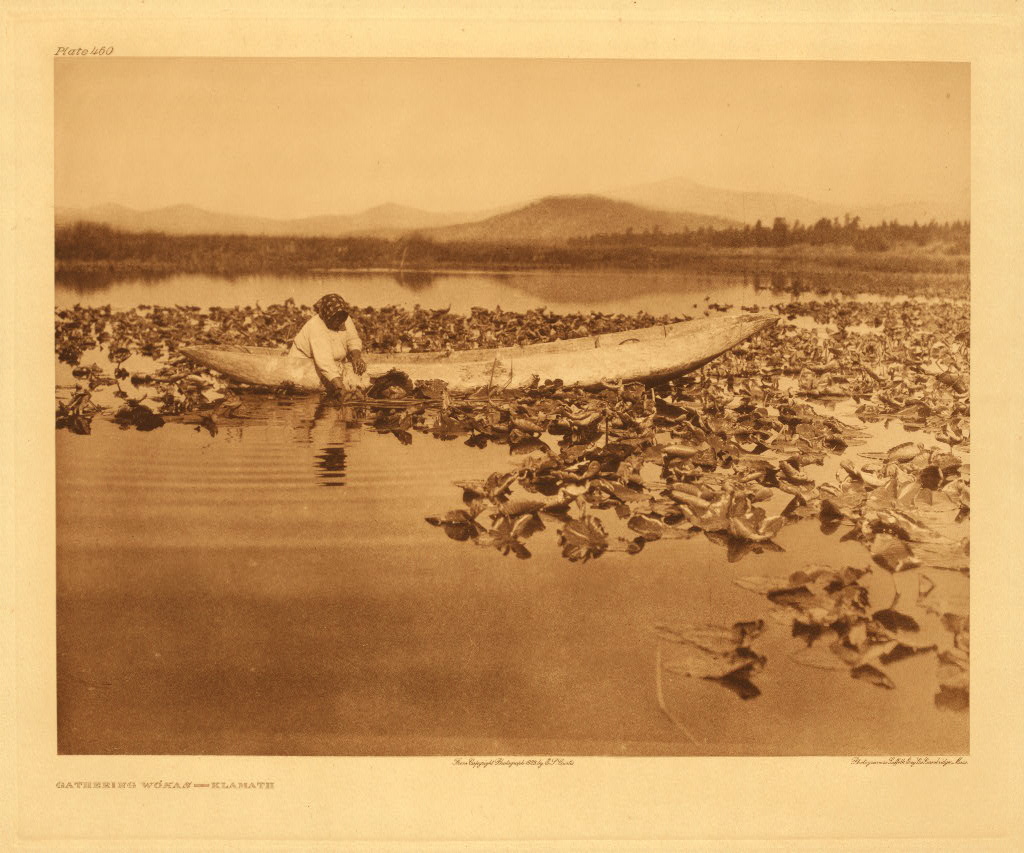
12018-03-16T21:12:19-07:00Erik Loyerf862727c4b34febd6a0341bffd27f168a35aa637Klamath lake marshes1Fairly extensive marshes occur along the shores of Klamath lake, and Klamath marsh covers about a hundred square miles. These areas are the resort of innumerable waterfowl, which were of great importance to the aboriginal Klamath, and thousands of acres were a mass of water-lilies, which yielded in abundance an edible seed.plain2018-03-16T21:12:19-07:00Erik Loyerf862727c4b34febd6a0341bffd27f168a35aa637
12018-03-16T21:12:20-07:00Erik Loyerf862727c4b34febd6a0341bffd27f168a35aa637Yurok drummer1The drum of deerskin stretched over a wooden frame was not aboriginal with the Yurok, but was introduced in imitation of drums seen in the possession of the garrison stationed among the Hupa from 1855 to 1892.plain2018-03-16T21:12:20-07:00Erik Loyerf862727c4b34febd6a0341bffd27f168a35aa637
12018-03-16T21:12:20-07:00Erik Loyerf862727c4b34febd6a0341bffd27f168a35aa637Fish-weir across Trinity River - Hupa1Each summer a substantial structure of this kind is thrown across the river, the southern and the northern divisions of the tribe alternating. The weir remains in place until the spring freshets carry it away. A fisherman stands on each of several platforms erected below an equal number of openings in the weir, and lowers and draws his dip-net at random. As the construction of a weir is a communal undertaking, the catch is divided each evening according to the requirements of the various families.plain2018-03-16T21:12:20-07:00Erik Loyerf862727c4b34febd6a0341bffd27f168a35aa637
12018-03-16T21:12:20-07:00Erik Loyerf862727c4b34febd6a0341bffd27f168a35aa637Gathering wokas - Klamath1Wokas, the seeds of the water-lily, Nymphaea polysepala, is harvested in the latter part of August and throughout September. The nearly ripe pods are plucked and deposited in the canoe, but the mature ones, having burst open, are too sticky to be plucked, and are scooped up in a tule ladle and placed in a basket. After the pods have fermented, the seeds are separated from the mass by stirring in water. They are then dried, parched, hulled, dried again, and stored in bags. Wokas was formerly a staple food, and is still much used as a luxury.plain2018-03-16T21:12:20-07:00Erik Loyerf862727c4b34febd6a0341bffd27f168a35aa637
12018-03-16T21:12:20-07:00Erik Loyerf862727c4b34febd6a0341bffd27f168a35aa637Woman's primitive dress - Tolowa1This is the gala costume of Coast Athapascan women. The ordinary dress was a deerskin kilt with the opening at the front protected by a fringed apron of deerskin or of bark. Ordinarily the feet and the upper part of the body were bare.plain2018-03-16T21:12:20-07:00Erik Loyerf862727c4b34febd6a0341bffd27f168a35aa637
12018-03-16T21:12:20-07:00Erik Loyerf862727c4b34febd6a0341bffd27f168a35aa637Wokas season - Klamath1plain2018-03-16T21:12:20-07:00Erik Loyerf862727c4b34febd6a0341bffd27f168a35aa637
12018-03-16T21:12:20-07:00Erik Loyerf862727c4b34febd6a0341bffd27f168a35aa637Crater Lake1Crater lake, a body of water indescribably blue, occupies an extinct crater in the heart of the Cascade mountains of southern Oregon. It is on the boundary of what was formerly the territory of the Klamath Indians, who held it to be especially potent in conferring shamanistic power upon men who there fasted and bathed. An important Klamath myth seeks to account for the former absence of fish from Crater lake, a condition that was altered in 1888 by the introduction of trout.plain2018-03-16T21:12:20-07:00Erik Loyerf862727c4b34febd6a0341bffd27f168a35aa637
12018-03-16T21:06:48-07:00Erik Loyerf862727c4b34febd6a0341bffd27f168a35aa637Achomawi basket-maker1The Achomawi, or Pit River Indians, produce baskets only by the process known as twining, which is true weaving, never by coiling, which is actually a sewing process. In general their baskets have bottoms and sides slightly rounded, openings broad, and depth rather shallow. The usual materials are willow rods for the warp, or upright elements, and pie-root strands for the weft, or horizontal elements. The structure in the background is a summer hut, a rudely conical or hemispherical tipi covered with tule mats. The workwoman is wearing a rabbit-skin robe.plain2018-03-16T21:06:48-07:00Erik Loyerf862727c4b34febd6a0341bffd27f168a35aa637
12018-03-16T21:12:20-07:00Erik Loyerf862727c4b34febd6a0341bffd27f168a35aa637Fishing platform on Trinity River - Hupa1As the run of spring salmon occurs at a season when the river is too high for the construction of a weir, they are taken in dip-nets from platforms erected above favorable eddies.plain2018-03-16T21:12:20-07:00Erik Loyerf862727c4b34febd6a0341bffd27f168a35aa637
12018-03-16T21:12:21-07:00Erik Loyerf862727c4b34febd6a0341bffd27f168a35aa637Principal female shaman of the Hupa1Many Hupa shamans were women, and among their neighbors, the Yurok and the Karok, as well as among the more distant Wiyot on the coast, male shamans were rare. Hupa shamans acquired the power to cure disease by dreaming and dancing. They were credited with the ability to inflict mysterious sickness by sorcery, and only they could relieve the victim of such magic.plain2018-03-16T21:12:21-07:00Erik Loyerf862727c4b34febd6a0341bffd27f168a35aa637
12018-03-16T21:12:21-07:00Erik Loyerf862727c4b34febd6a0341bffd27f168a35aa637Hupa woman in primitive costume1This is an excellent example of the gala costume of Hupa women. The deerskin skirt is worn about the hips and meets in front, where the opening is covered by a similar garment. Both are fringed and heavily beaded, and the strands of the apron are ornamented with the shells of pine-nuts.plain2018-03-16T21:12:21-07:00Erik Loyerf862727c4b34febd6a0341bffd27f168a35aa637
12018-03-16T21:12:21-07:00Erik Loyerf862727c4b34febd6a0341bffd27f168a35aa637Smelt fisher - Trinidad Yurok1The surf-net used in smelt-fishing is a bag suspended on two diverging poles. At the bottom of the net proper is a restricted opening into a long net-bag, which is held in the fisherman's hand. Dipping and raising his net, he allows the imprisoned smelts to fall down into the bag, where they are securely held until he has enough to justify him in going ashore to empty it.plain2018-03-16T21:12:21-07:00Erik Loyerf862727c4b34febd6a0341bffd27f168a35aa637
12018-03-16T21:12:21-07:00Erik Loyerf862727c4b34febd6a0341bffd27f168a35aa637Chief - Klamath1The subject of this plate, in deerskin suit and feathered war-bonnet of the Plains culture, is shown against a background of Crater lake and its precipitous rim towering a thousand feet above the water.plain2018-03-16T21:12:21-07:00Erik Loyerf862727c4b34febd6a0341bffd27f168a35aa637
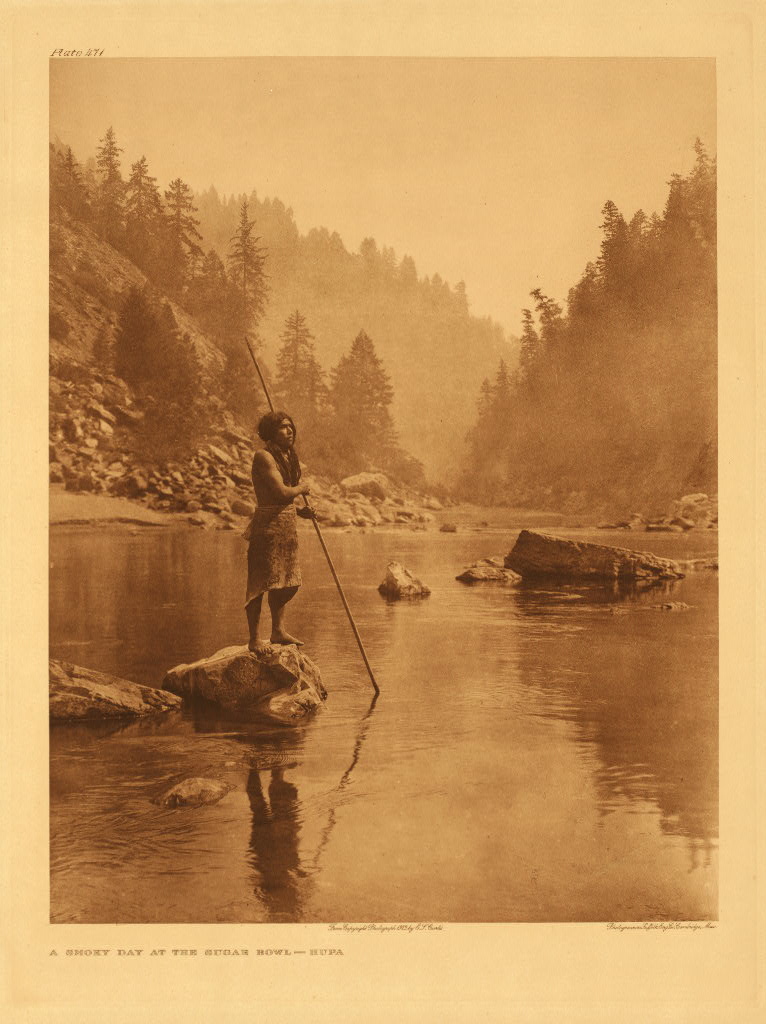
12018-03-16T21:12:21-07:00Erik Loyerf862727c4b34febd6a0341bffd27f168a35aa637Smoky day at the Sugar Bowl - Hupa1For the spring salmon-fishing season the southern division of the Hupa assembled at Sugar Bowl rapids of Trinity river, near the upper end of Hoopa valley. Each fishing station was the hereditary possession of some family. Men who owned no station begged the use of one from those who were either weary of fishing or had enough salmon for their immediate needs.plain2018-03-16T21:12:21-07:00Erik Loyerf862727c4b34febd6a0341bffd27f168a35aa637