Thanks for your patience during our recent outage at scalar.usc.edu. While Scalar content is loading normally now, saving is still slow, and Scalar's 'additional metadata' features have been disabled, which may interfere with features like timelines and maps that depend on metadata. This also means that saving a page or media item will remove its additional metadata. If this occurs, you can use the 'All versions' link at the bottom of the page to restore the earlier version. We are continuing to troubleshoot, and will provide further updates as needed. Note that this only affects Scalar projects at scalar.usc.edu, and not those hosted elsewhere.
Performing ArchiveMain MenuVisualizing the “Vanishing Race”: the photogravures of Edward S. CurtisFront Page for Visualizing the "Vanishing Race" pathCurtis' Image and Life: The Network of The North American Indian, Inc.An experiment with data visualization approach to understand and contextualize Curtis' images and his lifeMedia, Technology and MediationsCurtis's Technology, Relationships to Media and StyleContextualizing Curtis, The North American Indian, and Racethe collection of essays from the contributorsConsulting with Tribes as Part of Archive DevelopmentIntroduction to Consulting with Tribes by Ulia GosartContributing ArchivesInformation on how to participate in Performing ArchiveBrowsing the MediaA path of paths that allow users to cut through the collection in a variety of ways.Acknowledgements and Project InformationProject NetworkJacqueline Wernimontbce78f60db1628727fc0b905ad2512506798cac8David J. Kim18723eee6e5a79c8d8823c02b7b02cb2319ee0f1Stephan Schonberg23744229577bdc62e9a8c09d3492541be754e1efAmy Borsukc533a79d33d48cbf428e1160c2edc0b38c50db19Beatrice Schustera02047525b31e94c1336b01e99d7f4f758870500Heather Blackmored0a2bf9f2053b3c0505d20108092251fc75010bfUlia Gosart (Popova)67c984897e6357dbeeac6a13141c0defe5ef3403
12018-03-16T21:13:12-07:00Erik Loyerf862727c4b34febd6a0341bffd27f168a35aa637Volume Ten Illustrations and Portfolio ImagesErik Loyer1Media Galleriesstructured_gallery2018-03-16T21:13:12-07:00Erik Loyerf862727c4b34febd6a0341bffd27f168a35aa637
Contents of this path:
12018-03-16T21:12:00-07:00Erik Loyerf862727c4b34febd6a0341bffd27f168a35aa637Painting a hat - Nakoaktok1The painter is clad in a short, seamless, cedar-bark cape, which is worn for protection from rain. That she is a woman of wealth and rank is shown by the abalone-shell nose-ornament and the gold bracelets, no less than by her possession of a "chief's hat". These waterproof hats, of a form borrowed from the Haida are made of closely woven shreds of fibrous spruce-roots, and are ornamented with one of the owner's crests - a highly conventionalized painting of some animal or mythological being.plain2018-03-16T21:12:00-07:00Erik Loyerf862727c4b34febd6a0341bffd27f168a35aa637
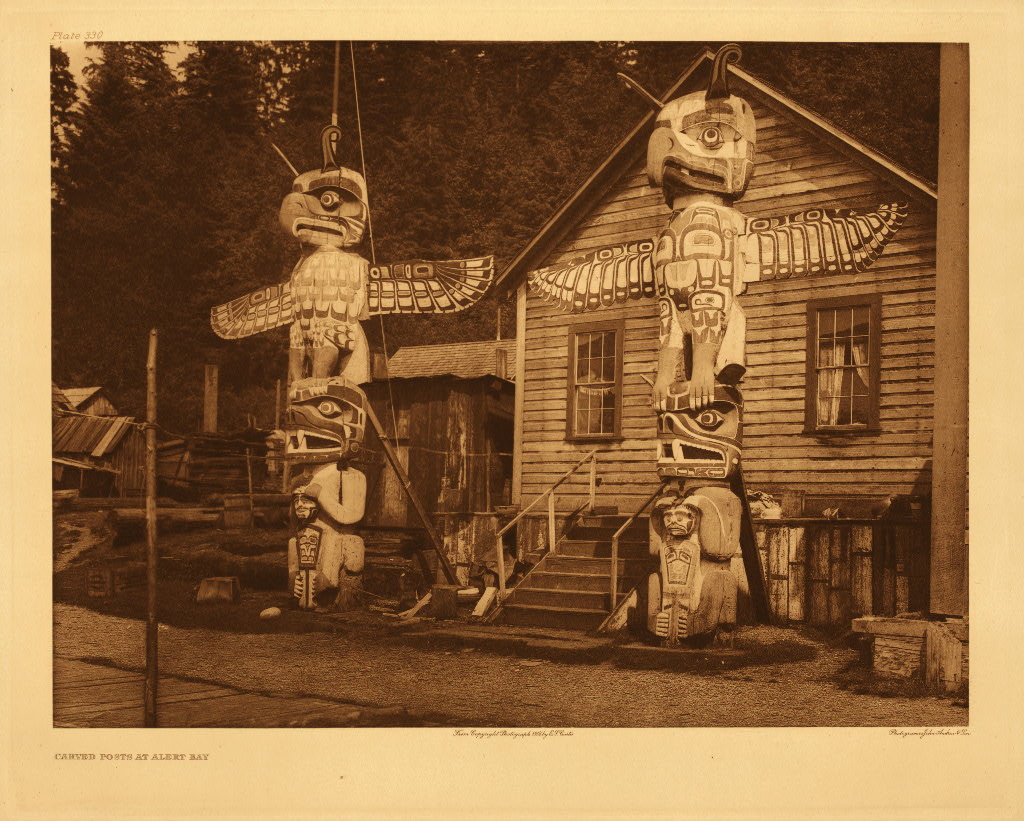
12018-03-16T21:12:00-07:00Erik Loyerf862727c4b34febd6a0341bffd27f168a35aa637Carved posts at Alert Bay1These two heraldic columns at the Nimkish village Yilis, on Cormorant island represent the owner's paternal crest, an eagle, and his maternal crest, a grizzly-bear crushing the head of a rival chief. On the subject of crests and totem poles, see Volume X, page 140, and illustrations facing pages 8,10,18,20,24,26,34,138,140,174,176, and folio plates 341,350,353.plain2018-03-16T21:12:00-07:00Erik Loyerf862727c4b34febd6a0341bffd27f168a35aa637
12018-03-16T21:12:00-07:00Erik Loyerf862727c4b34febd6a0341bffd27f168a35aa637Qa'hila - Koprino1This young chief of an almost extinct tribe resident on Quatsino sound, near the northwestern end of Vancouver island, is wearing one of the nose-ornaments formerly common among Kwakiutl nobility. The dentalium shells of which they consisted were obtained in vast numbers in certain waters of the sound. See Volume X, page 44.plain2018-03-16T21:12:00-07:00Erik Loyerf862727c4b34febd6a0341bffd27f168a35aa637
12018-03-16T21:12:02-07:00Erik Loyerf862727c4b34febd6a0341bffd27f168a35aa637Mowakiu - Tsawatenok1The Tsawatenok are an inland river tribe, depending on the sea for their sustenance much less than do most Kwakiutl tribes, and to an equal degree devoting more time to hunting and trapping in the mountains. Their territory lies along Kingcome river, at the head of the long, mainland indentation known as Kingcome inlet.plain2018-03-16T21:12:02-07:00Erik Loyerf862727c4b34febd6a0341bffd27f168a35aa637
12018-03-16T21:11:06-07:00Erik Loyerf862727c4b34febd6a0341bffd27f168a35aa637Hamasaka in Tlu'wulahu costume with speaker's staff - Qagyuhl1The principal chief of the Qagyuhl is depicted in a "button blanket" (which is simply a woollen blanket ornamented with hundreds of large mother-of-pearl buttons), cedar-bark neck-ring, and cedar-bark head-band. His right hand grasps a shaman's rattle, and his left the carved staff which, as a kind of emblem of office, a man always holds when making a speech. The button designs along the edge of the blanket represent "coppers" (see page 144). The tlu'wulahu ceremony is described on page 243 of Volume X.plain2018-03-16T21:11:06-07:00Erik Loyerf862727c4b34febd6a0341bffd27f168a35aa637
12018-03-16T21:12:03-07:00Erik Loyerf862727c4b34febd6a0341bffd27f168a35aa637Nakoaktok chief's daughter1When the head chief of the Nakoaktok holds a potlatch (a ceremonial distribution of property to all the people), his eldest daughter is thus enthroned, symbolically supported on the heads of her slaves.plain2018-03-16T21:12:03-07:00Erik Loyerf862727c4b34febd6a0341bffd27f168a35aa637
12018-03-16T21:12:03-07:00Erik Loyerf862727c4b34febd6a0341bffd27f168a35aa637Kotsuis and Hohhuq - Nakoaktok1These two masked performers in the winter dance represent huge, mythical birds. Kotsuis (the Nakoaktok equivalent of the Qagyuhl Kaloqutsuis) and Hohhuq are servitors in the house of the man-eating monster Pahpaqalanohsiwi. See page 160. The mandibles of these tremendous wooden masks are controlled by strings.plain2018-03-16T21:12:03-07:00Erik Loyerf862727c4b34febd6a0341bffd27f168a35aa637
12018-03-16T21:12:03-07:00Erik Loyerf862727c4b34febd6a0341bffd27f168a35aa637Coming for the bride1In the bow qunhulahl, a masked man personating the thunderbird, dances with characteristic gestures as the canoe approaches the bride's village.plain2018-03-16T21:12:03-07:00Erik Loyerf862727c4b34febd6a0341bffd27f168a35aa637
12018-03-16T21:12:04-07:00Erik Loyerf862727c4b34febd6a0341bffd27f168a35aa637Chief's party - Qagyuhl1plain2018-03-16T21:12:04-07:00Erik Loyerf862727c4b34febd6a0341bffd27f168a35aa637
12018-03-16T21:12:04-07:00Erik Loyerf862727c4b34febd6a0341bffd27f168a35aa637On the beach - Nakoaktok1This high-born clam-digger is wearing aboriginal costume consisting of a cedar-bark blanket, used as a robe, a cedar-bark rain-cape, a spruce-root "chief's hat", and woollen ankle-bands.plain2018-03-16T21:12:04-07:00Erik Loyerf862727c4b34febd6a0341bffd27f168a35aa637
12018-03-16T21:12:04-07:00Erik Loyerf862727c4b34febd6a0341bffd27f168a35aa637In Kwakiutl waters1In a characteristic setting is shown a fleet of the beautifully modelled Kwakiutl canoes, manned by crews in aboriginal dress.plain2018-03-16T21:12:04-07:00Erik Loyerf862727c4b34febd6a0341bffd27f168a35aa637
12018-03-16T21:12:04-07:00Erik Loyerf862727c4b34febd6a0341bffd27f168a35aa637Koskimo house-post1The huge, grotesquely carved interior supporting columns are the most striking feature of Kwakiutl houses. The figures perpetuate the memory of incidents in the legendary history of the family, frequently representing a tutelary spirit of the founder.plain2018-03-16T21:12:04-07:00Erik Loyerf862727c4b34febd6a0341bffd27f168a35aa637
12018-03-16T21:12:05-07:00Erik Loyerf862727c4b34febd6a0341bffd27f168a35aa637Kwakiutl house-frame1The two long beams in the middle are twin ridge-timbers, which are supported in the rear, as in the front, by a transverse beam resting on two uprights. At the extreme right and left are the eaves-timbers. The longitudinal and circular flutes of the columns are laboriously produced by means of a small hand-adze of primitive form. This frame is at the village Memkumlis. Another view is given in the illustration facing page 36. Kwakiutl houses are discussed on page 6.plain2018-03-16T21:12:05-07:00Erik Loyerf862727c4b34febd6a0341bffd27f168a35aa637
12018-03-16T21:11:06-07:00Erik Loyerf862727c4b34febd6a0341bffd27f168a35aa637Wedding party - Qagyuhl1After the wedding ceremony at the bride's village the party returns to the husband's home. The newly married pair stand on a painted "bride's seat" in the stern of the canoe, and the bridegroom's sister or other relative, dances on a platform in the bow, while the men sing and rhythmically thump the canoes with the handles of their paddles.plain2018-03-16T21:11:06-07:00Erik Loyerf862727c4b34febd6a0341bffd27f168a35aa637
12018-03-16T21:12:05-07:00Erik Loyerf862727c4b34febd6a0341bffd27f168a35aa637Yakotlus - Quatsino, profile1In physique and intelligence the Quatsino seem inferior to the other Kwakiutl tribes. This plate illustrates the artificial deformation of the head, which formerly was quite general on the North Pacific coast. The process is described in Volume X, page 52.plain2018-03-16T21:12:05-07:00Erik Loyerf862727c4b34febd6a0341bffd27f168a35aa637
12018-03-16T21:12:06-07:00Erik Loyerf862727c4b34febd6a0341bffd27f168a35aa637Nimkish village at Alert Bay1The figure at the bottom of the column in the foreground, with the painting on the front of the house, represents a raven. When a feast or a dance is to be held in this house, the guests enter through the raven's beak, the lower mandible of which swings up and down on a pivot. When a guest steps beyond the pivot, his weight caused the beak to clap shut, and thus the mythic raven symbolically "swallows" the tribesman one by one. A view from the other end of this street is shown in the illustration facing page 8, Volume X.plain2018-03-16T21:12:06-07:00Erik Loyerf862727c4b34febd6a0341bffd27f168a35aa637
12018-03-16T21:12:06-07:00Erik Loyerf862727c4b34febd6a0341bffd27f168a35aa637Masked dancers in canoes - Qagyhl, A1Visitors approaching a village where the winter dance is in progress sometimes array themselves in their ceremonial costumes, and dance while the canoes slowly move shoreward. From left to right the dancers represent respectively Wasp, Thunderbird, and Grizzly-bear.plain2018-03-16T21:12:06-07:00Erik Loyerf862727c4b34febd6a0341bffd27f168a35aa637
12018-03-16T21:12:06-07:00Erik Loyerf862727c4b34febd6a0341bffd27f168a35aa637Rounding into port - Qagyhl1The primitive Kwakiutl sail for canvas was a sheet of cedar-bark matting, and on catamarans a large, square section of thin boards was propped up against the wind. Canvas is now used. The painting on the canoe at the left represents "sisiutl", the mythical double-headed serpent. The carved figure-heads of the middle canoe and the one on the right are respectively an eagle and a bear. The bear canoe is further embellished with highly conventionalized paintings of the head, flipper and tail of a whale.plain2018-03-16T21:12:06-07:00Erik Loyerf862727c4b34febd6a0341bffd27f168a35aa637
12018-03-16T21:12:06-07:00Erik Loyerf862727c4b34febd6a0341bffd27f168a35aa637Qagyuhl village at Fort Rupert1This village of Tsahes was founded in 1849, when the tribe abandoned Kalokwis, on Turnour island, in order to be near the Hudson's Bay Company post which was then established at Fort Rupert, on Vancouver island. The heraldic column in the foreground commemorates the legendary history of a Tsimshian family. Its presence in the Kwakiutl settlement is due to the following circumstances: A party of Seattle men, cruising in Alaska, innocently removed a totem pole from what they supposed was an abandoned village, and placed it in a public square of their city. In reality the inhabitants of the Alaskan village were only temporarily absent, and when they returned and learned of the spoliation, there was a many-voiced protest, the echoes of which finally reached even Fort Rupert. Here was living a prominent member of the wronged family, the aged Tsimshian widow of a former employee of the Hudson's Bay Company. In order to wipe out the stain in the family name, she had a local carver produce a totem pole according to her description of the lost one, and cause it to be erected at the house of her eldest son's eldest son.plain2018-03-16T21:12:07-07:00Erik Loyerf862727c4b34febd6a0341bffd27f168a35aa637
12018-03-16T21:12:06-07:00Erik Loyerf862727c4b34febd6a0341bffd27f168a35aa637Koskimo woman1The head is a good illustration of the extremes to which the Quatsino Sound tribes carried the practice of artificially lengthening the skulls of their infants.plain2018-03-16T21:12:06-07:00Erik Loyerf862727c4b34febd6a0341bffd27f168a35aa637
12018-03-16T21:12:07-07:00Erik Loyerf862727c4b34febd6a0341bffd27f168a35aa637Dancing to restore an eclipsed moon - Qagyuhl1It is thought that an eclipse is the result of an attempt of some creature in the sky to swallow the luminary. In order to compel the monster to disgorge it, the people dance round a smoldering fire of old clothing and hair, the stench of which, rising to his nostrils, is expected to cause him to sneeze and disgorge the moon.plain2018-03-16T21:12:07-07:00Erik Loyerf862727c4b34febd6a0341bffd27f168a35aa637
12018-03-16T21:12:07-07:00Erik Loyerf862727c4b34febd6a0341bffd27f168a35aa637Sailing - Qagyuhl1The canoe in the foreground, fifty-five feet in length overall, is probably the largest native craft now in existence on the North Pacific coast, and it is doubtful if any canoe of greater size was ever made in this region.plain2018-03-16T21:12:07-07:00Erik Loyerf862727c4b34febd6a0341bffd27f168a35aa637
12018-03-16T21:11:06-07:00Erik Loyerf862727c4b34febd6a0341bffd27f168a35aa637Masked dancers - Qagyuhl1The plate shows a group of masked and costumed performers in the winter ceremony. The chief who is holding the dance stands at the left, grasping a speaker's staff and wearing cedar-bark neck-ring and head-band and a few of the spectators are visible at the right. At the extreme left is seen a part of the painted mawihl through which the dancers emerge from the secret room; and in the centre, between the carved house-posts, is the Awaitlala hams'pek, showing three of the five mouths through which the hamatsa wriggle from the top to the bottom of the column. See page 175 and footnote.plain2018-03-16T21:11:06-07:00Erik Loyerf862727c4b34febd6a0341bffd27f168a35aa637
12018-03-16T21:12:07-07:00Erik Loyerf862727c4b34febd6a0341bffd27f168a35aa637Passing a dreaded point1Precipitous cliffs such as this are especially feared in rough weather, and the steersman usually supplicates the genius loci under the title of Numas ("old man").plain2018-03-16T21:12:07-07:00Erik Loyerf862727c4b34febd6a0341bffd27f168a35aa637
12018-03-16T21:12:07-07:00Erik Loyerf862727c4b34febd6a0341bffd27f168a35aa637Bridal group1The bride stands in the middle between two dancers hired for the occasion. Her father is at the left, and the bridegroom's father at the right behind a man who presides over the box-drum.plain2018-03-16T21:12:08-07:00Erik Loyerf862727c4b34febd6a0341bffd27f168a35aa637
12018-03-16T21:12:08-07:00Erik Loyerf862727c4b34febd6a0341bffd27f168a35aa637Masked dancers in canoes - Qagyuhl, B1plain2018-03-16T21:12:08-07:00Erik Loyerf862727c4b34febd6a0341bffd27f168a35aa637