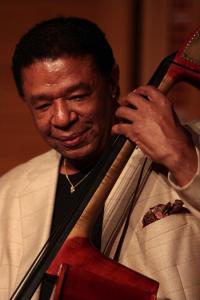
Buster Williams
Biography
Charles Anthony “Buster” Williams was born to Charles Anthony Williams Sr. and Gladys Williams on April 17, 1942 in Camden, New Jersey. His mother worked as a seamstress in Camden while his father worked various jobs during the day and would play jazz gigs with a number of different groups to fulfill his passion for playing jazz. Charles Anthony Williams Sr.’s passion for jazz bass metamorphosed into a teacher-student relationship between him and his son, Buster. As a adolescent, Buster recalls after school he “was suppose to practice, and then [his father] would listen while eating his dinner.” Buster’s admiration for his father motivated him to practice while Charles Anthony Williams Sr. lovingly pushed his son to become a talented jazz bassist, “It was an unwritten law that I had to play it right or hear about it [from his father]. I was going to be the best”.
In 1959, at the age of 17, Williams began to play with Jimmy Heath’s quartet which included a talented rhythm section including Samuel “Sure-Footed Sam” Dockery on piano and Charles “Specs” Wright on drums. After graduating high school in 1960, Buster Williams hit the road for a year, traveling with a new group including Gene Ammons and Sonny Sitt throughout the country. However, Williams found himself stranded in Kansas City in 1961 after Ammons off with the group’s earnings. Upon returning home, the young bassist decided to take courses in Composition, Harmony and Theory at Combs College of Music in Philadelphia. Williams joined up with a the group the Gerald Price Trio and quickly hired by Dakota Staton. This led to Williams making his first European tour in 1962 when the group joined Betty Carter and Sarah Vaughan. During his European tour, Williams met jazz icons such as Miles Davis, Ron Carter, Herbie Hancock, George Coleman and Tony Williams who have influenced his playing style ever since.
In 1964, Williams joined the vocalist Nancy Wilson, and moved to Los Angeles where he met and married his wife, Veronica Williams. During his time working with Wilson, Williams produced six albums while simultaneously producing several albums with Miles Davis. In 1968, Williams returned to New York. Upon his return he joined up with Art Blakey, Herbie Mann, Herbie Hancock and Mary Lou Williams, together forming the Herbie Hancock Sextet.
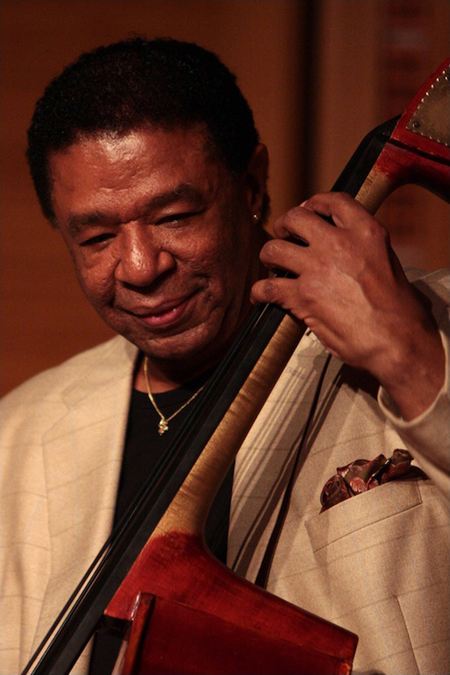
After joining the Sextet, Williams’ notoriety and popularity grew rapidly. In 1980, Williams was nominated for a Grammy Award for his work on the album "Love For Sale"/The Great Jazz Trio. He was featured in several commercials and hired to produce movie soundtracks. In 1991, Williams was presented with a National Endowment for the Arts grant as well as a New York for the Arts Fellowship Grant. The grant money helped Buster Williams construct the Buster Williams Quintet named “Something More”. In his own words; “After working almost continuously for 30 years as a sideman I decided it was time to take the plunge, step up to the front, play my music, and express my concept of a cohesive musical unit. I've served my apprenticeship under many great masters and feel that it's my honor and privilege to carry on the lineage that makes this music such an artistically rich art form”. Today, Williams continues to record and tour with his band “Something More”, consistently producing hits such as "Enchanted Flower". The 75 year old continues to be happily married to his Veronica and makes his home in his childhood town of Camden, NJ.
Buster Williams on Mentorship
Previous Page
Next Page
This page has paths:
- Conclusion Charles Feinberg
- Our Other DH Method Dylan Thies