Thanks for your patience during our recent outage at scalar.usc.edu. While Scalar content is loading normally now, saving is still slow, and Scalar's 'additional metadata' features have been disabled, which may interfere with features like timelines and maps that depend on metadata. This also means that saving a page or media item will remove its additional metadata. If this occurs, you can use the 'All versions' link at the bottom of the page to restore the earlier version. We are continuing to troubleshoot, and will provide further updates as needed. Note that this only affects Scalar projects at scalar.usc.edu, and not those hosted elsewhere.
US Latinx Activism and Protests: From the Farm to the (Legislative) Table
Main Menu
Collection
Media Thumbnails
Hashtag Description
Art produced during the Chicanx Movement
Abstract: In the midst of change, The Chicanx Movement was a monumental time for Mexican Americans in the United States during the late 1960s. The movement addressed the social, economic, and political inequalities experienced by Mexican Americans across the nation. Aimed to celebrate and acknowledge cultural pride and identity, the movement also sought to reclaim and celebrate Mexican and Mexican American history, art, and culture. The Chicanx Movement played a significant role in shaping the Latino identity and influencing subsequent social justice movements, and the artwork produced during this time allowed for many to voice their opinions on the political and social climate of the U.S during the time.
Chicano Moratorium
Examining the causes, events, and leaders of the Chicano Moratorium #chicanx #feminism #movement
LA Demonstrations During the Chicano Movement
Abstract: The Chicano Movement was a movement that involved Mexican-Americans all over the United States and was a crucial component to establishing civil rights for Latinos. While Chicanos living in the United States were at the focal point of discrimination in society, they figured that it was best to come together and establish a sense of familiarity in order to combat these racial remarks and disadvantages. To spark attention to their cause and movement, many Chicanos participated in numerous demonstrations and while many were peaceful, many considered them as radical. By Steve, Lexi, and Ricardo
Bracero Program
In this project we will be analyzing a number of facets of the Bracero Program with a specific focus on the causes, on both sides of the border, which culminated in the agreement. Consequently, we will explore the historical context of the US and Mexico of the first half of the twentieth century, including the impact of the Mexican Revolution as well as the dire situation brought about by the second world war. By utilizing this basis we will then analyze the “migration aspect” entailed by the program, travel from Mexico to the US and various territories. Not only as an in depth look at the agreement, but also as a necessary foundation. One which will permit the Bracero Program to be positioned in history, while simultaneously deepening the exposition and understanding of a largely forgotten case of large-scale abuse and exploitation. We anticipate this will form the backbone of the examination of bracero experiences: first-hand accounts and testimonials.. By Fernando, Joy and Lizeth
Migration in the United States
The United States has often been called a "nation of immigrants," here we observe specific instances of migration policy within the United States and how certain themes regarding immigrants have changed or been maintained. By: Zulema Arguello, Sofia Perez Valles, and Natalie Manzo-Silva
Guatemalan Genocide & Its Dark Truth
This page will focus on the Guatemalan genocide, a period of brutal violence that brought tremendous adversity to those indigenous communities residing in the rural areas of Guatemala. It will provide details regarding the atrocities that the Mayan people experienced, the trauma that was left behind, and the hardships that they continue to face today. Furthermore, it will demonstrate how this heinous period of history fostered activism and social movements in Guatemala. By Paola Chavarria and & Aurora Nieves
Chicano Farm Worker Movement
In this project, we will be discussing about the Chicano Farm Worker Movement and how it brought change to not only farm workers but to society as a whole. We will be focused on the working conditions of farm workers prior and after the movement, notable or influential leaders, and the communities that were fueling the movement. By examining their struggles, successes, and legacy, we wanted to provide a better understanding of the process needed to advocate and bring forth social change for a marginalized group of people. Last, we wanted to remove stereotypes and other misconceptions about the movement in creating a more equitable society. Por: Justin Bui, Kristi Kang, Jenniffer Young
Las "Brujas" Feministas: Magazines, Art, and Television
This project intends to provide a comprehensive analysis of women's representation in different mediums such as art, television, and fanzines. In this way, the goal is to understand the gender stereotypes that women have had to overcome from a feminist perspective. Through this discussion, the hope is to amplify women's voices to promote inclusive and equitable representation in society. By Claudia Mejia, Janet Landa, Diana Andrade
Young Lords Party
The Young Lords Party was founded at the peak of the 1960s political and civil rights movement in the United States. With a focus on empowering Puerto Ricans while embracing other Latinx communities, the Young Lords Party sought to effect change and fight systematic oppression faced by marginalized groups. By Isha Das, Hayden Holliman, Carli Meinert & Elise Oliver
Walkouts and Protests in Los Angeles
On our page, we will discuss the walkouts and protests that took place within schools and communities across Los Angeles. The school protests happened because Latino students wanted to see a change in the education system. Some of the changes Latino students wanted to see implemented were hiring more Chicano professors and administrators, having more Chicano Studies classes in higher education, and overall being treated better without discrimination or judgment. In the 1960s, high school students faced racism and discrimination, which included a lack of education and insufficient school buildings in comparison to those of white students in the area. Walkouts famously took place at Roosevelt High School in Los Angeles, where there was a large population of Latino students. In 1993, college students also faced a lack of Chicano education when budget cuts put the Chicano classes at UCLA at risk of being shut down. This led to a hunger strike, where UCLA students protested and ultimately helped to establish the UCLA César E. Chávez Department of Chicana/o Studies. In the years leading up to 1965, Latino and Black communities also protested because they wanted to see a change in the way they were treated. The Black community finally had enough in 1965 and the Watts Riots happened, which in the end led to positive changes in their community. By Sydney Schwinger, Vanessa Harris, Jazmin Chavez
Adelmar Ramirez
a4bf3b19b77c9f4b12cc64aa3ed1a273dcebf85a
Claudia Mejia
c8d5e93b01e3f9e266d0698f4d3de7d098913509
Carli Meinert
258799133757c0fd900724ba1b9346b0c7ff2c0e
Sydney Schwinger
2fd30160d375f5f2dfdfa669e9993981ebe70bcc
Vanessa Harris
656d617b1ff5827b07c62075e95fef74f9368ceb
Lindsay Beckwith
ca6ef940737c47da9507e08247a0b0c63917c9b9
Diana Andrade
f50468ff8545a3ba106daa74d52fc677790ce4bb
Hayden Holliman
e670fc01e2419044e98b24b13def84be8a2daff6
Gabrielle Siegel
9a507b217b1781c2f2905a7761c7fc6faa7862a7
Steve Mauricio Flores
d666c7384100e9fa0c5e0dd27e74164002382e77
Isha Das
dfc8e2b93311c6226f47b5074510c9618ffb947e
Ricardo Alvarado-Contreras
d4a1e6b9711759f7210bdf8ad6f288d0f9049195
Claire Saguy
962579d84737790111312949a61f6c7c45818d27
Natalie Manzo-Silva
4c0593bd11306e96ee9cbaa10ba0a90dccc3f9d4
Paola Chavarria
5f8100958653707124d6e7eca289a43139a83ef2
Kristi Kang
8eb7e15487a34d9b2b1347f3e789aeac93335bfc
Sofia Perez Valles
3522f3aecc69e345cd2128f1ced5df44b9a92328
Maria Hernandez
8c5d3a6c8021c0623f5c8be8fd20d720c5c8beca
Jenniffer Young
2be540e74e7b2d2587ec0072a0b4a87b2ec7d833
Zulema Arguello
ddff37d5870110495bbff8ad5a8fa7ba7421913c
Bryan Son-Garcia
5178c21c69f0025ff50e02015b5b0f29755bdbdb
Jazmin Chavez
05e9e811eb2d94af99b241a992aa15cecc97d53f
Elise Oliver
d99044ad38ce76bdbc04601c337e701e6ac85911
Alexis Grimes
e9f6865a1bd4bc705a96159328e67f876af17554
Heewon Kim
649c73d6b31ae76c1fb03b9fded9b226f4931f7d
Lizeth Moran
22a2294fa946d3889af930dda5cc3d46da43145e
Vanessa Salgado
bda00098d30b38b2229c2907b310043e9362a3ab
Fernando Rodriguez
b1dad1f1887e0f69bbc0a767b31d47403f9f3087
Janet Landa
fe3b2d058688f8c7ac74f78a94cf65cbaf4b5190
Breanna Reyes
78c3ec8566df90d8d5e768dcfb0a1f6b51689ead
Aidan Le Francois
ff83062ca83f1fad95f09acddc284f225c049ac9
Justin Bui
e96a3e9a6cc9cb92c35ed87cc7b1858091fa2316
Aurora Nieves
bb509a3272fc336c413bc0b4c29a22b59365bdf7
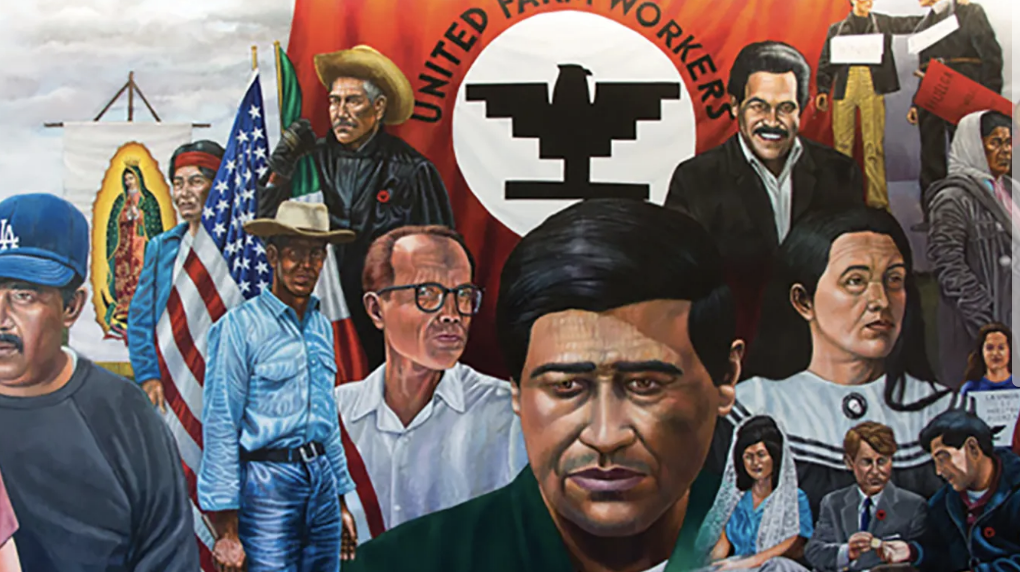
Cesar Chavez Mural (2022)
1 media/Screen Shot 2023-06-06 at 1.38.54 PM_thumb.png 2023-06-06T13:39:20-07:00 Kristi Kang 8eb7e15487a34d9b2b1347f3e789aeac93335bfc 42723 3 Cesar Chavez mural with the United Farm Worker's Association logo in the flag plain 2023-06-06T13:46:29-07:00 Kristi Kang 8eb7e15487a34d9b2b1347f3e789aeac93335bfcThis page has annotations:
- 1 2023-06-06T13:41:58-07:00 Kristi Kang 8eb7e15487a34d9b2b1347f3e789aeac93335bfc Women Kristi Kang 2 #Farmworkers #Protest plain 2023-06-06T13:42:47-07:00 Kristi Kang 8eb7e15487a34d9b2b1347f3e789aeac93335bfc
- 1 2023-06-06T13:40:05-07:00 Kristi Kang 8eb7e15487a34d9b2b1347f3e789aeac93335bfc UFW Logo Kristi Kang 2 #Farmworkers #Protest plain 2023-06-06T13:42:46-07:00 Kristi Kang 8eb7e15487a34d9b2b1347f3e789aeac93335bfc
- 1 2023-06-06T13:41:09-07:00 Kristi Kang 8eb7e15487a34d9b2b1347f3e789aeac93335bfc Farm Worker Kristi Kang 2 #Farmworker #Protest plain 2023-06-06T13:42:46-07:00 Kristi Kang 8eb7e15487a34d9b2b1347f3e789aeac93335bfc
This page is referenced by:
-
1
media/Screen Shot 2023-05-30 at 1.32.06 PM.png
media/download (3).jpg
2023-05-15T11:29:56-07:00
Leaders of the Delano Strike
50
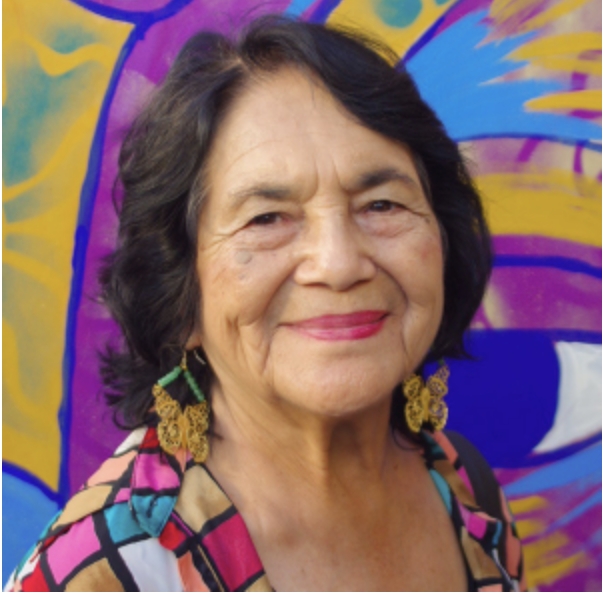
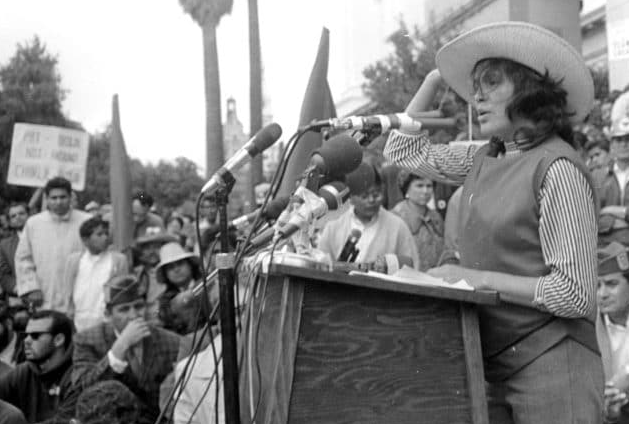
In this page I will be going into depth upon the two leaders of the Delano Strikes, Dolores Huerta and Cesar Chavez. They were two important key figures due to not only their leadership, but upon how they handled the unfair representation of farm workers and fought hard in order to pave the way for a brighter future for the future generations. Por: Kristi Kang
image_header
2023-06-07T10:28:07-07:00
Introduction
Many farm workers suffered from the mistreatment and unfair wages. The migrant farmworkers who sought a better life in the United States were greeted with the cold shoulder from the government. They were left on their own and faced terrible wages and unsustainable working conditions. Some people refused to stay silent during the struggle and banded together in order to fight against the oppression.
Dolores Huerta
Dolores Huerta was a co-founder of the United Farmer Workers Association. She was a prominent leader in the Chicano civil rights movement. She was shaped by discrimination due to her school teacher, prejudiced against the Hispanics, accused her of cheating due to the eloquent way she would write her papers. She would go forward to organize the 1965 Delano Strikes of 5,000 grape workers and was the lead negotiator of the worker's contract. She fought hard for the unemployment and healthcare benefits of the agricultural workers. She led many more boycotts that lead to the formation of a successful union contract by 1970. This soon lead to her forming the California Agricultural Labor Relations Act of 1975 and this allowed for farm workers to form unions and bargain for better wages. Her goal was to improve the workers labor representation and did it in such a way that was successful and allowed for others to improve upon their working conditions.
Her role in the farmworkers movement has been overshadowed due to Cesar Chavez, whom she worked with closely and he was her collaborator and co-founder for the Farm Workers of the American union. She coined the term, "Sí se puede" which means "Yes we can" which holds political significance. It was a term that was part of the struggle of the working-class Latinos. It was the United Farm Worker's Union's rally cry during the 1970s. It was meaningful and meant to inspire the workers to stand up against exploitation and to fight for fair wages and medical and pension wages. This was their challenge to create a better society and to allow others to have equal opportunities to succeed in the nation.
Cesar Chavez
He was a first generation American, and he was born on March 31, 1927 near his family's small homestead in Yuma, Arizona. His family lost their farm during the Great Depression when he was only 11 years old. They became migrant workers and he had to work in the fields full-time to help his family with their finances. He was constantly exposed to the injustices of farm work life and thus, sparked his interest to represent those who are also suffering through the unfairness of the labor system.
He started to start his career in community organizing in 1952 after he was recruited and trained by Fred Ross. Fred Ross was a legendary community organizer who was working to form the San Jose chapter of the Community Service Organization. This was one of the more prominent Latino civil rights groups and Cesar spent 10 years with them. He was able to coordinate campaigns against racial and economic discrimination and organized new CSO opportunities across California. Cesar had the dream to organize a union that would protect and serve his fellow farm workers that they share the same struggles, poverty and powerlessness. He recognized that all the farm workers needed to band together to fight for their rights and to be recognized by the government in order to gain their recognition and help.
Cesar Chavez was the labor union activist for the United Farm Workers. He was deeply inspired by Martin Luther King Jr. and Mahatma Gandhi. He advocated strongly for better wages, safer working conditions, and less exposure to pesticides. He challenged the National Labor Relations Act of 1935, which went against their cause. It was a federal law that did not protect farm workers, thus Cesar and his supporters led boycotts against lettuce, table grapes, and wine to promote their message and to protect the farmers and workers against these unjust laws. He dedicated his life to protecting against the injustice of the labor conditions and he led the Delano grape strike of 1965 - 1970. His acts had allowed for 2.5 million farmworkers to benefit from his struggles and allowed for those to pave a path towards a brighter future.
Conclusion
The farm workers today face better opportunities due to the people that had represented them in the past. Organizations such as the UFW is still around today and they continue to mobilize farm workers to advocate for better policies to represent them.
Citations
Dolores Huerta Foundation (2021). https://www.doloreshuerta.org/doloreshuerta/
Women's history (2015). Edited by Debra Michals. https://www.womenshistory.org/education-resources/biographies/dolores-huerta
Cesar Chavez Foundation (2022). https://chavezfoundation.org/about-cesar-chavez/
Garcia, Kristina (2021). https://voiceofoc.org/2021/03/cesar-chavez-day-orange-county-murals-by-emigdio-vasquez-sr-honor-chavez-and-his-activism/