"Food"
1 2018-03-16T21:12:53-07:00 Erik Loyer f862727c4b34febd6a0341bffd27f168a35aa637 29482 1 plain 2018-03-16T21:12:53-07:00 Erik Loyer f862727c4b34febd6a0341bffd27f168a35aa637This page has paths:
- 1 2018-03-16T21:12:56-07:00 Erik Loyer f862727c4b34febd6a0341bffd27f168a35aa637 Keyword Paths Erik Loyer 1 Explore the Images Through Keywords structured_gallery 2018-03-16T21:12:57-07:00 Erik Loyer f862727c4b34febd6a0341bffd27f168a35aa637
Contents of this path:
-
1
2018-03-16T21:11:19-07:00
Erik Loyer
f862727c4b34febd6a0341bffd27f168a35aa637
Saguaro harvest - Pima
1
The fruit of the saguaro, or giant cactus, called "hasen" by the Pima, forms a very important source of the food supply of the tribes of southern Arizona. This fruit is of about the size of a small pear, and is very sweet. It is eaten fresh, dried, or in the form of syrup, and a sort of wine is made from its juice. In gathering it the natives use a long pole with a wooden blade at the end.
plain
2018-03-16T21:11:19-07:00
Curtis, Edward S. 1868-1952
1907
Digital images of the plates supported by an award from the Library of Congress/Ameritech National Digital Library Competition, and mounted in American Memory. See http://memory.loc.gov/ammem/award98/ienhtml/curthome.html
Digital reproduction of the photomechanical print cp02001 - portfolio 2 plate no. 40 For educational, non-commercial use only. Written permission required for any reproduction beyond fair use. Credit: Northwestern University Library, Edward S. Curtis's "The North American Indian," 2003.
http://digital.library.northwestern.edu/curtis/ The North American Indian (1907-1930) v.02, The Pima. The Papago. The Qahatika. The Mohave. The Yuma. The Maricopa. The Walapai. The Havasupai. The Apache-Mohave, or Yavapai ([Seattle] : E.S. Curtis ; [Cambridge, Mass. : The University Press], 1908), plate no. 40 1 photogravure : brown ink ; 46 x 34 cm [plate size]
Original photogravure produced in Boston by John Andrew & Son http://curtis.library.northwestern.edu/curtis/info.cgi?id=nai.02.port.00000002.p Erik Loyer f862727c4b34febd6a0341bffd27f168a35aa637 -
1
2018-03-16T21:11:21-07:00
Erik Loyer
f862727c4b34febd6a0341bffd27f168a35aa637
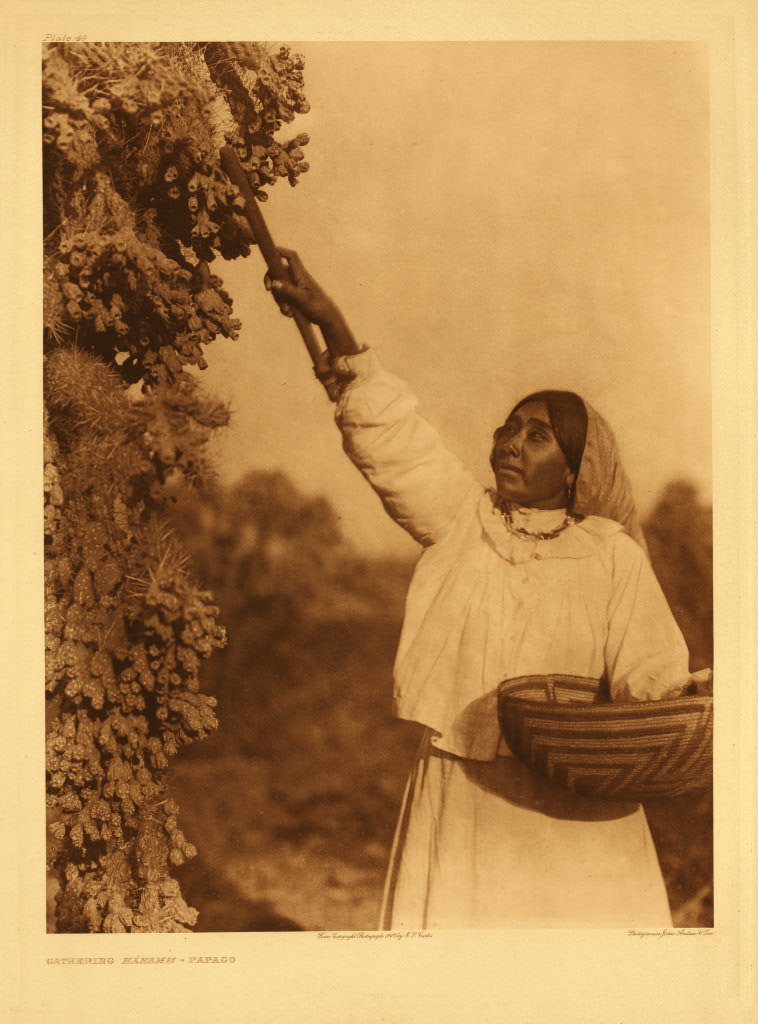
Gathering hanamh - Papago
1
Hanamh is the Piman name for the cholla cactus and its fruit. The natives gather the fruit of this spiny plant in large quantities, and it forms a food of material importance to the several tribes living within its habitat. In gathering it they use rude tongs made from a split stick. After a basket is filled, the fruit is spread on the ground and bushed about with a small, stiff besom until the spines are worn off, or the spines are burned of in an open fire.
plain
2018-03-16T21:11:21-07:00
Curtis, Edward S. 1868-1952
1907
Digital images of the plates supported by an award from the Library of Congress/Ameritech National Digital Library Competition, and mounted in American Memory. See http://memory.loc.gov/ammem/award98/ienhtml/curthome.html
Digital reproduction of the photomechanical print cp02010 - portfolio 2 plate no. 49 For educational, non-commercial use only. Written permission required for any reproduction beyond fair use. Credit: Northwestern University Library, Edward S. Curtis's "The North American Indian," 2003.
http://digital.library.northwestern.edu/curtis/ The North American Indian (1907-1930) v.02, The Pima. The Papago. The Qahatika. The Mohave. The Yuma. The Maricopa. The Walapai. The Havasupai. The Apache-Mohave, or Yavapai ([Seattle] : E.S. Curtis ; [Cambridge, Mass. : The University Press], 1908), plate no. 49 1 photogravure : brown ink ; 46 x 34 cm [plate size]
Original photogravure produced in Boston by John Andrew & Son http://curtis.library.northwestern.edu/curtis/info.cgi?id=nai.02.port.00000011.p Erik Loyer f862727c4b34febd6a0341bffd27f168a35aa637 -
1
2018-03-16T21:12:09-07:00
Erik Loyer
f862727c4b34febd6a0341bffd27f168a35aa637
Seaweed gatherer
1
Seaweed of the genus Porphyra is a favorite food among all the tribes of the North Pacific coast. The green, membranous fronds are gathered in the spring from tidal rocks and are pressed into flat cakes and dried.
plain
2018-03-16T21:12:09-07:00
Curtis, Edward S. 1868-1952
1915
Digital images of the plates supported by an award from the Library of Congress/Ameritech National Digital Library Competition, and mounted in American Memory. See http://memory.loc.gov/ammem/award98/ienhtml/curthome.html
Digital reproduction of the photomechanical print cp11005 - portfolio 11 plate no. 369 Berry-picker – Clayoquot - photogravure plate For educational, non-commercial use only. Written permission required for any reproduction beyond fair use. Credit: Northwestern University Library, Edward S. Curtis's "The North American Indian," 2003.
http://digital.library.northwestern.edu/curtis/ The North American Indian (1907-1930) v.11, The Nootka. The Haida ([Seattle] : E.S. Curtis ; [Cambridge, Mass. : The University Press], 1916), plate no. 369 1 photogravure : brown ink ; 45 x 33 cm [plate size]
Original photogravure produced in Boston by John Andrew & Son http://curtis.library.northwestern.edu/curtis/info.cgi?id=nai.11.port.00000006.p Erik Loyer f862727c4b34febd6a0341bffd27f168a35aa637 -
1
2018-03-16T21:11:13-07:00
Erik Loyer
f862727c4b34febd6a0341bffd27f168a35aa637
Canoeing on Clayoquot Sound
1
Two Hesquiat women are homeward bound with the product of their day's labor in gathering food, and cedar-bark to be used in making mats.
plain
2018-03-16T21:11:13-07:00
Curtis, Edward S. 1868-1952
1915
Digital images of the plates supported by an award from the Library of Congress/Ameritech National Digital Library Competition, and mounted in American Memory. See http://memory.loc.gov/ammem/award98/ienhtml/curthome.html
Digital reproduction of the photomechanical print cp11009 - portfolio 11 plate no. 373 For educational, non-commercial use only. Written permission required for any reproduction beyond fair use. Credit: Northwestern University Library, Edward S. Curtis's "The North American Indian," 2003.
http://digital.library.northwestern.edu/curtis/ The North American Indian (1907-1930) v.11, The Nootka. The Haida ([Seattle] : E.S. Curtis ; [Cambridge, Mass. : The University Press], 1916), plate no. 373 1 photogravure : brown ink ; 35 x 43 cm [plate size]
Original photogravure produced in Boston by John Andrew & Son http://curtis.library.northwestern.edu/curtis/info.cgi?id=nai.11.port.00000010.p Erik Loyer f862727c4b34febd6a0341bffd27f168a35aa637 -
1
2018-03-16T21:12:17-07:00
Erik Loyer
f862727c4b34febd6a0341bffd27f168a35aa637
Karok baskets
1
The basketry of the Karok does not differ from that of the Hupa and the Yurok. The process is always twining, and the usual materials are hazel rod for the warp, roots of the digger or the yellow pine for the weft, and Xerophyllum grass for white overlay, bark of the maidenhair fern for black, and fibres from the stem of Woodwardia fern, dyed in alder-bark juice in the mouth of the workwoman, for red. Represented in the plate are the receptacle for the storage of seeds and nuts, the burden-basket, the winnowing tray, various sizes of mush-baskets and food containers, and the cradle-basket.
plain
2018-03-16T21:12:17-07:00
Curtis, Edward S. 1868-1952
1923
Digital images of the plates supported by an award from the Library of Congress/Ameritech National Digital Library Competition, and mounted in American Memory. See http://memory.loc.gov/ammem/award98/ienhtml/curthome.html
Digital reproduction of the photomechanical print cp13003 - portfolio 13 plate no. 438 For educational, non-commercial use only. Written permission required for any reproduction beyond fair use. Credit: Northwestern University Library, Edward S. Curtis's "The North American Indian," 2003.
http://digital.library.northwestern.edu/curtis/ The North American Indian (1907-1930) v.13, The Hupa. The Yurok. The Karok. The Wiyot. The Tolowa and Tututni. The Shasta. The Achomawi. The Klamath ([Seattle] : E.S. Curtis ; [Cambridge, Mass. : The University Press], 1924), plate no. 438 1 photogravure : brown ink ; 35 x 43 cm [plate size]
Original photogravure produced in Cambridge, Mass. by Suffolk Engraving Co. http://curtis.library.northwestern.edu/curtis/info.cgi?id=nai.13.port.00000004.p Erik Loyer f862727c4b34febd6a0341bffd27f168a35aa637 -
1
2018-03-16T21:12:20-07:00
Erik Loyer
f862727c4b34febd6a0341bffd27f168a35aa637
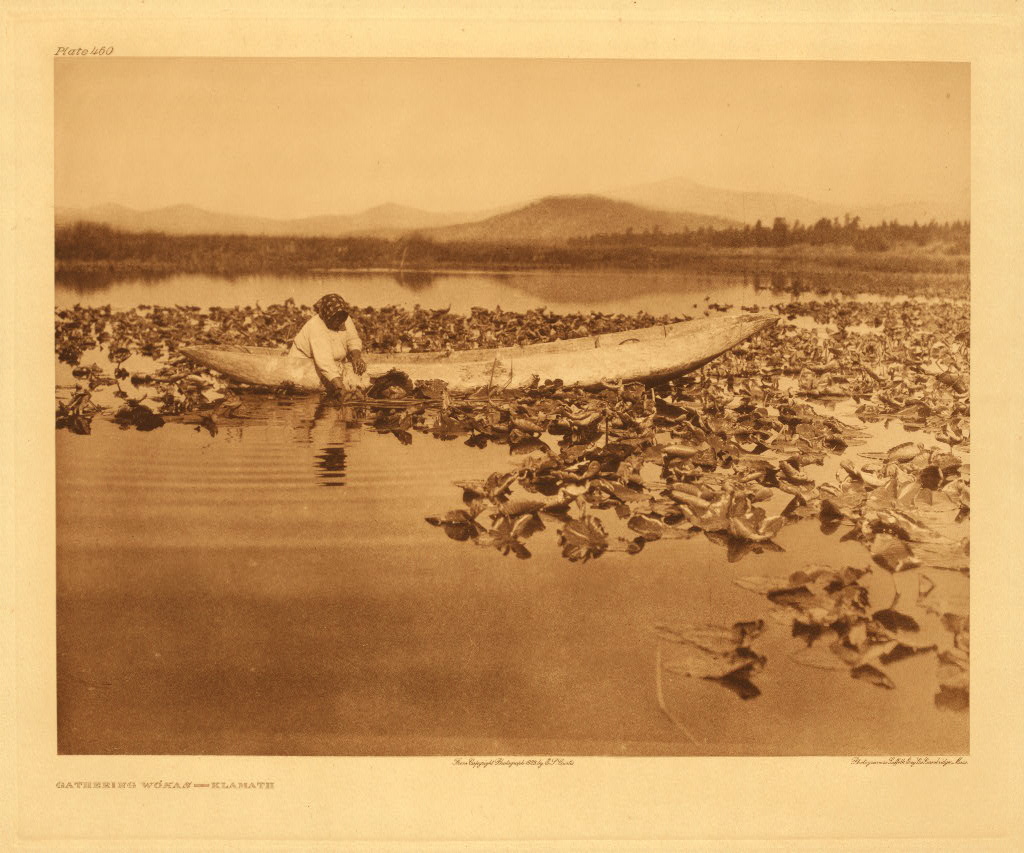
Gathering wokas - Klamath
1
Wokas, the seeds of the water-lily, Nymphaea polysepala, is harvested in the latter part of August and throughout September. The nearly ripe pods are plucked and deposited in the canoe, but the mature ones, having burst open, are too sticky to be plucked, and are scooped up in a tule ladle and placed in a basket. After the pods have fermented, the seeds are separated from the mass by stirring in water. They are then dried, parched, hulled, dried again, and stored in bags. Wokas was formerly a staple food, and is still much used as a luxury.
plain
2018-03-16T21:12:20-07:00
Curtis, Edward S. 1868-1952
1923
Digital images of the plates supported by an award from the Library of Congress/Ameritech National Digital Library Competition, and mounted in American Memory. See http://memory.loc.gov/ammem/award98/ienhtml/curthome.html
Digital reproduction of the photomechanical print cp13025 - portfolio 13 plate no. 460 Gathering wokas – Klamath - photogravure plate For educational, non-commercial use only. Written permission required for any reproduction beyond fair use. Credit: Northwestern University Library, Edward S. Curtis's "The North American Indian," 2003.
http://digital.library.northwestern.edu/curtis/ The North American Indian (1907-1930) v.13, The Hupa. The Yurok. The Karok. The Wiyot. The Tolowa and Tututni. The Shasta. The Achomawi. The Klamath ([Seattle] : E.S. Curtis ; [Cambridge, Mass. : The University Press], 1924), plate no. 460 1 photogravure : brown ink ; 35 x 43 cm [plate size]
Original photogravure produced in Cambridge, Mass. by Suffolk Engraving Co. http://curtis.library.northwestern.edu/curtis/info.cgi?id=nai.13.port.00000026.p Erik Loyer f862727c4b34febd6a0341bffd27f168a35aa637 -
1
2018-03-16T21:12:24-07:00
Erik Loyer
f862727c4b34febd6a0341bffd27f168a35aa637
Rattlesnake design in Yokuts basketry
1
Basketry was the principal, and remains the only, manufacturing industry of the Yokuts. Both the coiled and the twined process are followed, but the better baskets, and by far the greater number, are coiled. The examples shown in the plate are coiled, and of the kind used for cooking liquid foods by means of heated stones.
plain
2018-03-16T21:12:24-07:00
Curtis, Edward S. 1868-1952
1924
Digital images of the plates supported by an award from the Library of Congress/Ameritech National Digital Library Competition, and mounted in American Memory. See http://memory.loc.gov/ammem/award98/ienhtml/curthome.html
Digital reproduction of the photomechanical print cp14029 - portfolio 14 plate no. 500 For educational, non-commercial use only. Written permission required for any reproduction beyond fair use. Credit: Northwestern University Library, Edward S. Curtis's "The North American Indian," 2003.
http://digital.library.northwestern.edu/curtis/ The North American Indian (1907-1930) v.14, The Kato. The Wailaki. The Yuki. The Pomo. The Wintun. The Maidu. The Miwok. The Yokuts ([Seattle] : E.S. Curtis ; [Cambridge, Mass. : The University Press], 1924), plate no. 500 1 photogravure : brown ink ; 46 x 34 cm [plate size]
Original photogravure produced in Norwood, Mass. by Plimpton Press http://curtis.library.northwestern.edu/curtis/info.cgi?id=nai.14.port.00000030.p Erik Loyer f862727c4b34febd6a0341bffd27f168a35aa637 -
1
2018-03-16T21:11:07-07:00
Erik Loyer
f862727c4b34febd6a0341bffd27f168a35aa637
Zuni woman
1
Bowls of food are often thus carried on the head with a woven yucca ring during an intermission in or following a ceremony, when the participants feast.
plain
2018-03-16T21:11:07-07:00
Curtis, Edward S. 1868-1952
1903
Digital images of the plates supported by an award from the Library of Congress/Ameritech National Digital Library Competition, and mounted in American Memory. See http://memory.loc.gov/ammem/award98/ienhtml/curthome.html
Digital reproduction of the photomechanical print cp17035 - portfolio 17 plate no. 614 For educational, non-commercial use only. Written permission required for any reproduction beyond fair use. Credit: Northwestern University Library, Edward S. Curtis's "The North American Indian," 2003.
http://digital.library.northwestern.edu/curtis/ The North American Indian (1907-1930) v.17, The Tewa. The Zuñi ([Seattle] : E.S. Curtis ; [Cambridge, Mass. : The University Press], 1926), plate no. 614 1 photogravure : brown ink ; 46 x 34 cm [plate size]
Original photogravure produced in Cambridge, Mass. by Suffolk Engraving Co. http://curtis.library.northwestern.edu/curtis/info.cgi?id=nai.17.port.0000036.p Erik Loyer f862727c4b34febd6a0341bffd27f168a35aa637 -
1
2018-03-16T21:11:12-07:00
Erik Loyer
f862727c4b34febd6a0341bffd27f168a35aa637
A Chipewyan tipi among the aspens
1
The Chipewyan are one of several Athapascan groups occupying the territory between the Hudson bay and the Rocky mountains, from about the fifty-seventh parallel to the Arctic circle. Much of this area is barren, but the streams that feed and drain the innumerable lakes are bordered by thick groves of the slender, white boles of aspens, whose pleasant glades are favored by camps of fishermen and berrypickers. The Chipewyan dwelling, formerly made of the skins of caribou, on which animal these people principally depended for food, clothing, and shelter, was one of the few points in which their culture resembled that of the plains Indians. Their distinctive garment was a leather or fur coat with skirts cut to a point before and behind, a feature to which the appellation Wichipwayaniwuk ("they pointed fur people"), the Cree original of Chipewyan, alluded.
plain
2018-03-16T21:11:12-07:00
Curtis, Edward S. 1868-1952
1926
Digital images of the plates supported by an award from the Library of Congress/Ameritech National Digital Library Competition, and mounted in American Memory. See http://memory.loc.gov/ammem/award98/ienhtml/curthome.html
Digital reproduction of the photomechanical print cp18001 - portfolio 18 page plate no. 616 For educational, non-commercial use only. Written permission required for any reproduction beyond fair use. Credit: Northwestern University Library, Edward S. Curtis's "The North American Indian," 2003.
http://digital.library.northwestern.edu/curtis/ The North American Indian (1907-1930) v.18, The Chipewyan. The Western woods Cree. The Sarsi ([Seattle] : E.S. Curtis ; [Cambridge, Mass. : The University Press], 1928), plate no. 616 1 photogravure : brown ink ; 45 x 33 cm [plate size]
Original photogravure produced in Cambridge, Mass. by Suffolk Engraving Co. http://curtis.library.northwestern.edu/curtis/info.cgi?id=nai.18.port.00000002 Erik Loyer f862727c4b34febd6a0341bffd27f168a35aa637 -
1
2018-03-16T21:12:41-07:00
Erik Loyer
f862727c4b34febd6a0341bffd27f168a35aa637
As it was in the old days
1
In early days, before white men invaded the Great Plains and ruthlessly slaughtered them by the hundreds of thousands, bison were of prime importance to the hunting tribes of the vast region in which those animals had their range. The bison was not only the chief source of food of the Plains Indians, but its skin was made into clothing, shields, packs, bags, snowshoes, and tent and boat covers; the horns were fashioned into spoons and drinking vessels; the sinew was woven into reatas, belts, personal ornaments, and the covers of sacred bundles; and the dried droppings, "buffalo-chips," were used as fuel. So dependent on the buffalo were these Indians that it became sacred to them, and many were the ceremonies performed for the purpose of promoting the increase of the herds.
plain
2018-03-16T21:12:41-07:00
Curtis, Edward S. 1868-1952
1927
Digital images of the plates supported by an award from the Library of Congress/Ameritech National Digital Library Competition, and mounted in American Memory. See http://memory.loc.gov/ammem/award98/ienhtml/curthome.html
Digital reproduction of the photomechanical print cp19001 - portfolio 19 page plate no. 652 For educational, non-commercial use only. Written permission required for any reproduction beyond fair use. Credit: Northwestern University Library, Edward S. Curtis's "The North American Indian," 2003.
http://digital.library.northwestern.edu/curtis/ The North American Indian (1907-1930) v.19, The Indians of Oklahoma. The Wichita. The southern Cheyenne. The Oto. The Comanche. The Peyote cult ([Seattle] : E.S. Curtis ; [Cambridge, Mass. : The University Press], 1930), plate no. 652 1 photogravure : brown ink ; 35 x 44 cm [plate size]
Original photogravure produced in Cambridge, Mass. by Suffolk Engraving Co. http://curtis.library.northwestern.edu/curtis/info.cgi?id=nai.19.port.00000002 Erik Loyer f862727c4b34febd6a0341bffd27f168a35aa637 -
1
2018-03-16T21:12:44-07:00
Erik Loyer
f862727c4b34febd6a0341bffd27f168a35aa637
Reindeer - Nunivak
1
Formerly caribou were of great importance to the Nunivak Eskimo, both for food and for many utilitarian purposes; but they have been entirely superseded by the reindeer introduced to the island.
plain
2018-03-16T21:12:44-07:00
Curtis, Edward S. 1868-1952
1928
Digital images of the plates supported by an award from the Library of Congress/Ameritech National Digital Library Competition, and mounted in American Memory. See http://memory.loc.gov/ammem/award98/ienhtml/curthome.html
Digital reproduction of the photomechanical print cp20002 - portfolio 20 page plate no. 689 For educational, non-commercial use only. Written permission required for any reproduction beyond fair use. Credit: Northwestern University Library, Edward S. Curtis's "The North American Indian," 2003.
http://digital.library.northwestern.edu/curtis/ The North American Indian (1907-1930) v.20, The Alaskan Eskimo. The Nunivak. The Eskimo of Hooper Bay. The Eskimo of King Island. The Eskimo of Little Diomede Island. The Eskimo of Cape Prince of Wales. The Kotzebue Eskimo. The Noatak. The Kobuk. The Selawik ([Seattle] : E.S. Curtis ; [Cambridge, Mass. : The University Press], 1930), plate no. 689 1 photogravure : brown ink ; 35 x 44 cm [plate size]
Original photogravure produced in Cambridge, Mass. by Suffolk Engraving Co. http://curtis.library.northwestern.edu/curtis/info.cgi?id=nai.20.port.00000003 Erik Loyer f862727c4b34febd6a0341bffd27f168a35aa637 -
1
2018-03-16T21:09:41-07:00
Erik Loyer
f862727c4b34febd6a0341bffd27f168a35aa637
Food caches, Hooper Bay
1
plain
2018-03-16T21:09:41-07:00
Curtis, Edward S. 1868-1952
1928
Digital images of the plates supported by an award from the Library of Congress/Ameritech National Digital Library Competition, and mounted in American Memory. See http://memory.loc.gov/ammem/award98/ienhtml/curthome.html
Digital reproduction of the photomechanical print ct20034 - volume 20 facing: page 96 For educational, non-commercial use only. Written permission required for any reproduction beyond fair use. Credit: Northwestern University Library, Edward S. Curtis's "The North American Indian," 2003.
http://digital.library.northwestern.edu/curtis/ The North American Indian (1907-1930) v.20, The Alaskan Eskimo. The Nunivak. The Eskimo of Hooper Bay. The Eskimo of King Island. The Eskimo of Little Diomede Island. The Eskimo of Cape Prince of Wales. The Kotzebue Eskimo. The Noatak. The Kobuk. The Selawik ([Seattle] : E.S. Curtis ; [Cambridge, Mass. : The University Press], 1930), Facing page 96 1 photogravure : brown ink ; 14 x 19 cm [image size], 18 x 22 cm [plate size]
Original photogravure produced in Cambridge, MA, by Suffolk Engraving Co. http://curtis.library.northwestern.edu/curtis/info.cgi?id=nai.20.book.00000150.p Erik Loyer f862727c4b34febd6a0341bffd27f168a35aa637 -
1
2018-03-16T21:09:45-07:00
Erik Loyer
f862727c4b34febd6a0341bffd27f168a35aa637
Food containers, pokes, Kotzebue
1
plain
2018-03-16T21:09:45-07:00
Curtis, Edward S. 1868-1952
1928
Digital images of the plates supported by an award from the Library of Congress/Ameritech National Digital Library Competition, and mounted in American Memory. See http://memory.loc.gov/ammem/award98/ienhtml/curthome.html
Digital reproduction of the photomechanical print ct20060 - volume 20 facing: page 178 For educational, non-commercial use only. Written permission required for any reproduction beyond fair use. Credit: Northwestern University Library, Edward S. Curtis's "The North American Indian," 2003.
http://digital.library.northwestern.edu/curtis/ The North American Indian (1907-1930) v.20, The Alaskan Eskimo. The Nunivak. The Eskimo of Hooper Bay. The Eskimo of King Island. The Eskimo of Little Diomede Island. The Eskimo of Cape Prince of Wales. The Kotzebue Eskimo. The Noatak. The Kobuk. The Selawik ([Seattle] : E.S. Curtis ; [Cambridge, Mass. : The University Press], 1930), Facing page 178 1 photogravure : brown ink ; 14.2 x 19 cm [image size], 18 x 22 cm [plate size]
Original photogravure produced in Cambridge, MA, by Suffolk Engraving Co. http://curtis.library.northwestern.edu/curtis/info.cgi?id=nai.20.book.00000258.p Erik Loyer f862727c4b34febd6a0341bffd27f168a35aa637 - 1 2018-03-16T21:12:51-07:00 Erik Loyer f862727c4b34febd6a0341bffd27f168a35aa637 The Hopi Maiden and Watching the Dancers 1 part of Visualizing the "Vanishing Race" plain 2018-03-16T21:12:51-07:00 Erik Loyer f862727c4b34febd6a0341bffd27f168a35aa637
- 1 2018-03-16T21:11:11-07:00 Erik Loyer f862727c4b34febd6a0341bffd27f168a35aa637 Chief Josef –Nez Perce 1 Page 2 of Visualizing the "Vanishing Race" plain 2018-03-16T21:11:11-07:00 Erik Loyer f862727c4b34febd6a0341bffd27f168a35aa637
- 1 2018-03-16T21:11:03-07:00 Erik Loyer f862727c4b34febd6a0341bffd27f168a35aa637 Vanishing Race and Cañon de Chelly 1 Page 3 of Visualizing the "Vanishing Race" plain 2018-03-16T21:11:03-07:00 Erik Loyer f862727c4b34febd6a0341bffd27f168a35aa637
- 1 2018-03-16T21:06:48-07:00 Erik Loyer f862727c4b34febd6a0341bffd27f168a35aa637 At the Old Well and A Zuni Woman 1 part of Visualizing the "Vanishing Race" plain 2018-03-16T21:06:48-07:00 Erik Loyer f862727c4b34febd6a0341bffd27f168a35aa637