Third Heading(2)
1 2016-07-29T12:02:29-07:00 Andrea Ledesma 3398f082e76a2c1c8a9101d91a66e1d764540d34 8401 4 plain 2016-09-21T08:57:39-07:00 Andrea Ledesma 3398f082e76a2c1c8a9101d91a66e1d764540d34This page has tags:
- 1 media/ChinaTradeOldChinaSt.jpg 2016-05-04T18:12:50-07:00 Zachary Ziebell 8eecdb2214ffc2e89ec5ed5f180953625d845cc7 The China Trade Era Caroline Frank 20 image_header 281351 2019-08-11T07:44:12-07:00 Caroline Frank a1a5e7e9a2c3dba76ecb2896a93bf66ac8d1635e
This page is referenced by:
-
1
2016-06-24T08:02:30-07:00
Trade-Related Terms
9
plain
2017-02-02T06:07:03-08:00
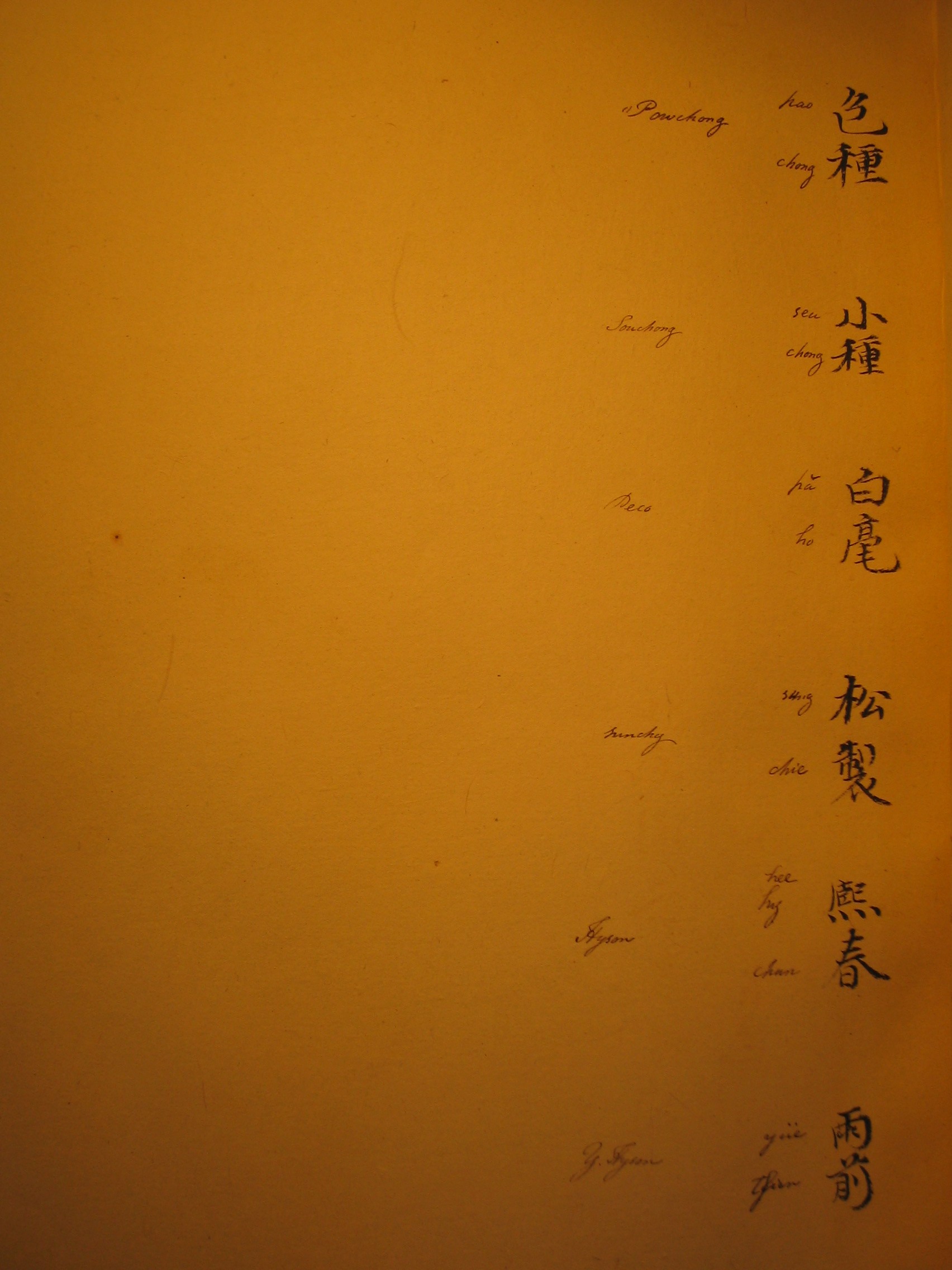
The second section begins with three lists of export goods to three different countries. The first country mentioned is Britain, with the heading “紅毛囯茶名號頭疋頭各布名色 hong mo [english] kuo [country] cha [tea] meung [name] ho tow [chop] pat tow [silk] kǒ [any] po [cloth] mëu̇ng shic [name]” (Names of tea, merchant shops, silk and textile products for the country of the Red-haired people). The goods included are (duplicates are deleted):
包種 pao chong/Powchong;小種 seu chong/Souchong;白毫 pǎ ho/Peco;松製 sung chie/sunchy;熙春 hee {hy} chun/Hyson;雨前 yu̇ë tsien/Y. Hyson;珠茶 chu̇ë cha/Gunpowder;珠蘭 chue lan/Chulan;茶花 cha fa/Tea flower;小種 seau chan/Souchong;熙春 hee chun/Hyson;白毛 pe ho/Parhoo;工夫茶 Confu tea;吧哋唎小種 Padoy Souchong;茶 Tea;鵝眉 Homy;好雨前 Young Hyson;頂上貨 First quality;冰糖 Sugar;送礼 Present;疋頭 silks;梭布 nankins;藍布 Blue;白布 White;縐紗 Show shaw;絲巾 Silk Hkfs (handkerchief);絲帶 Hair ribbons;白八絲 White Satin;元青斜紋 Zwart Satin;白萡絹 White lustring;萡絹 lustring;扎藍 sky blue;口杀頓 satin;沙士訥 Saucenett;青蓮 Laylac;水紅 Pink;白色 White;水綠 Full green;珠色 French Grey
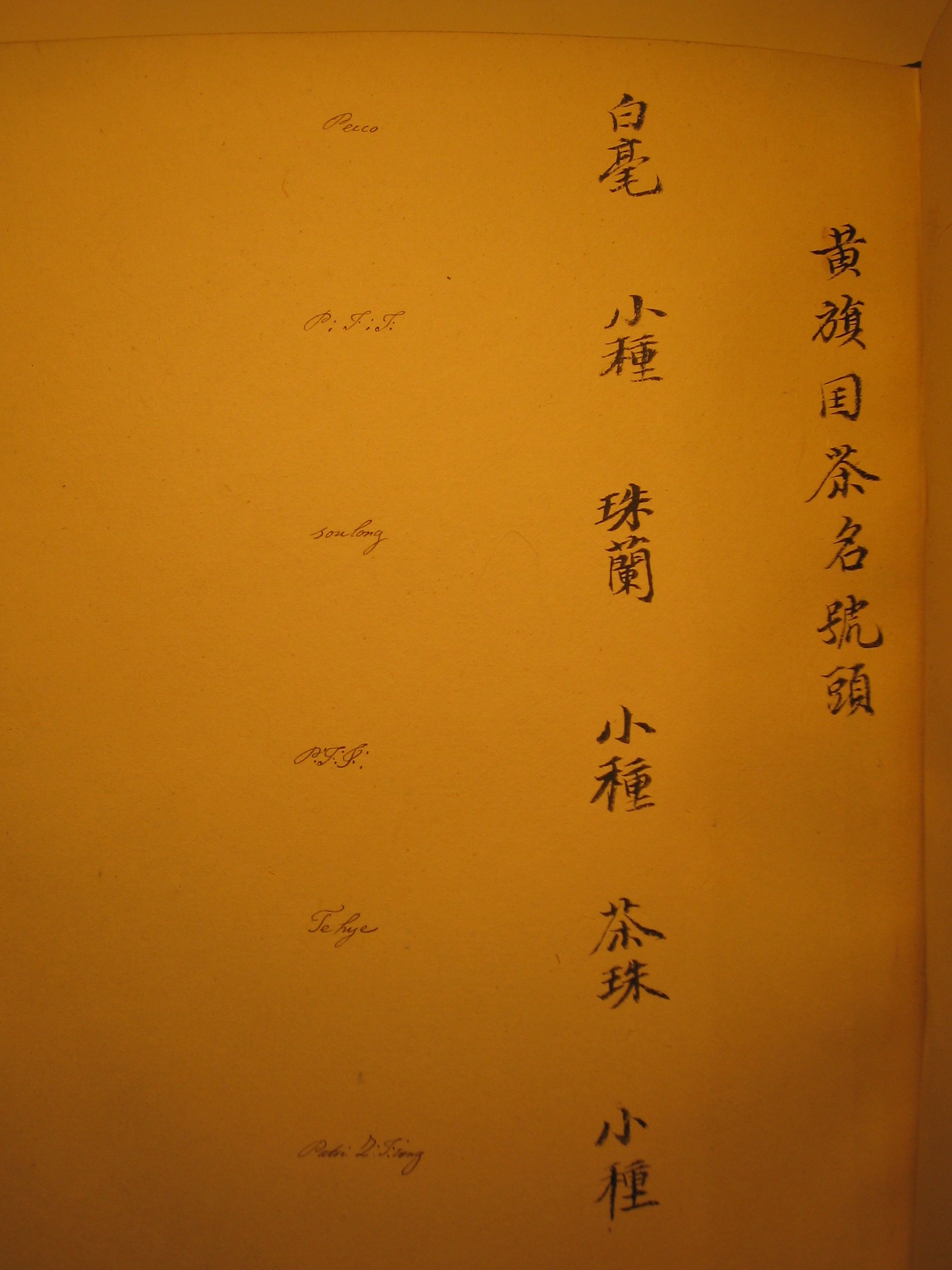
The second country mentioned is Denmark, with the heading “黃旗囯茶名號頭” (Names of tea and merchant shops for the country with Yellow-flag). The goods listed here are comparatively less and some of the names are transliterated differently:白毫 Pecco;小種 P:F:F;珠蘭 soulong;小種 P:F:I:;茶珠 Tehye;小種 Padri Z:F:iong;大黃 Rhubarb;正茶 Haysan;包種 Pow zion;仝上 P:F:;珠蘭 Tehye Tudan;白毫 Pahow;熙春 hysuen
The third country mentioned is France, with the heading “咈囒哂囯茶名號頭” (Names of tea and merchant shops for France). The least goods are listed here.小種 Saolchon;松製 Tha chay;白毫 Pekao;鵞{鵝}眉 hessuenonry(?);珠茶 Wulcha;熙春 hessuen;茶花;珠蘭 Chulan;松製 Son chay
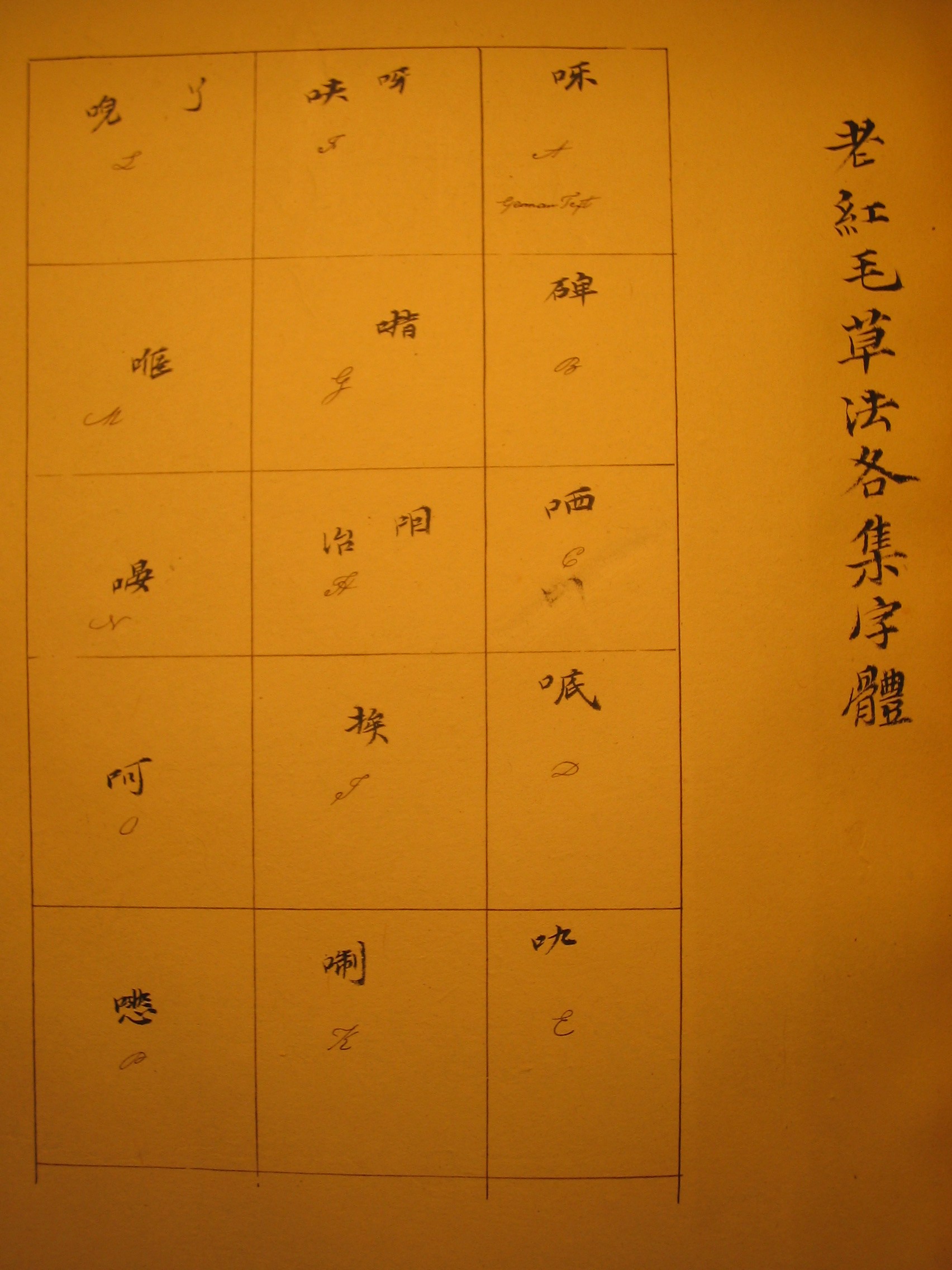
The next part of this section starts with the heading “各茶壹字名” (abbreviations for the names of tea in a single word) and examples are: “熙春 H”, “小種 S”, “珠茶 G”, “白毫 P”, “包種 PZ”, “正號 No”. Although this part has not yet finished, it continues with a four-page introduction to different styles of writing English alphabets. Under the heading “老紅毛草法各集字體” (writing style of all cursive scripts of the old Red-haired people), the writing methods of A to Z (except J) and their Cantonese transliteration are listed, such as “A/呀”.[32] The second heading is “老紅毛草法 lao [old] hong mo cho fat” (cursive scripts of the old Red-haired people), and it again lists the writing methods of A to Z (except J).[33] The third heading is “合字法 hop [pair] tsu fat” (method of pairing words), and it explains “時辰鐘內十二點数定式xi shun [hour] chung noië [clock] xe ee dim chong [clock] tung shick [custom]” (the custom of counting clock time) and the twelve examples are listed as “一/Ⅰ,二/Ⅱ……”.
________________________
[32] The Cantonese transliteration here is different from those provided by “正字法定式讀本”: D: 口底; E: 㕤; G: 口指; K: 口制; L: 丫唲; Q: 㕤; S: 嘻士; T: 哋; W: 急鼻喱呋; Z: 㖇夕. Besides, the alphabet A has a remark that reads: “German Text”.
[33] The Cantonese transliteration here is different from those provided by “正字法定式讀本”: C: 哂; D: 口底; E: 口几; G: 口指; I: 口挨; K: 口制; L: 丫唲; Q: 㕤; S: 嘻士; T: 哋; W: 急鼻喱口士.
.jpg)
.jpg)