Ōno Bakufu (大野麦風)
Ōno Bakufu was an oil painter and print artist who studied at the Hyōgo Prefectural Academy of Fine Arts and later at the Pacific Western-Style Painting Association (Taiheiyōgakai, 太平洋画会). He favored fish and flower prints, with one exceptional series being the Great Japanese Fish Picture Collection published by Kyoto Hanga-in. While Bakufu belonged to the sōsaku hanga (創作版画) movement, which was known for artists producing self-carved woodblocks prints, Bakufu frequently utilized skilled carvers and woodblock printmakers to publish his work.References Guide to Modern Japanese Woodblock Prints: 1900-1975 . Honolulu: University of Hawai’i Press, 1992.Back to Artists in Our Collection
This page has paths:
1
2018-11-30T19:00:49-08:00
MaryJane Eischen
040a3a6e41fd9906ebf9ac0f3949654252ab83ff
Artists in Our Collection
MaryJane Eischen
37
visual_path
848163
2019-04-13T15:10:24-07:00
MaryJane Eischen
040a3a6e41fd9906ebf9ac0f3949654252ab83ff
Contents of this path:
1
media/Masaharu_key.jpg
2018-11-30T18:39:36-08:00
Aoyama Masaharu
9
plain
2019-04-19T17:42:03-07:00
1
media/Benji_key.jpg
2018-11-30T18:39:52-08:00
Asada Benji
8
plain
2019-04-19T17:41:29-07:00
1
media/Harunobu_key.jpg
2018-11-30T18:40:03-08:00
Hishikawa Harunobu
13
plain
2019-04-19T17:44:06-07:00
1
media/Shiro_key.jpg
2018-11-30T18:54:30-08:00
Kasamatsu Shiro
9
plain
2019-04-19T17:45:15-07:00
1
media/Shuntei_key.jpg
2018-11-30T18:59:39-08:00
Miyagawa Shuntei
11
plain
2019-04-19T17:46:29-07:00
1
media/Toshikata_key.jpg
2018-11-30T18:55:15-08:00
Mizuno Toshikata
13
plain
2019-04-19T17:47:28-07:00
1
media/Kunichika_key.jpg
2018-11-30T18:55:34-08:00
Toyohara Kunichika
10
plain
2019-04-19T17:48:34-07:00
1
media/Yoshitoshi_key.jpg
2018-11-30T18:55:45-08:00
Tsukioka Yoshitoshi
23
plain
2019-04-19T17:49:33-07:00
1
media/Kunisada_I_key.jpg
2018-11-30T18:56:07-08:00
Utagawa Kunisada I
12
plain
2019-04-19T17:50:17-07:00
1
media/Nobukazu_key.jpg
2018-11-30T18:56:17-08:00
Yōsai Nobukazu
9
plain
2019-04-19T17:51:11-07:00
1
media/Chikanobu_key.jpg
2018-11-30T17:34:35-08:00
Yōshū Chikanobu
20
plain
2019-04-19T17:52:00-07:00
1
media/Gekkō_key.jpg
2019-02-27T22:00:40-08:00
Ogata Gekkō
9
plain
2019-04-19T17:52:57-07:00
1
media/Bakufu_key.jpg
2019-02-27T22:03:06-08:00
Ōno Bakufu
8
plain
2019-04-19T17:56:11-07:00
1
media/Kunisada_II_key.jpg
2019-02-27T22:06:03-08:00
Utagawa Kunisada II
9
plain
2019-04-19T17:56:59-07:00
1
media/Yoshitora_key.jpg
2019-02-27T22:07:38-08:00
Utagawa Yoshitora
13
plain
2019-04-19T17:57:58-07:00
1
media/Hiroshige_III_key.jpg
2019-02-27T22:04:52-08:00
Utagawa Hiroshige III
8
plain
2019-04-19T17:59:07-07:00
1
media/IMG_0994.jpg
2018-11-13T02:57:07-08:00
Print Collection
69
structured_gallery
816571
2019-05-24T02:48:07-07:00
This page has tags:
1
media/IMG_0994.jpg
2018-11-13T02:57:07-08:00
MaryJane Eischen
040a3a6e41fd9906ebf9ac0f3949654252ab83ff
Print Collection
MaryJane Eischen
69
structured_gallery
816571
2019-05-24T02:48:07-07:00
MaryJane Eischen
040a3a6e41fd9906ebf9ac0f3949654252ab83ff
Contents of this tag:
1
media/Yoshitoshi_key.jpg
2018-11-30T18:55:45-08:00
Tsukioka Yoshitoshi
23
plain
2019-04-19T17:49:33-07:00
1
media/Chikanobu_key.jpg
2018-11-30T17:34:35-08:00
Yōshū Chikanobu
20
plain
2019-04-19T17:52:00-07:00
1
media/Yoshitora_key.jpg
2019-02-27T22:07:38-08:00
Utagawa Yoshitora
13
plain
2019-04-19T17:57:58-07:00
1
media/Harunobu_key.jpg
2018-11-30T18:40:03-08:00
Hishikawa Harunobu
13
plain
2019-04-19T17:44:06-07:00
1
media/Toshikata_key.jpg
2018-11-30T18:55:15-08:00
Mizuno Toshikata
13
plain
2019-04-19T17:47:28-07:00
1
media/Kunisada_I_key.jpg
2018-11-30T18:56:07-08:00
Utagawa Kunisada I
12
plain
2019-04-19T17:50:17-07:00
1
2019-02-15T17:06:54-08:00
The Great Battle at Yashima (1185), B
11
Part of a triptych (center). A print featuring the naval battle at Yashima (屋嶋) (22 March 1185) during the Genpei War (1180–1185), a national civil war between the Taira and Minamoto clans during the late-Heian period of Japan. Following a string of defeats, the Taira clan retreated to Yashima (in today's Takamatsu) off the coast of Shikoku. The ensuing naval battle resulted in a Minamoto victory. It was led by Minamoto no Yoshitsune (on the Minatoto side) and Taira no Munemori and Taira no Noritsune (on the Taira side). Additional notes: Signed Ichimōsai Yoshitora ga (一猛斎芳虎画) in the bottom left. Signature on each sheet. Censor's seals: Muramatsu and Yoshimura. No blockcutter's mark could be identified.
plain
2019-03-08T15:37:04-08:00
1
media/Shuntei_key.jpg
2018-11-30T18:59:39-08:00
Miyagawa Shuntei
11
plain
2019-04-19T17:46:29-07:00
1
media/Kunichika_key.jpg
2018-11-30T18:55:34-08:00
Toyohara Kunichika
10
plain
2019-04-19T17:48:34-07:00
1
2018-11-16T15:17:05-08:00
Spring-Colored Garden in Snow, A
10
Part of a triptych (left). Thirteen women are playing or enjoying music in an interior scene. One woman is playing the koto (琴) (left), one is playing a transverse flute (middle), and one is playing an ichigenkin (一絃琴) or monochord (right). There is a gold-backed floral folding screen (byōbu; 屏風) in the back of the room featuring peony and a pheasant. The windows are open to show a winter garden landscape complete with plum blossoms (ume; 梅). This particular print makes a strong use of akaline red in the carpet and kimono of the women. Additional notes: Signed Chikanobu hitsu 周延筆 with toshidama seal; Blockcutter's mark: Horikô Ginjirô (彫工銀次郎)
plain
2019-03-08T15:46:07-08:00
1
2019-02-19T22:37:40-08:00
Cherry Blossom Viewing, A
10
Part of a triptych (left). A group of court women are enjoying the cherry blossoms (sakura, 桜) on a spring day. Mt. Fuji (富士山) can be seen in the background. The women hail from the court of the Tokugawa shogunate shown by the repeating Tokugawa clan seal (mon, 紋) on the umbrellas (three hollyhock leaves inside of a circle). 16 women are pictured in total, and women in the middle and left panels seem to be playing a game together which involves being blindfolded. Additional notes: Signed Yōshū Chikanobu (楊洲周延) on the right panel; Publisher's seal: Fukuda Kumajirō (福田熊次郎) in a fish-shaped seal on the left panel; Blockcutter's mark seems like it might be present on left panel, but unidentified. The Chiyoda Inner Palace (Chiyoda no Ōoku) series of 1895-1896, together with his 1897 series Chiyoda Outer Palace (Chiyoda no on-omote) provided detailed depictions of life in and around Edo Castle before the Meiji Restoration of 1868. In the Chiyoda Inner Palace set, Chikanobu documented various annual ceremonies in the women’s quarters, especially those at New Year’s, and seasonal activities, particularly those conducted in the palace gardens. While Chikanobu did not indicate specific events or name certain people that would link these images to a single date or time period, the scenes give an overall impression of what the shogun’s private quarters might have looked like in the mid-19th century.
plain
2019-03-08T15:22:40-08:00
1
2019-02-19T22:20:06-08:00
Cherry Blossom Viewing, B
10
Part of a triptych (center). A group of court women are enjoying the cherry blossoms (sakura, 桜) on a spring day. Mt. Fuji (富士山) can be seen in the background. The women hail from the court of the Tokugawa shogunate shown by the repeating Tokugawa clan seal (mon, 紋) on the umbrellas (three hollyhock leaves inside of a circle). 16 women are pictured in total, and women in the middle and left panels seem to be playing a game together which involves being blindfolded. Additional notes: Signed Yōshū Chikanobu (楊洲周延) on the right panel; Publisher's seal: Fukuda Kumajirō (福田熊次郎) in a fish-shaped seal on the left panel; Blockcutter's mark seems like it might be present on left panel, but unidentified. The Chiyoda Inner Palace (Chiyoda no Ōoku) series of 1895-1896, together with his 1897 series Chiyoda Outer Palace (Chiyoda no on-omote) provided detailed depictions of life in and around Edo Castle before the Meiji Restoration of 1868. In the Chiyoda Inner Palace set, Chikanobu documented various annual ceremonies in the women’s quarters, especially those at New Year’s, and seasonal activities, particularly those conducted in the palace gardens. While Chikanobu did not indicate specific events or name certain people that would link these images to a single date or time period, the scenes give an overall impression of what the shogun’s private quarters might have looked like in the mid-19th century.
plain
2019-03-08T15:22:58-08:00
1
2018-11-24T18:37:05-08:00
Depiction of an Official Hearing at Fukiage, B
10
Part of a triptych (center). Two women (shogunal concubines?) are presenting a case to an official at Fukiage, a manor in the private section of Edo Castle. Additional notes: Signed Yōshū Chikanobu (楊洲周延) with unidentified circular seal on right panel; Publisher's seal: Fukuda Kumajirō (福田熊次郎) in a fish-shaped seal; Blockcutter's seal present, but the last character is unidentified. Appears to read Umezawa (梅澤). This is from the 1897 companion series to Chiyoda Inner Palace (Chiyoda no Ōoku), titled Chiyoda Outer Palace (Chiyoda no on-omote). It consists of 32 scenes depicts life outside the Ōoku and even outside Edo, showing activities which Chikanobu may have participated in when he was part of the shogun's retinue. This set, too, while more authentic because of Chikanobu's personal experiences, is also an artistic representation, and focuses on the elite side of life in the late Edo period.
plain
2019-03-08T15:34:51-08:00
1
media/Masaharu_key.jpg
2018-11-30T18:39:36-08:00
Aoyama Masaharu
9
plain
2019-04-19T17:42:03-07:00
1
media/Nobukazu_key.jpg
2018-11-30T18:56:17-08:00
Yōsai Nobukazu
9
plain
2019-04-19T17:51:11-07:00
1
2019-02-15T15:49:06-08:00
The Great Battle at Yashima (1185), A
9
Part of a triptych (left). A print featuring the naval battle at Yashima (屋嶋) (22 March 1185) during the Genpei War (1180–1185), a national civil war between the Taira and Minamoto clans during the late-Heian period of Japan. Following a string of defeats, the Taira clan retreated to Yashima (in today's Takamatsu) off the coast of Shikoku. The ensuing naval battle resulted in a Minamoto victory. It was led by Minamoto no Yoshitsune (on the Minatoto side) and Taira no Munemori and Taira no Noritsune (on the Taira side). Additional notes: Signed Ichimōsai Yoshitora ga (一猛斎芳虎画) in the bottom left. Signature on each sheet. Censor's seals: Muramatsu (村松) and Yoshimura (吉村); No blockcutter's mark could be identified.
plain
2019-03-08T15:37:16-08:00
1
media/Shiro_key.jpg
2018-11-30T18:54:30-08:00
Kasamatsu Shiro
9
plain
2019-04-19T17:45:15-07:00
1
media/Gekkō_key.jpg
2019-02-27T22:00:40-08:00
Ogata Gekkō
9
plain
2019-04-19T17:52:57-07:00
1
2019-02-17T23:34:14-08:00
Cherry Blossom Viewing, C
9
Part of a triptych (right). A group of court women are enjoying the cherry blossoms (sakura, 桜) on a spring day. Mt. Fuji (富士山) can be seen in the background. The women hail from the court of the Tokugawa shogunate shown by the repeating Tokugawa clan seal (mon, 紋) on the umbrellas (three hollyhock leaves inside of a circle). 16 women are pictured in total, and women in the middle and left panels seem to be playing a game together which involves being blindfolded. Additional notes: Signed Yōshū Chikanobu (楊洲周延) on the right panel; Publisher's seal: Fukuda Kumajirō (福田熊次郎) in a fish-shaped seal on the left panel; Blockcutter's mark seems like it might be present on left panel, but unidentified. The Chiyoda Inner Palace (Chiyoda no Ōoku) series of 1895-1896, together with his 1897 series Chiyoda Outer Palace (Chiyoda no on-omote) provided detailed depictions of life in and around Edo Castle before the Meiji Restoration of 1868. In the Chiyoda Inner Palace set, Chikanobu documented various annual ceremonies in the women’s quarters, especially those at New Year’s, and seasonal activities, particularly those conducted in the palace gardens. While Chikanobu did not indicate specific events or name certain people that would link these images to a single date or time period, the scenes give an overall impression of what the shogun’s private quarters might have looked like in the mid-19th century.
plain
2019-03-08T15:23:09-08:00
1
media/Kunisada_II_key.jpg
2019-02-27T22:06:03-08:00
Utagawa Kunisada II
9
plain
2019-04-19T17:56:59-07:00
1
2019-02-15T18:46:46-08:00
The Battle of Ichinotani (1184), A
8
Part of a triptych (left). A print depicting The Battle of Ichinotani (寿永三年一ノ谷合戦) in 1184. This was a Taira defensive position at Suma during the Genpei War (1180–1185), a national civil war between the Taira and Minamoto clans during the late-Heian period of Japan. The Taira suffered a crucial defeat to the forces of Yoshitsune and Noriyori. The death of Taira no Atsumori at the hand of Kumagai no Naozane is a particularly famous passage in Tales of the Heike (Heike Monogatari). Additional notes: Signed Ichimōsai Yoshitora ga (一猛斎芳虎画) in the bottom left. Signature on each sheet. Censors' seals: Mera (米良), Murata (村田) (Mera is upside down on right panel). No blockcutter's mark.
plain
2019-03-08T15:36:25-08:00
1
media/Hiroshige_III_key.jpg
2019-02-27T22:04:52-08:00
Utagawa Hiroshige III
8
plain
2019-04-19T17:59:07-07:00
1
2018-11-16T15:28:10-08:00
Spring-Colored Garden in Snow, B
8
Part of a triptych (middle). Thirteen women are playing or enjoying music in an interior scene. One woman is playing the koto (琴) (left), one is playing a transverse flute (middle), and one is playing an ichigenkin (一絃琴) or monochord (right). There is a gold-backed floral folding screen (byōbu; 屏風) in the back of the room featuring peony and a pheasant. The windows are open to show a winter garden landscape complete with plum blossoms (ume; 梅). This particular print makes a strong use of akaline red in the carpet and kimono of the women. Additional notes: Signed Chikanobu hitsu 周延筆 with toshidama seal; Blockcutter's mark: Horikô Ginjirô (彫工銀次郎)
plain
2019-03-08T15:46:43-08:00
1
media/Benji_key.jpg
2018-11-30T18:39:52-08:00
Asada Benji
8
plain
2019-04-19T17:41:29-07:00
1
2019-02-22T23:53:19-08:00
Parading of the Mochi (Rice Cakes), B
8
Part of a triptych (center). Five ladies watching a festival procession pulling a float of giant rice cakes (kagami mochi, 鏡餅) for the New Year celebration. The three women on the right panel are older than the two women in the middle panel.This is indicated by their hairstyles. The two girls in the middle wear their hair in a chigo-mage (稚児髷) style, a style that was based on what boys wore in the Momoyama and Azuchi eras. This style was appropriate for girls aged 5-12 who lived and worked in the palace. Some of the dancers in the background wear symbols associated with the New Year, such as a tengu mask and a lobster. Additional notes: Signed Yōshū Chikanobu (楊洲周延) with seal on the right panel; Publisher's seal: Fukuda Kumajirō (福田熊次郎) in a fish-shaped seal on the left panel. The Chiyoda Inner Palace (Chiyoda no Ōoku) series of 1895-1896, together with his 1897 series Chiyoda Outer Palace (Chiyoda no on-omote) provided detailed depictions of life in and around Edo Castle before the Meiji Restoration of 1868. In the Chiyoda Inner Palace set, Chikanobu documented various annual ceremonies in the women’s quarters, especially those at New Year’s, and seasonal activities, particularly those conducted in the palace gardens. While Chikanobu did not indicate specific events or name certain people that would link these images to a single date or time period, the scenes give an overall impression of what the shogun’s private quarters might have looked like in the mid-19th century.
plain
2019-03-08T15:28:44-08:00
1
2018-12-14T22:42:04-08:00
Scattering Gold in the Flourishing Pleasure Quarter: Tamagiku and Kinokuniya Bunzaemon, A
8
Part of a triptych (left). Kinokuniya Bunzaemon stands in the center panel scattering gold on the floor of a room in the pleasure quarters on a snowy evening. Kinokuniya was a famous merchant of the Edo period famous for selling citrus, salmon, and lumber. Courtesan Tamagiku watches the scene from the right panel. Many of the women and male and female children tumble over eachother trying to grab the money from the floor, and other women can be seen peering in to the room to see the commotion. Images in the right panel hints at this being at New Years. There is a large kagami mochi (鏡餅) rice cake in the right panel decorated with a lobster, a symbol of longevity. On the left panel, the artist depicts a large fusuma screen featuring chrysanthemum flowers (kiku, 菊). Additional notes: Signed Yôshû Chikanobu hitsu (楊洲周延筆) on left panel; Blockcutter's mark: Tsuge Yoshinobu (柘植よし信) on right panel; Publisher's seal indicates Matsuno Sadashichi (松野定七) on right panel.
plain
2019-03-08T15:40:23-08:00
1
media/Bakufu_key.jpg
2019-02-27T22:03:06-08:00
Ōno Bakufu
8
plain
2019-04-19T17:56:11-07:00
1
2018-11-24T18:29:23-08:00
Depiction of an Official Hearing at Fukiage, C
8
Part of a triptych (right). Two women (shogunal concubines?) are presenting a case to an official at Fukiage, a manor in the private section of Edo Castle. Additional notes: Signed Yōshū Chikanobu (楊洲周延) with unidentified circular seal on right panel; Publisher's seal: Fukuda Kumajirō (福田熊次郎) in a fish-shaped seal; Blockcutter's seal present, but the last character is unidentified. Appears to read Umezawa (梅澤). This is from the 1897 companion series to Chiyoda Inner Palace (Chiyoda no Ōoku), titled Chiyoda Outer Palace (Chiyoda no on-omote). It consists of 32 scenes depicts life outside the Ōoku and even outside Edo, showing activities which Chikanobu may have participated in when he was part of the shogun's retinue. This set, too, while more authentic because of Chikanobu's personal experiences, is also an artistic representation, and focuses on the elite side of life in the late Edo period.
plain
2019-03-08T15:36:17-08:00
1
2019-02-22T23:47:09-08:00
Parading of the Mochi (Rice Cakes), A
7
Part of a triptych (left). Five ladies watching a festival procession pulling a float of giant rice cakes (kagami mochi, 鏡餅) for the New Year celebration. The three women on the right panel are older than the two women in the middle panel.This is indicated by their hairstyles. The two girls in the middle wear their hair in a chigo-mage (稚児髷) style, a style that was based on what boys wore in the Momoyama and Azuchi eras. This style was appropriate for girls aged 5-12 who lived and worked in the palace. Some of the dancers in the background wear symbols associated with the New Year, such as a tengu mask and a lobster. Additional notes: Signed Yōshū Chikanobu (楊洲周延) with seal on the right panel; Publisher's seal: Fukuda Kumajirō (福田熊次郎) in a fish-shaped seal on the left panel. The Chiyoda Inner Palace (Chiyoda no Ōoku) series of 1895-1896, together with his 1897 series Chiyoda Outer Palace (Chiyoda no on-omote) provided detailed depictions of life in and around Edo Castle before the Meiji Restoration of 1868. In the Chiyoda Inner Palace set, Chikanobu documented various annual ceremonies in the women’s quarters, especially those at New Year’s, and seasonal activities, particularly those conducted in the palace gardens. While Chikanobu did not indicate specific events or name certain people that would link these images to a single date or time period, the scenes give an overall impression of what the shogun’s private quarters might have looked like in the mid-19th century.
plain
2019-03-08T15:28:29-08:00
1
2018-11-18T01:05:54-08:00
Snow in the Park, B
7
Part of a triptych (center). Missing left panel. Features women walking in a park in the snow, against the backdrop of a red Buddhist pagoda and temple complex. One of the women in the center panel is knocking the snow out of her geta (shoes). This triptych showcases women's winter fashion. Additional notes: Signed Yōshū Chikanobu (楊洲周延) with toshidama seal. Missing left panel which would likely contain publisher/carver information.
plain
2019-03-08T15:33:35-08:00
1
2018-11-18T01:01:56-08:00
Snow in the Park, C
7
Part of a triptych (right). Missing left panel. Features women walking in a park in the snow, against the backdrop of a red Buddhist pagoda and temple complex. One of the women in the center panel is knocking the snow out of her geta (shoes). This triptych showcases women's winter fashion. Additional notes: Signed Yōshū Chikanobu (楊洲周延) with toshidama seal. Missing left panel which would likely contain publisher/carver information.
plain
2019-03-08T15:33:50-08:00
1
2019-02-23T00:01:23-08:00
Parading of the Mochi (Rice Cakes), C
7
Part of a triptych (right). Five ladies watching a festival procession pulling a float of giant rice cakes (kagami mochi, 鏡餅) for the New Year celebration. The three women on the right panel are older than the two women in the middle panel.This is indicated by their hairstyles. The two girls in the middle wear their hair in a chigo-mage (稚児髷) style, a style that was based on what boys wore in the Momoyama and Azuchi eras. This style was appropriate for girls aged 5-12 who lived and worked in the palace. Some of the dancers in the background wear symbols associated with the New Year, such as a tengu mask and a lobster. Additional notes: Signed Yōshū Chikanobu (楊洲周延) with seal on the right panel; Publisher's seal: Fukuda Kumajirō (福田熊次郎) in a fish-shaped seal on the left panel. The Chiyoda Inner Palace (Chiyoda no Ōoku) series of 1895-1896, together with his 1897 series Chiyoda Outer Palace (Chiyoda no on-omote) provided detailed depictions of life in and around Edo Castle before the Meiji Restoration of 1868. In the Chiyoda Inner Palace set, Chikanobu documented various annual ceremonies in the women’s quarters, especially those at New Year’s, and seasonal activities, particularly those conducted in the palace gardens. While Chikanobu did not indicate specific events or name certain people that would link these images to a single date or time period, the scenes give an overall impression of what the shogun’s private quarters might have looked like in the mid-19th century.
plain
2019-03-08T15:28:57-08:00
1
2019-02-15T17:37:07-08:00
The Great Battle at Yashima (1185), C
7
Part of a triptych (right). A print featuring the naval battle at Yashima (屋嶋) (22 March 1185) during the Genpei War (1180–1185), a national civil war between the Taira and Minamoto clans during the late-Heian period of Japan. Following a string of defeats, the Taira clan retreated to Yashima (in today's Takamatsu) off the coast of Shikoku. The ensuing naval battle resulted in a Minamoto victory. It was led by Minamoto no Yoshitsune (on the Minatoto side) and Taira no Munemori and Taira no Noritsune (on the Taira side). Additional notes: Signed Ichimōsai Yoshitora ga (一猛斎芳虎画) in the bottom left. Signature on each sheet. Censor's seals: Muramatsu and Yoshimura. No blockcutter's mark could be identified.
plain
2019-03-08T15:37:26-08:00
1
2018-11-16T01:25:07-08:00
12 Months in the Present Day, November
6
Woman demonstrating tea ceremony (sadō; 茶道) to two younger women in a tea house. The background features a garden with a water feature in autumn. Top left of the print features a vignette view of the garden from the outside and gaslamps lighting the way. Additional notes: Signed Yōsai Nobukazu (楊斎延一) with toshidama seal.
plain
2019-03-08T15:33:05-08:00
1
2018-11-18T00:16:28-08:00
Picture of the Japanese Imperial Line, A
6
Part of a triptych (left). Emperor Meiji (昭憲皇后) (1852-1912) and Empress Shōken (昭憲皇后)(1849-1914) are surrounded by the emperors and empresses of the past. Meiji stands out for his western military-style outfit. Additional notes: Signed Yōshū Chikanobu (楊洲周延) in cartouche with toshidama seal; Blockcutter's seal: Hori Sada (彫定). There is also an inscription that gives the artist's name and address as Hashimoto Naoyoshi 橋下直義 living in Ueno.
plain
2019-03-08T15:30:15-08:00
1
2019-02-15T19:27:02-08:00
The Battle of Ichinotani (1184), B
6
Part of a triptych (center). A print depicting The Battle of Ichinotani (寿永三年一ノ谷合戦) in 1184. This was a Taira defensive position at Suma during the Genpei War (1180–1185), a national civil war between the Taira and Minamoto clans during the late-Heian period of Japan. The Taira suffered a crucial defeat to the forces of Yoshitsune and Noriyori. The death of Taira no Atsumori at the hand of Kumagai no Naozane is a particularly famous passage in Tales of the Heike (Heike Monogatari). Additional notes: Signed Ichimōsai Yoshitora ga (一猛斎芳虎画) in the bottom left. Signature on each sheet. Censors' seals: Mera (米良), Murata (村田) (Mera is upside down on right panel). No blockcutter's mark.
plain
2019-03-08T15:36:36-08:00
1
2018-12-11T03:14:14-08:00
[Chrysanthemum]
6
Single print featuring kiku (菊) or chrysanthemum in both pink/red and yellow. Additional notes: Signed Tangyu hitsu (丹牛筆) in upper left; Publsiher's seal: Uchida hanmoto (うちだ版元).
plain
2019-03-08T15:22:20-08:00
1
2018-11-18T00:27:02-08:00
Picture of the Japanese Imperial Line, B
6
Part of a triptych (center). Emperor Meiji (昭憲皇后) (1852-1912) and Empress Shōken (昭憲皇后)(1849-1914) are surrounded by the emperors and empresses of the past. Meiji stands out for his western military-style outfit. Additional notes: Signed Yōshū Chikanobu (楊洲周延) in cartouche with toshidama seal; Blockcutter's seal: Hori Sada (彫定). There is also an inscription that gives the artist's name and address as Hashimoto Naoyoshi 橋下直義 living in Ueno.
plain
2019-03-08T15:30:34-08:00
1
2019-02-15T20:26:32-08:00
View of Komaba, A
6
Part of a triptych (left). A view of a military parade at Komaba (駒場). Today, this is a residential neighborhood in Meguro, Tokyo. Mt. Fuji can be seen in the background. Additional notes: Signed Mōsai Yoshitora ga (孟斎芳虎画) in the bottom right of the right print; Publisher's seal: Dobashi Matsudaya han (土橋政田屋板); Blockcutter's seal: Hori Chō (彫長); Censor's seal: Aratame 1870 Horse 4th Mo (改午四).
plain
2019-03-08T15:39:10-08:00
1
2018-11-16T15:43:03-08:00
Spring-Colored Garden in Snow, C
6
Part of a triptych (right). Thirteen women are playing or enjoying music in an interior scene. One woman is playing the koto (琴) (left), one is playing a transverse flute (middle), and one is playing an ichigenkin (一絃琴) or monochord (right). There is a gold-backed floral folding screen (byōbu; 屏風) in the back of the room featuring peony and a pheasant. The windows are open to show a winter garden landscape complete with plum blossoms (ume; 梅). This particular print makes a strong use of akaline red in the carpet and kimono of the women. Additional notes: Signed Chikanobu hitsu 周延筆 with toshidama seal; Blockcutter's mark: Horikô Ginjirô (彫工銀次郎)
plain
2019-03-08T15:47:23-08:00
1
2019-02-15T20:37:44-08:00
View of Komaba, B
6
Part of a triptych (center). A view of a military parade at Komaba (駒場). Today, this is a residential neighborhood in Meguro, Tokyo. Mt. Fuji can be seen in the background. Additional notes: Signed Mōsai Yoshitora ga (孟斎芳虎画) in the bottom right of the right print; Publisher's seal: Dobashi Matsudaya han (土橋政田屋板); Blockcutter's seal: Hori Chō (彫長); Censor's seal: Aratame 1870 Horse 4th Mo (改午四).
plain
2019-03-08T15:39:21-08:00
1
2018-11-16T20:51:41-08:00
Three Kinds of Drunks in the Modern World, A
6
Part of a triptych (left). The work refers to three types of drunks: the angry drunk [center] (怒り上戸), the sad drunk [right] (泣き上戸), and the merry drunk [left] (笑い上戸). Set against a background of plum blossoms (ume). Additional notes: Signed Toyokuni ga (豊国画) in toshidama cartouche (on each sheet); Blockcutter's mark: Hori Mino (彫巳の); Censors' seals: Hama, Magome, Ox 1 (浜、馬込、丑正)
plain
2019-03-08T15:48:34-08:00
1
2018-11-16T20:44:33-08:00
Three Kinds of Drunks in the Modern World, B
6
Part of a triptych (center). The work refers to three types of drunks: the angry drunk [center] (怒り上戸), the sad drunk [right] (泣き上戸), and the merry drunk [left] (笑い上戸). Set against a background of plum blossoms (ume). Additional notes: Signed Toyokuni ga (豊国画) in toshidama cartouche (on each sheet); Blockcutter's mark: Hori Mino (彫巳の); Censors' seals: Hama, Magome, Ox 1 (浜、馬込、丑正)
plain
2019-03-08T15:49:06-08:00
1
2018-11-13T02:24:21-08:00
First Warbler: Woman of the Manji Era [1658-1661]
6
Two girls, one with a shamisen, looking outside a circular window at a green bird (a warbler) perched on a plum blossom tree. Next to them is an octagonal lacquer box with gold feet containing what looks like rice and food for the New Year (osechi ryōri). From the print series 36 Beauties Compared that visually explores a famous anthology of waka poetry titled "Thirty-six Master Poets" compiled by Fujiwara-no-Kintō. The series addresses 36 beauties from ancient times to the Era era and showcases the customs, manners, and fashions of each period. Additional notes: Signed: Toshikata (年方); Title also frequently transcribed as Thirty-six Elegant Selections (Sanjūroku kasen). This is No. 22 in the series.
plain
2019-03-08T15:31:03-08:00
1
2018-11-24T18:41:51-08:00
Depiction of an Official Hearing at Fukiage, A
6
Part of a triptych (left). Two women (shogunal concubines?) are presenting a case to an official at Fukiage, a manor in the private section of Edo Castle. Additional notes: Signed Yōshū Chikanobu (楊洲周延) with unidentified circular seal on right panel; Publisher's seal: Fukuda Kumajirō (福田熊次郎) in a fish-shaped seal; Blockcutter's seal present, but the last character is unidentified. Appears to read Umezawa (梅澤). This is from the 1897 companion series to Chiyoda Inner Palace (Chiyoda no Ōoku), titled Chiyoda Outer Palace (Chiyoda no on-omote). It consists of 32 scenes depicts life outside the Ōoku and even outside Edo, showing activities which Chikanobu may have participated in when he was part of the shogun's retinue. This set, too, while more authentic because of Chikanobu's personal experiences, is also an artistic representation, and focuses on the elite side of life in the late Edo period.
plain
2019-03-08T15:34:14-08:00
1
2018-12-14T23:10:39-08:00
Scattering Gold in the Flourishing Pleasure Quarter: Tamagiku and Kinokuniya Bunzaemon, B
6
Part of a triptych (middle). Kinokuniya Bunzaemon stands in the center panel scattering gold on the floor of a room in the pleasure quarters on a snowy evening. Kinokuniya was a famous merchant of the Edo period famous for selling citrus, salmon, and lumber. Courtesan Tamagiku watches the scene from the right panel. Many of the women and male and female children tumble over eachother trying to grab the money from the floor, and other women can be seen peering in to the room to see the commotion. Images in the right panel hints at this being at New Years. There is a large kagami mochi (鏡餅) rice cake in the right panel decorated with a lobster, a symbol of longevity. On the left panel, the artist depicts a large fusuma screen featuring chrysanthemum flowers (kiku, 菊). Additional notes: Signed Yôshû Chikanobu hitsu (楊洲周延筆) on left panel; Blockcutter's mark: Tsuge Yoshinobu (柘植よし信) on right panel; Publisher's seal indicates Matsuno Sadashichi (松野定七) on right panel.
plain
2019-03-08T15:41:47-08:00
1
2018-11-16T22:10:00-08:00
First Month: Oibane (Battledore & Shuttlecock), B
6
Part of a triptych (center). In the left and center panels, we see two women playing a New Years game called Hanetsuki (羽根突き), which is similar to badminton. It is played with a wooden paddle (hagoita, 羽子板) and a brightly colored shuttlecock. It is often played by women during the New Year and involves one person attempting to keep the shuttlecock aloft as long as possible. Players who fail to hit the shuttlecock get marked on the face with ink. The woman in the center chases her friend with a brush dipped in ink. On the right, a woman and a girl giggle as bystanders. In the background, we see a kite (takoage) in the shape of a boy with kabuki make-up being flown. Like the wooden paddle, this is also a symbol of good luck. Additional notes: Signed Miyagawa Shuntei (宮川春汀) with seal on the right panel; Publisher's seal: Daihei (大平) on left panel.
plain
2019-03-08T15:51:22-08:00
1
2018-12-14T22:53:13-08:00
Scattering Gold in the Flourishing Pleasure Quarter: Tamagiku and Kinokuniya Bunzaemon, C
6
Part of a triptych (right). Kinokuniya Bunzaemon stands in the center panel scattering gold on the floor of a room in the pleasure quarters on a snowy evening. Kinokuniya was a famous merchant of the Edo period famous for selling citrus, salmon, and lumber. Courtesan Tamagiku watches the scene from the right panel. Many of the women and male and female children tumble over eachother trying to grab the money from the floor, and other women can be seen peering in to the room to see the commotion. Images in the right panel hints at this being at New Years. There is a large kagami mochi (鏡餅) rice cake in the right panel decorated with a lobster, a symbol of longevity. On the left panel, the artist depicts a large fusuma screen featuring chrysanthemum flowers (kiku, 菊). Additional notes: Signed Yôshû Chikanobu hitsu (楊洲周延筆) on left panel; Blockcutter's mark: Tsuge Yoshinobu (柘植よし信) on right panel; Publisher's seal indicates Matsuno Sadashichi (松野定七) on right panel.
plain
2019-03-08T15:42:22-08:00
1
2018-12-11T02:57:57-08:00
[Hollyhock]
5
Single print featuring aoi (葵) or hollyhock (Alcea rosea) in both white/pink and red. Additional notes: Signed with seal in lower left.
plain
2019-03-08T15:27:48-08:00
1
2018-12-11T01:49:42-08:00
The Story of Momotaro (The Peach Boy), B
5
Part of a triptych (center). Depicting moment when Momotaro returns with treasures after slaying demons on the island of Onigashima. Additional notes: Signed Hishikawa Harunobu e(菱川春宣繪) with seal on right panel; Publisher's seal on left panel.
plain
2019-03-08T15:38:04-08:00
1
2018-12-12T02:46:39-08:00
Evening at Shiogama
5
Shiogama (塩竈市) is a city on the ocean in Miyagi Prefecture Japan. In this print, we see a spring evening marked by cherry blossoms (sakura, 桜). A building is reflected in the water below and people are milling about in the road. Additional notes: Signed Shiro (紫浪) in the bottom left along with a seal. In the left margin (not pictured here) are the title and Unsodo's "Gei" watermark.
plain
2019-03-08T17:12:15-08:00
1
2018-12-14T22:06:44-08:00
[Kabuki Theater Performance], A
5
Part of a triptych (left). Missing middle panel. Depicting a kabuki performance at the Chiyoda Inner Palace. The scene is set in late winter/early spring due to the plum blossoms (ume, 梅). Several male figures in kabuki makeup carry a bronze bell on the right panel while on the left panel the spectators appear in the distance. Additional notes: Signed Yōshū Chikanobu (楊洲周延) on right panel; Publisher's seal: Fukuda Kumajirō (福田熊次郎) in a fish-shaped seal; Blockcutter's seal present, but unidentified.
plain
2019-03-08T15:28:01-08:00
1
2018-12-11T01:56:58-08:00
The Story of Momotaro (The Peach Boy), C
5
Part of a triptych (right). Depicting moment when Momotaro returns with treasures after slaying demons on the island of Onigashima. Additional notes: Signed Hishikawa Harunobu e(菱川春宣繪) with seal on right panel; Publisher's seal on left panel.
plain
2019-03-08T15:38:37-08:00
1
2019-02-15T19:42:00-08:00
The Battle of Ichinotani (1184), C
5
Part of a triptych (right). A print depicting The Battle of Ichinotani (寿永三年一ノ谷合戦) in 1184. This was a Taira defensive position at Suma during the Genpei War (1180–1185), a national civil war between the Taira and Minamoto clans during the late-Heian period of Japan. The Taira suffered a crucial defeat to the forces of Yoshitsune and Noriyori. The death of Taira no Atsumori at the hand of Kumagai no Naozane is a particularly famous passage in Tales of the Heike (Heike Monogatari). Additional notes: Signed Ichimōsai Yoshitora ga (一猛斎芳虎画) in the bottom left. Signature on each sheet. Censors' seals: Mera (米良), Murata (村田) (Mera is upside down on right panel). No block cutter's mark.
plain
2019-03-08T15:36:48-08:00
1
2019-02-15T20:43:29-08:00
View of Komaba, C
5
Part of a triptych (right). A view of a military parade at Komaba (駒場). Today, this is a residential neighborhood in Meguro, Tokyo. Mt. Fuji can be seen in the background. Additional notes: Signed Mōsai Yoshitora ga (孟斎芳虎画) in the bottom right of the right print; Publisher's seal: Dobashi Matsudaya han (土橋政田屋板); Blockcutter's seal: Hori Chō (彫長); Censor's seal: Aratame 1870 Horse 4th Mo (改午四).
plain
2019-03-08T15:39:31-08:00
1
2018-11-16T01:51:35-08:00
Moon of Gojo Bridge
5
The young Minamoto no Yoshitsune (源義経) leaping above the Gojo Bridge, throwing down his fan. According to Scholten Japanese Art, "This composition is a novel take on a classic subject: the fateful meeting of the monk-warrior Musashibo Benkei and Minomoto no Yoshitsune on Gojo Bridge in Kyoto, where the young but nimble Yoshitsune manages to evade the previously undefeated warrior Benkei. Most depictions of this scene contrast the massive brute Benkei with the elegant Yoshitsune (who moments before had been delicately playing a flute) against the dramatic setting of the arching bridge. Here Yoshitoshi focuses only on Yoshitsune who leaps through the air and distracts his opponent by tossing his folding fan which falls in the foreground." Additional notes: Signed Yoshitoshi (芳年) with seal; Blockcutter's mark: Yamamoto (山本); Publisher's seal: Akiyama Buemon (秋山武右衛門).
plain
2019-03-08T15:29:09-08:00
1
2018-11-16T01:43:31-08:00
Courtesan of Okamoto-ya, no. 7
5
A woman is playing marginal songs (hauta 端うた) on the shamisen against indoors against a winter landscape seen through a circular window. These songs, performed by blind and amateur musicians, were popular in Osaka in the mid-18th century. It appears as if she is tuning the shamisen with a book on her lap, while warming sake. Her hair is slightly dissheveled and kimono is worn loose, indicating we are looking at a courtesan. The title tells us that she is of House Okamoto (brothel). Additional notes: Signed Kunichika-ga (国周画); Publisher's seal: Etsuka (越嘉); Blockcutter's mark: Hori Tashichi (彫多七)
plain
2019-03-08T15:32:02-08:00
1
2018-11-16T22:01:31-08:00
First Month: Oibane (Battledore & Shuttlecock), A
5
Part of a triptych (left). In the left and center panels, we see two women playing a New Years game called Hanetsuki (羽根突き), which is similar to badminton. It is played with a wooden paddle (hagoita, 羽子板) and a brightly colored shuttlecock. It is often played by women during the New Year and involves one person attempting to keep the shuttlecock aloft as long as possible. Players who fail to hit the shuttlecock get marked on the face with ink. The woman in the center chases her friend with a brush dipped in ink. On the right, a woman and a girl giggle as bystanders. In the background, we see a kite (takoage) in the shape of a boy with kabuki make-up being flown. Like the wooden paddle, this is also a symbol of good luck. Additional notes: Signed Miyagawa Shuntei (宮川春汀) with seal on the right panel; Publisher's seal: Daihei (大平) on left panel.
plain
2019-03-08T15:50:52-08:00
1
2018-11-16T03:27:01-08:00
Shinobugaoka Moon, Gyokuensai
5
Print shows a young samurai warrior, Gyokuensai, startled by the wind blowing blossom petals and a robe or kimono hanging on a rope tied to a tree. Additional notes: Signed Toshikata (年方); Blockcutter's mark: Enkatsusa (圓活刀), Publisher's seal: Akiyama Buemon (秋山武右衛門)
plain
2019-03-08T15:32:58-08:00
1
2018-12-11T02:22:02-08:00
The Story of Momotaro (The Peach Boy), A
5
Part of a triptych (left). Depicting moment when Momotaro returns with treasures after slaying demons on the island of Onigashima. Additional notes: Signed Hishikawa Harunobu e(菱川春宣繪) with seal on right panel; Publisher's seal on left panel.
plain
2019-03-08T15:37:54-08:00
1
2018-11-16T22:18:32-08:00
First Month: Oibane (Battledore & Shuttlecock), C
4
Part of a triptych (right). In the left and center panels, we see two women playing a New Years game called Hanetsuki (羽根突き), which is similar to badminton. It is played with a wooden paddle (hagoita, 羽子板) and a brightly colored shuttlecock. It is often played by women during the New Year and involves one person attempting to keep the shuttlecock aloft as long as possible. Players who fail to hit the shuttlecock get marked on the face with ink. The woman in the center chases her friend with a brush dipped in ink. On the right, a woman and a girl giggle as bystanders. In the background, we see a kite (takoage) in the shape of a boy with kabuki make-up being flown. Like the wooden paddle, this is also a symbol of good luck. Additional notes: Signed Miyagawa Shuntei (宮川春汀) with seal on the right panel; Publisher's seal: Daihei (大平) on left panel.
plain
2019-03-08T15:51:56-08:00
1
2018-12-12T03:26:21-08:00
[Kabuki Theater Performance], C
4
Part of a triptych (right). Missing middle panel. Depicting a kabuki performance at the Chiyoda Inner Palace. The scene is set in late winter/early spring due to the plum blossoms (ume, 梅). Several male figures in kabuki makeup carry a bronze bell on the right panel while on the left panel the spectators appear in the distance. Additional notes: Signed Yōshū Chikanobu (楊洲周延) on right panel; Publisher's seal: Fukuda Kumajirō (福田熊次郎) in a fish-shaped seal; Blockcutter's seal present, but unidentified.
plain
2019-03-08T15:28:16-08:00
1
2018-11-18T00:31:50-08:00
Picture of the Japanese Imperial Line, C
4
Part of a triptych (right). Emperor Meiji (昭憲皇后) (1852-1912) and Empress Shōken (昭憲皇后)(1849-1914) are surrounded by the emperors and empresses of the past. Meiji stands out for his western military-style outfit. Additional notes: Signed Yōshū Chikanobu (楊洲周延) in cartouche with toshidama seal; Blockcutter's seal: Hori Sada (彫定). There is also an inscription that gives the artist's name and address as Hashimoto Naoyoshi 橋下直義 living in Ueno.
plain
2019-03-08T15:30:52-08:00
1
2018-12-14T21:44:30-08:00
Poem by Sasaki Bunzan. "No urinating here, being a beautiful mountain of cherry blossoms."
4
Print illustrates a poem by Sasaki Bunzan. The 18th century calligrapher and artist Sasaki Bunzan leans back as he writes his poem on a screen: "No urinating here, beeing a beautiful mountain of cherry blossoms." Two men peer out at the calligrapher from behind the screen, and you can see the fingers of a third grasping on to the top of the screen. The print is a good example of Ogata Gekko's unconventional approach to printmaking. Additional notes: Signed Gekkō (月耕) with square seal in bottom left. Title and series title in top right. Although publisher information is not indicated here, most prints in this series were by Sasaki Toyokichi (佐々木豊吉) (Firm: Sasaki-ya 佐々木屋) (c. 1885-1898).
plain
2019-03-08T15:31:03-08:00
1
2018-11-16T21:22:16-08:00
Three Kinds of Drunks in the Modern World, C
4
Part of a triptych (right). The work refers to three types of drunks: the angry drunk [center] (怒り上戸), the sad drunk [right] (泣き上戸), and the merry drunk [left] (笑い上戸). Set against a background of plum blossoms (ume). Additional notes: Signed Toyokuni ga (豊国画) in toshidama cartouche (on each sheet); Blockcutter's mark: Hori Mino (彫巳の); Censors' seals: Hama, Magome, Ox 1 (浜、馬込、丑正)
plain
2019-03-08T15:49:36-08:00
1
2018-12-12T03:12:47-08:00
A Picture of the Venue of the Second National Industrial Exhibition in Ueno Park, Tokyo
4
Part of a triptych (left). Fountain produced by the First Japanese Manufacturing and Trading Company. It stands at a height of 1 jō and 5 shaku according to the label on the print. It is on the grounds of the Second National Industrial Exhibition circa 1885. Additional notes: Signed Hiroshige (広重) in the bottom left alongside publisher's seal. Title is on missing center panel.
plain
2019-03-08T15:23:39-08:00
1
2018-11-14T19:33:18-08:00
The Moon's Invention -- Hozo Temple
4
The head priest of the Hozoin Temple, Kakuzenbo Hoin In-ei (1521-1607), grasps a spear whilst looking at the reflection of a cresent moon in the water. The artist is "suggesting that this priest was inspired to invent the formidable crescent spear by the sight of the moon bisecting his reflected staff" (Lavenberg Collection of Japanese Prints). Additional notes: Signed Yoshitoshi (芳年); Artist's Seal: Kai (魁); Blockcutter's mark: Yoshihisa (義久刀). Publisher's information and seal has been trimmed from this print.
plain
2019-03-08T15:37:43-08:00
1
2018-11-14T19:46:43-08:00
Genji at Sugatami Bridge, 12th month
4
Part of a triptych (right). A snow scene featuring Prince Genji and attendants on Sugatami Bridge from a set of twelve months. Right panel shows a woman crossing the bridge with a snow-covered umbrella. Our collection is missing the left and center panels of this triptych. Additional notes: Publisher’s seal: Yamajin (山甚); This version is missing the black gofun (paint splatter) on the surface of the print as seen in other editions. Our collection is missing the left and center panels of this triptych.
plain
2019-03-08T15:27:37-08:00
1
2018-11-16T03:39:39-08:00
Mount Otowa Moon
3
This design is taken from a Noh-play called Tamura. According to the Lavenberg Print Collection, three itinerant monks visit the Kiyomizu Temple on a moonlit night in Spring. A youth appears and begins to sweep away fallen cherry blossoms with a broom. The monks ask him about the history of the temple, he answers, and then briefly disappears. A local commoner comes on the stage and tells them that the youth must have been the ghost of Sakanoe no Tamuramaro, who was a famous general of the later Nara period (710-794). Additional notes: Signed Yoshitoshi (芳年); Artist's Seal: Taiso (大蘇); Blockcutter's mark: Yamamoto (山本). Publisher information appears to be trimmed.
plain
2019-03-08T15:29:32-08:00
1
2018-11-16T02:50:12-08:00
Bon Festival Moon
3
Three women and two men dance under the moon to celebrate the Bon (盆) festival, a summertime festival still celebrated today. During this festival season, the ancestors return to the living world. According to John Stevenson, this print is drawn in the Shijō style, a simplified style of painting developed by 18th century artist Matsumura Goshun. Additional notes: Signed Yoshitoshi (芳年); Artist's Seal: Taiso (大蘇); Blockcutter's mark: Enkatsu (雕エ圓活); Publisher's seal: Akiyama Buemon (秋山武右衛門).
plain
2019-03-08T15:20:38-08:00
1
2018-11-16T03:15:18-08:00
Shirabyōshi Dancer: Woman of the Kenkyū Era [1190-99]
3
Shirabyōshi were female entertainers of the Japanese Imperial Court who known for performing traditional dances. They dressed in men's attire and often performed these dances for the gods. Their attire would consist of a tate-eboshi hat (worn by samurai), a tachi (samurai's sword), red hakama, a white and red suikan (male Shinto outfit), and a kawahori hand fan. They also traditionally wore white facial make-up that completely covered the face and neck, with painted eyebrows. Hair was worn long or pulled back in a long ponytail secured with a robbon (takenaga). Here, you can see the entertainer seated on the floor. In this print, she wears the red hakama and the white suikan, which is pulled down to expose the garment underneath. She holds a drum in reference to her musical talent. Her hair is down and her painted eyebrows and face are clearly apparent. In the corner of the room are arrows, bows, and a set of armor. The top left of the print has a blue and white striped curtain and the scene looks to the outdoors, featuring a pine and water. Additional notes: Signed Toshikata (年方); Title also frequently transcribed as Thirty-six Elegant Selections (Sanjūroku kasen).
plain
2019-03-08T15:33:08-08:00
1
2018-11-16T01:13:59-08:00
Morning Glory, no. 20
3
A women stands on the veranda (engawa; 縁側) of a building with a circular window facing a garden. Morning glory (asagao 朝顔), the flower found in the title of this work, can be seen in the bottom left. The purple and red and light blue of the flowers match the colors found in her robe. The print is likely set in midsummer as morning glories are particularly associated with the heat and humidity of that season. Additional notes: Signed Toyohara Kunichika hitsu (豊原国周筆); Blockcutter's mark: Hori Gin (彫銀)
plain
2019-03-08T15:29:21-08:00
1
2018-12-12T03:04:07-08:00
Flying fish
2
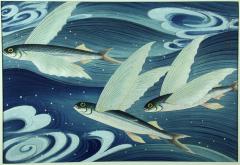
A composition of three flying fish (tobiuo, トビウオ) against swirling wave patterns. Additional notes: Signed Bakufu (麦風) in top right with seal.
plain
2019-03-02T02:02:53-08:00
1
2018-12-12T02:59:28-08:00
Snow at Nikko's Yomeimon (Sun Gate)
2
This scene shows the Sun Gate (Yomeimon, 陽明門) at Nikko (日光) in the snow. Toshogu Shrine (Tōshōgū, 東照宮) is the final resting place of Tokugawa Ieyasu, the founder of the Tokugawa Shogunate that ruled Japan for over 250 years until 1868. Ieyasu is enshrined at Toshogu as the deity Tosho Daigongen, "Great Deity of the East Shining Light". Additional notes: Signed Shiro (紫浪) in the bottom right along with a seal. In the left margin (not pictured) are title and Unsodo's "Gei" watermark.
plain
2019-03-08T15:33:17-08:00
Contents of this tag:
1
2018-12-12T03:04:07-08:00
MaryJane Eischen
040a3a6e41fd9906ebf9ac0f3949654252ab83ff
Flying fish
2
A composition of three flying fish (tobiuo, トビウオ) against swirling wave patterns. Additional notes: Signed Bakufu (麦風) in top right with seal.
media/3104_web.jpg
plain
2019-03-02T02:02:53-08:00
MaryJane Eischen
040a3a6e41fd9906ebf9ac0f3949654252ab83ff