Thanks for your patience during our recent outage at scalar.usc.edu. While Scalar content is loading normally now, saving is still slow, and Scalar's 'additional metadata' features have been disabled, which may interfere with features like timelines and maps that depend on metadata. This also means that saving a page or media item will remove its additional metadata. If this occurs, you can use the 'All versions' link at the bottom of the page to restore the earlier version. We are continuing to troubleshoot, and will provide further updates as needed. Note that this only affects Scalar projects at scalar.usc.edu, and not those hosted elsewhere.
The Bestselling Novel: Currents in American History and CultureMain MenuIntroductionIntersectionality and Power Relations in BestsellerismAn intersectional analysis of the concepts of gender, race and power relationships, highlighting how the overlap between these concepts fueled the novels’ rise as bestsellers.Slavery Beyond ChainsThe Variation of the Forms of Slavery Inflicted on Charlotte in Susanna Rowson's _Charlotte Temple_ and Dana in Octavia Butler's _Kindred_.Perception of Women in SocietyInspecting the ways in which the woman’s default “doomed” status can be blamed on the society's narrow perception of women in Susanna Rowson's Charlotte Temple and Edith Wharton's House of Mirth.Gendered Violence and Racism: The Short End of the StickThe Struggle of the Black Woman Across the CenturiesBrief summaries of course textsStudents in ENG 410: American Novel, an upper-level undergraduate seminar8105943177cf94521fefbbebb901e86333202954
Kindred, the Graphic Novel: The Gender Portrayal of Dana
1media/tumblr_mof7e9IRP41rt0l0ho1_1280.jpgmedia/kindred_cvr_wide-901534f27508cae1999b8a58703471711dffc9e3.jpg2018-04-25T09:14:02-07:00Alya Alhazamia980fbde3af7c08968d2ccecdf3326b25ebeb0352976115image_header2019-05-14T04:40:44-07:00Students in ENG 410: American Novel, an upper-level undergraduate seminar8105943177cf94521fefbbebb901e86333202954This year, artists Damian Duffy and John Jennings re-imagined Octavia Butler's bestselling 1979 novel, Kindred, as a graphic novel.
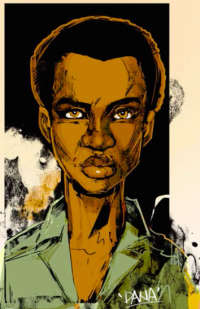
In their graphic novel, Dana is portrayed with masculine traits. She has sharp features, short hair, and dressed in what is considered masculine clothing. While Dana in the novel dresses up in trousers, which was considered dressing like a man in the 1800s, her feminine features somewhat give her gender away. In the novel, Dana has slightly longer hair: “I collected the food and 'borrowed' one of Nigel’s old hats, to pull down over my hair—which wasn’t very long, luckily” (Butler 170). This detail suggests that in the novel, Dana has features that could distinguish her as a female. As such, the graphic novel erases feminine features, changing the way Dana looks. Popular culture has played on the notion of hypermasculinity and portraying strong women with masculine features, hinting that feminine features are unappealing and weak. While that may not be the intention of the illustrators, it is important to discuss the significance of this phenomenon.
This occurrence is not unique to the graphic novel; in many movies and texts, the female heroine is portrayed in a more muscular way to indicate that she is “not like other girls,” deeming strength an exclusively masculine feature. Throughout the novel, Dana's looks are different due to her being from a different time period; however, the graphic novel places an extra emphasis on how different she looked as compared to the other women in the story. In essence, the “strong female character” is only strong when she looks like a man. A tomboy demeanor makes it more believable that a woman can be strong. This is not to state that gender is a dichotomy, and one must have specific traits to be a woman and vice versa. Still, deliberately making the strong female character different could be problematic.
However, that is not to say that Butler would not have approved of the way in which Dana was portrayed. As shown in this video, the illustrators explain that they drew their inspiration of portraying the character from Butler’s statements on gender conformity and ambiguity. For instance, in one encounter with a free black child, the child mentions that Dana looks like Alice’s mother, one of Dana’s female ancestors. When Dana denies the relationship, the child states that Dana could pass for Alice’s mother, however, she continues, “Not with you dressed like that! She [her mother] thought you were a man at first, just like I did—and like Daddy did” (Butler 29). This shows that Dana herself did not wish to conform to gender norms. This especially was useful to Dana when she tried to look like a man to plan her escape.
Fortunately, the dynamic of what makes a female character strong has been changing over the past few years. This can be seen in modern day films such as Frozen, where the protagonist’s femininity is not erased. The shift is highly significant as generations of children are impacted by what they see and read. While nonconformity to gender roles is pivotal in detaching from social norms, it is still important to show female audiences that being strong does not necessarily mean that one has to be stripped of any feminine characteristic.
References Butler, Octavia E. Kindred. Beacon, 2003
This page has paths:
1media/new hands.png2018-04-18T11:22:05-07:00Students in ENG 410: American Novel, an upper-level undergraduate seminar8105943177cf94521fefbbebb901e86333202954Intersectionality and Power Relations in BestsellerismStudents in ENG 410: American Novel, an upper-level undergraduate seminar20An intersectional analysis of the concepts of gender, race and power relationships, highlighting how the overlap between these concepts fueled the novels’ rise as bestsellers.splash7180782018-05-21T16:02:22-07:00Students in ENG 410: American Novel, an upper-level undergraduate seminar8105943177cf94521fefbbebb901e86333202954
This page references:
12018-05-05T17:23:08-07:00Dana1Image from Damian Duffy and John Jennings' graphic novel adaptation of Octavia Butler's novel, _Kindred_, published by Abrams Comic Arts in 2017.
media/Screen Shot 2018-05-05 at 9.14.29 PM.pngplain2018-05-05T17:23:09-07:00
12018-05-05T17:24:36-07:00Damian Duffy, John Jennings, and Krista Franklin at the Chicago Humanities Festival, 2018.1In her 1979 masterpiece, Kindred, Octavia E. Butler explored time travel, American slavery, and the social tensions of race and gender—the tough stuff that keeps tying us in knots. Now the mind-bending story has been transformed into a graphic novel, adapted by Damian Duffy and illustrated by John Jennings, expanding this examination of our troubled history into a vibrant format that widens its reach to newer audiences. Come hear Duffy and Jennings along with Chicago artist Krista Franklin for a discussion of the power of Kindred and what it takes to translate a novel into a graphic novel. This program was recorded on Saturday, April 29, as part of Chicago Humanities Festival's Springfest.
Video published August 17, 2018 by Chicago Humanities Festival. Viewable on YouTube: https://www.youtube.com/watch?v=a4HRKFvI3IAplain2018-05-05T17:24:36-07:00