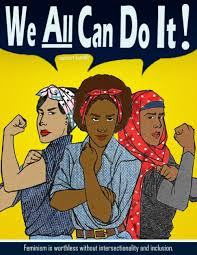
The internet can be a place of freedom of expression. However, when it comes to cyberfeminism, there is a type of backlash when it comes to explicitly defining race. Some cyberfeminists argue that race is an unimportant factor when it comes to expressing yourself online because there is no solution to race. White supremacy is clearly present among cyberfeminists. This is contradictory to the cyberfeminist viewpoint of equality. The article expresses how race can be an impeding factor when it comes to opportunities on the internet. Race plays a big role in publishing and many other opportunities such as job qualification. This article expresses the subtlety of racism in both the cyber world and in the real world.
READING SUMMARY
Race in the Cyberfeminist World
Cyberfeminism, Racism, Embodiment by Maria Fernandez
The
cyberfeminist world is one that attempts to bring equality to all. However,this is problematic in the sense that some cyberfeminists attempt to disregard race as an important identity factor. They tend to disregard differences because they cannot be changed or resolved. The relationships in cyberspace regarding feminism and race can be problematic to those who are not white and who have had different experiences because of their race.
The CyborgIn the history of feminist, differences such as culture, class, race, religion, sexual orientation, and politics have separated women. Because of this, some cyberfeminists believe differences should be ignored because there is no solution to them. Maria Fernandez does not believe erasing the differences within cyberfeminists will ever be possible.
Author
Donna Haraway's "A Manifesto for Cyborgs" was written after the breaking of the feminist movement. She based this idea of a "cyborg" on the mestizaje that took place during the era of Spanish conquest. Her fictional story is ironic in that she pushes for the idea that the cyborg cannot be classified or a subject of identity politics because it is a hybrid of animal, machine, and human. It is ironic in the sense that her character is based off of the story of
La Malinche.
Fernandez also sites an author named
Sadie Plant who wrote a book called "Zeroes+Ones" where she expresses women of color as forming part of a universal conspiracy between women and machines that will ultimately undermine the patriarchy. Plant expresses how the majority of assembly jobs regarding electronics have been held by women. However, she does not seem to realize that the reason a majority of women hold these types of jobs is due to necessity, not some form of revolt against the patriarchy,
White Supremacy and its Relations to CyberfeminismShe gives examples of power relations among people of different races and extracts a common theme: failure to acknowledge a person's presence or speech, interacting with others in a group and consistently excluding a specific person, failing to recognize someone’s achievements and expertise—i.e., absenting oneself from events one would normally attend when a person of color is the speaker or performer, etc. Racism is very subtle and makes it difficult to identify when someone is being racist. White supremacy is present when people of color are being silenced or ignored by white people who feel the need to be the center of attention and exert their power.
Embodied RacismRacism is present in every day scenarios. Maria Fernandez writes about an experience she had while studying a predominantly working class, white pre-school. The children targeted the only West Asian child who was of a darker complexion and began to bully him. Thus, this proves that race is something that affects everyone at a very young age and ignoring race ultimately leads to the silencing of people of color.
ANALYSIS
Cyberfeminism is ever growing and is present among many new media sites such as Tumblr and Facebook. This article by Maria Fernandez has attempted to define why race is being ignored among cyberfeminism. Race is an important aspect of identity. It the intersectionalities of different people that create differing experiences. The internet/cyber world provides people with a type of anonymity that is not available in the "real world." The idea that race should not be considered in the cyber world because it has no solution is problematic. By ignoring race and racism, it allows power relations to remain at play. Ignoring race silences the experiences of cyberfeminists of color and reinforces white supremacy in the cyber world. Maria Fernandez cites multiple authors in her article, all of which are white. This reinforces the idea that it is impossible to ignore important intersectionalities such as race and class because, as we saw from the cited authors, they express a one-sided view of issues which do not always pertain to women of color. In conclusion, it is important to take into account the different experiences held by those who are different than ourselves. While ignoring these differences may "unify" cyberfeminists, it ultimately leads to the disregard of those who are not in power (women of color).
Discussion Questions
1.) Should race be ignored because, as some cyberfeminists believe, it cannot be changed? What are some of the pros and cons of ignoring race when taking into account someone's experiences?
2.) How is racism present within the cyber world and how does it relate to the "real world"?
3.) Is it possible for white cyberfeminists to relate to women of color without acknowledging race? Why or why not?