Scalar's 'additional metadata' features have been disabled on this install. Learn more.
Plants & People: The Intersection of Botany and Human Experience
Main Menu
Project Pages
Lens: Project Pages
Catherine Nordstrom
eee5469f13f5b22449d345efe7a91438d420b603
Quinn Schwabauer
c956296b3a71313515a7b42080b7c21898a4e1b3
Jasmine White
5e6d9f39f5dca14a5efcc5b40c2233506f634d6e
Sarah Simpson
2cca5d1758ce821e43339c83d4af59d20561387f
Lysol Patino
fa4807587d439da7c652621d767462e8ddabe5bd
Ramses Cuellar
227d1101a6fc55c106a63da6f97fd9077c07d488
Giselle Correa
82a42a0fc272e6d9366f0c6a05623feb08490e90
Julianna Filice
de86fbc4c9fb4c37c7274aeb009eb12d157a6011
Amanda Lin
351a984f2f13af36387e431ad4c1bf4e2fe6442b
Jessica Manriquez
7a01046c42e42f088710b11e860bb302d9a1bc26
Amanda Bueno-Kling
6d5abc610c22a22e4d47af8113c6196fb76ced5c
Max Kwon
0e62f91ad2fccb5c1911b7cabfc2d67ad395c959
Tim Sisneros
a58829fb647d6ce7b9c40b457c686ddadf0f976f
Kyi Ther Min
bef3cb2bbf8d42cec3ceb3caaabd48943c6d0417
Edward Teng
f1c21e0ed6f73d48ad0b0ca737e4b208c441e39d
Mary Van Dyke
9e2c668c35f9c3e476eadfb42d2f33a996fe5cd3
Justin Haggard
d800073ab461eadee6e6715b98fe04a489d36a98
Holland James Smith
c6215e764616f18dc2ac54f79e800a56549a5a16
Jose Ismael Rodriguez
6d4715e7163f85d38025c4a74929b048c7f737eb
George Vetushko
28ffcc03954a96f0b0b9a57b40c5655eb929accc
Amanda Leyel
98935a5c087672934aee16f680afaf9132e76e30
Joshua Matsuda
2247a3d39cdfe957bbca6416ea46416c22545c46
Ian Morris
6ca94b2f17490b954dfe25231aee4c855ce98f06
Nikhitha Nair
923aa7cd2dc492bc285737def672e1e6cee8d689
Hojae Lee
d95326a339fcf3784c5d38537656c27fcd473cf6
Roberto Vindel
74869cdc6e4cbcab144ffdb6954169b7bacc0c5d
Shiva Nia
962b67344644b964eda3a1efd9dedb861983a57c
Pauline Le
90aae91f63664363b4dc493ff97073aaec561d82
Lauren Guevara
d3ab8c0eaac1066e5e591b0e15c4cfbc6d85e4ed
Ariela Navasartian
b706ff98a2718db176cb67e8d717a47ed8c4b6c0
Paria Maghsoudi
2fd8384def30ded736cc804c59ed30f65fb62a49
Jacqueline Duong
7ba49d8122d8595d23dae05feddc88d987a1bee5
Mellanie Gamero
145cdb416835ae5f2fd6057c64393ce87cb5016c
Karla Gonzalez
fd342cd724627c829347d847ef85f655430c8149
Phan Tran
91148bf3d7cb14e6d6590491bc9e3a572e4e737a
Kokonow Kinney
5aa005b7f097866e68b336839c60b92e3e3b90aa
Megan Chen
437c81235577cd34d86d461fc36d5c2cd1ba0d0a
Jin Zhu
524dd4acaf9b36b0629d5254b578a44a3e94b6c5
Natalie Nartz
c4f6efb33eae9bd143719d1b52bb9491171fc166
Matthew Nguyen
003d1825ac8b425d4322c4506166393d268a368c
Nicole Phelan
459bb3eb397625fc848ea954cd01858178296d64
Sarah Hoffman
9400350df5c9ca76e2405e77876e5f0e0edb5138
Skylar Yee
e2f87f03792b2a81afe11fe605107460a4f71f08
Chloe Fuson
ace0df69849f7f6ca276190dc0c1fd86c005df18
Brian Estarella-Murphy
831eaad1e3a4865984bec7368e88a589ef996e0a
Akshay Chellappa
76da17495df94c6c8bc0710f8fd207dfb8b5b6e1
Lester Squier
50c34f270c5c2e0ed0fafde1cc193434a4febd9c
Angelica Mae Rosete Soriano
e0e91b2960a04f4646d27c495705afaf132bce38
Julia Lindner
919433bcb6a91cbb9416833698e8012976f442c5
Joanne Kwak
035f00d5f05f3c560601b008cd0ae71d45b78461
Natalie Keung
bedcfd8b1a434b29988469c6e3224b2c3a94f2c8
Anthony Baniaga
3cc160e5607a280512d77ceff4259deb08abb3df
Breadfruit Reproductive Morphology
1 media/Breadfruit_Repro_Morph_thumb.jpeg 2022-05-25T13:19:54-07:00 Lester Squier 50c34f270c5c2e0ed0fafde1cc193434a4febd9c 40688 3 Reproductive Morphology plain 2022-05-26T09:37:52-07:00 Angelica Mae Rosete Soriano e0e91b2960a04f4646d27c495705afaf132bce38This page has annotations:
- 1 2022-05-25T13:47:50-07:00 Lester Squier 50c34f270c5c2e0ed0fafde1cc193434a4febd9c Female Flowers Lester Squier 3 plain 2022-05-26T17:13:11-07:00 Lester Squier 50c34f270c5c2e0ed0fafde1cc193434a4febd9c
- 1 2022-05-25T13:47:09-07:00 Lester Squier 50c34f270c5c2e0ed0fafde1cc193434a4febd9c Male Flowers Lester Squier 2 plain 2022-05-25T13:47:34-07:00 Lester Squier 50c34f270c5c2e0ed0fafde1cc193434a4febd9c
- 1 2022-05-26T17:13:29-07:00 Lester Squier 50c34f270c5c2e0ed0fafde1cc193434a4febd9c Breadfruits Lester Squier 2 plain 2022-05-26T17:19:38-07:00 Lester Squier 50c34f270c5c2e0ed0fafde1cc193434a4febd9c
- 1 2022-05-25T13:52:32-07:00 Lester Squier 50c34f270c5c2e0ed0fafde1cc193434a4febd9c Pollination Lester Squier 2 plain 2022-05-25T13:53:56-07:00 Lester Squier 50c34f270c5c2e0ed0fafde1cc193434a4febd9c
- 1 2022-05-26T17:07:59-07:00 Lester Squier 50c34f270c5c2e0ed0fafde1cc193434a4febd9c Seeds Lester Squier 2 plain 2022-05-26T17:13:12-07:00 Lester Squier 50c34f270c5c2e0ed0fafde1cc193434a4febd9c
This page is referenced by:
-
1
2022-05-11T11:25:18-07:00
Breadfruit: The Intrepid Fruit's Journey with Indigenous Peoples and Colonization
44
Breadfruit (Artocarpus altilis (Parkinson) Fosberg) is an intrepid dicot with a rich history and culture surrounding it. Breadfruit trees are a single-trunked tree with a spreading, evergreen canopy. Breadfruit trees are monoecious with both the male and female flowers on the same tree. The male flowers are club shaped, and the female flowers are thousands of small flowers with 2 anthers around a spongy core. The name is derived from the Greek words bread and fruit (artos = bread & karpos = fruit). There are over 2,000 documented names because of its widely spread distribution across the Pacific. A. altilis originated from the South Pacific and was later spread throughout Melanesia, Micronesia, and Polynesia by voyagers. As a result, breadfruit is adapted to a wide variety of climates and conditions in equatorial lowlands. In addition, breadfruit trees thrive in humid tropics and can grow in a variety of soils. Breadfruit became a staple crop because of its nutritional and medicinal value. In the 1700s, breadfruit’s ease of maintenance and nutritional value made it a prime crop, in the eyes of colonizers, to feed African slaves in the Caribbean. Today, breadfruit continues to have an important role in sustainability, fighting malnutrition, and increasing food security. There are research efforts to increase the nutritional value and initiatives to promote breadfruit cultivation in tropical and subtropical regions. For example, The National Tropical Botanical Garden established the Breadfruit Institute in 2003 in hopes of promoting the study of breadfruit for agroforestry, reforestation, global food security and economic development. #Angelica Soriano and Bucky Squier
plain
2022-06-03T09:49:43-07:00
Breadfruit’s preferred scientific name is Artocarpus altilis (Parkinson) Fosberg. The name is derived from the Greek words bread and fruit (artos = bread & karpos = fruit). There are over 2,000 documented names but a few indigenous names include: beta (Vanuatu), bia, bulo, nimbalu (Solomon Islands), kapiak (Papua New Guinea), kuru (Cook Islands), meduu (Palau), and mei (Federated States of Micronesia, Kiribati, Marshalls, Marquesas, Tonga, Tuvalu). Some other common names include: breadfruit (English), árbol a pan (Spanish), l’arbre à pan (French), rimas (Philippines), and sukun (Indonesia). A. altilis is a dicot part of the Moraceae (Mulberry) family, along with Artocarpus camansi “Blanco” and Artocarpus mariannensis “Trécul”. Artocarpus camansi “Breadnut'' is a wild, seeded, and ancestral form of breadfruit. It first originated in New Guinea and the Indo-Malay region and was then spread to the Pacific islands by voyagers. Artocarpus mariannensis is a relative of A. atilis and is native to Palau and the Mariana Islands.
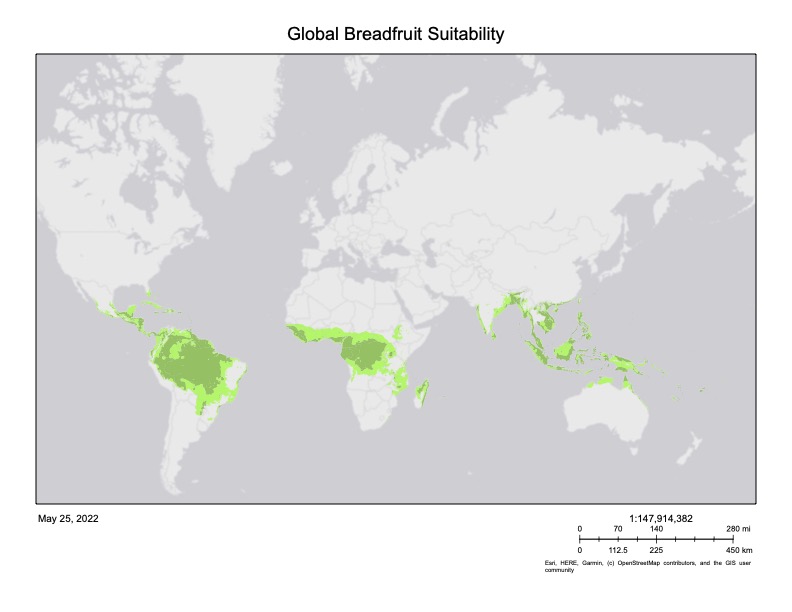
Breadfruit is adapted to a wide variety of climates and conditions in equatorial lowlands. Breadfruit trees require a mean annual rainfall between 1000-3000mm of rainfall per year. Depending on the cultivar, it can also tolerate sandy soils on rocky atolls. Breadfruit trees provide habitat and food for many pollinators and seed dispersers like bees, bats and birds (“Breadfruit History,” n.d.).
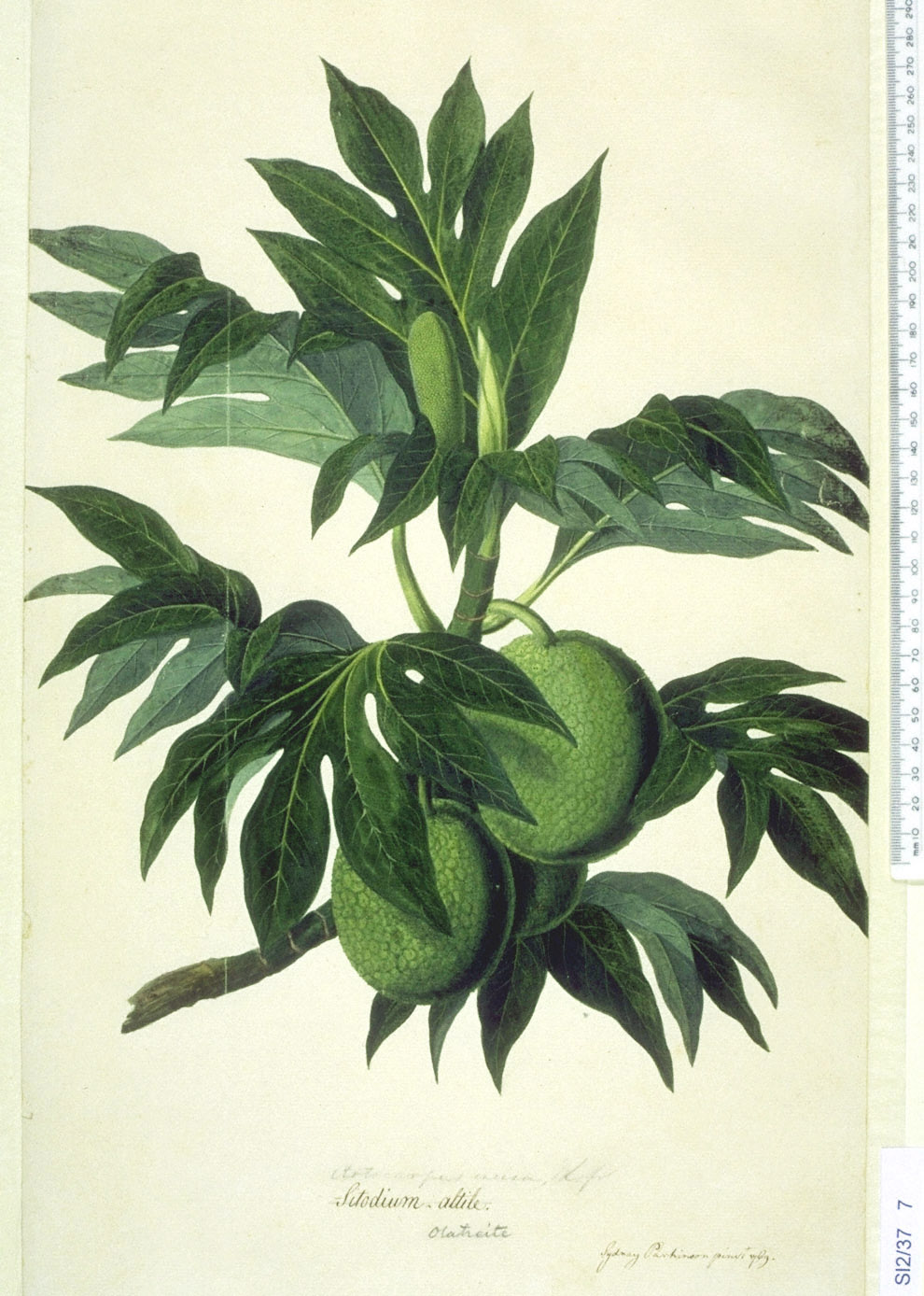
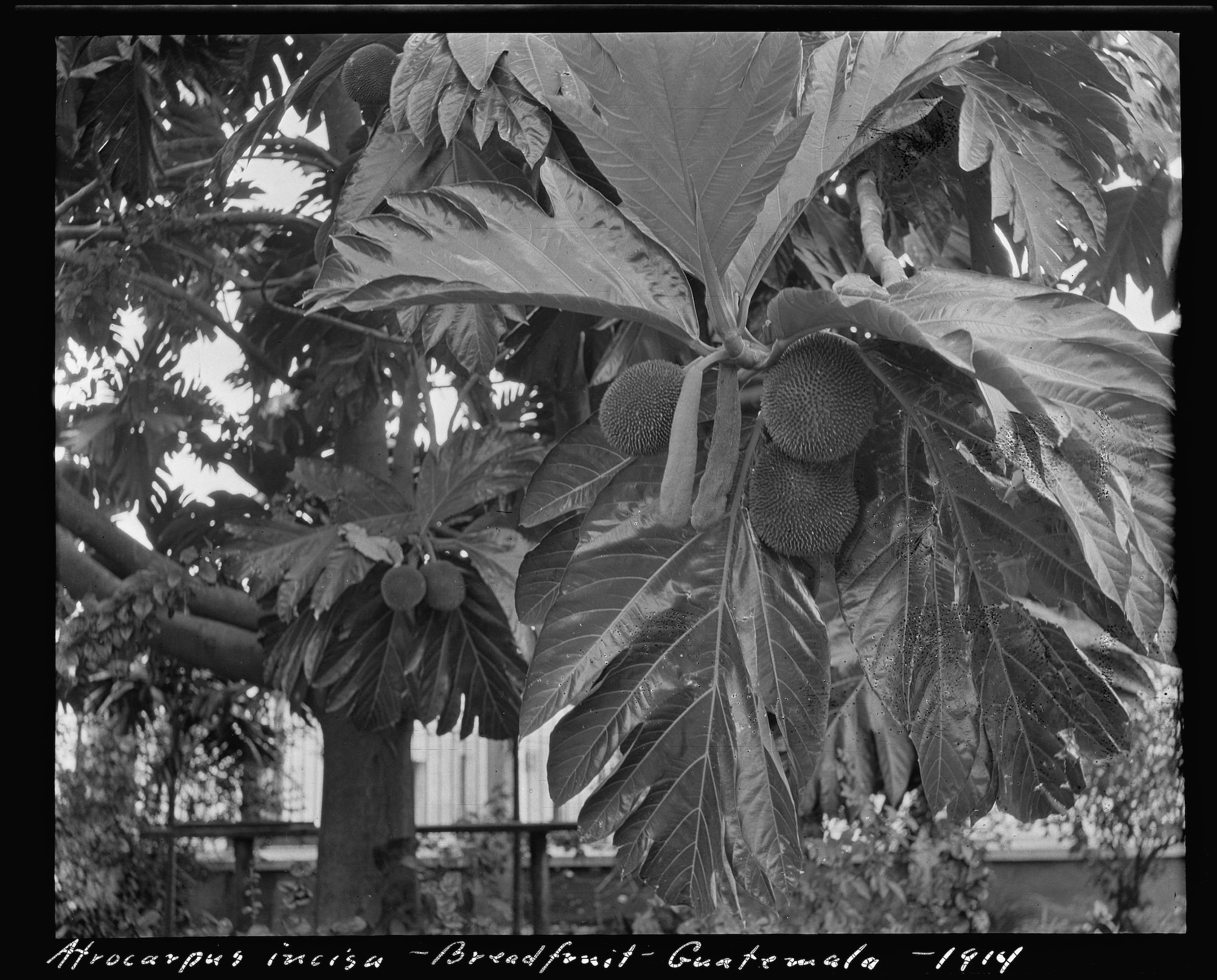
Breadfruit trees are a single-trunked tree with a spreading, evergreen canopy. Their trunk is straight and cylindrical and can be 1.8 m in diameter. Breadfruit trees vary in height: some reach up to 70 feet (21 m) at maturity but most are commonly 40-50 feet (12-15 m). The leaves also vary in shape; they can be broadly obovate or broadly ovate. Likewise, the leaves are deeply cut into seven or nine pointed lobes. The size of the leaf can range from 15-60 cm long and 25-50 cm wide. The blade is typically leathery and dark green. The veins can be green or yellow-green. The roots of breadfruit trees are spreading and grow on or slightly below the ground. Some varieties can develop buttress roots.
Breadfruit trees are monoecious with both the male and female flowers on the same tree. The male flowers are club shaped, and the female flowers are thousands of small flowers with 2 anthers around a spongy core. The flowers fuse together to form the breadfruit. The plants can be cross pollinated but it is not required for the fruit to form. The fruits vary in size, shape and texture depending on the variety. In general the fruit’s skin is compounded into small 5-7 sided discs that were once the flowers. Throughout their range, breadfruit have a great morphological variety of seeds. Varieties have different amounts of seeds, with many that have mostly aborted seeds, some seedless, and others are filled with seeds. The seeds can be found embedded in the pulp with dark brown seed coats and they don't have an endosperm. The seeds aren’t viable for very long; they germinate immediately.
Breadfruit trees thrive in humid tropics and can grow in a variety of soils. A. atilis first originated in the South Pacific and was later spread throughout Melanesia, Micronesia, and Polynesia by voyagers. Pacific Islander voyagers cultivated breadfruit trees on different islands using the root shoots and seeds of breadfruit trees (National Tropical Botanical Garden, n.d.). They are typically grown around homes in villages and towns (Ragone, 2006). Later, Polynesian varieties of breadfruit were introduced to the Caribbean in the late 1700s by colonizers. Now, breadfruit is grown in almost 90 countries. Breadfruit seeds are viable and germinate while in the fruit, so preservation is not an option. Breadfruit can be propagated in multiple ways, tissue culture, seeds, and most commonly cuttings. Breadfruit is more commonly vegetatively propagated using root shoots or root cuttings. Vegetative propagation is when a new plant is produced from vegetative parts of the original plant; the new plant will contain the genetic material of the original, thus you can reproduce plants with the same desirable traits. Propagation by root shoots is when new breadfruit trees grow from the root system of the original then are detached from the mother tree. Root cuttings can be planted into the soil and grow into a new breadfruit tree (Ragone, 2006). In the right conditions, trees can flower and fruit in three to five years (Breadfruit, n.d.).
Breadfruit has been a dietary staple in the Pacific islands and the Caribbean — it contains complex carbohydrates and low levels of protein and fat. Although breadfruit contains low levels of protein, it provides all essential amino acids (histidine, isoleucine, leucine, methionine, phenylalanine, threonine, tryptophan, and valine). In general, breadfruit is a good source of dietary fiber, iron, calcium, magnesium, potassium, and phosphorus. Breadfruit also contains small amounts of thiamin, riboflavin, and niacin, with some varieties containing folic acid (National Tropical Botanical Garden, n.d.). There is diversity in the nutritional content of breadfruit but overall, breadfruit is nutritionally complete, providing the recommended values of carbohydrates, protein, fat, vitamins, and minerals (Jones et al., 2011). The fruit can be cooked and eaten at all stages of maturity but is typically eaten at its mature, starchy stage when used as a potato substitute. Breadfruit can be cooked in many different ways: steaming, boiling, frying, microwaving, grilling, and barbecuing are a few examples. Otherwise, the fruit can only be eaten raw when it is soft and ripe. The seed is also edible when cooked.
In addition, breadfruit is thought to have medicinal properties. For example, breadfruit leaves are prepared as a tea in the West Indies and is used to control diabetes, reduce high blood pressure, and relieve asthma. Its diluted latex can also be consumed, in the Pacific Islands, it’s believed that the diluted latex of breadfruit treats diarrhea, stomachaches, and dysentery when taken internally (National Tropical Botanical Garden, n.d.).
The Breadfruit was isolated in the Pacific for thousands of years before it caught the eye of Joseph Banks Botanist and enslaver. Breadfruit was brought to the Caribbean in the late 1700’s after two attempts. The first voyage to bring breadfruit to the Caribbean ended in an infamous mutiny (Bellrock. Org). In the second attempt the saplings from Tahiti were delivered to islands like Barbados and Jamaica, where they were planted at botanical gardens and sugar plantations to provide low-cost, low-effort food to the enslaved. (Braun, 2019). When the fruit was brought to the Caribbean, enslaved Africans didn’t really like the breadfruit, despite this, breadfruit eventually became a staple food in the Caribbean, where it was first fried and given a variety of new uses (“Breadfruit,” 2021).
Breadfruit has been an essential food source for Pacific Islanders for over 3,000 years because breadfruit trees do not require lots of maintenance — they can be planted once and continue to provide fruit for more than 50 years. Breadfruit cultivation provides a potential solution to food insecurity and shortage. Approximately 80% of the world’s hungry live in tropical and subtropical regions which have the ecological conditions suitable for cultivating breadfruit. (National Tropical Botanical Garden, n.d.). The Breadfruit Institute at the National Tropical Garden in Hawaii has formed partnerships with other organizations and is engaged in an initiative to respond to global food security issues. The Institute has more than 300 breadfruit trees conserved in their living collection. The Institute and their partners have been able to micropropagate breadfruit trees and send them to tropical countries worldwide More than 100,000 breadfruit trees have been sent to 44 countries since the launch of the Global Hunger Initiative in 2009.
Another study sought to find an “elite” cultivar by evaluating protein and mineral content, fruit morphology, and flour production (Jones et al., 2011). Breadfruit flour was found to have a significantly higher concentration of calcium, iron, potassium, and magnesium than unfortified refined wheat, rice and corn flour. However, cultivars of breadfruit contain differing amounts of nutrients. Moreover, staple crops – such as rice, corn and wheat – are commonly consumed around the world but require intensive labor and modern technologies to obtain adequate yields. Breadfruit is versatile and does not require as much labor, technologies, fertilization, or pest control. Therefore, the study calls for the proper cultivar selection of breadfruit to increase its nutritional value, which in turn has the potential to combat food insecurity and nutrient deficiencies.
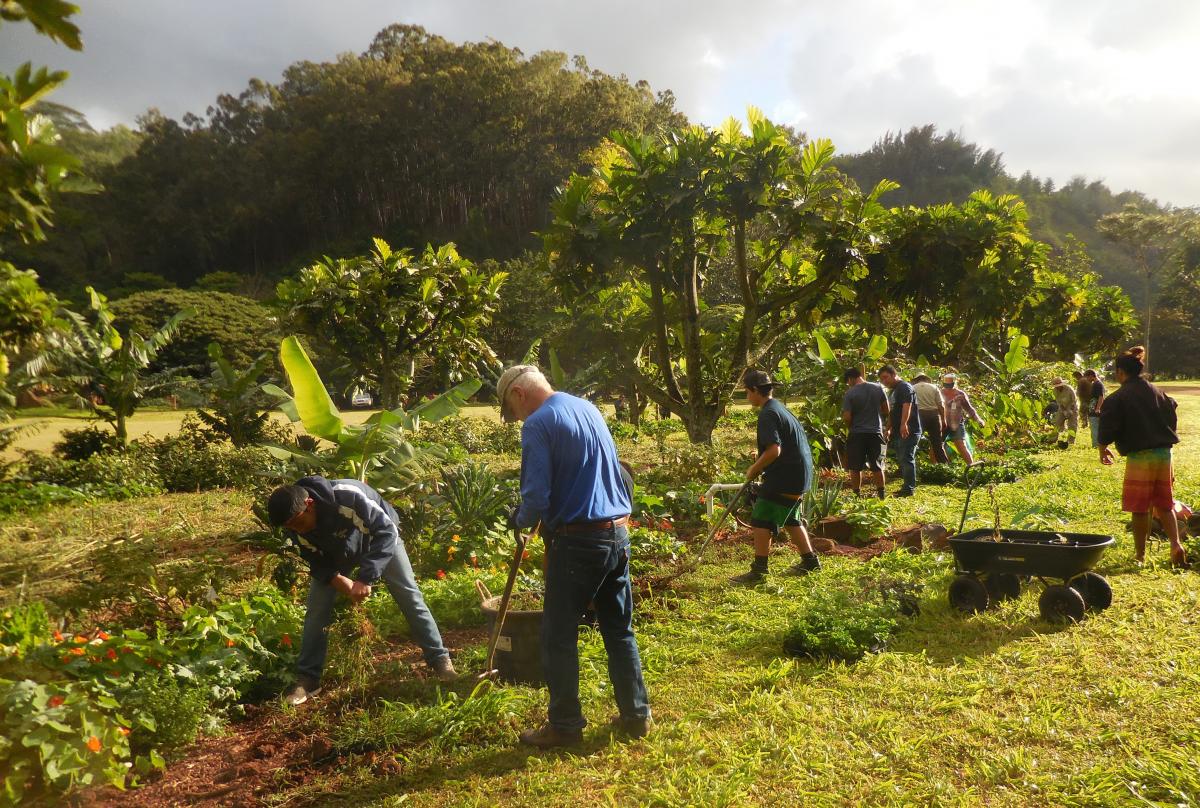
The National Tropical Botanical Garden also established the Breadfruit Institute in 2003 in hopes of promoting the study of breadfruit for agroforestry, reforestation, and economic development. Unlike other cereals which are planted in monoculture systems, breadfruit is a key component in traditional agroforestry-based cropping systems. The U.S. Department of Agriculture defines agroforestry as “the intentional integration of trees and shrubs into crop and animal farming systems to create environmental, economic, and social benefits.” Agroforestry systems have been demonstrated to improve climate and food security and promote the socioeconomic development of local farmers (Raj et al., 2022). Agroforestry practices are not widespread but there are initiatives to increase its scale and adoptability globally, especially breadfruit.
References
Braun, J. (2019). Bioprospecting Breadfruit: Imperial Botany, Transoceanic Relations, and the Politics of Translation. Early American Literature, 54(3), 643–672. https://www.jstor.org/stable/26780569
Jones, A. M. P., Ragone, D., Aiona, K., Lane, W. A., & Murch, S. J. (2011). Nutritional and morphological diversity of breadfruit (Artocarpus, Moraceae): Identification of elite cultivars for food security. Journal of Food Composition and Analysis, 24(8), 1091–1102. https://doi.org/10.1016/j.jfca.2011.04.002
National Tropical Botanical Garden. (n.d.). Breadfruit. Retrieved May 28, 2022, from https://ntbg.org/breadfruit/
Ragone, D. (2006). Artocarpus altilis (breadfruit). Specific Profiles for Pacific Island Agroforestry. https://agroforestry.org/free-publications/traditional-tree-profiles
Raj, A., Jhariya, M. K., Banerjee, A., Meena, R. S., Nema, S., Khan, N., Yadav, S. K., & Pradhan, G. (2022). Chapter 13—Agroforestry a model for ecological sustainability. In M. K. Jhariya, R. S. Meena, A. Banerjee, & S. N. Meena (Eds.), Natural Resources Conservation and Advances for Sustainability (pp. 289–307). Elsevier. https://doi.org/10.1016/B978-0-12-822976-7.00002-8