Aronia Berries: Native to North America and Eastern Canada
1 2022-05-26T11:35:07-07:00 Natalie Keung bedcfd8b1a434b29988469c6e3224b2c3a94f2c8 40688 3 Depicted is the Potawatomi Tribe in North America. plain 2022-05-26T11:39:03-07:00 Digital Research Library of Illinois History Journal Natalie Keung bedcfd8b1a434b29988469c6e3224b2c3a94f2c8This page has annotations:
- 1 2022-05-28T20:07:11-07:00 Joanne Kwak 035f00d5f05f3c560601b008cd0ae71d45b78461 Usage of Aronia berries Joanne Kwak 2 plain 2022-05-28T20:07:38-07:00 Joanne Kwak 035f00d5f05f3c560601b008cd0ae71d45b78461
This page has tags:
- 1 2022-05-11T11:25:21-07:00 Natalie Keung bedcfd8b1a434b29988469c6e3224b2c3a94f2c8 Aronia melanocarpa: fine wines to phenols Joanne Kwak 101 Aronia melanocarpa, also known as Aronia Berries or Black Chokeberries, recently garnered attention for its potential as a “superfood” that combats a variety of diseases. Its scientific name refers to its dark pome fruit, while its common name is a reference to its tart and astringent flavor. Originally native to woodlands and bogs in North America, this shrub has historically been used as medicines and food by the Potawatomi and Abnaki people. It was first described as “Mespilus arbutifolia var. Melanocarpa” in 1803, by the French botanist André Michaux. It was then recategorized as “Aronia melanocarpa”, by American botanist Stephen Elliot in 1821 .Now, it is enjoyed throughout Eastern Europe in jams and wines after its introduction post World War II. Beyond commercial production, this plant can be found planted in rows in people’s gardens. These plants are deciduous, with green, gold leaves that change color to a burgundy red in the fall. They produce inflorescences of small white flowers that ripen into the berries that provide many health benefits. Recent research into the uses of bioactive compounds such as antioxidants, anthocyanins, proanthocyanidins, flavonols, and phenolic acids suggests that extracts from the plant could be useful for anti-inflammatory purposes or treatments for diseases ranging from diabetes to cancers. As a result, the industries for Aronia berries have been on the rise and these berries have been introduced into many new recipes for everyday use. By Natalie Keung and Joanne Kwak #chokeberries plain 2022-06-01T11:51:51-07:00 Joanne Kwak 035f00d5f05f3c560601b008cd0ae71d45b78461
This page is referenced by:
-
1
2022-05-11T11:25:21-07:00
Aronia melanocarpa: fine wines to phenols
101
Aronia melanocarpa, also known as Aronia Berries or Black Chokeberries, recently garnered attention for its potential as a “superfood” that combats a variety of diseases. Its scientific name refers to its dark pome fruit, while its common name is a reference to its tart and astringent flavor. Originally native to woodlands and bogs in North America, this shrub has historically been used as medicines and food by the Potawatomi and Abnaki people. It was first described as “Mespilus arbutifolia var. Melanocarpa” in 1803, by the French botanist André Michaux. It was then recategorized as “Aronia melanocarpa”, by American botanist Stephen Elliot in 1821 .Now, it is enjoyed throughout Eastern Europe in jams and wines after its introduction post World War II. Beyond commercial production, this plant can be found planted in rows in people’s gardens. These plants are deciduous, with green, gold leaves that change color to a burgundy red in the fall. They produce inflorescences of small white flowers that ripen into the berries that provide many health benefits. Recent research into the uses of bioactive compounds such as antioxidants, anthocyanins, proanthocyanidins, flavonols, and phenolic acids suggests that extracts from the plant could be useful for anti-inflammatory purposes or treatments for diseases ranging from diabetes to cancers. As a result, the industries for Aronia berries have been on the rise and these berries have been introduced into many new recipes for everyday use. By Natalie Keung and Joanne Kwak #chokeberries
plain
2022-06-01T11:51:51-07:00
Aronia melanocarpa, commonly known as the Aronia Berries or the Black Chokeberry, is a deciduous shrub cultivated throughout Eastern Europe. Originally indegenous to North America, the plant was known as nîki’mînûn or sakwako’mînûn by the North American Potawatomi and Abnaki tribe. When European settlers arrived in the Americas they named the plant Mespilus arbutifolia var. Melanocarpa in 1803, by the French botanist André Michaux. It was then recategorized as “Aronia melanocarpa”, by American botanist Stephen Elliot in 1821 . The genus name, Aria, is derived from the Greek word “aria”, meaning Air or wind, while the species name, melanocarpa, is derived from the words "Melano"- meaning black, and "carpa", meaning fruit. Commonly known as the Chokeberry, this name is a reference to the berry’s tart flavor. As one ethnobotanical book from 1933 noted, “the natives eat the berries from this plant but they are entirely too bitter to suit the white man”. However, the plant is now used in a variety of foods throughout Europe (Englels et.al 2014) .
The Aronia berry is a member of the Rosacae family, or the “Rose” family, which includes plants such as roses, apricots, or almonds. The plant is one of three plants within the genus Aronia, and is closely related to Aronia arbutifolia, the red chokeberry, and Aronia prunifolia, the purple chokeberry, which some consider a hybrid of the two species instead of a fully fledged species itself. Although originally these plants were thought to be part of the Photinia genus, a 2004 study proved that genus Aronia was instead a distinct lineage and not closely related (Englels et.al 2014) . In modern cultivation, individual specimens of Aronia melanocarpa used in cultivation are often very closely related to each other, as new plants are established from cuttings although there are new efforts to produce new lineages that will have higher nutritional content and better flavor than their wild siblings.
Originally, this plant was most commonly found in the Northeastern part of North American, running from the Great Lakes region to the Appalachian Mountains. It was most commonly found in swamps, wet thickets, or in the margins of ponds and lakes, although it could also survive in drier soils. The plant is known to be hardy and does not suffer from any major pests or disease. The plant acts as a good source for birds and their flowers produce pollen to insect pollinators, with their main pollinators being small bees. On average the plant lives upwards of 25 years, depending on how favorable the location is. Due to its hardiness, it has the potential to become invasive in Eastern Europe (Henrich, 1976) .
Traditionally, the berries were used by North American Forest Potawatomi and Abnaki tribes in preparation of pemmican, a high calorie food made from animal fat, dried powdered meat, and sometimes fruit. Also, they used the fruits for medicinal teas, make dyes, cure meats, and as nutritional dried treats in the long winter months. The berries and the bark were used as an astringent (Engels et.al 2014).
After World War II, the first shrubs of Aronia melanocarpa were brought to Europe and Russia, specifically Altai, Moscow, and St. Petersburg. Starting 1946, large- scale black chokeberry cultivation was introduced to the former Soviet Union, including Belarus, Moldova, Russia, and Ukraine. In 1976, aronia was introduced to Japan and by the 1980s, it was introduced for cultivation in Bulgaria, Czechoslovakia, East Germany, Poland, Slovenia, Denmark and Finland. Poland was the main supplier of chokeberry to Germany despite cultivation being present in East Germany since 1976. In 1996, Jan Mills, president and CEO of Artemis International Inc. took the main commercial cultivars from Polish agricultural schools and brought them back to Indiana. Since then, the chokeberry bush is used as an ornamental plant in the United States. In England, it received the Royal Horticultural Society’s Award of Merit in 1972 for their white flowers in the spring, green foliage in the summer, and fruits in the late summer and autumn (Engels et.al 2014).
Aronia melanocarpa is a popular shrub on the industrial and amateur scale in Central Europe (Engels et.al 2014). It is used as an ornamental in the US and the berries are eaten fresh or incorporated into cooking in various locations and industries. In Poland, black chokeberries are used on a large scale by the food, pharmaceutical, and cosmetics industries. In Lithuania, these berries are used to produce wine. In general, Aronia is used in juice, jams, teas, and cordials. In the canning industry, Aronia are used to produce compotes, confitures, fruit jellies, marmalades, and the juices from the fruit are used to adjust or enhance flavor along with coloring. The fresh pressed juice is used as raw material for the manufacture of alcoholic sparkling wines, dessert wines, and liqueurs. In dairy processing, ice cream, yogurts, cream desserts, and sorbets include the berries. Black chokeberries are used for baking, specifically for praline fillings, cake fillings, fruit bars, cereals, and gummy bears. The pomace, or solid remains of the fruit after pressing, are used as color pigment (Engels et.al 2014).
In Eastern Europe, thousands of Aronia melanocarpa are grown commercially. In addition to commercial production, Aronia melanocarpa is also sold as an ornamental. In the U.S., the aronia berry industry is still developing, but currently is focused more in Harrison County inWestern Iowa. ‘Autumn Magic’ and ‘Iraqis Beauty’ are the two most commonly sold ornamental cultivars of Aronia melanocarpa. Different cultivars have different purposes. ‘Viking’ is a vigorous, productive variety from Scandinavia, which can grow to a height of 6 feet. ‘Nero’ is a shorter growing variety, reaching a height of 3 to 4 feet, with dark blue berries. In the U.S., a selection from a native source in Michigan is being sold as ‘Morton’ black chokeberry. It is marketed in the Midwest under the trademark Iroquois Beauty™. ‘McKenzie’ is a larger form that grows from 6 to 12 feet developed especially for conservation use and agroforestry benefits by the Plant Materials Center at Bismarck, North Dakota (Ochmian 2012).
The Aronia melanocarpa shrub produces their first fruits in 3 years and the first large harvest occurs after 5 years (Mahoney 2019). The berries tend to hang in clusters of up to 12 berries. They are harvested by hand or mechanically with a blueberry picker in late August or early September after they ripen (University of Maine 2022). This shrub has many adaptations from their fibrous roots. Aronia berries can grow without irrigation because these fibrous roots store moisture. These roots also prevent soil erosion, which protects the soil. This shrub grows and spreads by suckering, allowing it to reproduce easily. However, when growing commercially or in personal gardens, cultivators tend to plant the Aronia in rows in slightly acidic soils for the best results (University of Maine 2022).
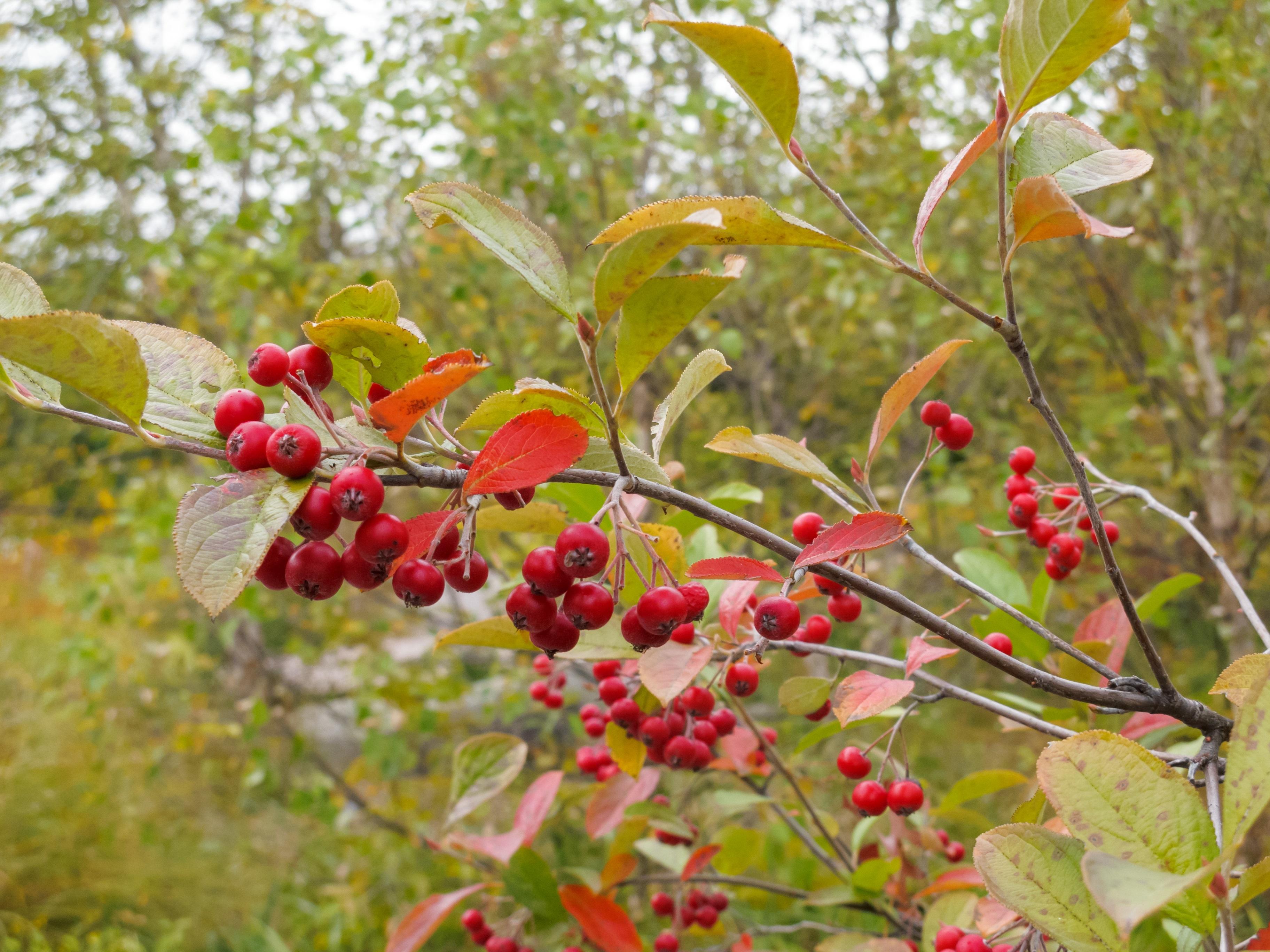
Aronia melanocarpa are deciduous, rounded, but upright shrubs that become leggy as they age. These shrubs grow to a height of 2-3 meter but vary based on the particular cultivars (Englels et.al 2014). The bark of this shrub is thin and smooth. The leaves are simple and alternately arranged with serrated edges and an elliptical shape. Since the Aronia melanocarpa are deciduous, the leaves change color in the fall. Throughout the year, the leaves are gold or yellow and dark green but as fall approaches, the leaves turn into a burgundy or red color (N.C. State University 2022). New branches of this plant range from grey to brown with scattered lenticels and are often covered in small white hairs, which smooth and become covered with a white film with age. New buds are sharp-pointed with a prominent terminal bud and smaller lateral buds pressed against the twig.
In late May to June, the plant produces 20-30 small white flowers that eventually mature into dark purple berries that span in diameter from 6 to 13 millimeters and weigh from .5 to 2 grams, similar to the size of blueberries. The small white flowers are perfect, with both male and female reproductive structures. The inflorescences and each have 4-5 white petals with pink anthers. They are protogynous and self compatible and reproduce apomictically via gametophytic apomixis, which results in embryos identical or nearly identical to maternal plants (Mahoney 2019). The primary pollinators of these shrubs are small bees. Reproduction in the wild is mainly by seeds, which are small, slightly more than 1/16 of an inch. These seeds must be cleaned and dried after harvest for the best germination. However, in cultivation the plant is propagated by cuttings (Mahoney 2019).
Historically, the Black Chokeberry was used both as food and medicine by a wide variety of people. Especially in Eastern Europe, the food is a common flavoring and colorant. Currently, in addition to its use as an ornamental shrub and food source, this plant has drawn attention for its high levels of antioxidants, anthocyanins, proanthocyanidins, flavonols, and phenolic acids (Halina et.al, 1970). A variety of studies are being conducted on the impact on these compounds on reducing the risk of non-communicable diseases such as diabetes, metabolic syndrome, and neurological disease, acting as an anti-inflammatory, or preventing cancers (King et. al, 2020) (Martin et.al, 2014). Current research is being conducted into how to best breed new strains to maximize the concentration of bioactive compounds, how to process the berries to retain bioactive compounds as well as how to best apply these compounds to treatments in a clinical setting (Tolic et.al, 2015). These promises have categorized the plant as a “superfood”, and a variety of supplements are on the market, although not approved by the FDA for medicinal use. Anecdotal evidence claims that these supplements have helped reduce inflammation, reduce blood sugar levels, and reduce blood pressure.Notes
Because this plant is not very commonly consumed, at least in the Americas, it was quite difficult to find reputable english-languages sources. Most large databases lacked images or records on the Aronia genus as a whole, much less the specific species melanocarpa. Many sources found online differed in their claims. For example, The taxonomy of the plant is still debated, with some considering the diploid and tetraploid populations as different species or considering the Japanese cultivar Aronia mitschurinii separate species. One source claimed that the plant was common in East Asia after its introduction after the Soviet Era, while a Smithsonian painting by a Japanese master dated a depiction of the genus to between 1797-1858, or the Edo period. Other sources claimed that the plant was not prevalent in Eastern Asia at all. Modern peer-reviewed literature on the plant centered on its medicinal properties, with little insight into its history. Additionally, many sources very clearly had plagiarized from each other, and neglected to cite sources. Overall, exploring this plant helped us think more critically about the information we found online, and helped us appreciate the effort put into clear and reputable sources.
References
A. PERSSON HOVMALM, H. E. L. E. N. A., Jeppsson, N., V. BARTISH, I. G. O. R., & Nybom, H. (2004). RAPD analysis of diploid and tetraploid populations of Aronia points to different reproductive strategies within the genus. Hereditas, 141(3), 301-312.
“Aronia Melanocarpa.” Aronia Melanocarpa (Black Berried Aronia, Black Chokeberry) | North Carolina Extension Gardener Plant Toolbox, https://plants.ces.ncsu.edu/plants/aronia-melanocarpa/.
Culture of aronia for fruit production - cooperative extension: Agriculture - University of Maine Cooperative Extension. Cooperative Extension: Agriculture. (n.d.). Retrieved May 10, 2022, from https://extension.umaine.edu/agriculture/aronia/culture/
Engels, Gayle, and Josef Brinckmann. “Black Chokeberry Aronia Melanocarpa Family: Rosaceae.” Black Chokeberry - American Botanical Council, https://www.herbalgram.org/resources/herbalgram/issues/101/table-of-contents/hg101-herbpro-chokeberry/.
Everhart, E. (n.d.). Aronia - a new crop for Iowa. News. Retrieved May 10, 2022, from https://www.extension.iastate.edu/news/2009/mar/110401.htm
Heinrich, B. 1976. Flowering phenologies: Bog, woodland, and disturbed habitats. Ecology. 57(5):890-899.
Halina Maria Ekiert, Agnieszka Szopa, & Paweł Kubica. (1970, January 1). High production of depsides and other phenolic acids in different types of shoot cultures of three Aronias: Aronia melanocarpa, Aronia arbutifolia, Aronia × prunifolia. SpringerLink. Retrieved May 9, 2022, from https://link.springer.com/referenceworkentry/10.1007/978-3-030-30185-9_11
King, E. S., & Bolling, B. W. (2020). Composition, polyphenol bioavailability, and health benefits of aronia berry: A review. Journal of Food Bioactives, 11.
Mahoney, Jonathan D., et al. “Sexual and Apomictic Seed Reproduction in Aronia Species with Different Ploidy Levels.” Hortsci, American Society for Horticultural Science, 1 Apr. 2019, https://journals.ashs.org/hortsci/view/journals/hortsci/54/4/article-p642.xml.
Martin, D. A., Taheri, R., Brand, M. H., Draghi II, A., Sylvester, F. A., & Bolling, B. W. (2014). Anti-inflammatory activity of aronia berry extracts in murine splenocytes. Journal of Functional Foods, 8, 68-75.
Tolić, M. T., Jurčević, I. L., Krbavčić, I. P., Marković, K., & Vahčić, N. (2015). Phenolic Content, Antioxidant Capacity and Quality of Chokeberry (Aronia melanocarpa) Products. Food technology and biotechnology, 53(2), 171–179. https://doi.org/10.17113/ftb.53.02.15.3833
Ochmian, Ireneusz, et al. Notulae Botanicae Horti Agrobotanici Cluj-Napoca, Comparison of Some Morphological Features, Quality and Chemical Content of Four Cultivars of Chokeberry Fruits (Aronia Melanocarpa).
“WSU Clark County Extension.” Black Chokeberry - Aronia Melanocarpa - PNW Plants, http://www.pnwplants.wsu.edu/PlantDisplay.aspx?PlantID=59.





:max_bytes(150000):strip_icc()/black-chokeberry-growing-profile-3269200-04-d8fdd90939a34d828e611e07255c3747.jpg)
