Thanks for your patience during our recent outage at scalar.usc.edu. While Scalar content is loading normally now, saving is still slow, and Scalar's 'additional metadata' features have been disabled, which may interfere with features like timelines and maps that depend on metadata. This also means that saving a page or media item will remove its additional metadata. If this occurs, you can use the 'All versions' link at the bottom of the page to restore the earlier version. We are continuing to troubleshoot, and will provide further updates as needed. Note that this only affects Scalar projects at scalar.usc.edu, and not those hosted elsewhere.
Reclaiming Ohi:yo'- Restoring the Altered Landscape of the Beautiful River Main MenuWelcomingFront page for this Digital Exhibit.The Seneca Nation of IndiansWe call ourselves Onödowá'ga:' (oh-non-doh-wah!-gawh!), which means "People of the Great Hill". We are one of six other nations that collectively call ourselves Hodinöhsö:ní (hoh-dee-nonh-sonh-neeh!), meaning "People of the Longhouse".Ohi:yo'Ohi:yo', our Beautiful River, has always been our home and source of nourishment.The Kinzua Dam ProjectOur elders fought for our land and sovereignty in the 1950s and 1960s. They fought to stop the construction of Kinzua Dam.The Allegheny ReservoirThe reservoir has altered the landscape, ecosystem, and our interactions with Ohi:yo.The Allegheny Reservoir: A Visual Depiction of Water LevelsAt times of water storage the water depth of the river channel is approximately 26 feet, with as little as 6 to 8 feet of water during the winter months.The Significance of Kinzua to our Seneca PeopleThe U.S. Army Corps of EngineersThe U.S. Army Corps of Engineers in collaboration with the U.S. federal government built Kinzua Dam between 1960 and 1965.Kinzua Era TimelinesThis page provides two different temporal representations of the Kinzua Era (1956-1966).Kinzua Dam's Environmental ImpactsThe creation of Kinzua Dam has had lasting environmental impacts on our land and water. Learn more here.Ohi:yo' Restoration and Resiliency ProjectsMembers of the Seneca Nation's Watershed Resources Working Group are involved in various restoration and resiliency projects for our Ohi:yo'. The Seneca Nation's Fish and Wildlife Department in particular engages in projects related to building artificial habitat, repopulating our river's Walleye population, and building trenches to help land locked fish.Seneca Nation Fish and Wildlife DepartmentThe Nation's Fish and Wildlife Department engages in restoration and resiliency projects related to Ohi:yo'.A Legacy of ResilienceWe will continue on.Access and Use RightsFor our full statement on rights and use of our exhibit contents see this page.Additional ResourcesThis page contains additional resources that can provide more in-depth information that is perhaps not included within our exhibit.About this ExhibitThis page contains information about our intra-Nation departmental collaborations and exhibit acknowledgements.The Seneca-Iroquois National Museum663b8929f7a99e6bad2d94d8e2c4f4c0dbfcfc0fDana Reijerkerk3c44fb85ab096c2290175e81dd4f16f0002a41e0This exhibit was published by the Seneca-Iroquois National Museum, 2018.
Fighting for the Water: Fracking Wastewater in Ohi:yo'
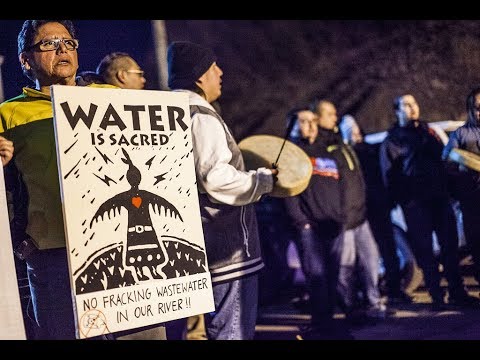
12018-07-12T16:11:55-07:00Dana Reijerkerk3c44fb85ab096c2290175e81dd4f16f0002a41e03086110In 2016 the Pennsylvania Department of Environmental Protection (PA DEP) began deliberating a 1,000-barrel/day of unconventional gas drilling wastewater (Frack Wastewater) disposal facility in Potter County proposed by Epiphany Allegheny LLC. In response to the news of these fracking plans, our Seneca people again fought for our people, our communities, and our Ohi:yo'.plain2018-08-31T18:22:43-07:00Dana Reijerkerk3c44fb85ab096c2290175e81dd4f16f0002a41e0The Kinzua Dam ProjectOur elders fought for our land and sovereignty in the 1950s and 1960s. They fought to stop the construction of Kinzua Dam.In 2016 the Pennsylvania Department of Environmental Protection (PA DEP) began deliberating a 1,000-barrel/day of unconventional gas drilling wastewater (Frack Wastewater) disposal facility in Potter County proposed by Epiphany Allegheny LLC. Potter county, Pennsylvania has been engaging in unconventional gas drilling with companies, such as JKLM Energy, particularly in Coudersport, Pennsylvania. The proposed project would not require the waste treatment plant to monitor for radioactive materials or chemicals used for fracking; the wastewater produced from fracking process is well known to be radioactive.
In June of 2017 the Coudersport Area Municipal Authority began reviewing the a plan proposed by Epiphany Allegheny LLC to discharge fracking wastewater into Ohi:yo'. Ohi:yo' travels north from Coudersport, Pennsylvania and into the state of New York, flowing through our Seneca people's land and the Seneca Nation's Allegany Territory. In addition, many non-Native communities would also be affected.
In response to the news of these fracking plans, our Seneca people again fought for our people, our communities, andour Ohi:yo'.
In April of 2018 the Coudersport Area Municipal Authority unanimously resolved to terminate its connection to Epiphany Environmental LLC.
On May 12, 2018 the Seneca Nation Council passed a resolution to ban unconventional gas drilling, any disposal, storage, or treatment of unconventional gas drilling byproducts, and transportation of unconventional gas drilling byproducts by any means through and on Nation lands.
This page has paths:
1media/84.1007.0001.jpg2018-07-18T15:41:02-07:00Dana Reijerkerk3c44fb85ab096c2290175e81dd4f16f0002a41e0The Seneca Nation of IndiansDana Reijerkerk71We call ourselves Onödowá'ga:' (oh-non-doh-wah!-gawh!), which means "People of the Great Hill". We are one of six other nations that collectively call ourselves Hodinöhsö:ní (hoh-dee-nonh-sonh-neeh!), meaning "People of the Longhouse".image_header7770492018-08-24T14:54:12-07:00Dana Reijerkerk3c44fb85ab096c2290175e81dd4f16f0002a41e0
1media/80.1002.0022.jpg2018-07-25T21:44:55-07:00Dana Reijerkerk3c44fb85ab096c2290175e81dd4f16f0002a41e0Ohi:yo'Dana Reijerkerk22Ohi:yo', our Beautiful River, has always been our home and source of nourishment.image_header2018-08-24T14:57:58-07:00Dana Reijerkerk3c44fb85ab096c2290175e81dd4f16f0002a41e0
Contents of this path:
1media/SINM-003-v3.jpg2018-08-09T18:47:11-07:00Dana Reijerkerk3c44fb85ab096c2290175e81dd4f16f0002a41e0The Watershed Resources Working Group (WRWG)7The WRWG is a technical advisory board to our Nation's Council, whose sole purpose is to protect the environment.plain2018-08-24T14:24:33-07:00Dana Reijerkerk3c44fb85ab096c2290175e81dd4f16f0002a41e0
Contents of this tag:
1media/SINM-003-v3.jpg2018-08-09T18:47:11-07:00Dana Reijerkerk3c44fb85ab096c2290175e81dd4f16f0002a41e0The Watershed Resources Working Group (WRWG)7The WRWG is a technical advisory board to our Nation's Council, whose sole purpose is to protect the environment.plain2018-08-24T14:24:33-07:00Dana Reijerkerk3c44fb85ab096c2290175e81dd4f16f0002a41e0
This page references:
12018-08-27T02:11:50-07:00Seneca Nation Rallies To Defend River From Fracking Wastewater1Video's Original Caption: In Coudersport Pennsylvania, over 100 members of the Seneca Nation of Indians appeared at a public meeting to oppose a fracking wastewater treatment facility planned for development on the Allegheny river, known by the Seneca as the Ohi:yo', which means "beautiful waters." "We're the protestors of tomorrow," Seneca Nation of Indians Treasurer, Maurice John, stated during public comment to the Coudersport Area Municipal Authority (CAMA) board on the evening of February, 26.plain2018-08-27T02:11:51-07:00