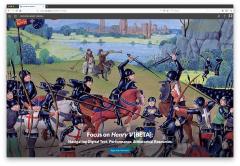
Navigating Digital Text, Performance, & Historical Resources
Navigating this Book
Like a print book, this digital book has a cover, a Table of Contents, individual chapters, running titles, text on finite pages, and illustrations. Navigating to the menu in the top left-hand corner of the screen (the three bullet points, each followed by a short line) displays the Table of Contents. Unlike a print book, however, some of this text's illustrations comprise streaming video, each page includes audio files of contributors reading their own or other contributors' texts, and its still images include audio captions. Also unlike a print book, this text explicitly offers multiple additional ways to navigate this book and to uncover relationships among its chapters.
Moving your cursor or mouse to the menu attached to the circular icon that resembles a magnetic compass shows you some of the textual and thematic routes that a reader can traverse this book. We imagine different audiences navigating this digital book in different ways. A traditional reader might prefer to navigate sequentially, left-to-right, top-to-bottom, through the book, page (or screen) by page, one essay at a time, in order, moving from information about the text of the play, and its sources, to critical interpretations, to stage history, to film and popular adaptations, and finally to lesson plans and teaching aids.
Information about the authors and provenance of the essays in this introduction leads such a traditional reader to the textual history of the early printed editions of Henry V (Daniel Yabut's essay), and to the sources that Shakespeare used to create the play (Mikaela LaFave's essay). Nora Galland's and Charlène Cruxent's pieces take us from paratexts (Yabut's brief editorial history) and antecedent texts (LaFave) to individual scene-analyses. Cruxent's contribution both builds on the information provided in Yabut's textual survey to argue for the placement of Act 4, Scene 4 (the scene between Pistol and the French Captain, Le Fer) right after King Henry "galvaniz[es] his troops," and stands alone as an intervention that identifies the roles of onomastics (naming), vituperation (cursing), paronomasia (puns) and (mis)translation perform in challenging Henry V's ostensible ideal of a "United" kingdom of Britain. Nora Galland's essay similarly develops concerns surrounding race, ethnicity, and language previously discussed in the book and works as a free-standing discussion of rhetorical figures of abuse (insultatio, execratio, abominatio, invective) in light of critical race theory and postcolonial studies. Janice Valls-Russell's and Florence March's essays shift us from page to stage, with temporal and geographic foci respectively. The former's essay traces a stage history of Shakespeare's play over the past four decades ("From the Falklands War to Brexit," as her title puts it), and identifies an "arc" or range of differently politicized stagings that depend on current events for their power. The latter's article explores the historical dearth of performances of Henry V in France and the ways in which festival performances in Southern France were able to recuperate through imaginative framing what many had considered an irredeemably anti-Gallic play. Valls-Russell's essay additionally focuses on the scenes between Katherine and Henry and the changing portrayal of the princess over the decades, notably the development of feminist or non-traditional or non-binary approaches towards social gender and gendered characters on stage. Philip Gilreath's essay explores the afterlife of Henry V in popular Anglophone culture, from Hollywood blockbuster movies to cult computer games and comic books, while Julia Koslowsky's concentrates on the specific changes that Lawrence Olivier made to the script of the Chorus in his 1944 film of the play. The book concludes with a set of lesson plans tailored for US middle- and high-school classroom use, by Hayden Benson, with discussion questions or essay directives for college classrooms (which are also linked to particular essays within this book), and with the Folger Digital Editions text of Henry V.
Less traditionally minded readers -- such as an undergraduate student writing a paper -- might start with a particular essay that includes lines that pique the student's interest, and then move outwards to other essays or to multimedia excerpts in other essays that chime with the student's concerns. A schoolteacher or high school student might look for commentary or explication or performances of particular lines or speeches. For example, if on October 25th, St. Crispin's Day, teachers or students feel like comparing historical stage or film declamations of the speech in the twentieth century, or looking at what Shakespeare did with his sources to convert prose history into King Henry's stirring verse, they can follow this pathway through the book to find the references, clips, images, and arguments within this book concerning this famous speech. Other pathways include study and discussion questions for college students; references to King Henry's exhortation, "Once more unto the breach!", and listings of all film-clips and audio files. Students of visual culture and those who "think visually" might choose to explore the rich visualizations that this format produces, such as the data network, scatter, or the more traditional "tree" structures [images].
This page has paths:
- Overview by Sujata Iyengar and Nathalie Vienne-Guerrin Sujata Iyengar