Thanks for your patience during our recent outage at scalar.usc.edu. While Scalar content is loading normally now, saving is still slow, and Scalar's 'additional metadata' features have been disabled, which may interfere with features like timelines and maps that depend on metadata. This also means that saving a page or media item will remove its additional metadata. If this occurs, you can use the 'All versions' link at the bottom of the page to restore the earlier version. We are continuing to troubleshoot, and will provide further updates as needed. Note that this only affects Scalar projects at scalar.usc.edu, and not those hosted elsewhere.
Coors Boycott: The Influence of the Chicano MovementMain MenuCoors: Corruption and DiscriminationHow did the issues within Coors spark the boycott? What did Coors do during the Boycott?Support on Coors' SideWho was supporting Coors during this boycott? What was Coors perspective on the matter?Support for the BoycottWho supported the Boycott as it was occurring, why did they support it, and specific examples of supporting documentsImpact and LegacyWhat happened to Coors? Was the boycott effective? Coors today?CreditsFliers and CartoonsCheyenne, Bryana, Naomi366c519e9e71a9d3a9837fedd4b7faabd765a585
Beer and Politics: An Introduction
12019-02-21T18:09:04-08:00Bryana Owens2315aa736d0f2db2336fa1d85863a1577ccb81f03276917An introduction to the who, what, when, and where of the Coors Boycottplain2019-05-01T11:56:13-07:00Cheyenne Romerobcc0ca762d14836e1713b7c9e18d12a8dfcd4a6c
Alcohol and politics have been directly linked since prohibition in the 1920s. Issues dealing with its legality, its effects, and the ways in which it is sold are often the focus of debates when it comes to the subjects of beer and politics. Many people find most of their issues with the product itself and do not focus on where it all came from. The Coors Boycott of 1966, which continues still in some social groups today, changed this mindset as politics and beer furthered the interest and understanding of the manufacturing and labor forces that go into making these products.
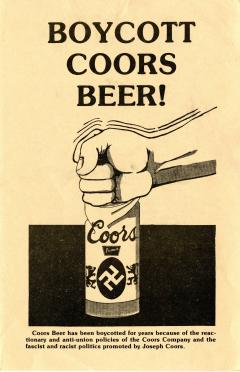
Opposition to the Adolph Coors Company mainly centered on three issues. First, the company did not support the organization of labor forces often using a variety of union busting tactics. Second, critics claimed that Coors hiring practices discriminated against Hispanics/Latinos, African-Americans, women, and those of the LGBT community. Finally, members of the Coors family, particularly Joseph Coors, actively supported and funded conservative politicians and organizations that discriminated against the basic rights of their workers.
This page has paths:
1media/Coors Boycott.jpg2019-03-04T03:09:12-08:00Bryana Owens2315aa736d0f2db2336fa1d85863a1577ccb81f0The Coors BoycottCheyenne, Bryana, Naomi4The Influence of the Chicano Movement in the Laborforcebook_splash2019-03-05T18:33:18-08:00Cheyenne, Bryana, Naomi366c519e9e71a9d3a9837fedd4b7faabd765a585
Contents of this path:
12019-02-21T18:23:37-08:00Bryana Owens2315aa736d0f2db2336fa1d85863a1577ccb81f0Coors: Corruption and Discrimination21How did the issues within Coors spark the boycott? What did Coors do during the Boycott?plain2019-05-01T12:02:10-07:00Cheyenne Romerobcc0ca762d14836e1713b7c9e18d12a8dfcd4a6c
This page references:
12019-04-11T17:57:46-07:00Anti-Coors Cartoon4A political cartoon dipicting the literal crushing of Coors. Here connections between Coors Beer and Nazis are made with the use of a swastika.media/rsz_img014.jpgplain2019-04-16T11:45:47-07:00