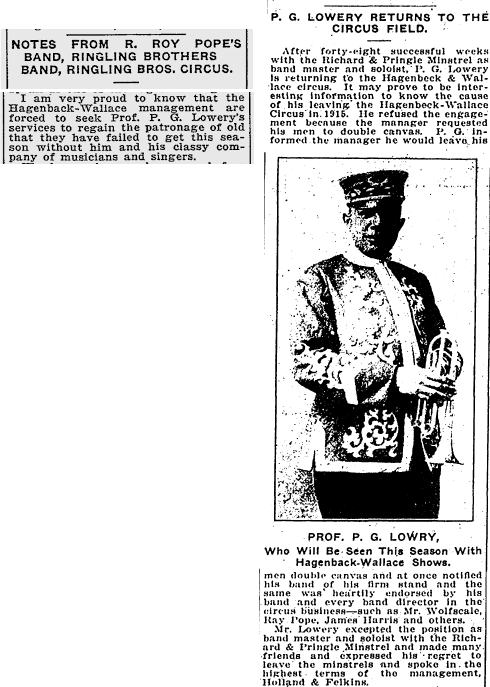
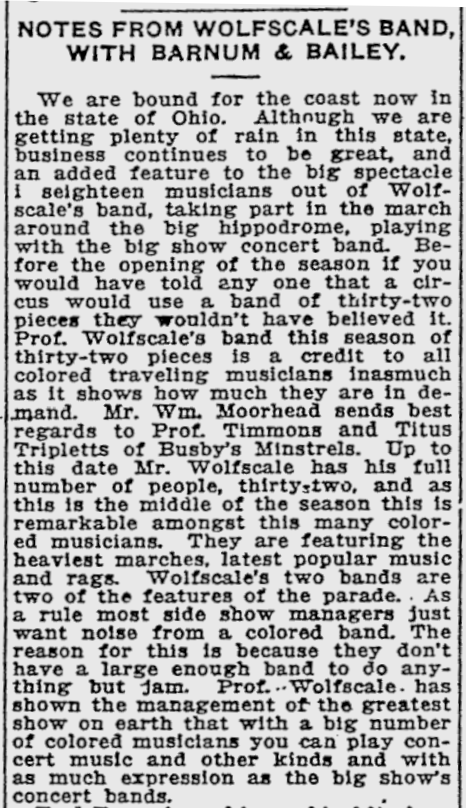
Prof. Wm. Blue – Dear Sir: I received your favor and I appreciate your valuable offer, but at present I must decline the same as I am under contract with Mr. Pat Chappelle, and I have no desire to give up my job here for several reasons.
First. I am a black man, and I am interested in anything that a black man has, and will do all in my power to make it a success.
Second. I have been with Mr. Chappelle for over four years, and have always found him to be a perfect gentleman; he is always ready to help his people in any way he can; he has helped me and most every one of the company …
My third reason is I was learned with this show … and I know that Messrs. Rusco and Holland would have never picked me up as Mr. Chappelle did and learn me, so I will frankly say that, if you were to offer me $20 per week, I would consider it an insult…
I would never persuade a member of a colored man’s show to join a show run by a white man, as you know that the white man bought and sold our fore-parents, and I thank the Lord to-day that there are some young Negros in the world that they cannot buy. I am one of them that Messrs. Rusco and Holland can not buy. And, as for yourself, Mr. Blue, I earnestly trust that this will be a lesson to you in the future – to hunt a black man for a white man. … I trust, in the future, you will try to get other people from other places for your white bosses instead of trying to break up a colored show.
… and we get the money [so] the colored people do not have to go up the side fire-escape or in back door and set in the gallery to see show. They set where they pay for.
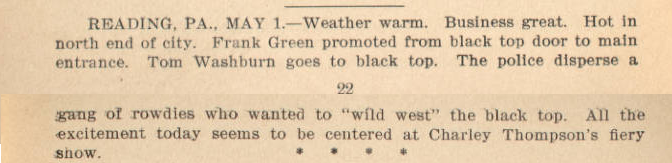
In contrast to Williams' remarks on African Americans having an equitable place in the audience is Forepaugh's diary from 1900, which not only provides evidence of the "black top" but also the racially-charged perspectives held by many circus owners. It is these sorts of commentaries that drove African Americans to create their own newspapers: