In literary studies, the broad discipline to which I owe my training, we often repeat Fredric Jameson's instruction to "Always historicize!" Whether you feel equipped to live out this command on the grounds Jameson articulates in his book The Political Unconscious (he describes it therein as a "slogan") I can think of at least one good reason to engage with the past that doesn't involve being "destined to repeat it."
Put briefly, learning about the history of something--whether it's a cultural phenomenon or political issue or subject of personal interest––is, to my mind, the surest way to write with substance. When you engage with the past, you can gain a deeper sense of how something works in its current manifestations.
Everything has a past; and when you think about it, that's pretty cool, isn't it
?
I should be clear here in noting that I don't mean that history itself is a monolith, or that it ever works in a clear, linear fashion; the past does not lead neatly into the present and future, and historians and other scholars who help us construct what has transpired do not always agree upon the details.
Moreover, if you're thinking that we always need to contextualize what's wrong now with how bad it used to be, stop right there. We shouldn't think the past was always worse, nor should we assume it was always better. In fact, writing with substance requires that you not only look at what something was like in the past, but also ask questions about the perspectives from which those accounts are written. You may conclude that a current version of something is superior to its predecessors, but you must always contextualize that assessment by asking "superior for whom, in what way, and at what cost?"
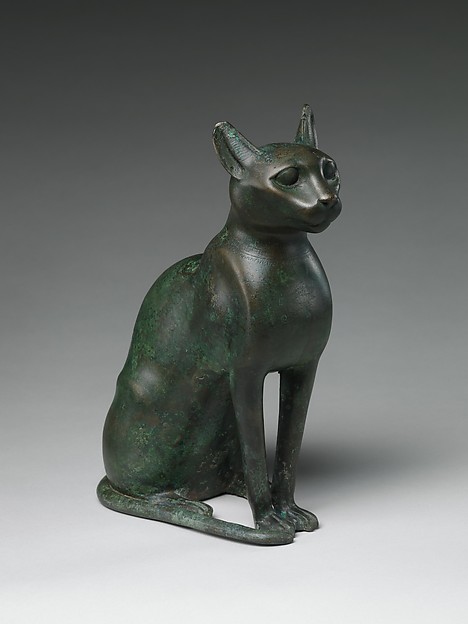
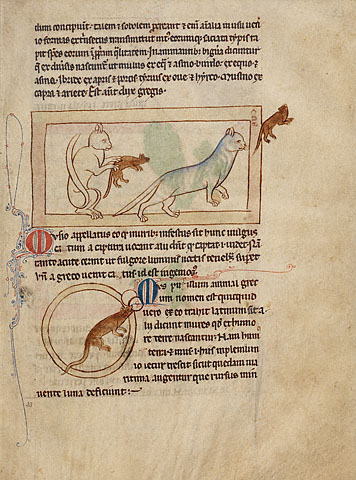
Take, for instance, the representations of cats, one of my favorite sources of amusement. If I examine the history of these representations, I can't help but notice that cats are often represented in relation to mice
. Long before
Tom and Jerry, their relationship featured in a fable usually attributed to Aesop, originating before the common era, or BCE, that told the story about the belling of the cat. This story, in which some mice or rats form a council to solve the problem presented by the cat, has been told in a variety of ways over the course of a thousand years. As we can see in
the Wikipedia entry for the
tail tale, the story circulates in different texts for different audiences, but in all cases it functions as an allegory for any difficult but necessary task.
Depictions of this tale usually present the perspective of the mice, a community terrorized by a ruthless invader
. Other stories circulate, however, such as the tale of Dick Whittington and his Cat, in which the mice or rats are themselves perceived as problems. In the account featured at left, the "fine cat" appears as a solution to both a King's infestation problem as well as Whittington's own ticket out of poverty
. Historical records suggest that the Richard Whittington upon whom the story was based was not actually a poor man; furthermore, there's no record that this Whittington had a cat, let alone a cat that helped him gain favor with the king. But the rags-to-riches narrative it presents, along with the cat's role as a saving grace, was apparently compelling to readers in the 17th and 18th centuries for some reason, even those who also read and enjoyed the tale of the rat council's idea for a tell-tale bell.
The fact that competing narratives exist shouldn't stop us from looking for more information or from thinking about representations of these animals more deeply; ideally, they will inspire us to do the opposite. Why is this relationship so commonly represented in popular culture? What kinds of dynamics do they comment upon, and what does it mean to shift the perspective in which these stories are told? Indeed, the act of grappling with the messiness of history is an act fundamental to learning and it is essential if you want to write with substance.
The essays I mentioned in your
Assignment 1 by Ta-Nehisi Coates (especially
"The Case for Reparations") offer great examples of the way historical research provides substance for what we write and strong support for it as well.
This
essay on Beyoncé by Natalia Cecire that you will read prior to completing
Assignment 7 provides another example. In it, Cecire analyzes Beyoncé's video material through screen shots and animated gifs, but also contextualizes the content of both (especially the infamous napkin drop) within a variety of historical moments and cultural forms. These include the
biopic about Tina Turner (from 1993) and another
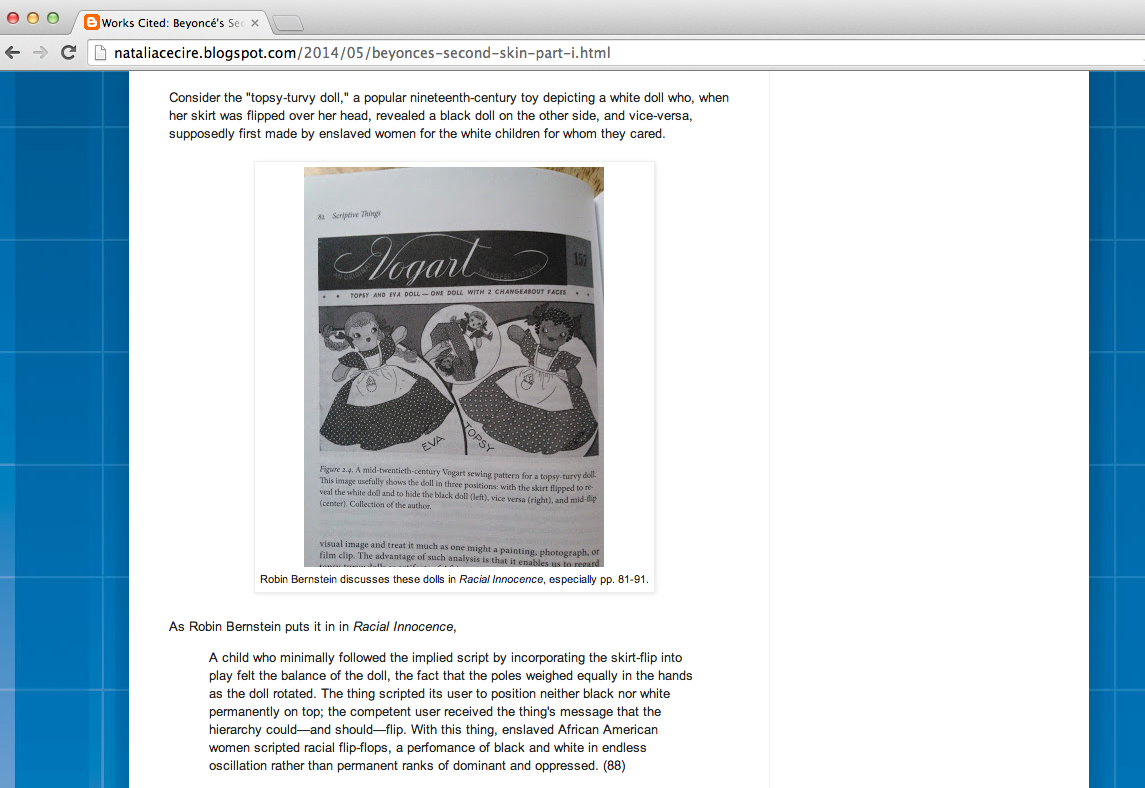
Beyoncé song featuring Jay-Z (from 2003) as well as a 19th-century doll called the Topsy-Turvy doll and a photograph of Josephine Baker (1906-1975)
. In discussing the oldest of these examples, Cecire draws upon the work of
Robin Bernstein, a scholar of African and African American Studies and Gender studies at Harvard; more specifically, she uses insights from
Bernstein's book, Racial Innocence, to think through the way the videos are not only taking archetypal gestures and "flipping them," but also to draw attention to the dynamics of race, class, and gender that make the significance of such "flipping" difficult to pin down.
Finally, the search techniques I showed you in the
video on using JSTOR afford another way to think about history that is even more in keeping with Jameson's command to "always historicize." Consider not just the way something evolved over time, but also how scholars talked about that thing or concept over time. Think of this kind of history as a sort of meta-history--that is, a history on top of a history, or the history behind the history we now consider "knowable." For instance, the way we talk about privacy in the age of the internet is indebted to long-standing scholarly interest in privacy as a concept, discussions that were happening prior to the introduction of the World Wide Web. Although the objects and contexts of these inquiries have shifted over time, we build knowledge by drawing on earlier ways of thinking and by looking in multiple directions––that is, forward and backwards in time, but also in academic work on subjects we might see as "adjacent" or affiliated in some way.
We will discuss together how historical research and historcized research can give substance to your writing on topics that interest you; the assigned essays and exercises in this course will give you several opportunities to practice doing both.