Thanks for your patience during our recent outage at scalar.usc.edu. While Scalar content is loading normally now, saving is still slow, and Scalar's 'additional metadata' features have been disabled, which may interfere with features like timelines and maps that depend on metadata. This also means that saving a page or media item will remove its additional metadata. If this occurs, you can use the 'All versions' link at the bottom of the page to restore the earlier version. We are continuing to troubleshoot, and will provide further updates as needed. Note that this only affects Scalar projects at scalar.usc.edu, and not those hosted elsewhere.
Transboundary E-wasteMain MenuIntroduction: a map of the map.An introductory page for users after the landing page.Defining a starting point for the controversy map.A description of how we obtained a floating statement for the controversy map.Mapping the controversy on the web.A path containing the movements through the web corpus.Mapping the controversy on the scholarly web.A path leading users through the controversy as it can be traced in the scholalrly literature.Key findings.A short summary of key findings with links to appropriate parts of the map.Procedures for mapping the wild web.A path through the procedures we used to map the wild web.Procedures for mapping the scholarly web.A path through the procedures used to map the scholarly web.References, further reading, and tools.A page offering a list of suggested further reading and descriptions of main tools used in this controversy map.Josh Lepawsky31444794f29f45991a28c6c997946216e765688eJohn-Michael Davisf787e14b50e5a81b5a0cddeca64901018c933909Donny Persaud113ae967bd2d3037d2982353d771c6ad48515166Grace Akesebb4c76b563d1dcb8fc6851361486b801fce50755Liwen Chen0afa93a5fb126f8db135c704ec2d04b9f33ea134
A Detour Through the Wikiweb I.
12017-01-24T06:14:19-08:00Josh Lepawsky31444794f29f45991a28c6c997946216e765688e682636A path through the wikiweb.plain2017-12-06T04:32:15-08:00Josh Lepawsky31444794f29f45991a28c6c997946216e765688eIn creating the web corpus for all URLs found through our initial Google search queries, Wikipedia articles were included as results in multiple queries. Wikipedia pages, much like the scholarly literature on electronic waste for which a separate corpus was created, require specific and individualized attention given their user accessibility and malleability.
Our initial Google query resulted in 5 Wikipedia entries being included in the corpus:
"Electronic waste"
"Electronic waste by country"
"Electronic waste in China"
"Electronic waste in the United States"
"Waste picker"
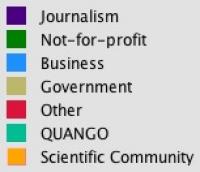
Below is a visualization of these entries and the concepts (or semantic terms) they link to on Wikipedia. The visualization is, in effect, a visualization of the web of meanings with which the above entries are associated within Anglophone Wikipedia pages. The web shows us how users of Wikipedia are conceptualizing the topic of electronic waste. An exploration of the web in the visualization shows both what is being included and, of course, hints at a variety of exclusions in the conceptualization of electronic waste within the Anglophone Wikipedia pages. Users can explore the visualization within this page or launch it in a separate window by clicking here or the "Source" tab below the image.
When a user accesses a Wikipedia page they are not presented with a fixed article as they would be with other URLs in our corpus or a scholarly article, but the most recent version of it. Users in addition to being able to access Wikipedia freely also have the ability to create and edit any articles as they see fit. As a result, a Wikipedia article can be taken to be a living artifact undergoing continuous revisions between users holding contesting points of view (POVs) (Borra et al., 2015a). As per Wikipedia’s Core Content Policies, these POVs must be negotiated to present a “neutral point of view” for the article at large “representing significant views fairly, proportionately and without bias” (Wikipedia contributors, 2016). But notice how two substantially different organizations, the Basel Action Network (BAN) and the US Environmental Protection Agency (EPA), receive an equal number links from Wikipedia articles concerned with e-waste. BAN is an organization with perhaps half a dozen employees and a budget of approximately $1 million. EPA, on the other hand, employs over 15,000 people with a budget exceeding $8 billion. Yet, the two organizations appear of equal significance in the linking behavior of Wikipedia entries on e-waste. This linking behavior of Wikipedia contributors points to how entries can, despite the Core Content Policies, shape disproportionate representations of an issue.
This page has paths:
12017-01-10T10:31:14-08:00Josh Lepawsky31444794f29f45991a28c6c997946216e765688eMapping the controversy on the web.Josh Lepawsky44A path containing the movements through the web corpus.image_header3770622017-12-06T04:51:03-08:00Josh Lepawsky31444794f29f45991a28c6c997946216e765688e
This page references:
12017-02-07T11:04:38-08:00Semantic network of Wikipedia pages.3A semantic network of Wikipedia pages created using SeeAlsoOlogy.plain2017-02-07T11:09:46-08:00
12017-02-09T11:09:03-08:00Legend of Meta-Actor Types1Legend of Meta-Actor Types for Wikipedia link networks.media/legend-wiki-meta-actor-location.jpgplain2017-02-09T11:09:03-08:00