Identity
The word açaí is the European corruption of the Tupian word ïwasa’i, meaning “fruit that cries or expels water.” (The Tupi-speaking people have inhabited Brazil dating back to the 1500s) (Alzugaray 1988). As for the plant’s Latin binomial, the genus Euterpe may be so named due to the tree’s graceful growth habit. In Greek mythology, Euterpe was the daughter of Mnemosyne and Zeus and one of the muses of music, song, and dance. (Atsma 2008). The species name, oleracea, refers to having the nature of herbs for cookery, i.e., being edible.
The identity of euterpe oleracea mart., popularly known as açaí, is strongly influenced by indiginous cultures based in South America. In an indigenous settlement located in the Vaupes department of Columbia, cubeo is the native language. In cubeo the euterpe oleracea is known as Acai, Asai, Bambil, Cansin, Murrapo, Nãhõemimueñi, and Nãhõemimueñi (Kew Science, 2022). At the border of Colombia, Panama, and Ecuador the spoken language shifts into one of the greater Choco languages Wounaan. The language, unlike cubeo, has a less diverse array of terms for acai, calling it murrapho (Kew Science, 2022). As you near more centralized areas of South America the Spanish language begins to dominate, each country having a different slang for the species. In Colombia acai is known as Naidi, while Ecuador named it palmiche (Cococauca, 2019).Phylogeny
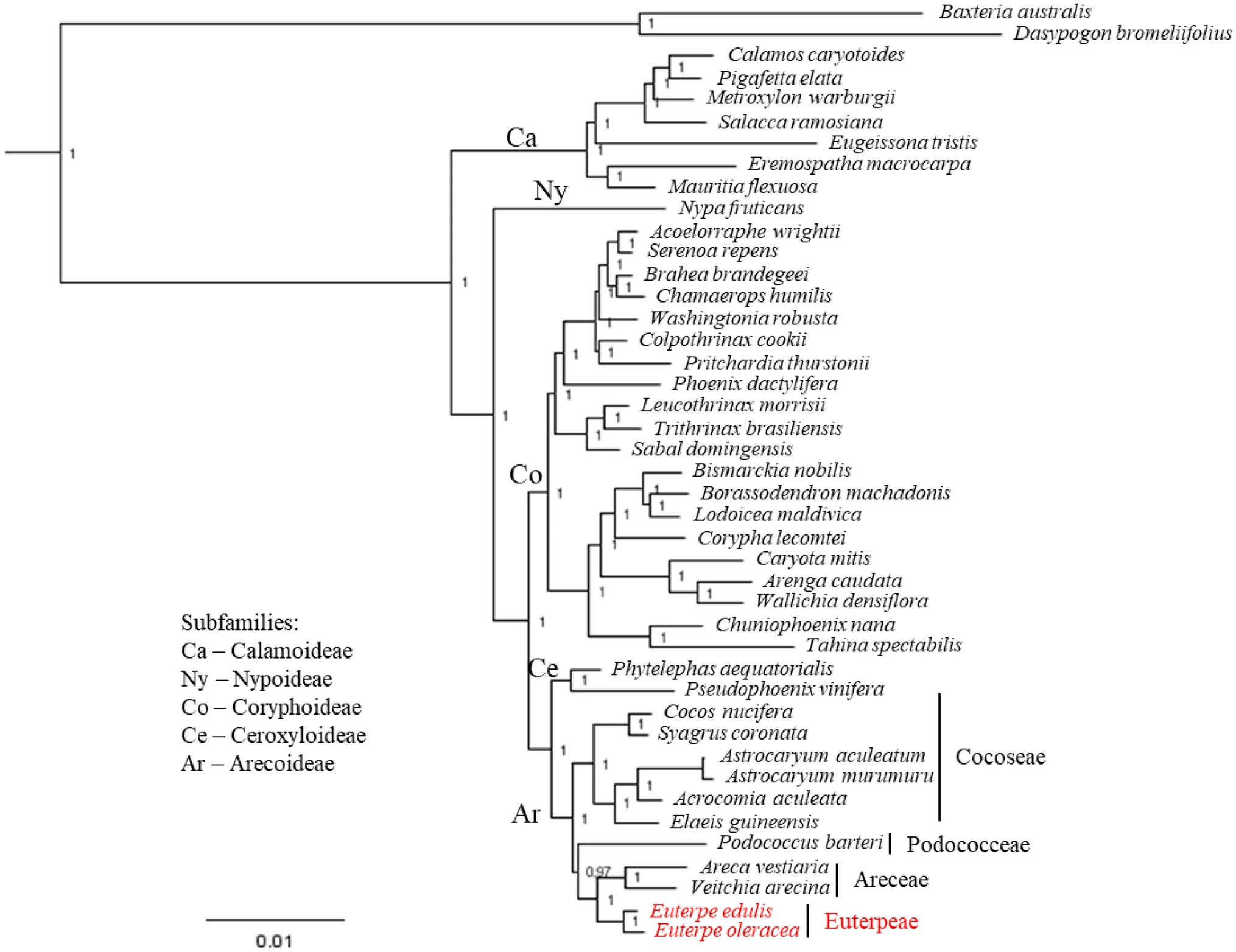
The Arecaceae family is composed of perennial flowering species normally found in humid climates. The lineage is split into five subspecies Calamoideae, Nypoideae, Coryphoideae, Ceroxyloideae, and Arecaceae (De Santana Lopes et al., 2021). The basal subfamily, Calamoideae, diverged with its scale-bearing fruits and an abundant number of climbing species. The lineage then diverges into the four sister subfamilies where spiny leaved palms are produced in tropical and humid climates such as South America. Euterpe is the only genus that produces the acai fruit with oleracea and precatoria being the main sources (Yamaguchi K K, 2015). The former produces fruit from multiple stems and the latter uses only a single stem.Ecology
The açaí palm is able to grow the fruit and flowers throughout the whole year, but there are periods of high production. High amounts of berry production usually happen during the dry seasons of the year. The palm is found in the flooded plains of the Amazon and can handle being in poor soil conditions due to the formation of a large root structure. Humans and animals either inadvertently or purposely spread the seeds as they seek the desired taste of its fruit and high energy content. Alternatively, the flooded plains transport seed through the flow of water. As the seed settle the defining factor in its quick growth is the availability of light. Their incapability to grow in the shade forces humans to cut down the canopy as well as competition to allow its quick growth.
Vegetative Morphology
The açaí is a tall palm tree that can reach up to 25m (Masats, 2021) with pinnate compounded leaves called fronds. There is a grouping of branches at the top, and the açaí fruit hangs lower in clusters. The trunk, or stipes, is slender, cylindrical, fibrous, and often light-grey in color. The stems are often clustered in clumps of up to 20. The açaí has epigeal or aerial roots 40-50 cm. above ground and utilizes pneumataphores (sciencedirect.com).
Reproductive Morphology
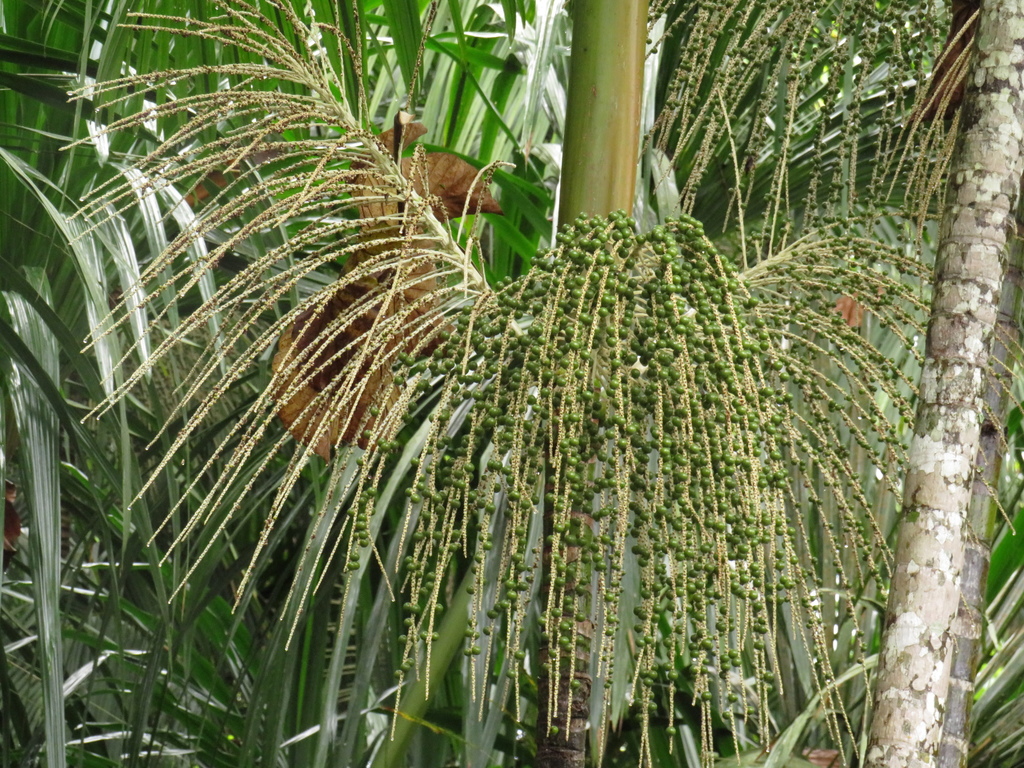
The açaí has inflorescence-branched flowering that are cream or purple in color. They are also monoecious, which means they have flowers that are staiminate and pistillate, with the female flowers 2-3 times bigger than the male counterpart (nparks.gov.sg). The fruit is a small, round drupe that is black/purple in color at maturity. It is indehiscent, with the exocarp/skin being green and ripening to a dark purple (sciencedirect.com). The fleshy mesocarp is pulpy, and the endocarp is single-seeded and large, making up 60-80% of the fruit (Marcason, 2009). The açaí tree bears fruit year round, but there are usually two large harvests a year.
Historical Accounts
There is a historical legend associated with the açaí. An indigenous tribe of Pará was in a famine and starved, so the chief, Itaki, wanted to save his people and thus ordered that all the newborns be sacrificed - including his own daughter’s child, Iaça. She was heartbroken and walked through the woods, weeping and crying. The next day, Itaki found Iaça under a tree with small black fruits in the leaves. They made a drink from the fruit and solved the hunger problem, and in honor of Iaça, they named the palm tree after her name in reverse: açaí.
Historically, açaí has been in Brazilian diets for centuries, often eaten as a juice or pudding-like pulp. The tribes in the Amazon rainforest region used the açaí to treat ailments as medicine and for health in “strengthening the immune system, fighting off infection, heart health, and even a sexual stimulant” (Colapinto, 2011). Acai is harvested by the ribeirinhos, or river people, and is often seen in every meal. The local people have a saying that “Without acai, I am still hungry”, symbolzing the importance of acai in the region (Colapinto, 2011). In addition to the fruit, acai trees are cultivated for its heart of palm, leaves, and wood.
Domestication History
The açaí has been domesticated for centuries in the northern Brazilian Amazon region as a staple in their diet. The villagers would learn to climb the tree trunk and harvest the fruit starting from a young age - starting around seven or eight years old (nature.org). Açaí exploded in popularity around the world starting in the early 1990s due to Jeremy and Ryan Black, from Southern California, when they began exporting the fruit to the US (nativoacai.com). It has been advertised as a ‘superfood’ and healthy snack alternative, which launched further productivity for the açaí crop.Cultivation Practices
The açaí berry grows in the tropical setting of the Amazon on trees that reach up to 60 feet tall. Açaí harvesters, commonly referred to as peconheiros, are mainly families living in surrounding areas in Brazil (McCoy). Thousands of families participate in the harvest each year, as it is their sole source of income. Peconheiros use nothing but small serrated knives and burlap bound to their feet to scale these trees. Oftentimes the weight of a grown adult can cause the trees to snap, so children are expected to work to provide.Nutritional Value and Part of Plant Consumed
The açaí berry has a high fat content and boasts several health benefits including weight loss and detoxification; however, very little research has been done to prove these claims. The part of the plant that is consumed lies within the drupe of the açaí itself. After harvesting, the berries are plucked off the stems and soaked in water, which aids in skin removal. After the outer layer of skin is removed, the yellow pulp is scraped off the fibrous pit and mashed into a thick paste. This paste is eaten in many ways, including as a side dish, a juice, wine, or mixed with tapioca. Its popularization in the United States is thanks to the creation of açaí bowls, which use the açaí mixture as a base and are topped with various other fruits.Human Experience
The açaí berry harvest is not inherently detrimental to the Amazon. It has been a primary source of income and food for many families living in Brazil for many years. However, the exponential rise in popularity of the açaí in urban communities in the United States has indirectly fed into an unsustainable increase in harvesting and production of açaí trees in the Amazon. This only exacerbates the issue of exploitation of labor for families who depend on the açaí harvest for income. Organizations such as Amazon Conservation attempt to provide relief to these families in the form of safer cultivation measures. Current harvesting trends are unsustainable in the long run; therefore more awareness and action must be taken by consumers to push for safer and more sustainable harvesting of açaí.References
Acai. (n.d.). NCCIH. Retrieved May 24, 2022, from https://www.nccih.nih.gov/health/acai Acai berry harvesting Archives. (n.d.). Amazon Conservation Association. Retrieved May 24, 2022, from https://www.amazonconservation.org/tag/acai-berry-harvesting/
Acai berry harvesting Archives. (n.d.). Amazon Conservation Association. Retrieved May 24, 2022, from https://www.amazonconservation.org/tag/acai-berry-harvesting/
Açaí: The roots of a super fruit. The Nature Conservancy. (2018, November 9). Retrieved May 29, 2022, from https://www.nature.org/en-us/about-us/where-we-work/latin-america/brazil/stories-in-brazil/acai-the-roots-of-a-super-fruit/
Alzugaray D, Alzugaray C. Enciclopédia de Plantas Brasileiras. São Paulo: Ed. Três Ltda; 1988:24.
Atsma AJ. The Theoi Project: Greek Mythology: Euterpe. Auckland, New Zealand. 2008. Available at: www.theoi.com/Ouranios/MousaEuterpe. html. Accessed January 18, 2010.
Colapinto, J. (2011, May 23). Strange fruit. The New Yorker. Retrieved May 29, 2022, from https://www.newyorker.com/magazine/2011/05/30/strange-fruit-john-colapinto
McCoy, Terrence. Small children are climbing 60-foot trees to harvest your açaí. (2021, November 28). Washington Post. https://www.washingtonpost.com/world/2021/11/28/brazil-acai-child-labor/
de Oliveira, M. do S. P., & Schwartz, G. (2018). Açaí—Euterpe oleracea. In S. Rodrigues, E. de Oliveira Silva, & E. S. de Brito (Eds.), Exotic Fruits (pp. 1–5). Academic Press. https://doi.org/10.1016/B978-0-12-803138-4.00002-2
de Santana Lopes, A., Gomes Pacheco, T., Nascimento da Silva, O., do Nascimento Vieira, L., Guerra, M. P., Pacca Luna Mattar, E., de Baura, V. A., Balsanelli, E., Maltempi de Souza, E., de Oliveira Pedrosa, F., & Rogalski, M. (2021). Plastid genome evolution in Amazonian açaí palm (Euterpe oleracea Mart.) and Atlantic forest açaí palm (Euterpe edulis Mart.). Plant Molecular Biology, 105(4), 559–574. https://doi.org/10.1007/s11103-020-01109-5 Euterpe oleracea.
Euterpe Oleracea - an overview | ScienceDirect Topics. (n.d.). Retrieved May 29, 2022, from https://www.sciencedirect.com/topics/agricultural-and-biological-sciences/euterpe-oleracea
Euterpe oleracea Mart. | Plants of the World Online | Kew Science. (n.d.). Plants of the World Online. Retrieved May 27, 2022, from http://powo.science.kew.org/taxon/urn:lsid:ipni.org:names:666941-1
Fruit of Brazil: The Fascinating History of the Acai Berry. Nativo Acai. (n.d.). Retrieved May 29, 2022, from https://www.nativoacai.com/fruit-of-brazil-the-fascinating-history-of-the-acai-berry/
Marcason, W. (2009). What is the acai berry and are there health benefits. Masats, J. (2021, June 30). Acai cultivation. Botanical online. Retrieved May 29, 2022, from https://www.botanical-online.com/en/cultivation/acai-how-to-grow
Masats, J. (2021, June 30). Acai cultivation. Botanical online. Retrieved May 29, 2022, from https://www.botanical-online.com/en/cultivation/acai-how-to-grow
NAIDÍ. (2019, July 12). COCOCAUCA. https://cococauca.org/2019/07/12/naidi/
NParks: Euterpe oleracea. National Parks Board. (n.d.). Retrieved May 29, 2022, from https://www.nparks.gov.sg/florafaunaweb/flora/2/6/2628
Tomlinson, P. B., Horn, J. W., & Fisher, J. B. (2011). Subfamily Calamoideae. In The Anatomy of Palms. Oxford University Press. https://doi.org/10.1093/acprof:osobl/9780199558926.003.0010
Yamaguchi, K. K. de L., Pereira, L. F. R., Lamarão, C. V., Lima, E. S., & da Veiga-Junior, V. F. (2015).
Amazon acai: Chemistry and biological activities: A review. Food Chemistry, 179, 137–151.
https://doi.org/10.1016/j.foodchem.2015.01.055