Thanks for your patience during our recent outage at scalar.usc.edu. While Scalar content is loading normally now, saving is still slow, and Scalar's 'additional metadata' features have been disabled, which may interfere with features like timelines and maps that depend on metadata. This also means that saving a page or media item will remove its additional metadata. If this occurs, you can use the 'All versions' link at the bottom of the page to restore the earlier version. We are continuing to troubleshoot, and will provide further updates as needed. Note that this only affects Scalar projects at scalar.usc.edu, and not those hosted elsewhere.
Introduction to Digital HumanitiesMain MenuWhat is Digital Humanities?Module I: A Theoretical IntroductionExploring The Tool BoxModule I: An Experiential IntroductionCreating Digital IdentitiesModule I: A Personal IntroductionConstructing DataModule II: DH MethodsWorking with Big DataModule II: DH MethodsData VisualizationModule II: DH MethodsMappingModule II: DH MethodsDistant ReadingModule II: DH MethodsNetwork AnalysisModule II: DH MethodsCritical Platform StudiesModule III: Critical PerspectivesPostcolonial and Intersectional Digital HumanitiesModule III: Critical PerspectivesDH ProjectModule IV: Creative ExpressionsAndrea Davise50475e163fb87bc8bd10c6c0244468fd91e8da5Digital Humanities Certificate
Complete Miriam Posner's suite of Mapping Tutorials to create an interactive map using Tableau. Be sure to follow the instructions on the "Assignment" page of our workbook to make sure that this assignment shows up in the contents of your personal page and the "Assignment #7" page.
OR
Use Scalar to create an interactive map with 6 entries on a topic of your choosing. To make a map, you first have to create a page for each entry in our Scalar workbook. Each of these pages must contain a title, a description, a key image or media url, and metadata that specifies the location (either dcterms: spatial or dcterms: coverage). After you have created a page for each of your entries, you can "gather" them via the Scalar Map Widget (directions here) or the Scalar Google Map Layout (directions here) on your "Assignment #7" page. Be sure to follow the instructions on the "Assignment" page of our workbook to make sure that this assignment shows up in the contents of your personal page and the "Assignment #7" page.
This page has paths:
12023-06-08T09:42:54-07:00Andrea Davise50475e163fb87bc8bd10c6c0244468fd91e8da5ScheduleAndrea Davis1Requirements and Due Datesimage_header2023-06-08T09:42:54-07:00Andrea Davise50475e163fb87bc8bd10c6c0244468fd91e8da5
This page references:
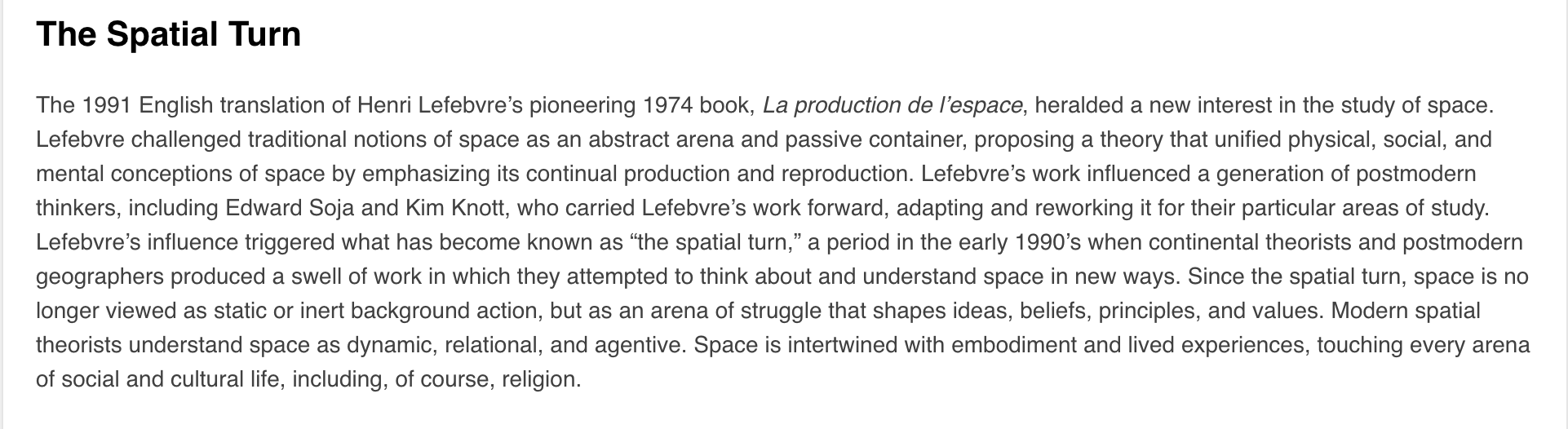
12023-06-08T09:42:58-07:00Spatial Turn1Jaimie Gunderson, Theory and Methods in the Study of Religion, UT Austin, December 9, 2014. https://sites.utexas.edu/religion-theory/bibliographical-resources/spatial-theory/overview/plain2023-06-08T09:42:58-07:00