Thanks for your patience during our recent outage at scalar.usc.edu. While Scalar content is loading normally now, saving is still slow, and Scalar's 'additional metadata' features have been disabled, which may interfere with features like timelines and maps that depend on metadata. This also means that saving a page or media item will remove its additional metadata. If this occurs, you can use the 'All versions' link at the bottom of the page to restore the earlier version. We are continuing to troubleshoot, and will provide further updates as needed. Note that this only affects Scalar projects at scalar.usc.edu, and not those hosted elsewhere.
Exhibiting Historical Art: Out of the Vault: Stories of People and ThingsMain MenuWorld MapClick pins to learn more about the object that originated thereTimelinePre-Columbian Gold Headband800 A.D. - 1500 A.D.Gold Eagle PendantsSepik River Headrest20th centuryStatue of Saint Barbara17th century France, polychromed wood, artist unknownCabinet door from the Imperial Palace of Beijing with Imperial DragonChen Youzhang, 1755Bronze LampHead of John the BaptistLauren Linquest, '19Ida Rubenstein, 1909 Sculpture by Jo DavidsonCassone ChestWater-Carrier Vase with Bamboo Pattern and BambooLenore Vanderkooi, 1996Lotus Flowers in a Wood VaseRevolutions Per Minute: The Art RecordOpening page
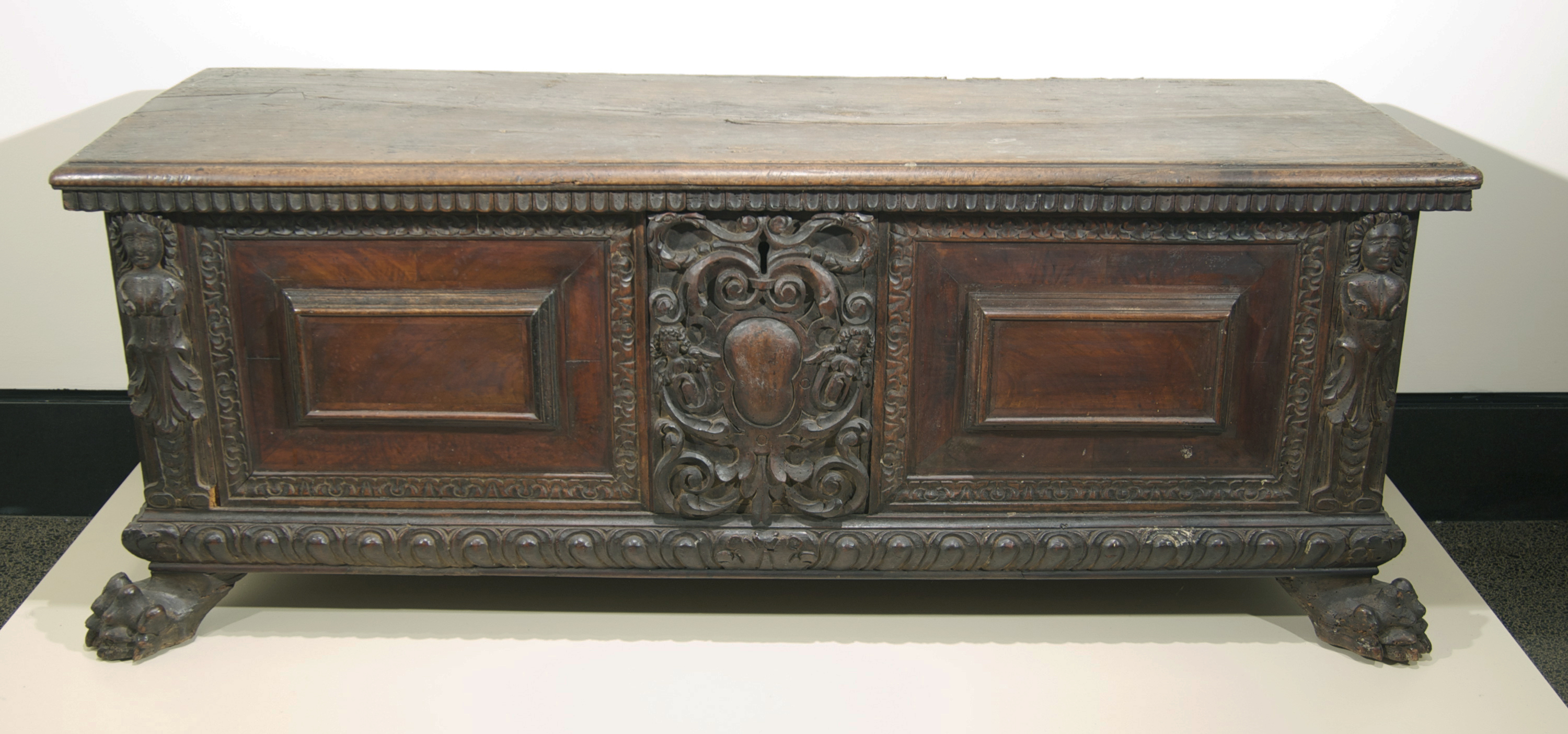
Cassone, said to belong to the Colonna Family Italy 16th century
A cassone is a narrow, rectangular wooden chest used to store linens and for seating. Because it was usually placed against a wall or at the end of a bed, the back is often unfinished. Cassoni were popular wedding gifts in Renaissance Italy. They would be carried in the wedding procession from the home of the bride’s father to that of her husband. The intricacy of the carved and painted decoration on the cassone indicated the family’s wealth and social status.
Since the Colonnas were a wealthy noble family, it is unlikely that this relatively simple chest actually belonged to them. Recent examination of the chest has further cast doubt on its origins. The insect damage on the front legs of the chest, but not the back, as well as overall inconsistencies in the wear on the chest suggest that it is not in fact from the sixteenth century. Rather, it may have been compiled from other pieces of furniture and sold to tourists as an antique in post-World War II Italy.