Thanks for your patience during our recent outage at scalar.usc.edu. While Scalar content is loading normally now, saving is still slow, and Scalar's 'additional metadata' features have been disabled, which may interfere with features like timelines and maps that depend on metadata. This also means that saving a page or media item will remove its additional metadata. If this occurs, you can use the 'All versions' link at the bottom of the page to restore the earlier version. We are continuing to troubleshoot, and will provide further updates as needed. Note that this only affects Scalar projects at scalar.usc.edu, and not those hosted elsewhere.
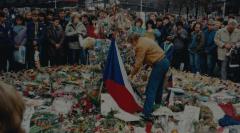
1media/image-1.jpg2018-12-07T15:24:44-08:00Jan Hamaradbb9b4e12a0a9cd10529d07c16b0755ad03ddfed324455The anti-Communist revolution started on 16 November 1989 in Bratislava, with a demonstration of Slovak university students for democracy, and continued with the well-known similar demonstration of Czech students in Prague on 17 November.image_header2018-12-09T15:12:42-08:00Jan Hamaradbb9b4e12a0a9cd10529d07c16b0755ad03ddfedDemocratic Czechoslovakia (1989-1992)A coalition government, in which the Communist Party had a minority of ministerial positions, was formed in December 1989. The first free elections in Czechoslovakia since 1946 took place in June 1990 without incident and with more than 95% of the population voting.On 17 November 1989, the communist police violently broke up a peaceful pro-democracy demonstration, brutally beating many student participants. In the following days, Charter 77 and other groups united to become the Civic Forum, an umbrella group championing bureaucratic reform and civil liberties. Its leader was the dissident playwright Václav Havel. Intentionally eschewing the label "party", a word given a negative connotation during the previous regime, Civic Forum quickly gained the support of millions of Czechs, as did its Slovak counterpart, Public Against Violence.
In response to the collapse of other Warsaw Pact governments and the increasing street protests, the Communist Party of Czechoslovakia announced on 28 November that it would relinquish power and dismantle the one-party state. Two days later, the legislature formally deleted the sections of the Constitution giving the Communists a monopoly of power. Barbed wire and other obstructions were removed from the border with West Germany and Austria in early December. On 10 December, President Gustáv Husák appointed the first largely non-communist government in Czechoslovakia since 1948, and resigned. Alexander Dubček was elected speaker of the federal parliament on 28 December and Václav Havel the President of Czechoslovakia on 29 December 1989.
The astonishing quickness of these events was in part due to the unpopularity of the communist regime and changes in the policies of its Soviet guarantor as well as to the rapid, effective organisation of these public initiatives into a viable opposition. The result was the end of 41 years of one-party rule in Czechoslovakia, and the subsequent dismantling of the planned economy and conversion to a parliamentary republic. Faced with an overwhelming popular repudiation, the Communist Party all but collapsed. Its leaders, Husák and party chief Miloš Jakeš, resigned in December 1989, and Havel was elected President of Czechoslovakia on 29 December.
This page has paths:
1media/image-14.jpg2018-12-07T12:49:08-08:00Jan Hamaradbb9b4e12a0a9cd10529d07c16b0755ad03ddfedThe Czechoslovak Socialist Republic (1948–1989)Jan Hamara12In February 1948, the Communists took power in the 1948 Czechoslovak coup d'état, and Edvard Beneš inaugurated a new cabinet led by Klement Gottwald. Czechoslovakia was declared a "people's democracy" (until 1960) – a preliminary step toward socialism and, ultimately, communism.image_header8265212018-12-09T15:07:36-08:00Jan Hamaradbb9b4e12a0a9cd10529d07c16b0755ad03ddfed
12018-12-06T20:51:45-08:00Jan Hamaradbb9b4e12a0a9cd10529d07c16b0755ad03ddfedMajor Events | The history of CzechoslovakiaJan Hamara18This page describes major events that had an influence on the history of Czechoslovakia, as well as on nations of Slovaks and Czechs separatelyvisual_path2018-12-10T15:27:45-08:00Jan Hamaradbb9b4e12a0a9cd10529d07c16b0755ad03ddfed
This page has tags:
12018-12-06T20:51:45-08:00Jan Hamaradbb9b4e12a0a9cd10529d07c16b0755ad03ddfedMajor Events | The history of CzechoslovakiaJan Hamara18This page describes major events that had an influence on the history of Czechoslovakia, as well as on nations of Slovaks and Czechs separatelyvisual_path2018-12-10T15:27:45-08:00Jan Hamaradbb9b4e12a0a9cd10529d07c16b0755ad03ddfed
12018-12-07T18:39:53-08:00Jan Hamaradbb9b4e12a0a9cd10529d07c16b0755ad03ddfedTimeline | The Dissolution of CzechoslovakiaJan Hamara12On this page, you can refer to crucial events in the history of Czechoslovakia on a timeline.timeline2018-12-10T17:07:52-08:00Jan Hamaradbb9b4e12a0a9cd10529d07c16b0755ad03ddfed
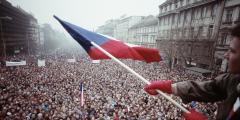
This page references:
12018-12-06T15:23:59-08:00The Velvet Revolution4This historical photo from demonstrations during the Velvet Revolution displays a man waving a former flag of Czechoslovakia and currently a flag of Czech Republic in front of crowds.media/VelvetRevolutionWP-1024x512.jpgplain2018-12-11T15:42:44-08:00