Thanks for your patience during our recent outage at scalar.usc.edu. While Scalar content is loading normally now, saving is still slow, and Scalar's 'additional metadata' features have been disabled, which may interfere with features like timelines and maps that depend on metadata. This also means that saving a page or media item will remove its additional metadata. If this occurs, you can use the 'All versions' link at the bottom of the page to restore the earlier version. We are continuing to troubleshoot, and will provide further updates as needed. Note that this only affects Scalar projects at scalar.usc.edu, and not those hosted elsewhere.
1media/image-14.jpg2018-12-07T12:49:08-08:00Jan Hamaradbb9b4e12a0a9cd10529d07c16b0755ad03ddfed3244512In February 1948, the Communists took power in the 1948 Czechoslovak coup d'état, and Edvard Beneš inaugurated a new cabinet led by Klement Gottwald. Czechoslovakia was declared a "people's democracy" (until 1960) – a preliminary step toward socialism and, ultimately, communism.image_header8265212018-12-09T15:07:36-08:00Jan Hamaradbb9b4e12a0a9cd10529d07c16b0755ad03ddfedIn February1948, the Communists took power in the 1948 Czechoslovak coup d'état, and Edvard Beneš inaugurated a new cabinet led by Klement Gottwald. Czechoslovakia was declared a "people's democracy" (until 1960) – a preliminary step toward socialism and, ultimately, communism.
Bureaucratic centralism under the direction of KSČ leadership was introduced. Dissident elements were purged from all levels of society, including the Roman Catholic Church. The ideological principles of Marxism-Leninism and socialist realism pervaded cultural and intellectual life. The economy was committed to comprehensive central planning and the abolition of private ownership of capital.
Czechoslovakia became a satellite state of the Soviet Union; it was a founding member of the Council for Mutual Economic Assistance (Comecon) in 1949 and of the WarsawPact in 1955. The attainment of Soviet-style command socialism became the government's avowed policy.
Slovak autonomy was constrained; the CommunistPartyofSlovakia (KSS) was reunited with the KSČ (Communist Party of Czechoslovakia), but retained its own identity. Following the Soviet example, Czechoslovakia began emphasizing the rapid development of heavy industry. Although Czechoslovakia's industrial growth of 170 percent between 1948 and 1957 was impressive, it was far exceeded by that of Japan (300 percent) and the Federal Republic of Germany (almost 300 percent) and more than equaled by Austria and Greece.
Beneš refused to sign the CommunistConstitutionof1948 (the Ninth-of-May Constitution) and resigned from the presidency; he was succeeded by Klement Gottwald. Gottwald died in March 1953. He was succeeded by Antonín Zápotocký as president and by Antonín Novotný as head of the KSČ.
In the 1950s, the Stalinists accused their opponents of "conspiracy against the people's democratic order" and "high treason" in order to oust them from positions of power. In all, the Communist Party tried 14 of its former leaders in November 1952 and sentenced 11 to death.
De-Stalinization had a late start in Czechoslovakia. In the early 1960s, the Czechoslovak economy became severely stagnant. The industrial growth rate was the lowest in Eastern Europe. As a result, in 1965, the party approved the New Economic Model, introducing free market elements into the economy. The KSČ "Theses" of December 1965 presented the party response to the call for political reform. Democratic centralism was redefined, placing a stronger emphasis on democracy. The leading role of the KSČ was reaffirmed, but limited. Slovaks pressed for federalisation.
On 5 January 1968, the KSČ Central Committee elected Alexander Dubček, a Slovak reformer, to replace Novotný as first secretary of the KSČ. On 22 March 1968, Novotný resigned from the presidency and was succeeded by General Ludvík Svoboda.
This page has paths:
1media/image-5.jpg2018-12-06T21:00:50-08:00Jan Hamaradbb9b4e12a0a9cd10529d07c16b0755ad03ddfedThe History of CzechoslovakiaJan Hamara13This chapter of the book talks about individual historical periods of the Czechoslovak state as well as about the general history leading to the Velvet Revolution and the dissolution of this nation.image_header8265452018-12-07T16:12:20-08:00Jan Hamaradbb9b4e12a0a9cd10529d07c16b0755ad03ddfed
Contents of this path:
1media/image-15.jpg2018-12-07T14:57:02-08:00Jan Hamaradbb9b4e12a0a9cd10529d07c16b0755ad03ddfedThe Prague Spring (1968)9The Prague Spring reforms were a strong attempt by Dubček to grant additional rights to the citizens of Czechoslovakia in an act of partial decentralization of the economy and democratization. The freedoms granted included a loosening of restrictions on the media, speech and travel.image_header2018-12-09T15:08:12-08:00Jan Hamaradbb9b4e12a0a9cd10529d07c16b0755ad03ddfed
1media/image-13.jpg2018-12-07T14:52:28-08:00Jan Hamaradbb9b4e12a0a9cd10529d07c16b0755ad03ddfedWarsaw Pact Invasion of Czechoslovakia9The Warsaw Pact invasion of Czechoslovakia, officially known as Operation Danube, was a joint invasion of Czechoslovakia by five Warsaw Pact countries – the Soviet Union, Poland, Bulgaria, East Germany and Hungary – on the night of 20–21 August 1968image_header2018-12-09T15:10:17-08:00Jan Hamaradbb9b4e12a0a9cd10529d07c16b0755ad03ddfed
1media/image-16.jpg2018-12-07T15:17:43-08:00Jan Hamaradbb9b4e12a0a9cd10529d07c16b0755ad03ddfedThe Final Years of the Communist Era5Although, in March 1987, Husák nominally committed Czechoslovakia to follow the program of Mikhail Gorbachev's perestroika, it did not happen much in reality.image_header2018-12-07T15:29:10-08:00Jan Hamaradbb9b4e12a0a9cd10529d07c16b0755ad03ddfed
1media/image-1.jpg2018-12-07T15:24:44-08:00Jan Hamaradbb9b4e12a0a9cd10529d07c16b0755ad03ddfedThe Velvet Revolution (1989)5The anti-Communist revolution started on 16 November 1989 in Bratislava, with a demonstration of Slovak university students for democracy, and continued with the well-known similar demonstration of Czech students in Prague on 17 November.image_header2018-12-09T15:12:42-08:00Jan Hamaradbb9b4e12a0a9cd10529d07c16b0755ad03ddfed
This page references:
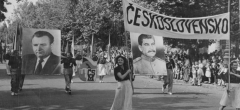
12018-12-09T14:50:13-08:00The March in the Czechoslovak Socialist Republic3This historic photo displays the march from times of the Czechoslovak Socialist Republic under the communist Rulemedia/Schermata-2017-07-11-alle-20.12.19.pngplain2018-12-11T16:01:53-08:00