Thanks for your patience during our recent outage at scalar.usc.edu. While Scalar content is loading normally now, saving is still slow, and Scalar's 'additional metadata' features have been disabled, which may interfere with features like timelines and maps that depend on metadata. This also means that saving a page or media item will remove its additional metadata. If this occurs, you can use the 'All versions' link at the bottom of the page to restore the earlier version. We are continuing to troubleshoot, and will provide further updates as needed. Note that this only affects Scalar projects at scalar.usc.edu, and not those hosted elsewhere.
Counter-Cola: A Multinational History of the Global CorporationMain MenuAn Introduction to the Digital BookCounter-Cola: IntroductionThe Coca-Cola Bottling System and the Logics of the FranchiseMediating Coca-Colonization: Negotiating National Development and Difference in Coca-Cola’s Postwar Internationalization“I’d Like to Buy the World a Coke”: The “Real Thing” and the Revolutions of the 1960s"Indianize" or "Quit India": Nationalist Challenges in Post-Colonial IndiaA Man in Every Bottle: Labor and Neoliberal Violence in Colombian BottlingWater for Life, Not for Coca-Cola: Commodification, Consumption, and Environmental ChallengesCSR: Corporate Social Responsibility and Continued Social ResistanceA NonconclusionAmanda Ciafone0aef7449200e57e794d451fa2ca99b0795928eaf
Neoliberal India Through a Glass Bottle of Coke
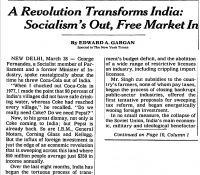
1media/All Over the World Coca Cola Brings Refreshment Larger cropped.jpgmedia/water for life cropped Screen Shot 2017-11-22 at 1.02.59 AM copy.jpg2017-11-21T20:53:48-08:00Amanda Ciafone0aef7449200e57e794d451fa2ca99b0795928eaf1520019image_header2017-11-28T23:05:41-08:00Amanda Ciafone0aef7449200e57e794d451fa2ca99b0795928eafIn 1993, after sixteen years of exile from India imposed by the postcolonial socialist state, The Coca-Cola Company dramatically re-entered the country as it opened itself up to foreign corporations through economic reforms and deregulation. The company was eager to expand into one of the largest markets of the “sweat belt,” as company executives called the stretch of hot, developing countries of the Middle East, Africa and Asia with large Muslim and/or Hindu populations that looked down on alcohol consumption and thus held vast potential profits for the soft drink industry; they were all the more eager as soft drink sales had begun to slow in their developed western markets like the U.S.[1] To capture this Indian market, The Coca-Cola Company spent a billion dollars re-establishing its brands and bottling system in the country, and simultaneously appropriated the material and symbolic resources of rural India to produce its brands as localized global commodities.
With Coca-Cola’s sudden, almost ubiquitous reappearance it became a powerful sign in the semiotics of neoliberal transformation. It was both an aspirational sign of global consumer-citizenship for India’s urban middle class and, with its reassemblage by Indian peasant communities, one evocative of neoliberal exploitation for those dispossessed of resources to fuel this consumption. As a result, Coca-Cola generated powerful responses.
[1] Quoting Mark Pendergrast in Sonia Shah, “Coke In Your Faucet?” The Progressive, August, 2001.