Traveling with a Circus: a History of Hunting's Enormous R. R. Shows, Circus, Museum and Menagerie, for the Tenting Season of 1893, Page 7
1 2021-03-17T18:49:56-07:00 Angela Yon 72f2fd7a28c88ceeba2adcf2c04fee469904c6f1 38294 6 Page 7 of Hunting's 1893 circus route book listing the performers within Griffin's Wizard's Annex. Includes an illustration of Griffin's Famous Congo Band, comprised of white and Black musicians. plain 2021-04-05T09:49:46-07:00 1893 Media is provided here for educational purposes only. Angela Yon 72f2fd7a28c88ceeba2adcf2c04fee469904c6f1This page is referenced by:
-
1
2020-12-02T15:43:21-08:00
Banished to the Annex: The Catch-22 of Circus Work
23
Side Show Musicians
plain
2021-05-06T17:21:03-07:00
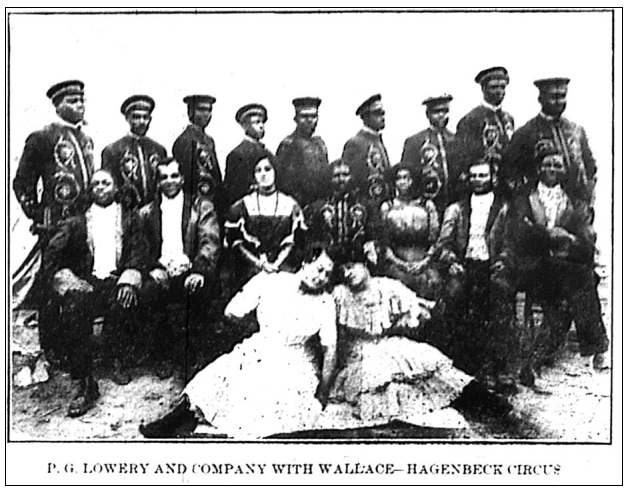
Black sideshow bands – first documented in 1881 within Milner Library’s Circus Route Books Digital Collection – were relegated to the circus annex, constrained by compounding layers of liminality. The circus itself was a marginal (albeit culturally significant) stage, literally located at the outskirts of society near the railroads upon which it traveled. Black musicians performed within an additional layer of marginality. Sideshows housed those performers labeled as “exotic,” and musicians were expected to perform as such.At the turn of the twentieth century, most Americans celebrated the arrival of a circus. Circus Day had become a local holiday that brought together ethnicities, races, and classes (of both genders) that did not usually assemble at the same place and time. Within the circus itself, however, race and gender provided boundaries and fostered acrimony. The racism and segregation of the nineteenth and twentieth centuries could be found aboard any circus train and throughout every show lot. African Americans were relegated to certain jobs, segregated within those jobs, and usually paid less than their white counterparts. The show’s scheduled route often took them into areas in which they experienced the racial volatility typical of the era. Although the public perception of circus employment often produced thoughts of travel and fun adventures, African American circusfolk endured harsh treatment, low pay, and vile racism.2
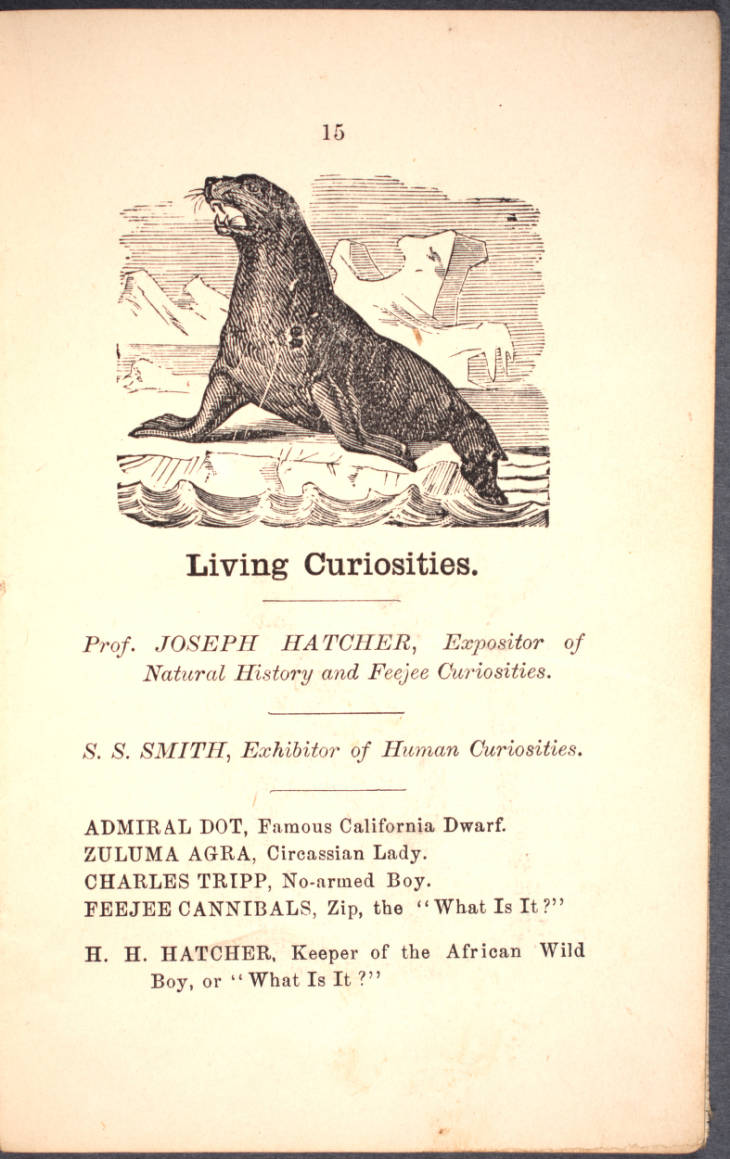
The earliest records of black participation in circuses dates back to Europe in the late 1700’s, where black equestrians performed tricks on horseback. In the mid-1800’s, American circuses employed black performers. However, they were usually presented as oddities. For example, P. T. Barnum … exhibited “Zip-What-Is-It?” “Zip” was a black man billed as the genetic link between man and beast. Blacks in tent shows were commonly given strange names and presented as savage creatures from Africa, “the dark continent.”3
Black sideshow musicians were in the company of other Black circus performers and workers. With the big tent filled with white performers in blackface, there were three roles available to African Americans in United States circuses: ethnic specimen; roustabout; or musician. The circus was a microcosm of its surrounding culture, and Black circusfolk endured "the restrictive conditions that eventually permeated steel mills and automobile factories" in their northward movements to escape Jim Crow throughout the Exoduster Movement (~1879) and the Great Migration (~1916-1970). “After the first Great Migration, in which hundreds of thousands of black southerners made their way to urban centers (usually in the north, often to filling the openings left by whites when the United States entered the First World War), many blacks discovered that they were excluded from certain jobs, and any employment they found was often at a lower wage than their white counterparts."4
Many Black sideshow musicians later entered the role of devalued, manual laborer, as evidenced by census records. "A lot of them were retired. That doesn’t mean that they were 65 years old, it means that after they did a run with the Ringling Brothers, there were no more opportunities." Not only were they forced into performing the role of the Other on the stage, they were forced into the role of union busters as management weaponized them to lower wages and job security both under and beyond the big top – much like Chinese railroad construction workers of the era – which didn’t help race relations between circus workers. In response, most circuses segregated their workers, and some even “resisted hiring blacks because he thought his labor force would perceive black laborers as economic threats.”5
Black circusfolk thus bore the intersectional brunt of racial and economic inequities, sequestered into a Catch-22. In traveling north to escape racism, they just discovered another type of racism:
-Hortense Collier (Chinese-American Hortense Collier was a dancer in and manager of Silas Green from New Orleans, one of the longest-lasting tent shows in America. Formerly owned by Prof. Eph Williams, the first African American circus owner, it was then run by Charles Collier, who was white.)I’m beginning to believe that the prejudice of the South is far less dangerous than the so-called tolerance of the North. A Northerner will tell you that he has no prejudice whatsoever and then he will find all sorts of ways to keep you out of employment, using one excuse or another as a pretext. That makes him a hypocrite. With a prejudiced Southerner, you always know what to expect.6
Thankfully for musicians, “music was the only performing area into which blacks made consistent headway … Nearly every circus had a black sideshow band. Their presence became so expected, in fact, that no self-proclaimed big show traveled without a black band." Although “show proprietors recognized that black bands had become a part of circusgoers’s expectations, the bands existed as part of the sideshow … circus employment offered an alternative to the rural, Southern, sharecropping life … [but] the trend of exclusion, segregation, and salary discrimination was evident within popular entertainment long before the demographic-altering shift in black population."7
The first circus that a Black band played with was Sells Bros in 1881 (A. W. Stencell says 1880 in his book Circus and Carnival Ballyhoo, though no circus or reference is given). We wonder, were the Sells Bros ethical or economical?
Black musicians responded to their forced Otherness and wage discrimination within this confined stage. Through ingenious spectacles, they deployed the marketing of exoticism onto the audience’s desire for the novel and the authentic. Possessing both musical and managerial skills, they utilized their market share to transform themselves from employees to autonomous business owners.