Thanks for your patience during our recent outage at scalar.usc.edu. While Scalar content is loading normally now, saving is still slow, and Scalar's 'additional metadata' features have been disabled, which may interfere with features like timelines and maps that depend on metadata. This also means that saving a page or media item will remove its additional metadata. If this occurs, you can use the 'All versions' link at the bottom of the page to restore the earlier version. We are continuing to troubleshoot, and will provide further updates as needed. Note that this only affects Scalar projects at scalar.usc.edu, and not those hosted elsewhere.
People, Place, and Power in Eighteenth-Century GhentMain MenuPeople, Place, and Power in Eighteenth-Century GhentWhat Festival Books Can Tell UsThe Festival Book: Narrative, Image, and RemembranceTimelineScroll-Over Locales in the Festival BookEarly 18th-Century map with locales mentioned in the Festival BookPersonnages and Pathways 1Personnages and Pathways 2Sounds and Sights in GhentMemorializationFurther ReadingContributorsRutgers University, Department of Italian
Images and Image makers
1media/Bouquet_images_title_cropped.jpg2019-05-13T01:49:58-07:00Maria Teresa De Luca183068fc9e122e312b7c443a54b76ceed8f543963196117image_header2019-05-13T15:38:28-07:00Maria Teresa De Luca183068fc9e122e312b7c443a54b76ceed8f54396Many famous artists are known to have contributed, over and above their main artistic activities, to the designing of provisional structures such as theatre built for important ceremonies, and to producing the illustrations for festival books. Among them are Pierfrancesco Giambullari, Antonio and Lorenzo Landi, Palladio, Ronsard, Rubens, and Vasari.
The artists involved in the illustrations of the Festival Book printed to celebrate the entry of Charles VI into Ghent are local, though their number included experienced illustrators or engravers.
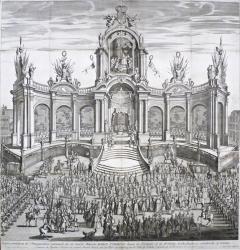
In particular, Jacobus Harrewijn, Jean-Baptiste van Volsom and Jean-Baptiste Berterham also contributed to the making of the festival book printed in Bruxelles to commemorate the royal entry that happened there the week before. While the two festival books represented similar scenes such as the theater, the fireworks and the triumphal arch, nevertheless the particular artists chose to depict different scenes in the different books (different artists represented for example the theater in the two different books), thus showing some range and variability in their interest).
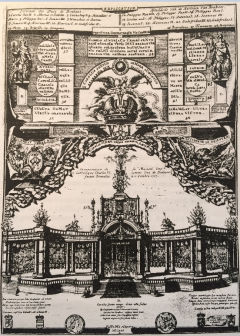
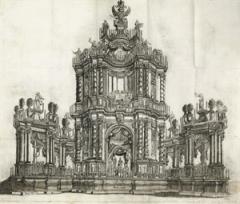
Also interesting is that the representation of the same item changes according to time and place. For example, illustrations of the theater in Bruxelles (1717), in Messina (1720) and in Ghent (1744)
This page has paths:
12019-03-02T03:09:11-08:00Laura Morreale031753391a508421eef4a1295a4189e88460e4d5Images for Charles VIMaria Teresa De Luca79gallery2019-05-13T05:24:50-07:00Maria Teresa De Luca183068fc9e122e312b7c443a54b76ceed8f54396
1media/Bouquet_images_title_cropped.jpg2019-05-13T01:35:23-07:00Maria Teresa De Luca183068fc9e122e312b7c443a54b76ceed8f54396The book as a remembrance toolLaura Morreale7image_header2019-05-13T14:14:15-07:00Laura Morreale031753391a508421eef4a1295a4189e88460e4d5
12019-05-12T22:52:25-07:00Bruxelles 1717_11Grand Theatre, illustrated and engraved by Harrewijnmedia/Bruxelles 1717_1.pngplain2019-05-12T22:52:25-07:00