Personalization
Given this status as ‘remembrance tool’, it is not surprising to discover that some exemplars of the Festival book for Charles VI include handwritten text reporting additional and sometimes essential information about the way the event was organized, celebrated, and publicized.
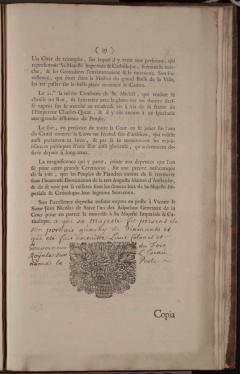
Exemplar at Rutgers (p. 19)
The last page of the exemplar held at Rutgers contains what can be considered a follow-up report on the event that took place in Ghent. According to the text, written by an anonymous person (probably someone contemporary to the event, maybe the original owner of the book?), Jean Nicolas de Seive, the ‘Adjudan General’ that had been sent to Charles VI to report to his majesty about the cermony hosted at Ghent, was presented by Charles VI with a painting of himself decorated with diamonds.
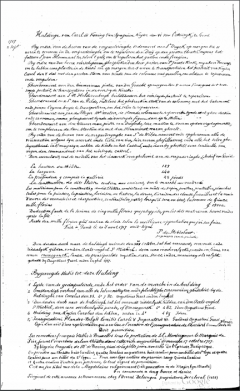
Exemplar on Google Books (Flyleaf)
A digitalized copy of the book, available on Google Books, shows the insertion of an added page among the preliminary pages before the frontispiece. The page contains a dense text, written by a single hand in a mix of French and Flemish, reporting, among other things, information regarding the size of the theatre built for the ceremony, as well as the different price categories of the tickets sold for the performances held there.
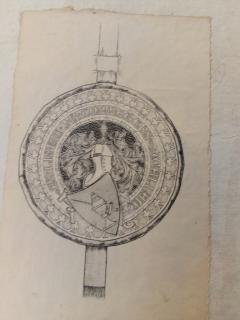
Ex libris from the Princeton Exemplar
A copy of the book is also at the Princeton University Library. The ex libris in the book allows us to identify one of the likely first owners of the exemplar. The inscription Ex libris J-B Coppieters t Wallant likely identifies a member of a prominent Belgian political family:
- Jean-Baptiste Coppieters 't Wallant (1695-1783), ‘receveur général de West Flandre, premier échevin de Courtrai et de Bruges, prévôt de la Confrérie du Saint-Sang’;
- Jean-Baptiste-Marie-Ghislain Coppieters 't Wallant (1770-1840) or
- Jean-Baptiste-Adolphe-Ghislain Coppieters 't Wallant (1806-1860)
The exceptional quality of the exemplar held at Princeton, in particular its very clear illustrations, suggest that this exemplar may be one of the first to come off of the printing press.
This page has paths:
- The book as a remembrance tool Laura Morreale