Thanks for your patience during our recent outage at scalar.usc.edu. While Scalar content is loading normally now, saving is still slow, and Scalar's 'additional metadata' features have been disabled, which may interfere with features like timelines and maps that depend on metadata. This also means that saving a page or media item will remove its additional metadata. If this occurs, you can use the 'All versions' link at the bottom of the page to restore the earlier version. We are continuing to troubleshoot, and will provide further updates as needed. Note that this only affects Scalar projects at scalar.usc.edu, and not those hosted elsewhere.
C2C Digital Magazine (Spring/Summer 2023)
Main Menu
Letter from the C2C Chair -- Cheryl Zelle
This is a letter from the 2022 - 2023 C2C Chair, Cheryl Zelle.
The SHARE technique for designing assignments and assessments in the age of AI
This article is "The SHARE technique for designing assignments and assessments in the age of AI." This was written by Brent A. Anders.
Changing our classrooms to address COVID-19’s impact on cognition
This article is "Changing our classrooms to address COVID-19’s impact on cognition." This was written by Dr. Jessica A. Cannon.
Learning by doing: The flight path of Dr. Sheldon L. Eakins, an intrepid equity entrepreneur
This article is "Learning by doing: The flight path of Dr. Sheldon L. Eakins, an intrepid equity entrepreneur."
At the intersection of information science, learning technologies, and data science: A reflection of a three-article dissertation journey
This article is "At the intersection of information science, learning technologies, and data science: A reflection of a three-article dissertation journey." This is by Dr. Javier Leung.
A practical framework for ethics in educational technology
This research article is "A practical framework for ethics in educational technology."
“I have a need…the need for speed”: Why slowing down can benefit instructional design
This article is: “I have a need…the need for speed”: Why slowing down can benefit instructional design
Josh Lake: The cheerleader and life coach every school needs
This article is "Josh Lake: The cheerleader and life coach every school needs." This is by Dr. Robb Scott.
Animating and voicing digital puppets with Adobe Character Animator
This article is "Animating and voicing digital puppets with Adobe Character Animator."
A starter conversation about “educational technologies” with Bard AI and ChatGPT
This article is "A starter conversation about “educational technologies” with Bard AI and ChatGPT."
Using Aero to make mobile AR learning experiences
This article is "Using Aero to make mobile AR learning experiences."
Credible efficient pathways to project completion with AON diagrams
This article is "Credible efficient pathways to project completion with AON diagrams."
Book review: Shaping up online education post-pandemic
This article is "Book review: Shaping up online education post-pandemic ."
Book review: Harnessing computation for more sustainable living
This article is "Book review: Harnessing computation for more sustainable living."
Book review: Improving human decision-making by reducing bias and noise
This article is "Book review: Improving human decision-making by reducing bias and noise."
Book review: Harnessing problem solving as a superpower
This article is "Book review: Harnessing problem solving as a superpower."
Book review: Volunteer technologists breaking ransomware by criminal gangs
This work is titled "Book review: Volunteer technologists breaking ransomware by criminal gangs."
Book review: Helping advocacy citizen journalists upskill
This article is "Book review: Helping advocacy citizen journalists upskill."
SIDLIT Awards: 2001 - Present
This page shows "SIDLIT Awards: 2001 - Present."
Call for Article Submissions: Fall 2023 - Winter 2024
This page is "Call for Article Submissions: Fall 2023 - Winter 2024."
Colleague 2 Colleague
63e768dc8f8b0f24d3f519aec8f8ab91fe4a26a3
Individuals Completing a Needs Assessment
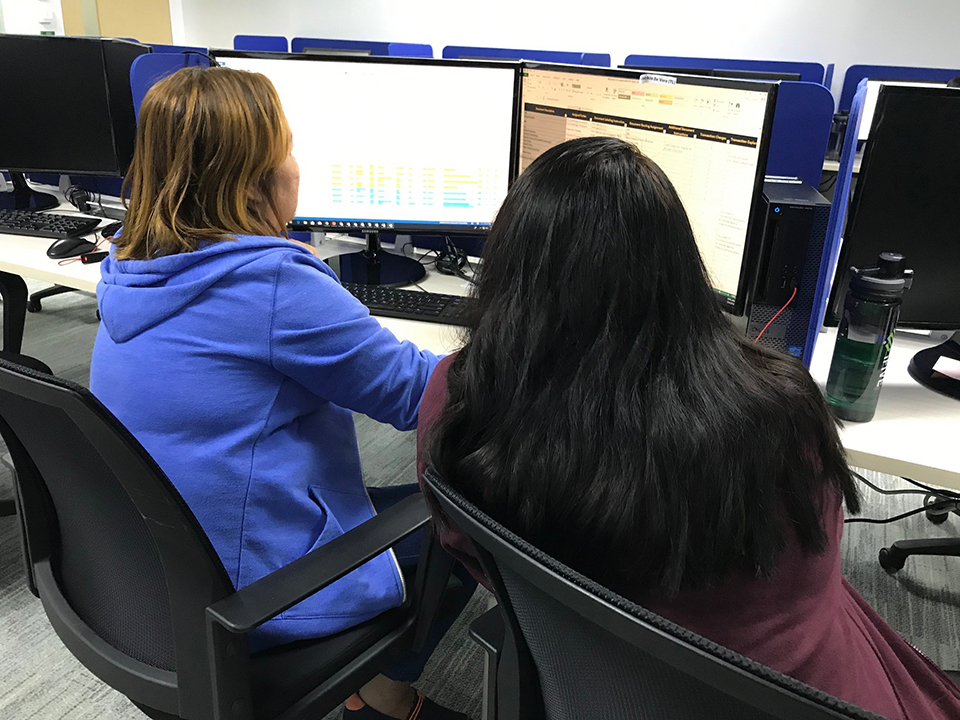
1 media/IndividualsCompletingNeedsAssessment_thumb.jpg 2023-06-29T09:43:45-07:00 Shalin Hai-Jew 0b2ab93fbfe95de74ca7fefa80ae22adae3a64ef 41407 1 This visual shows "Individuals Completing a Needs Assessment." This photo is by Darin Challacombe. plain 2023-06-29T09:43:48-07:00 Shalin Hai-Jew 0b2ab93fbfe95de74ca7fefa80ae22adae3a64efThis page is referenced by:
-
1
2023-06-29T05:36:31-07:00
“I have a need…the need for speed”: Why slowing down can benefit instructional design
10
This article is: “I have a need…the need for speed”: Why slowing down can benefit instructional design
plain
2023-06-29T10:14:23-07:00
By Darin Challacombe
The classic Top Gun movie line is a defunct mantra of many in the instructional design field. A manager will assign a task, and immediately we are thinking of the ways to approach the task. I cannot be the only person guilty of this.
As my career in instructional design has progressed, I have focused less on trying to prove myself to managers and others, and instead tried to create better, more responsive content. This has been a challenge and constant struggle for me, as I want to put something together quickly so it can be deployed faster. Faster, however, is not always better.
I have recently worked on ensuring I follow a process for new instructional design tasks. This process includes conducting a needs assessment, developing a project map and timeline, and ensuring I focus on the learner. For this article, I am going to discuss these three ways I use to slow down and how the ways can benefit instructional design.
Way Number 1. Return to the basics
A few years back, I sat down and developed out a “needs assessment” template that I could use when working in the instructional design field. This template is basics—it’s an aggregation (or an amalgamation) of various other needs assessments found in other places. However, I like to use it when I am approaching a task.
Recently, I was asked to review an analytical program and develop out instructions on how to use this program. I like analytical programs. I like instructional design. But I was not liking this project. Why? It was very vague. I could document what each of the filter parameters did, the dashboards, etc., but would this really provide value?
I had my “ah-ha” moment during a meeting when a question was posed: How can someone use this to pull X, Y, Z reports? I found my objective. I was thrilled and could accomplish the task better and easier.
As I have gone through my career, I tend to fail to take the time to use my needs assessment until 1) it is too late or 2) it doesn’t really matter much. This is a basic technique that can really improve my efficiency and effectiveness.
I would posit that if you have something like a needs assessment, take the time to complete it, even for small or mundane tasks. This will provide you with a structure where you know what the needs are for the stakeholder/s, learners, etc., as well as what tools can be utilized to meet those needs.
The Department of Education has some archived information on needs assessments that is surprisingly good:
Way Number 2. Scope out the work
If you have ever worked in IT or related fields, you’re probably familiar with different concepts regarding project design optimization like Agile and Lean Six Sigma. For the latter, the “Six Sigma” is a process improvement methodology addressing which arise due to variability in process execution. Lean, on the other hand, is a methodology that removes waste, increases speed, and removes non-value-added process steps. Both focus on the customer. It is easy to understand why companies like this methodology – speed plus accuracy.
When approaching instructional design, many of us may fail to really scope out the work. We are presented with a problem (e.g., “design a web-based course on XYZ”). We may consider the various dependences of a project this size (e.g., research on XYZ, develop goals and objectives, etc.), but few of us truly map out the project.
I would posit that it is in the project mapping phase where we can find benefit.
Referring to the Lean Six Sigma methodology, we can increase our speed and accuracy if we take the time to map out the project. Take the few moments to document our end goal, the dependences, a timeline, etc. This can help so we are not approaching an instructional design task as something that is overly daunting. Also, (and a life pro tip) it can be beneficial when the manager or stakeholder asks about the status to refer to a project map.
There are multiple templates available for project mapping. While it seems counterintuitive, these tools and this technique can help to improve quality and speed of your instructional design taskings (or other projects you must do in life).
There are multiple, free templates available online for this process. I have used Smartsheet before.
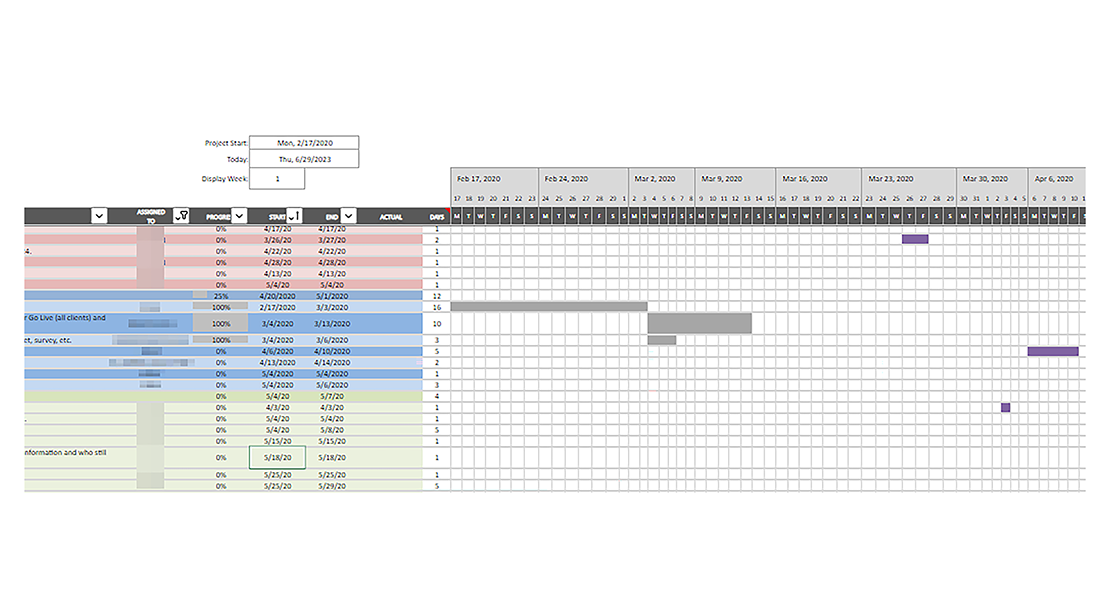
Also, if you want to really impress your manager, you can develop out a Gantt chart. Excel has a template, but here are some others:
Note: Gantt charts, like the above, can assist in the timeline planning of projects, keep yourself and everyone on task, and provide that visual needed for managers.
Way Number 3. Consider the learner
A good needs assessment should have an area that describes the learner. Even still, I would strongly recommend taking some extra time to really consider the learner, their needs, ability, time, and motivation.
Note: It is sometimes better to work with others when completing a needs assessment.
Let’s parse this out
I teach a General Psychology course in an online, synchronous setting. The students are in a nursing program—this course is required. The class is only 8 weeks long, so I teach 2 hours every week to the students. This is on top of all their other courses, work, and life (as they are all nontraditional learners).
When I structured the course, I knew about the students to some degree. I know with required courses, the students may not have any interest at all in the subject. This is an uphill battle. I also know that the course being offered in the evenings presents the additional challenge of learner distractions—many of the students have children, relationships, etc. so they are multitasking the course and cooking dinner or putting the kids to bed.
When I am structuring the course, I need to be mindful about these situations and try to make the course in a fashion that can be as accommodating as possible. I know a nursing student is likely not going to care about the difference between the Big Five personality model and others. However, that same nursing student will likely be interested in learning the basic life span development stages their child will go through. If I can find that niche, I can make the training focus more on the student.
I also try very hard to make pictures and videos I use to be as inclusive as possible. This means searching to either find diverse photos or content creators. It can be daunting, but it is worth it to make a connection worthwhile.
Conclusion
At Top Gun, there are “no points for second place”. Thankfully, instructional design is not as cut-throat. We still do feel the pressure to make things faster.
By following the above three steps, you can take a project, conduct a needs assessment, build out a project map, and then plan the training around the learners. These steps should help to make things flow better.
About the Author
Darin Challacombe is an educator, author, and training professional. He has worked in the education space for 20 years. He currently oversees training for a nationwide medical records company and teaches psychology as an adjunct professor at several places, including Fort Hays State University.