In
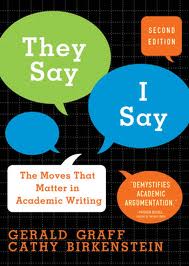
They Say / I Say, a textbook I adopted in my previous writing courses, the authors Gerald Graf and Cathy Birkenstein encourage students to craft their own writing in response to something somebody else said about a topic. The book is constructed around the concept of discourse (a word that encompasses the concepts of conversation, dialogue, and debate), with the aim that you will understand the stakes of writing are the same as the stake of participating in a civic society. It is useful for reminding us that knowledge is something that we circulate socially--that is, with other people––and that it matters therefore that what we say is articulated in relation to what somebody else says. Because what we say has ramifications for others, what people are saying should matter to us and we should have an opportunity to respond; we are all here together and need to talk to one another about what we're seeing and experiencing.
Generally speaking, I like the way the book emphasizes conversations amongst writers. And I also like that the textbook's subtitle, "the moves that matter in academic writing," is transparent about the fact that there are "moves that matter" in academic writing. There are indeed constructions that are characteristic of academic discourse that professors sometimes merely assume you will intuit instead of explicitly telling you how to word a thesis statement. Rather than allow these "moves" to be the purview of professionals alone, the authors of the textbook provide students with a series of formulas that reveal common ways of organizing claims in response to other claims.
Yet even as I appreciated the idea that professors should be more clear in conveying these conventions for students, I also found that my own students who read the book (or refused to read it) often concluded from it that there were merely several different ways to phrase their agreement or disagreement with a published author.
On one hand, that conclusion is absolutely correct. Learning the structures that academics employ to make statements of all sorts will enable you to ability to express your ideas in relation to other writers in college assignments. On the other hand, I am not convinced that simply rehearsing "these moves" and using them against a "they" who said something is the best way for you to learn about academic writing. Putting these constructions to work in your own prose won't do much more than ensure you've got a formula down. And merely writing something to agree or disagree with somebody else is not enough to ensure readers will see a discussion of substance in your work. Even if you can articulate good reasons for your disagreement or agreement, you may find that laying out those arguments often allows you to feel satisfied or victorious rather than learned––that is, you may feel comfortable that you're right rather than feeling challenged, knowledgeable, and fulfilled by a learning experience. Supporting your agreement or disagreement has an end point, whereas genuine thinking does not.
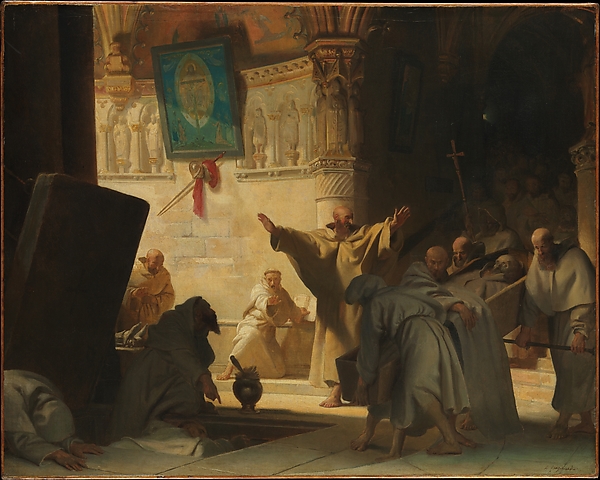
To be sure, your engagement in conversation with others is indeed one way to learn and a necessary part of a sound education. We are social animals and even the most scholarly, solitary monks needed to share their thoughts with
their peers. Dialogue is useful for all the reasons that
Socrates noted in his famous philosophical works (and
he did, after all, provide us with one of the best methods we can deploy for thinking critically). However, dialogue is most useful (and most substantive) when the parties involved are invested in learning more and have something to bring to a conversation that goes beyond an opinion.
Along these lines, we should attempt to distinguish between experience and knowledge. We all have experiences that inform our thoughts and responses to what we see, hear, and read. But experience alone does not constitute knowledge. And you're in college to gain something you didn't have before or already. Much of what you gain will come from reading and the experiences you gain concurrently in the classrooms you inhabit daily. Neither one nor the other is complete on its own. Still, if I had to choose which one will improve your writing more quickly, I'd come down on the side of reading on your own
.
Most obviously, reading is a great way to gain knowledge about something you haven't experienced; the best articles, books, plays, and poems are powerful precisely because they encourage understanding and empathy and allow you to experience vicariously what others have suffered, endured, or enjoyed. Reading widely and with focus can also help you convert something you experienced yourself into knowledge, if only because what you read can broaden your own subjective sense of what you experienced with other perspectives that complicate or support yours. Reading is necessary in academic work in particular because we can't know everything just by what we've lived through or what we've read by a certain age.
Reading is also necessary because it allows us to see how other people articulate knowledge, and, therein, it gives us a sense of how we, too, can formulate our own ideas. To say so is not to say we all plagiarize from one another, but rather, to admit that we learn what constitutes good prose by reading it and imitating the style, structure, and diction we've seen elsewhere. I owe the strength of my own writing to reading for precisely this reason. I'm certainly not telling to you to copy the sentences of published writers and submit them as your own work. I am telling you that the more you read, the more ideas you will have about how to express your knowledge in written form.
This last point is, I think, is akin to the "moves" that the authors of They Say / I Say were hoping to provide for students. Rather than seeing them written out in a textbook as formulas, and rather than reading them exclusively in essays by people who write for The New York Times and other mainstream news sources (as are a great many essays in that textbook), we will (most often) examine them in writing produced for the people to whom you will likewise be submitting your writing: scholars. Their work, in its purest state, is not involved in the business of selling papers or advertisements. In the ideal formulation of academic enterprise, those who produce it are free to pursue ideas for the sake of ideas. In this regard, at least, your writing as a college student has the same status and purpose as that you'll read by professors.
To invoke the scholar's intellectual purpose is not to say, of course, that academic writers live in an "ivory tower"; nor is to imply that their work is not useful for the so-called "real world." Academic writers are indeed invested in their work because of its relationship to the "real world"––frankly, we are not special enough to get our own world––and because of the knowledge that this real world requires. It is to say, however, that academics often define "useful"* in ways that aren't only, or even centrally, concerned with profiting in a narrow, economic sense.**
Over the next few weeks, you will complete
a Series of Assignments to help you to think about how reading informs writing. You will also continue to read additional parts of this book and watch videos that offer some basic advice about research. All of the work you'll do under the guidance of this book and our class meetings will advance our goal of writing with substance; in order to complete them, you must commit to reading what I have assigned, carefully and thoughtfully, with a goal that goes deeper than using their authors as a "they" by which to set up what you want to say.
*This book and the platform that hosts it are a good example of the sort of utility I mean.
**The university's place in relation to "the world" is complex, as is the scholar's relationship to capitalism.
Even monks have to eat, you see. In fact, two of the subjects we will consider in the first half of this class, the "Ed Tech" industry and the use of student data, and the structuring of professional labor in the academy, will give you a glimpse into the business of learning that is instructive on both of these points.