Mapping the commons of Vitoria
Mapping the commons of Vitoria was a joint realization of the Federal University of Espíritu Santo Architecture and Urbanism Department, coordinated by Professor Clara Luiza Miranda, and the Laboratory of Studies on Image and Cyberculture (LABic), coordinated by Professor Fabio Malini.
The activities developed were based on a methodology designed by Pablo DeSoto et al., which was previously worked out in cities such as Athens, Istanbul, Rio de Janeiro, São Paulo and Belo Horizonte. That methodology deal with the study of the urban commons through parametrization, cartography, and finally, the production of texts and short documentaries.
The workshop participants included representatives from social and environmental movements, artists and collectives. In the academic world, it was addressed to research groups, postgraduate students and teachers who are interested in cartography in its various approaches and who accompany study socio-environmental conflicts, urban and social movements in the Metropolitan Region of Greater Vitória.
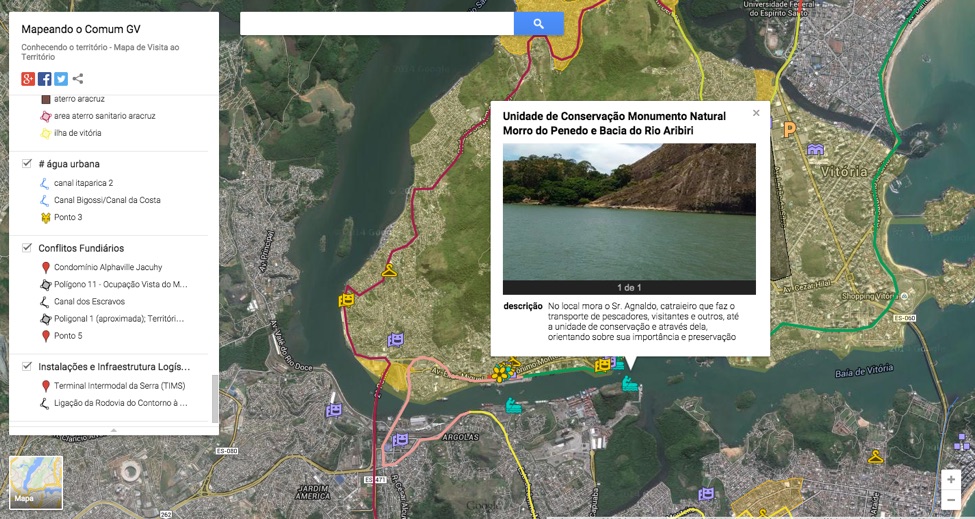
The activities carried out theoretical and practical work through workshops, lectures and technical visits Several maps were produced, as one to visualize the water and land conflicts in the Region of Greater Vitoria. A tent made from recycled wood and bamboo, called the commons tent, was built by the students to host the workshop lectures.
This page has paths:
- Postgraduate Teaching Pablo DeSoto