Thanks for your patience during our recent outage at scalar.usc.edu. While Scalar content is loading normally now, saving is still slow, and Scalar's 'additional metadata' features have been disabled, which may interfere with features like timelines and maps that depend on metadata. This also means that saving a page or media item will remove its additional metadata. If this occurs, you can use the 'All versions' link at the bottom of the page to restore the earlier version. We are continuing to troubleshoot, and will provide further updates as needed. Note that this only affects Scalar projects at scalar.usc.edu, and not those hosted elsewhere.
Network EcologiesMain MenuCoordinatesNetwork Ecologies: Designing Scholarly Rigor in Innovative Digital Publication EnvironmentsNetwork Ecologies IntroductionArchive ArchitecturesTransmedial Publishing Interfaces for Open Learning SystemsDisplacement PathsOrganisms in ReticulaLetters From Distant Lands: Carolingian Intellectuals and Their Network(s)Living Network Ecologies: A Triptych on the Universe of Fernand DelignyA three-part introduction to Fernand Deligny from his English-language translatorThe Entity MapperAn Introduction to the Development and Application of the Open-source Software for Visual Data Analysis in Qualitative ResearchJourneying A Thousand MilesA Developmental Network Approach to MentorshipNetworks, Abstraction, and Artificially Intelligent Network(ed) SystemsA conversation with UNC RENCI's Dr. Reagan Moore and Dr. Arcot RajasekarArchitecture Networks: Interview with Turan Duda and Jeff PaineExhibition: Network Ecologies Arts in the EdgeDuke UniversityKarin Denson & Shane Denson: Sculpting DataKarin Denson & Shane Denson: Making Mining NetworkingRebecca Norton: The Edge LibraryNetwork Ecologies SymposiumContributorsAuthor and Editor BiographiesImprintAmanda Starling Gould88396408ea714268b8996a4bfc89e43ed955595eFlorian Wiencekce1ae876f963bfc3b5cf6c3bbd8f57daf911e67fFranklin Humanities Institute
Hypothes.is
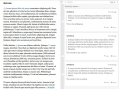
12016-06-15T08:48:17-07:00Amanda Starling Gould88396408ea714268b8996a4bfc89e43ed955595e25533Information about the Hypothes.is Plug-inplain2016-06-15T08:59:35-07:00Amanda Starling Gould88396408ea714268b8996a4bfc89e43ed955595e Information on the Hypothes.is plug-in from Scalar: "[With Hypothes.is] users are free to comment on selections of text and to set those comments to either public or private. In the public mode, all future visitors can view those comments in the Hypothes.is sidebar and reply to them if desired. While users must have a Hypothes.is account in order to make or reply to comments (to sign up for a Hypothes.is account, simply launch the Hyptothes.is sidebar and click Sign In > Create an Account) public comments are viewable to all visitors.
Hypothes.is thus allows per-paragraph, per-sentence and even per-word commenting for readers. It also allows groups of authors on a project to comment on and generate discussion threads around textual elements in a Scalar book. More information on the Hypothes.is project can be found at their website, here. To learn more about using the Hypothes.is plugin itself, click here."
12016-06-15T08:54:03-07:00Hypothes.is Used in Scalar3" "[With Hypothes.is] users are free to comment on selections of text and to set those comments to either public or private. In the public mode, all future visitors can view those comments in the Hypothes.is sidebar and reply to them if desired. While users must have a Hypothes.is account in order to make or reply to comments (to sign up for a Hypothes.is account, simply launch the Hyptothes.is sidebar and click Sign In > Create an Account) public comments are viewable to all visitors." Source http://scalar.usc.edu/scalar-feature-update-hypothes-is-annotation-sidebar/media/Scalar+Hypothes.is2_.jpgplain2016-08-07T17:04:41-07:00