Working Together?
Interrogating Collaboration towards Decolonizing Music and Dance Research
Organizer
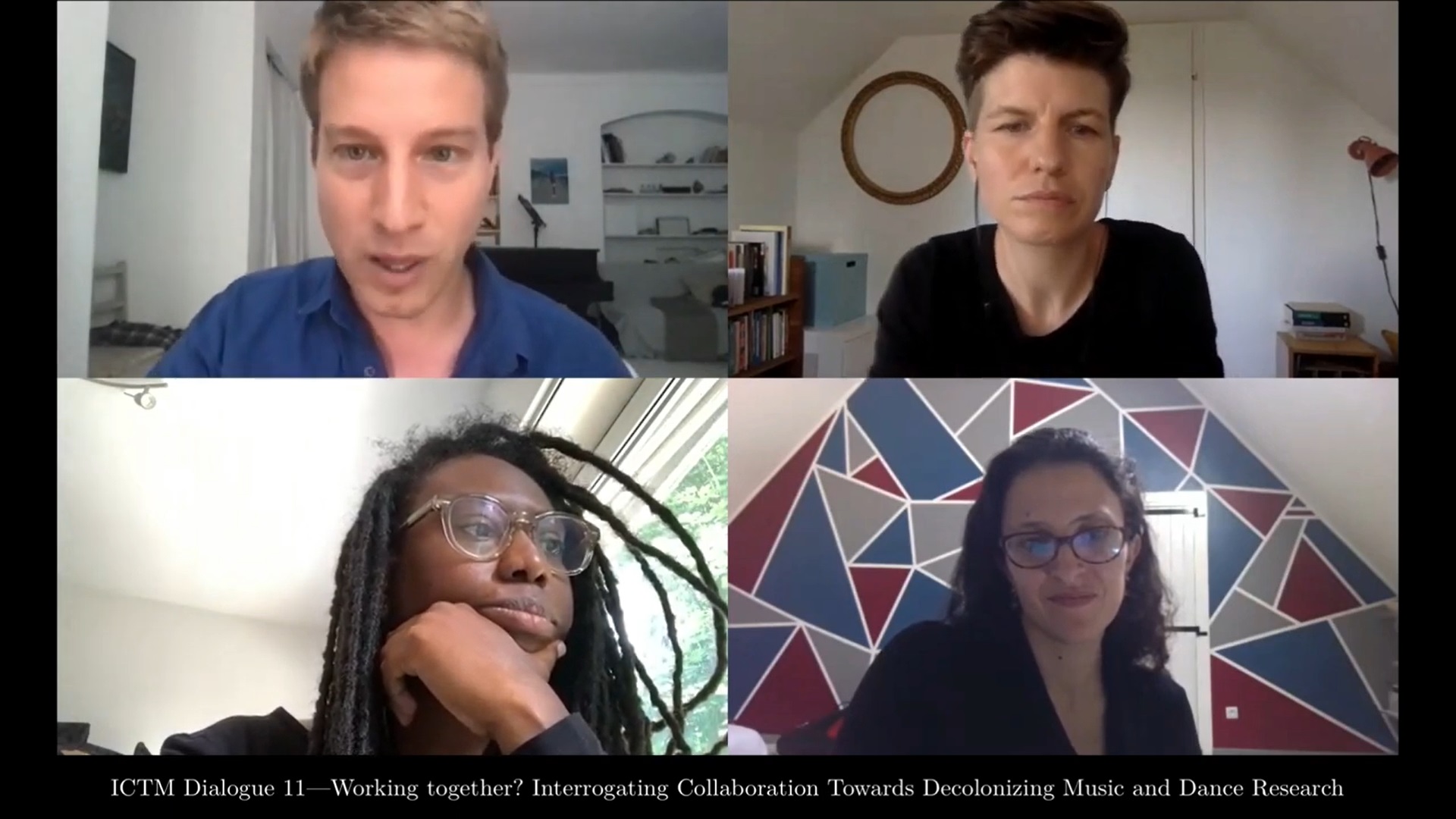
Cornelia Gruber (University of Vienna)Moderator
Cornelia GruberLanguage
Bi-lingual: English/ French (subtitles in English)Presenters
Cornelia GruberCharissa Granger (University of the West Indies)
Talia Bachir-Loopuyt (University of Tours)
Marko Kölbl (University of Music and Performing Arts Vienna)
Working together is a vital aspect of ethnomusicology. Ethnomusicologists have always depended upon individuals or groups in and from the research field, cultural, social, and political actors, and researchers from various disciplines. Yet, their collaborations and collaborators have not always been acknowledged as such, and the level of socio-political awareness differs from project to project. Furthermore, ethnomusicological and academic analysis, writing, and theorizing are still generally individualized and isolated practices. Working together remains a personal choice rather than being structurally encouraged, as it implies more time, effort, and resources.
Collaboration has become a keyword for an ethnomusicology that is working on decolonizing the discipline, particularly for developing collaborative research projects and applying collaborative methodologies. Applied ethnomusicology has included those “researched” into research processes to not write “about” people, but “with” people. Yet, regarding decolonizing, what does collaboration imply for power relations, building relationships? Has it, by now, become an empty promise within a neoliberal and neocolonial academic system? Are “decolonizing” and “collaboration” simply academic buzzwords in a feel-good decolonial academia, and essentially non-performative (Ahmed, 2006)? Can ethnomusicologists alone decolonize music studies? Should we focus more on working with other music specialists within academia? Or should we invest less into the institution and more into engagements and coalitions outside academia? What does forging relationships in terms of collaboration as an active political gesture imply within and beyond academic work? What does collaboration imply for decentring power relations, disturbing objective knowledge, and building relationships? What are alternative modes of action and engagement?
Panelists in this ICTM Dialogues session discuss aims, challenges, misunderstandings, the discomfort of feel-good politics, blind spots, and the risk of empty concepts in relation to the questions above. Each session participant contributes a brief presentation on one aspect of collaboration based on our own experiences, projects, collectives, and discourses of collaboration. Cornelia Gruber speaks about intra-academic collaboration within a workshop series and collective of early-career scholars who are currently or were formerly involved in German-speaking (ethno)musicological institutions. Through her discussion of a collaboration with percussionist and composer Vernon Chatlein, Charissa Granger emphasizes the necessity of collaboration in ongoing attempts to make sense of Zikinza, a Curaçaoan ethnographic archive that holds songs and melodies sung by descendants of enslaved peoples. Marko Kölbl addresses ethnomusicological refugee studies, particularly ethnographic fieldwork and the coloniality of asylum that shapes collaborations in the field. Talia Bachir-Loopuyt discusses the aspect for intra-academic collaborations and the necessity for ethnomusicologists to work with other specialists in order to enhance our understanding of coloniality. In respect to collaboration, coalition, and crossings in music and dance research, we then think through three key topics in a curated discussion – ethnography, friendships and general relationships, and the futurity and longevity of decolonizing practices in relation to ongoing dialogues – which was developed over several weeks of continuous online meeting within our group prior to the session. While we think that working together is a necessary and possible form of decolonizing, it remains vital to interrogate and reimagine our practices and premises regarding this subject.

Further References

Reflections
Based on our collective reflections from these dialogues, we ask ourselves how we can transgress many of the structural restraints within academia particularly by raising consciousness for the many ontological and epistemological boundaries we expect and accept as a given. Humanizing knowledge and knowledge producers such as the many collaborators within our academic practices and beyond, and the archival “material” we work with is one of the central starting points which can help transgress supposed academic boundaries. This involves radically rethinking “ownership,” “data” and, in the case of ethnomusicology, disinvesting from canonical ethnography.
We hope to continue our work in various spaces and continue our dialogues with activists, not in terms of “retrieving information” but in terms of learning from and with each other. We want to continue building spaces such as intradisciplinary and interdisciplinary workshops, especially with specialists from other academic fields (music historians, sociologists) as well as music and dance activists, and cultural agents.

Questions to Consider
What do radical reconsiderations of academic research, collaboration and ethnographic practices in regard to collaboration look like - and how can we ensure that they inhabit decolonizing directions and anti-racist principles?
How can we bring the issue of decolonization to spaces where it is not yet being debated, or where it is not well understood due to variable geo-political positions and related power relations?
How can we use our access to funds, infrastructure, and power from within the university to humanize knowledge production beyond a strictly academic understanding thereof?


This page has paths:
- The Dialogues Tan Sooi Beng & Marcia Ostashewski (Co-Editors), The International Council for Traditional Music