Thanks for your patience during our recent outage at scalar.usc.edu. While Scalar content is loading normally now, saving is still slow, and Scalar's 'additional metadata' features have been disabled, which may interfere with features like timelines and maps that depend on metadata. This also means that saving a page or media item will remove its additional metadata. If this occurs, you can use the 'All versions' link at the bottom of the page to restore the earlier version. We are continuing to troubleshoot, and will provide further updates as needed. Note that this only affects Scalar projects at scalar.usc.edu, and not those hosted elsewhere.
12021-11-03T13:47:58-07:00Paige Naumnikf8cb1777fa080a2d2dc7e445f472336bb886ce2e3944712Pyxis Side 1plain2023-01-14T13:01:08-08:00Amanda Luyster17d39c1ecea88fb7ff282fe74a410b89478b8327by Paige Naumnik '24
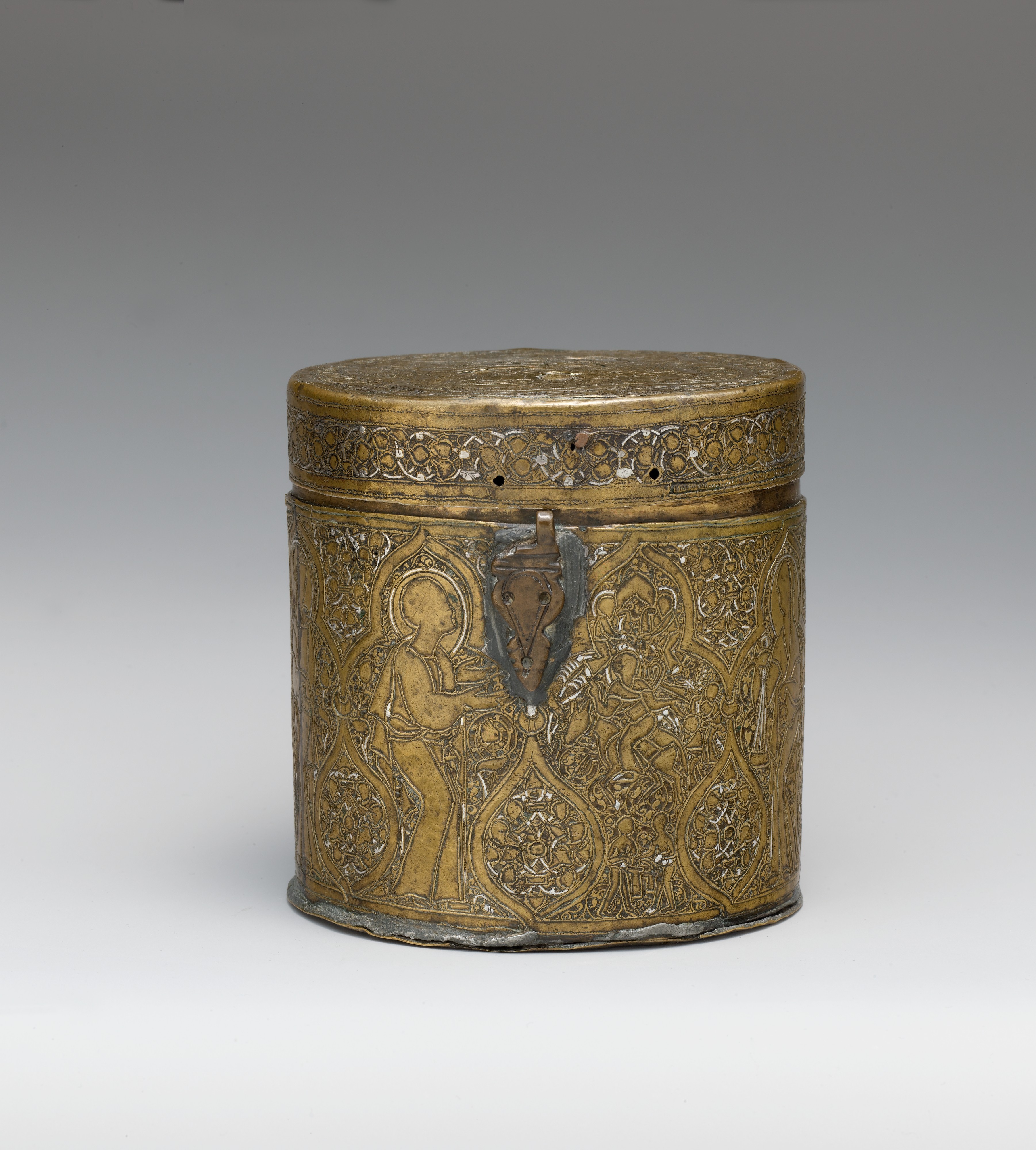
Pyxides are small cylindrical boxes meant to hold different kinds of objects. Greeks used them as storage for small objects like makeup, Christians used them to hold the sacred Eucharist, and during the medieval Islamic period, they were sometimes used to hold jewelry or an early form of laundry detergent in powder form.
This pyxis is elegant and was probably used for more expensive objects like jewelry. This pyxis is also different from other pyxides because it has no written inscriptions. This makes the interpretation more difficult because there are only visual aspects to help us understand us its original purpose. Through comparison of this piece to others, it has been established that this piece was probably made for a Christian, by a Muslim (or at least by someone trained in Islamic metalworking techniques).