Thanks for your patience during our recent outage at scalar.usc.edu. While Scalar content is loading normally now, saving is still slow, and Scalar's 'additional metadata' features have been disabled, which may interfere with features like timelines and maps that depend on metadata. This also means that saving a page or media item will remove its additional metadata. If this occurs, you can use the 'All versions' link at the bottom of the page to restore the earlier version. We are continuing to troubleshoot, and will provide further updates as needed. Note that this only affects Scalar projects at scalar.usc.edu, and not those hosted elsewhere.
The Allan Hancock Foundation ArchiveMain MenuIntroduction to the Allan Hancock Foundation ArchiveThe Hancock FoundationG. Allan HancockKUSCSue Luftscheinc3da4f338cfb5c3d980919bd84c8fb083c380bd6
The Hancock Foundation Building
12020-04-23T11:25:26-07:00Sue Luftscheinc3da4f338cfb5c3d980919bd84c8fb083c380bd63725135plain9886352020-05-01T10:28:28-07:00Sue Luftscheinc3da4f338cfb5c3d980919bd84c8fb083c380bd6The heart of the Hancock Foundation was the building, funds for which were donated to the University of Southern California by Allan Hancock. Construction began in 1939, and the building was dedicated in 1941. Situated in the heart of USC's University Park campus, the building was designed by Samuel E. Lunden, consulting architect, with C. Raimond Johnson, and decorated with bas reliefs in cast concrete by sculptor Merrell Gage. Gage's bas reliefs depict zoological specimens and represent the purpose of the building. On the west side (main entrance) are a total of 26 small panels illustrating animals and plants encountered by the cruises of the Velero III up and down the Pacific coast. On the north and east walls of the building (the exterior of the auditorium) are much larger (essentially life size) reliefs depicting mammals from the Pleistocene discovered in the La Brea tar pits (property originally owned by the Hancock family).
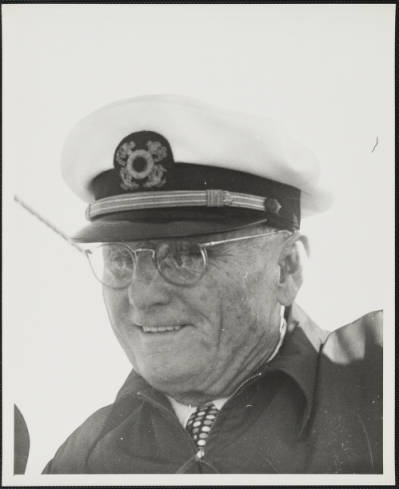
12020-04-21T15:32:28-07:00G. Allan Hancock22plain9886362020-05-01T12:04:27-07:00George Allan Hancock was born on 26 July 1875, the heir to the Hancock family's extensive Los Angeles land holdings, including Rancho La Brea. Hancock expanded the family fortunes through oil exploration on the Rancho beginning in 1901, and continued to increase those fortunes for the next two decades. In 1920, he founded the California Bank. By the middle of the 1920's he also had significant holdings in railroads and communications.
In addition to his business skills, Hancock was an accomplished cellist, an avid sailor (licensed to captain any sailing vessel), and aviator. He formed the Hancock Ensemble, later associated with his Hancock Foundation at USC (dedicated to oceanographic research), and captained many of the Foundation's early scientific expeditions, including those to the Galapagos Islands. In 1928 he opened the Hancock College of Aeronautics in Santa Maria, California.
In 1934, as a result of an early Foundation expedition, Hancock became involved in a tabloid sensation concerning Germans living in a "Garden of Eden" nudist colony on Galapagos. There were several mysterious murders in the colony, and Hancock was said to have "rescued" the companion of one of the victims.
Hancock also served on the University of Southern California's Board of Regents, and in 1937 was granted an honorary doctoral degree in Business Administration by the University. Very soon thereafter Hancock initiated plans to construct a building on the USC campus for the Hancock Foundation. The Allan Hancock Foundation continued the work begun by USC's Venice Marine Station and Professor Albert Ulrey. In turn, it was ultimately superceded in the 1990's by the Catalina Station.
In 1939 Hancock funded the construction of a new building for the Foundation that was dedicated in 1941. With the dedication of the new Foundation building, Hancock also donated his yacht, the Velero III, to USC for oceanographic studies. In 1948 a new ship, the Velero IV, was commissioned exclusively for the use of the Foundation; it remained in service until the mid-1980's.
Hancock died on 1 June 1965. The Foundation, Museum, and Library he established continued to function in their original forms for three more decades until they were absorbed into other USC operations. [Adapted from the Finding aid to the Allan Hancock Foundation Archive, https://archives.usc.edu/repositories/3/resources/260]
This page references:
1media/Hancock_Building_USC_1940_thumb.jpg2020-04-22T11:46:11-07:00Hancock Foundation Building, University of Southern California3Hancock Building, USC, 1940. University Archives Image Collection, http://digitallibrary.usc.edu/cdm/singleitem/collection/p15799coll104/id/280344/rec/14media/Hancock_Building_USC_1940.jpgplain2020-04-23T14:03:34-07:00
12020-04-29T14:01:01-07:00Hancock Foundation building dedication events2Hancock bldg dedication events. Allan Hancock Foundation Collection, http://cdm15799.contentdm.oclc.org/cdm/compoundobject/collection/p15799coll82/id/25891/rec/33plain2020-05-01T10:32:33-07:00