Thanks for your patience during our recent outage at scalar.usc.edu. While Scalar content is loading normally now, saving is still slow, and Scalar's 'additional metadata' features have been disabled, which may interfere with features like timelines and maps that depend on metadata. This also means that saving a page or media item will remove its additional metadata. If this occurs, you can use the 'All versions' link at the bottom of the page to restore the earlier version. We are continuing to troubleshoot, and will provide further updates as needed. Note that this only affects Scalar projects at scalar.usc.edu, and not those hosted elsewhere.
The Shadow of World War II in Modern Japan: Professor's ManualMain MenuHow to Use this ModuleAbstractAn introduction to this moduleModule MaterialsTerminologyScheduleIntroduction to JapanJapan and World War IICommunityDragon Head 『ドラゴンヘッド』Discussion: Dragon Head"Victim's History"Grave of the Fireflies 『火垂るの墓』Discussion: Grave of the FirefliesHiroshimaBarefoot Gen 『はだしのゲン』Discussion: Barefoot GenGodzilla 『ゴジラ』Discussion: GodzillaGodzilla, Mothra, and King Ghidorah: Giant Monsters All-Out Attack!『ゴジラ・モスラ・キングギドラ 大怪獣総攻撃』Discussion: All-Out Attack!Godzilla Resurgence 『シン・ゴジラ』Discussion: Godzilla ResurgenceModule Wrap UpBradley J. Wilsond07e2adfeaea18284aa4bc3bb77cb735351313e9
Terminology
12017-07-27T11:16:03-07:00Bradley J. Wilsond07e2adfeaea18284aa4bc3bb77cb735351313e9207783plain4854722017-09-15T06:34:13-07:00Bradley J. Wilsond07e2adfeaea18284aa4bc3bb77cb735351313e9manga (mahn-gah)[JPN まんが{漫画}]: Japanese comic books. This can encompass anything from simple four-panel gag comics to extensive, multivolume series.
anime (ah-knee-may)[JPN アニメ]: Japanese animation. Differentiated from Western animation (animeeshon). Made popular in the 1960s in Japan, it has boomed internationally since the 1990s.
Tokyo (toh-kyoh)[JPN とうきょう{東京}: Current capital of Japan and center of animation production.
Kobe (koh-bay)[JPN こうべ{神戸}]: Major city in south-central Japan and the sixth largest city in the country. Heavily firebombed during World War II, it is the setting of the film Grave of the Fireflies.
Hibakusha (hee-bak-shah)[JPN ひばくしゃ{被爆者}]: People who were exposed to the atomic bomb. There are four official categories of hibakusha: 1. those exposed directly to the bomb, 2. those who were exposed to radiation after entering the city after the bomb, 3. those exposed to radiation though the disposal of the remains of victims, 4. those in utero of a hibakusha of the previous three categories.
Hiroshima (hero-shee-mah)[JPN ひろしま{広島} ]: Major city in south-western Japan. Spared the typical firebombings in World War II, it became the first site of the use of atomic weaponry in human history. The setting of the film Barefoot Gen.
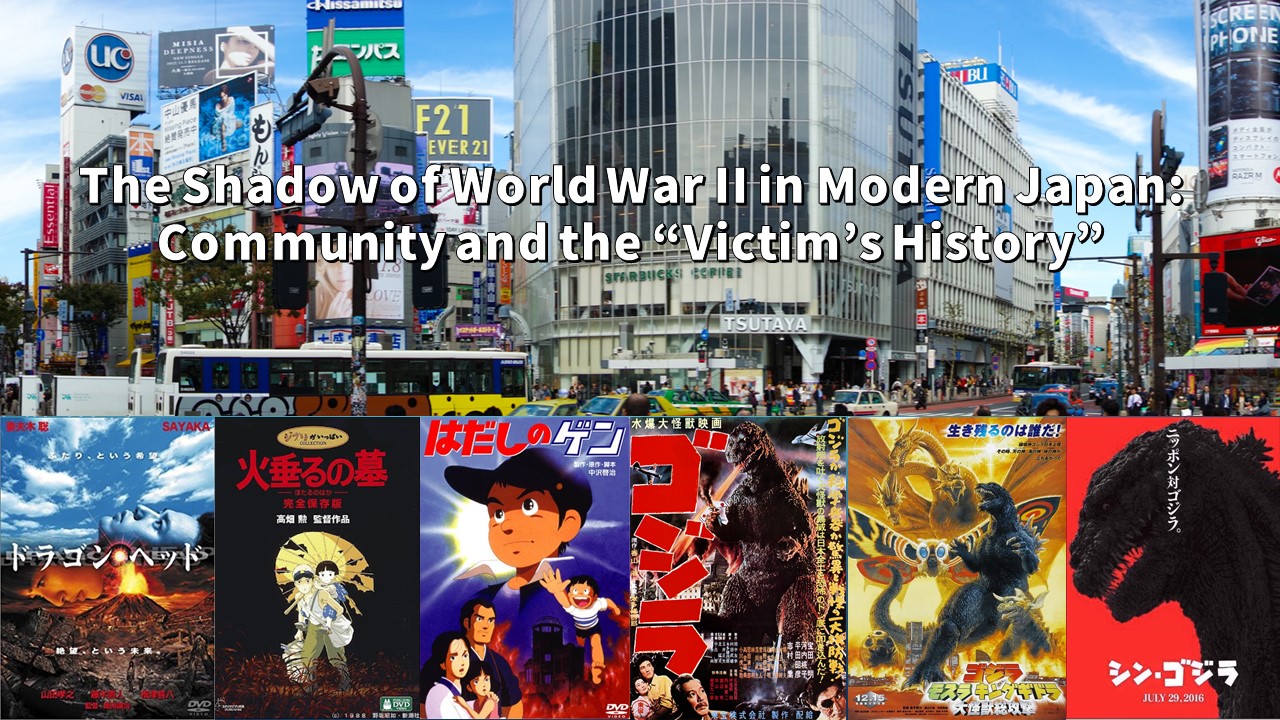
Godzilla (god-zill-ah)[JPN ゴジラ]: The titular monster of Ishirō Honda’s classic 1954 Toho film. One of the most famous exports of Japan, Godzilla has starred in a multitude of films since the 1950s. While generally known as the central figure in a series of “monster fight” films, the origins of the creature are steeped in Japan’s war history.
Victim’s History: A term coined by scholar Susan Napier and defined as how “the Japanese people were seen as helpless victims of a corrupt and evil conspiracy between their government and military. This ‘victim’s history’ is partly due to the collaborative American-Japanese efforts under the Occupation to create an image of a postwar democratic Japan that would free the Japanese from an inescapable fascist and militarist past.” Noteworthy due to the tendency to focus on the tragedies perpetrated upon Japan during World War II (particularly the atomic bombings) and an avoidance of discussion of the Japanese aggression during the war (particularly incursions in to China and the Korean peninsula).
In-Group / Out-Group Dynamic: Central to the Japanese mindset, the differentiation of people into in-groups and out-groups is the major lens through which the Japanese view themselves and others. The most basic in-group is the nuclear family. However, there are several layers of groups and they often overlap. For example, your immediate family is your in-group and your neighbor’s family is an out-group. However, you and your neighbors are an in-group in comparison to residents from another neighborhood. The company you work for is an in-group in comparison to the out-group of a rival company, et. al. This dynamic affects social behavior and even language use for the Japanese.
The Professor: Pages which contain the image of the Professor are designed for use by the instructor only.
12017-07-27T11:16:01-07:00Bradley J. Wilsond07e2adfeaea18284aa4bc3bb77cb735351313e9Schedule11plain2019-08-02T13:53:11-07:00Ronae Matriano8ed24d71e6036affdb22f6e2fd0ec83a8e515e95
12017-07-27T11:15:58-07:00Bradley J. Wilsond07e2adfeaea18284aa4bc3bb77cb735351313e9Introduction to Japan1plain2017-07-27T11:15:58-07:00Bradley J. Wilsond07e2adfeaea18284aa4bc3bb77cb735351313e9
12017-07-27T11:15:58-07:00Bradley J. Wilsond07e2adfeaea18284aa4bc3bb77cb735351313e9Japan and World War II1plain2017-07-27T11:15:58-07:00Bradley J. Wilsond07e2adfeaea18284aa4bc3bb77cb735351313e9
12017-07-27T11:15:57-07:00Bradley J. Wilsond07e2adfeaea18284aa4bc3bb77cb735351313e9Community1plain2017-07-27T11:15:57-07:00Bradley J. Wilsond07e2adfeaea18284aa4bc3bb77cb735351313e9
12017-07-27T11:15:52-07:00Bradley J. Wilsond07e2adfeaea18284aa4bc3bb77cb735351313e9Dragon Head 『ドラゴンヘッド』1plain2017-07-27T11:15:52-07:00Bradley J. Wilsond07e2adfeaea18284aa4bc3bb77cb735351313e9
12017-07-27T11:15:57-07:00Bradley J. Wilsond07e2adfeaea18284aa4bc3bb77cb735351313e9Discussion: Dragon Head10plain2019-08-02T14:09:24-07:00Ronae Matriano8ed24d71e6036affdb22f6e2fd0ec83a8e515e95
12017-07-27T11:16:00-07:00Bradley J. Wilsond07e2adfeaea18284aa4bc3bb77cb735351313e9"Victim's History"1plain2017-07-27T11:16:00-07:00Bradley J. Wilsond07e2adfeaea18284aa4bc3bb77cb735351313e9
12017-07-27T11:16:00-07:00Bradley J. Wilsond07e2adfeaea18284aa4bc3bb77cb735351313e9Grave of the Fireflies 『火垂るの墓』2plain2019-06-24T17:36:05-07:00Ronae Matriano8ed24d71e6036affdb22f6e2fd0ec83a8e515e95
12017-07-27T11:15:54-07:00Bradley J. Wilsond07e2adfeaea18284aa4bc3bb77cb735351313e9Discussion: Grave of the Fireflies6plain2019-08-02T14:18:40-07:00Ronae Matriano8ed24d71e6036affdb22f6e2fd0ec83a8e515e95
12017-07-27T11:15:57-07:00Bradley J. Wilsond07e2adfeaea18284aa4bc3bb77cb735351313e9Hiroshima2plain2017-09-26T10:22:26-07:00Bradley J. Wilsond07e2adfeaea18284aa4bc3bb77cb735351313e9
12017-07-27T11:15:56-07:00Bradley J. Wilsond07e2adfeaea18284aa4bc3bb77cb735351313e9Barefoot Gen 『はだしのゲン』4plain2017-09-26T10:38:48-07:00Bradley J. Wilsond07e2adfeaea18284aa4bc3bb77cb735351313e9
12017-07-27T11:15:52-07:00Bradley J. Wilsond07e2adfeaea18284aa4bc3bb77cb735351313e9Discussion: Barefoot Gen6plain2019-08-02T14:28:18-07:00Ronae Matriano8ed24d71e6036affdb22f6e2fd0ec83a8e515e95
12017-07-27T11:15:52-07:00Bradley J. Wilsond07e2adfeaea18284aa4bc3bb77cb735351313e9Godzilla 『ゴジラ』1plain2017-07-27T11:15:52-07:00Bradley J. Wilsond07e2adfeaea18284aa4bc3bb77cb735351313e9
12017-07-27T11:15:53-07:00Bradley J. Wilsond07e2adfeaea18284aa4bc3bb77cb735351313e9Discussion: Godzilla6plain2019-08-02T14:29:29-07:00Ronae Matriano8ed24d71e6036affdb22f6e2fd0ec83a8e515e95
12017-07-27T11:15:51-07:00Bradley J. Wilsond07e2adfeaea18284aa4bc3bb77cb735351313e9Discussion: All-Out Attack!6plain2019-08-02T14:31:16-07:00Ronae Matriano8ed24d71e6036affdb22f6e2fd0ec83a8e515e95
12017-07-27T11:15:53-07:00Bradley J. Wilsond07e2adfeaea18284aa4bc3bb77cb735351313e9Godzilla Resurgence 『シン・ゴジラ』1plain2017-07-27T11:15:53-07:00Bradley J. Wilsond07e2adfeaea18284aa4bc3bb77cb735351313e9
12017-07-27T11:16:01-07:00Bradley J. Wilsond07e2adfeaea18284aa4bc3bb77cb735351313e9Discussion: Godzilla Resurgence2plain2019-06-26T23:56:39-07:00Ronae Matriano8ed24d71e6036affdb22f6e2fd0ec83a8e515e95