Thanks for your patience during our recent outage at scalar.usc.edu. While Scalar content is loading normally now, saving is still slow, and Scalar's 'additional metadata' features have been disabled, which may interfere with features like timelines and maps that depend on metadata. This also means that saving a page or media item will remove its additional metadata. If this occurs, you can use the 'All versions' link at the bottom of the page to restore the earlier version. We are continuing to troubleshoot, and will provide further updates as needed. Note that this only affects Scalar projects at scalar.usc.edu, and not those hosted elsewhere.
The International Prester John Project: How A Global Legend Was Created Across Six CenturiesMain MenuOrientation to ProjectPath One: 1122-1235Path Two: 1236-1310 ADPath Three : 1311-1460 ADPath Four : 1461-1520 ADPath Five: 1521-1699 ADPath Six: 1700-1800 ADChristopher Taylor // christopher.eric.taylor@gmail.com946e2cf6115688379f338b70e5b6f6c039f8ba6f Global Middle Ages
Marco Polo
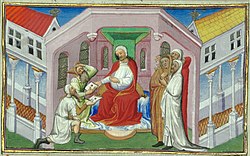
12015-06-15T11:25:57-07:00Christopher Taylor // christopher.eric.taylor@gmail.com946e2cf6115688379f338b70e5b6f6c039f8ba6f528110image_header2024-01-18T19:47:11-08:00Christopher Taylor // christopher.eric.taylor@gmail.com946e2cf6115688379f338b70e5b6f6c039f8ba6fBorn in Venice, Marco Polo (1254-1324) is well known to history as a merchant-explorer who ventured across the Steppe, traveling as far as Hangzhou, China, all the while recording the manners and customs of the peoples he encountered into what became a medieval and early modern best-seller, the Livres des merveilles du monde.
From 1271-1295, Marco traveled with his father Niccolò and his uncle Maffeo, who were already experienced travelers, having already met Kublai Khan. The young Marco was gifted with languages and became an important asset to Kublai Khan during their stay in at his capital, where the three men remained until honored guests/captives until 1292.
Upon their return to Venice in 1295, the Polos found their native Venice embroiled in conflict with Genoa. Marco was imprisoned, during which time he dictated his adventures to a fellow prisoner and author of popular romance, Rustichello da Pisa. The result of this encounter was a travel narrative interspersed with imaginative detail. While at times historically specious, the Travels of Marco Polo have entertained and informed amateur readers and professional critics for hundreds of years.
This page has tags:
1media/Screen Shot 2018-01-09 at 9.11.43 PM.png2015-05-17T12:23:26-07:00Christopher Taylor // christopher.eric.taylor@gmail.com946e2cf6115688379f338b70e5b6f6c039f8ba6fMap 2.1 : Author Origins and TravelsChristopher Taylor // christopher.eric.taylor@gmail.com26plain2023-11-24T15:37:14-08:00Christopher Taylor // christopher.eric.taylor@gmail.com946e2cf6115688379f338b70e5b6f6c039f8ba6f
Contents of this tag:
12016-03-27T11:02:33-07:00Christopher Taylor // christopher.eric.taylor@gmail.com946e2cf6115688379f338b70e5b6f6c039f8ba6fPepper6plain2021-09-08T07:50:24-07:00Christopher Taylor // christopher.eric.taylor@gmail.com946e2cf6115688379f338b70e5b6f6c039f8ba6f
12024-01-18T19:47:07-08:00Christopher Taylor // christopher.eric.taylor@gmail.com946e2cf6115688379f338b70e5b6f6c039f8ba6fMerchants and Prester John1plain2024-01-18T19:47:08-08:00Christopher Taylor // christopher.eric.taylor@gmail.com946e2cf6115688379f338b70e5b6f6c039f8ba6f
This page is referenced by:
12015-07-20T10:26:24-07:00European Contact with the Mongol Empire12image_header2023-11-25T20:09:15-08:00On his pilgrimage from Spain to the Holy Land, Benjamin of Tudela (c. 1165) described an encounter with powerful Eastern king, called Kofar-al-Turak, increasing Western interest in the Mongols but hardly shedding light on the Prester John legend. By 1241 groups of Mongol warriors had traveled across the Asian Steppe and entered into Poland, Hungary, and the Danube Valley. Half a decade later, eastbound travelers returned to the Latin West with even more first-hand intelligence about the Mongols whom the crusading advocates of the previous century had fleshed out into the fiction of Prester John.
Already in 1245, Innocent IV had sent Franciscan John of Plano Carpini to the East to deliver letters to the Mongol khan, inviting the khan to embrace Christianity. The resulting journey, the most widely known of all early Western accounts with Mongols, describes “Ethiopians” from the lands of Prester John: here John has already lost his place at the head of Eastern politics.
Prester John plays no part in John's mission to guarantee cooperation from the Great Khan. Later narratives, including those of Ascelin of Lombardia (1245-48) , André de Longjumeau (1249), Joinville’s Chronicle, and John Mandeville allude to a union between these Mongols and Prester John. John of Monte Corvino (c. 1294) brought back a more reliable account of Indian Christians than had been circulating previously in the West but does not explicitly mention Prester John. Other travelers, including William of Rubruck (c. 1253), Marco Polo (c. 1269-99), and Odoric of Pordenone (1320s) attempt to rationalize the assumptions regarding a kingdom of Prester John as fantastical extrapolations of minor Eastern truths.
Even when these writers undercut some of the splendor of John’s kingdom, they keep him alive figuratively and literally. To ally Prester John with the Mongols may seem like a threat to the legend’s persistence, but in fact these travelers were updating the legend of Prester John by integrating John into the genealogy of an Eastern people foremost in the minds of Western leaders since the mid-thirteenth century. Even as some writers describe the legend as an exaggeration, their authority is restricted by the fact that none of these travelers claimed to have met the enigmatic figure.
12015-07-30T04:05:22-07:00Purchas His Pilgrimes11image_header2023-12-09T08:50:13-08:00Hakluytus Posthumus, or Purchas his Pilgrimes Contayning a History of the World in Sea Voyages and Lande Travells by Englishmen and others (1613)
Published in four volumes, Samuel Purchas' Purchas His Pilgrimes attempted to provide a full, Anglican overview of the world as it was known at the time. In it, he retells many of the most famous European travel narratives that highlight the diversity of Earth's inhabitants.
Although Purchas never traveled himself, he certainly familiarized himself with the theories about Prester John. He identified Prester John with the Ethiopian monarch, averring that this figure "was called Priest John, by error of Covilhā, follwed by other Portugals in the first discoverie, applying by mis-coinceit through some like occurrents in the Relations in M. Polo and others touching Presbyter John, in the North-east parts of Asia" (qtd. in Silverberg, p. 317).
As Brewer writes,
Purchas, with scholarly acuity...reviews the various hypotheses as to the location of Prester John and the origin of his name, eventually concluding that he was once an Asian monarch whose name was mistakenly applied to the emperor of Ethiopia. (236)
In discussing the Prester John legend, Purchas argues that his kingdom stretched from Nubia in the north to “that part where the Kingdome and Land of Manicongo lyeth,” cutting across the African continent “behind the Springs and Lakes of Nilus, going through the fierie and unknowne Countries.” He includes a detailed map of these boundaries, which encompass nearly a third of the African continent.
Purchas' synthesis of contemporaneous travel lore recalls Mandeville. Like its predecessor, Purchas His Pilgrimes was well-received in its time and remained influential for another century, most famously inspiring the landscape and opening lines of Coleridge's "Kubla Khan." As he mentions in the well-known preface to Sybilline Leaves (1816), he fell asleep while reading Purchas, though the phrase ‘In Xanadu did Cublai Can build a stately palace" remained in his mind.
12016-07-11T20:31:03-07:00Ong Khan11plain2023-12-31T14:17:54-08:00 Ong Khan, alternately known as Unc Khan, Toghril, Tooril Khan, Unach, King David, and King John was the Khereid ruler in the late 12th/early 13th centuries. The title ong is the Mongol form of the Chinese honorific wang meaning 'universal' (Hamilton, p. 248).
Reportedly a Nestorian Christian– although according to Bar Hebraeus' Chronicon Syriacum, a lapsed one– "Unach" Khan was killed by his blood brother and subordinate, the soon-to-be Genghis Khan, who was acting on rumors that a jealous Unc was planning to kill him.
This is the same figure known in other mid-thirteenth century texts as King David, son of Prester John.
Ong Khan figures in a number of Prester John narratives, including the Historia Tartarum (c. 1246), William of Rubruck's Itinerarium(c. 1253), the Chronicon Syriacum, Marco Polo's Travels,
12023-11-27T09:19:43-08:00Christopher Columbus' Notes2plain2024-01-06T15:52:26-08:00At some point before his famous voyage across the Atlantic, Christopher Columbus annotated a copy of Marco Polo's Il Milione, a book that is still extant.
In the margins we find two annotations related to Prester John, which confirm that Columbus had thought of Prester John as the wealthy and powerful "Ongchan." These notes are mentioned in Brewer's (p. 286) list of Prester John texts.
In addition to this circumstantial evidence of Columbus' interest in Prester John, an anonymous crew member's journal makes explicit what Columbus's ownership of the Polo book implies.