Thanks for your patience during our recent outage at scalar.usc.edu. While Scalar content is loading normally now, saving is still slow, and Scalar's 'additional metadata' features have been disabled, which may interfere with features like timelines and maps that depend on metadata. This also means that saving a page or media item will remove its additional metadata. If this occurs, you can use the 'All versions' link at the bottom of the page to restore the earlier version. We are continuing to troubleshoot, and will provide further updates as needed. Note that this only affects Scalar projects at scalar.usc.edu, and not those hosted elsewhere.
James Lee Dickey: An Analysis of One African-American's Leadership in Jim Crow TexasMain MenuJames Lee Dickey: An Analysis of One African American's Leadership in Jim Crow TexasIntroductionSlave No MoreFreedman after Bondage 1865 - 1955African American LeadershipContenders for the TitleJames Lee DickeyThe Leadership of James Lee DickeyLocations in Dr. James Lee Dickey's StoryGoogle locations for Dr. Dickey's BiographyMaureen Grayab288c53aefb942d3e6102c32f4d6e3a10268d3b
The Other 90%
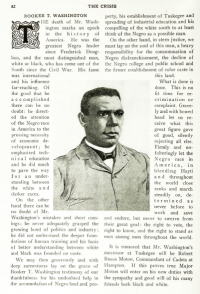
1media/The Atlanta Conference NAACP.jpg2018-04-07T02:17:17-07:00Maureen Grayab288c53aefb942d3e6102c32f4d6e3a10268d3b197018image_header2018-06-11T19:03:15-07:00Maureen Grayab288c53aefb942d3e6102c32f4d6e3a10268d3bOver time, Du Bois grew increasingly distainful of his own people. He thought black churches needed to be reformed so “colored men and women of education and energy can work for the best things.” He referred to The Crisis as the “Guardian of Liberties.” In 1913, he chastised three Negro publications for disagreeing with him because Negroes had enough conflicts without engaging in squabbling, all the while doing the same to Booker T. Washington. The next year he chastised other Negro publications for their poor grammar and spelling and lack of factual data. When editors expressed indignation, he sidestepped by saying he was expressing popular opinion, not his own. In 1912, Du Bois wrote in The Crisis, “to treat all Negroes alike is treating evil as good and good as evil,” and again in 1919, “many a colored man in our day called to conference with his own and rather dreading the contact with uncultivated people even though they were of his own blood.” When Du Bois published Booker T. Washington’s obituary in The Crisis in 1915, he qualified each of Washington's successes by pointing out that in each accomplishment, Washington had failed to recognize the connection between economic equality and political equality. He blamed the current state of Negro affairs squarely on Booker T. Washington.
This page has paths:
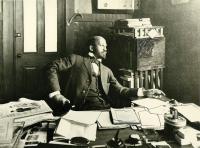
1media/DuBoisatDesk.jpg2018-04-07T00:29:09-07:00Maureen Grayab288c53aefb942d3e6102c32f4d6e3a10268d3bW.E.B. Du BoisMaureen Gray7image_header2018-06-11T23:46:12-07:00Maureen Grayab288c53aefb942d3e6102c32f4d6e3a10268d3b
This page references:
12018-06-11T18:35:08-07:00Du Bois - BTW Obituary2"The Crisis," Volume 11, No. 2, December 1915media/Screen Shot 2018-06-11 at 1.31.54 PM.pngplain2018-06-11T18:36:10-07:00
12018-04-12T04:35:19-07:00WEB DuBois at Desk2Dr. Du Bois at his desk at Atlanta Universitymedia/DuBoisatDesk.jpgplain2018-06-11T23:58:04-07:00