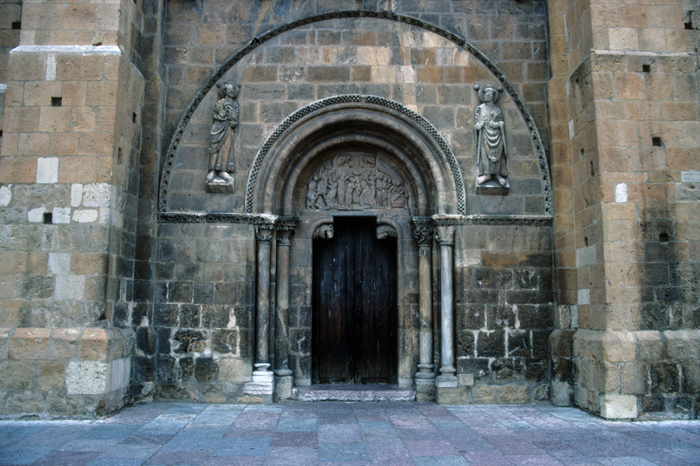
Roman Spain Manifested in Art and Architecture
The era following the Roman empire’s conquest of the Iberian peninsula witnessed a subsequent period of what some scholars call “Romanization”, in which the region experienced a transformation of its political practices, religion, and overall culture. One area in which this assimilation of Roman culture and way of life was most prevalent, and continues to be very visible in modern-day Spain, was the art and architecture of the Iberian peninsula. Spain even experienced a revitalization of Roman culture during the 10th through 13th centuries, demonstrating its enduring impact and the area’s nostalgic desire to "call back" to this era. The preservation of Roman architecture and pieces of art, combined with the allusions back to Roman style during the Romanesque period, reveal the significance that the empire had on its cultural history.
Roman Architecture
Various architecture structures from the Roman Imperial period have persisted through time and continue to be monumental symbols of Spanish history. The Aqueduct of Segovia is one such Roman architectural feature that despite the passing of time, has remained as an important landmark and emblem of Roman influence in Spain. Following the conquest of the city of Segovia by the Romans in around 90 BCE, the aqueduct was constructed in 50 A.D in order to bring water from the Rio Frio to the growing city of Segovia. The contiguous arches present on the aqueduct, also known as "arcades", were a key architectural feature of the Roman style of architecture. Beyond the impressive height and width of the two-tiered structure, the structure consists of granite stone held together with nearly no mortar. A possible reasoning for this design choice was to make the structure more resistant to long-term erosion from water flow. The aqueduct was operational in Spain until 1973; its longevity as a functional piece of infrastructure is a testament to the architectural prowess of the Romans.
Other semi-preserved pieces of Roman architecture include the Ruins in Itálica and the Mérida theater in Spain. Itálica was in fact the first Roman city founded in the Iberian peninsula, from which a large amphitheater was erected that is still visited today for its impressiveness and rich history. Grand, constructed amphitheaters such as those in Itálica and Mérida drew crows from all over Hispania (the name given to the Iberian peninsula by the Romans), contributing to immense cultural diffusion and wealth of the empire. Furthermore, the fact that the structures have been left relatively untouched and have remained as important sites within Spain demonstrate the strength of the Roman architectural legacy in the country.


Enim ut sem viverra aliquet eget sit amet tellus cras. Eget arcu dictum varius duis. Malesuada bibendum arcu vitae elementum curabitur. Pretium fusce id velit ut tortor pretium viverra suspendisse potenti. Eleifend mi in nulla posuere sollicitudin aliquam ultrices sagittis. Aliquam nulla facilisi cras fermentum odio eu feugiat pretium. Hendrerit gravida rutrum quisque non tellus orci. Eros in cursus turpis massa tincidunt dui ut ornare. Nunc id cursus metus aliquam eleifend mi in nulla posuere. Odio morbi quis commodo odio aenean. Pulvinar elementum integer enim neque volutpat ac.
Id neque aliquam vestibulum morbi blandit cursus risus at. Ornare massa eget egestas purus viverra accumsan in nisl nisi. Pretium quam vulputate dignissim suspendisse in est ante in. Enim ut tellus elementum sagittis. Mi proin sed libero enim. Imperdiet massa tincidunt nunc pulvinar. Amet dictum sit amet justo donec enim diam vulputate. Sed felis eget velit aliquet. Id diam vel quam elementum pulvinar etiam non. Rhoncus mattis rhoncus urna neque viverra justo nec ultrices dui. Eros donec ac odio tempor. Ullamcorper eget nulla facilisi etiam dignissim diam quis. At ultrices mi tempus imperdiet. Massa eget egestas purus viverra accumsan in nisl nisi scelerisque. Nec nam aliquam sem et. Tempor nec feugiat nisl pretium. Nisl tincidunt eget nullam non nisi est sit amet. Lectus urna duis convallis convallis tellus id interdum. Tellus mauris a diam maecenas sed enim. Eget nunc scelerisque viverra mauris in aliquam sem.
Vitae tempus quam pellentesque nec nam aliquam sem et. Fermentum iaculis eu non diam phasellus vestibulum lorem. Eu scelerisque felis imperdiet proin fermentum leo vel orci. Dolor purus non enim praesent elementum facilisis leo vel. Et magnis dis parturient montes nascetur ridiculus mus. In ornare quam viverra orci sagittis eu volutpat odio facilisis. Enim facilisis gravida neque convallis a cras semper auctor neque. Egestas egestas fringilla phasellus faucibus scelerisque eleifend donec pretium. Sit amet justo donec enim diam vulputate ut pharetra sit. Ac turpis egestas sed tempus urna et pharetra pharetra massa. Nunc sed augue lacus viverra vitae congue eu consequat ac.
This page has paths:
- Projects Lisbeth Escobar