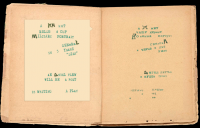
Don't Read This
Additionally, we have discussed how this experience is shaped by Gutenbergian formatting of the page and that how one point of disruption popular among the Russian Futurist Bookartists was developing their craft in opposition this standard orientation of that text. In these examples, we were able to see how the rotation or otherwise altering of text away from the Gutenbergian felt strange and often disorienting. Given a pile of words without lines nor consistency, the reader feels their force, compelling as they did before, but now without a clear way to discern the best course of action. "Should they even be read at all?" was becoming a more and more plausible question to ask and, while on one hand it seemed as though the loss of the Gutenbergian order of things had stripped the work of every last thing, it still seemed impossible not to read, maybe now more difficult than ever to resist. Maybe this readability, or rather the demand to be read, this "bookiness" was then coming not from the book, but from the language itself.
If
The next move from there, and the focus of the project in general, would be discussing this "bookiness" of text outside the medium of book or when this medium is disrupted. For now, I am investigating pieces by Lyubov Popova and Olga Rozanova and how even in this medium (or especially in this medium) something of the bookiness is maintained. My working theory is that pieces like this suggest that it is not the medium that is the source of this experience of non-dimensionality, but actually rather that the source is the language itself, and that this experience is internal to it.
This page has paths:
- The Big Bang Theory Evan Sarafian