Thanks for your patience during our recent outage at scalar.usc.edu. While Scalar content is loading normally now, saving is still slow, and Scalar's 'additional metadata' features have been disabled, which may interfere with features like timelines and maps that depend on metadata. This also means that saving a page or media item will remove its additional metadata. If this occurs, you can use the 'All versions' link at the bottom of the page to restore the earlier version. We are continuing to troubleshoot, and will provide further updates as needed. Note that this only affects Scalar projects at scalar.usc.edu, and not those hosted elsewhere.
Exploding Tongues: Language, Art, and the Russian Avant-gardeMain MenuBack to Futurism: Russian Artist BooksIntroductory Page by Chris GilmanBookENDS: A Working Theory of Textuality as Cultural Dominant, 1912-An Introduction and Conclusion to a Semester's Investigation into the Book Arts as an Avant-garde PracticeBook Case StudiesCollaborative Research by Case StudiesBig Bang: Timeline of Russian Avant-Garde Book Arts and Their Cultural ImpactsA Timeline of Russian Avant-Garde Book Arts and Their Cultural ImpactsCoaRse CaLIBrationARTS 227 "Introduction to Letterpress Printing" (Pedersen) and CSLC134/RUSN334 "Exploding Tongues" (Gilman)NthOlogyA limited edition collaborative book arts project by students of ARTS 227 (Pedersen) and CSLC 134/RUSN 334 (Gilman), Spring, '17MANIFESTERS (AB & Kelly): A portfolio of process and productsAppendix: A Path Through Russian Avant-Garde BooksChristopher Gilman1985b99a2acd541caa12a10c3ebf6896565283abDexter Blackwell92e005ca94195f836c6089cf147faff4c74fa79eZoe Foster-La Duc1c8954189fb3ee4ab6e36bfb90fae86777eab97Stephen Heim7069d17c035042745c96bc6c7619096cd7b33da4Kelly Kirklande1805e502570d093d70f00df18f145c99290d0a3Ian Lehineb028c384a69e4b92166e7791b002fa3f2cee5818Timothy Lewis13880d3d99b4b71ce85be63e69a6d44e38853d68Jmedina29ac3fc10003fb639ac412984b59b01a5b826e161Taylor Robinsonaa08dd3939f1f1c6162c5518ae531385e51659afEvan Sarafian042e10782d9a6d3f0001a4b35abb02f58ad84684Craig Dietrich2d66800a3e5a1eaee3a9ca2f91f391c8a6893490ILiADS (Institute for Liberal Arts Digital Scholarship)
Dyr bul schul and the Dominant
12017-04-13T11:04:35-07:00Dexter Blackwell92e005ca94195f836c6089cf147faff4c74fa79e1204119plain2017-04-29T17:31:05-07:00Dexter Blackwell92e005ca94195f836c6089cf147faff4c74fa79eAs a vital component to Russian Formalist theory, the Dominant is the ruling force of an artistic work. According to Roman Jakobson's description of the Dominant, each type of work holds a system of values, which are organized into a hierarchy. The time period determines which of these values is at the top of the hierarchy, thus becoming the dominant. Furthermore, the dominant form which existed during the era of the Russian avant-garde was the textual, which began with the rise of the novel during the Romantic period and through the poetry of Pushkin.
When asked to explain Anna Karenina, Tolstoy replied that he would have to re-write the whole book, exactly the same. This is to say, there is no reduction of the novel's textual form. In terms of the Russian avant-garde, Gerald Janecek examines the visual and material elements of the page, especially in the works of Kruchenyk and Khlebnikov. Evidently, his inquiry is influenced by this notion of the dominant textual form. However, Kruchenyk's Dyr bul schulhas at least three different textual forms created by the author, all quite different in their appearance. This suggests that the textual aspect is not the dominant feature of the poem. Instead, sound has become the dominant feature of Zaum poetry.
According to Jakobson, cultural change reflects itself through a re-ordering of values in artistic works, therefore asserting a new dominant. Pre-dating the Russian avant-garde was the so-called "Golden Age" of Russian literature. The 19th century saw the rise and acclaim of novelists and poets such as Tolstoy, Dostoevsky, and Pushkin, who remain as some of Russia's most celebrated writers. Their literary dominance, as well as the influence of the Romantic era in general, made the textual form the dominant aspect of the era.
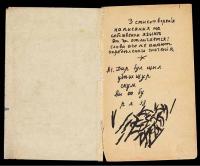
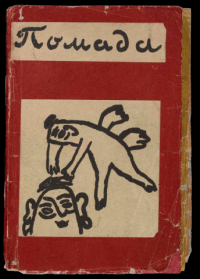
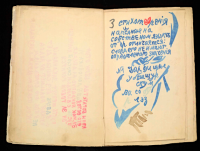
However, the dominant form was changing amongst the Russian avant-garde. Starting in 1913, Alexei Kruchenyk authored at least three different versions of his Zaum poem Dyr bul schul. These three versions had varied textual presentations, sourced from the same author. The first, as shown above, appeared in his book Pomada in 1913. This version included an illustration of a nude woman by Mikhail Larionov, creating an eroticized, masculine poem.
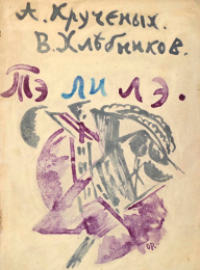
A second version was produced in the book Te li le, a written collaborative effort by Kruchenyk and Khlebnikov, illustrated by Olga Rozanova. This version of Dyr bul schul from 1914 is the richest of the three in color and is the only one to have a feminine creative influence, as Rozanova was deemed responsible for its creation.
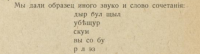
Lastly, in his 1913 essay The Word as Such (Слово как таковое), Kruchenyk printed yet another version of the poem to use as an example in the work. It is devoid of illustration and any handwritten creation, existing only in print on the page.
The only things that are consistent between these three variations of Dyr bul schul are the authorship and the sounds of the poem itself. This should lead us to acknowledge sound as the Dominant force of Kruchenyk's poem, rather than its textual and artistic elements.
This page has paths:
1media/924a9ded79eeae57cad83b9b12c570cb.jpg2017-04-13T11:02:09-07:00Christopher Gilman1985b99a2acd541caa12a10c3ebf6896565283abThe Big Bang TheoryEvan Sarafian5Collaborative Research by Case Studiessplash2017-04-25T10:14:56-07:00Evan Sarafian042e10782d9a6d3f0001a4b35abb02f58ad84684