Exploding Tongues: Language, Art, and the Russian Avant-garde

(Hyper)cubism

The ideas of the fourth dimension and non-Euclidean geometry were a popular scientific, literary, and artistic cultural phenomenon throughout Europe at the dawn of the 20th century. As such certain aspects of these ideas were incorporated into the then-developing Cubist theories. The "freedom" of geometries not constrained by convention or Euclid's three dimensions was particularly appealing to Cubist artists. Farther East, Russian mathematicians and scholars wrote prolifically on the subject of non-Euclidean geometry. It was the idea of a fourth dimension, however, that caught on and spread throughout popular culture and appeared in many art forms of the Russian Avant-garde. The philosophical and mystical - in addition to mathematical - elements of a spatial fourth dimension as described by the writings of Peter Ouspensky were extremely influential to several artists and styles of this movement. We can track the influence and appearance of the cultural phenomenon that is the fourth dimension as it spreads through the Russian Avant-garde; in one of Kazimir Malevich's earliest contributions to a Futurist book as well as Mikhail Larionov and Natalya Goncharova's Rayist paintings, then in El Lissitzky's Prouns, sketches, and diagrams, and finally in various works of (unrealized) Russian fantasy architecture.

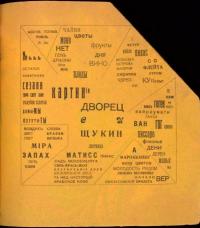
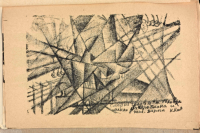
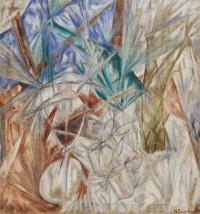
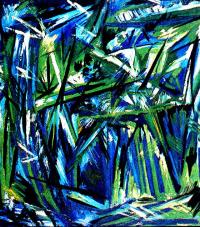
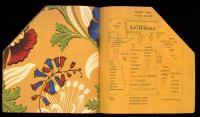
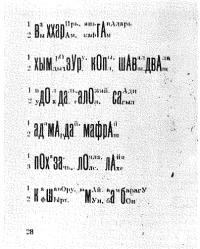
The aforementioned Futurist piece by Kazimir Malevich, "Death of a man simultaneously on an airplane and the railway", and Rayist works by Mikhail Larionov and Natalya Goncharova, "Glass" and "Green and Blue Forest" respectively, exhibit particularly notable parallels to the fourth dimension and Ouspensky's ideas and writings. Highly geometrical, jagged, and acute lines as well as abstract color masses are used to suggest a reconciliation of human perception and the unknowable fourth dimension - an intuition of new meaning and understanding from recognizable fragments. Upon examining these qualities within these early pieces of the Russian Avant-garde and similar ones in later works such as Vasily Kamensky's "Tango With Cows" and Ilia Zdanevich's "As Though Zga", it is clear that certain elements of fourth dimensionality persisted in bookmaking throughout the artistic movement. Tango With Cows exhibits qualities seen in Malevich's Futurist piece as well as qualities seen in Larionov and Goncharova's Rayist pieces. "As Though Zga" exhibits elements of simultaneity and fragmented realities seen in the fourth dimension through its countless possible readings.

This page has paths:

  1. The Big Bang Theory Evan Sarafian
This page references: